Reimagining the Automobile
Royce Hong’s Made-in-Taiwan Electric Supercar
Lynn Su / photos Chuang Kung-ju / tr. by Scott Williams
March 2018


Many people love cars, but few are able to indulge that love to its fullest. Royce Hong, chairman of Panasonic Taiwan and CEO of IPEVO, is one of those few. His passion for automobiles has manifested in a number of ways, including a car collection that includes antiques as well as the first Tesla Roadster in Taiwan. It also includes his involvement with Xing Mobility, an automotive technology company he cofounded in early 2015 with former Tesla engineer Azizi Tucker, whom he came to know through his Roadster.
Royce Hong looks elegant in his casual suit and thick-rimmed glasses. The CEO of three companies, he speaks about his favorite cars not just as a fan, but as an entrepreneur sensitive to changing trends, and as a former industrial designer in touch with the human side of products. His enthusiasm is contagious even to someone who doesn’t get cars.
Hong says that he’s an ardent fan of technology. As one of the earliest of early adopters, he is what market analysts who study technology adoption lifecycles call an “innovator,” one of the 2.5% of consumers who track the smallest changes to products and always rush out to buy the newest versions. Hong came to this kind of “innovation” through his love of cars.
“Cars offer a complete product experience.” Hong elaborates, explaining that every detail of the automotive experience, from the vehicle’s appearance to its steering and acceleration, delivers pleasure each time you drive. It’s as if each driving experience opens a hidden window to a realm of opportunity and magic. “Those experiences are priceless!”
Hong’s purchase of his Tesla Roadster seven years ago upended his thinking about cars. A first-generation product from a production run of just 2,400 vehicles, the car suffers from a myriad of ills, yet Hong saw it as the gateway to a new dimension. “It’s like a smartphone: once you’ve used one, there’s no going back.”
He has since parked this Tesla in the lobby of Xing Mobility as an example of the forward thinking and the boundless imagination that electric cars represent.
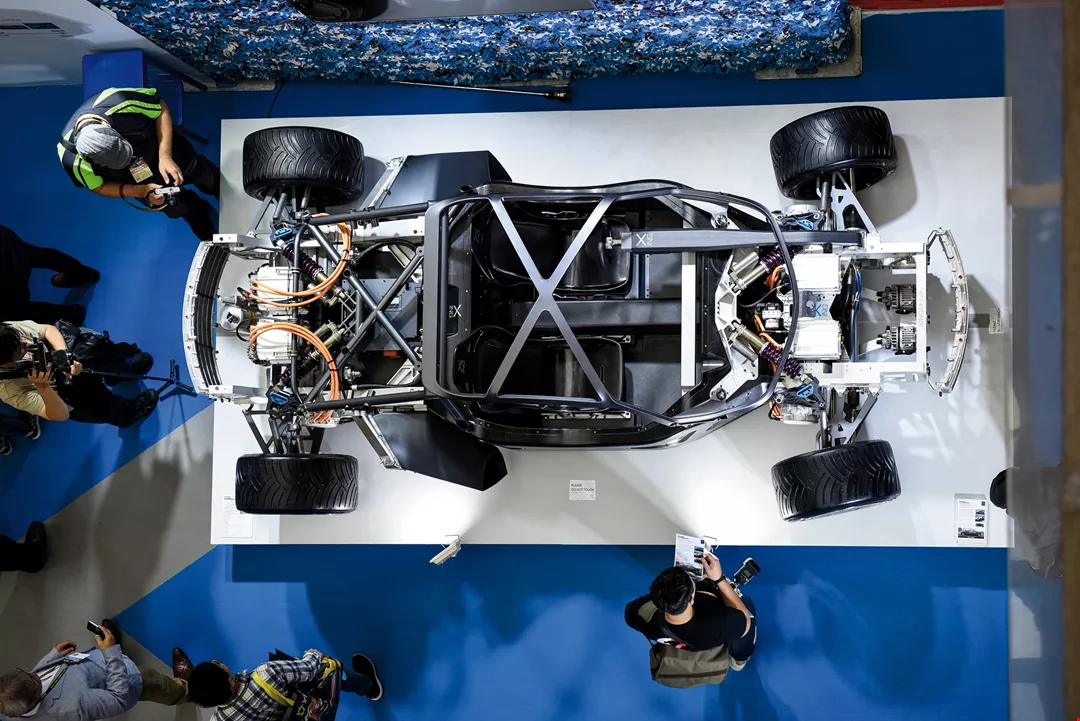
“Miss R,” an electric supercar that is due to be released soon, has four motors that together are capable of developing 1,341 horsepower. (courtesy of Xing Mobility)
The future is now
A farsighted tech lover who is usually ahead of the pack, Hong has a feel for the culture of young people. “It’s like the technology adoption lifecycle. The early adopters of a product tend to be people who focus on the technology rather than the functionality. Once users gain experience with a product and work out the kinks, it jumps the divide into the mainstream.” He says that the same thing is happening with electric cars.
Hong chose to call his new car company “Xing” as an embodiment of his expectations for the electric vehicle industry and of his observations of cultural phenomena. He explains: “‘X’ represents the unknown, the experimental. It suggests a future that is happening right now. The ‘ing’ was inspired by the language of Taiwanese subculture, such as the Mayday song ‘Lian’ai ing’ [‘love-ing’], and represents youthfulness and things occurring in this moment. Together, the name suggests ‘the future happening now’ and ‘creating possibilities through experimentation,’ which are the kinds of things you associate with an innovative company.”
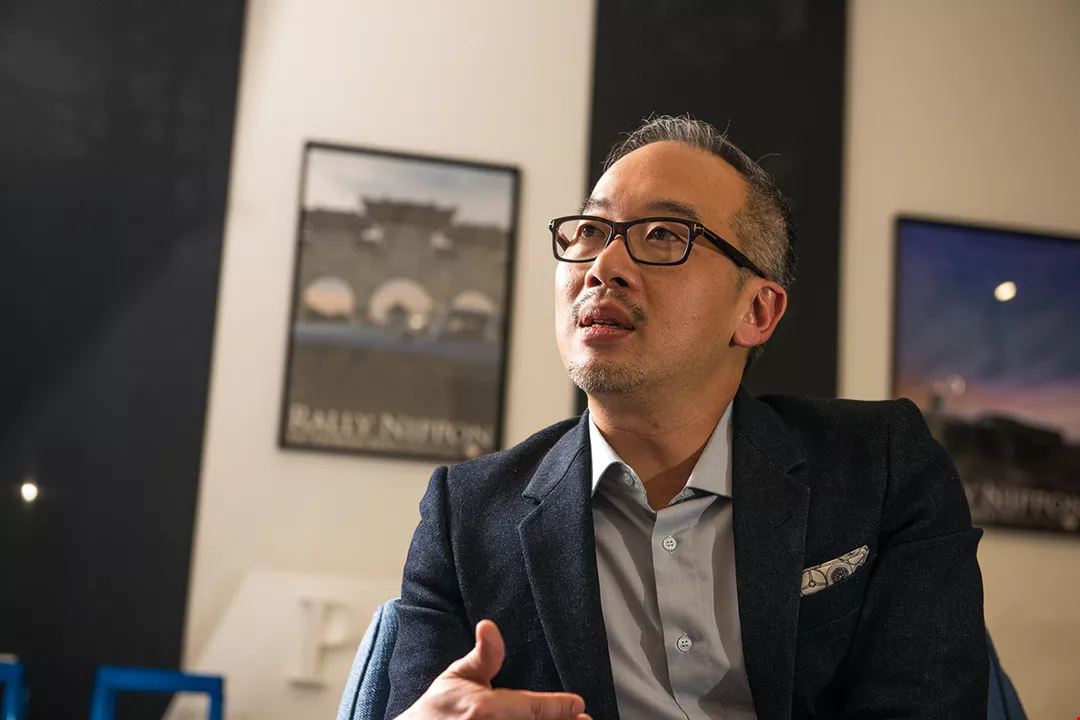
Speaking about the outlook for electric cars, a confident Royce Hong exclaims, “This is the future!”
Exploiting Taiwan’s strengths
Hong drew up his strategy soon after founding the company, focusing Xing on electric vehicle technology R&D and consulting. But it still needed to build a platform capable of highlighting its technological prowess. While 2016’s “Miss E” electric car was only an experimental platform for innovative tech, this year’s ”Miss R” supercar is a more fully developed demonstration model.
A former product designer, Hong continues to be very concerned with finding ways to make his products unique. Happily, Xing has succeeded. “Everything about our car, from R&D to production, was done in Taiwan,” says Hong. But, since Xing itself focuses on R&D, the manufacturing was outsourced to dozens of factories.
Taiwan’s manufacturing sector is known for being highly flexible, producing large numbers of different high-quality products in small volumes, and bringing production online quickly. Distances between factories are also short, and communication is nearly instantaneous.
All of this enabled the Miss R to go from the concept stage to the street in just 18 months, a process that might easily take three to five years overseas. Hong says, “We couldn’t have done it so fast without Taiwan’s production chain.”
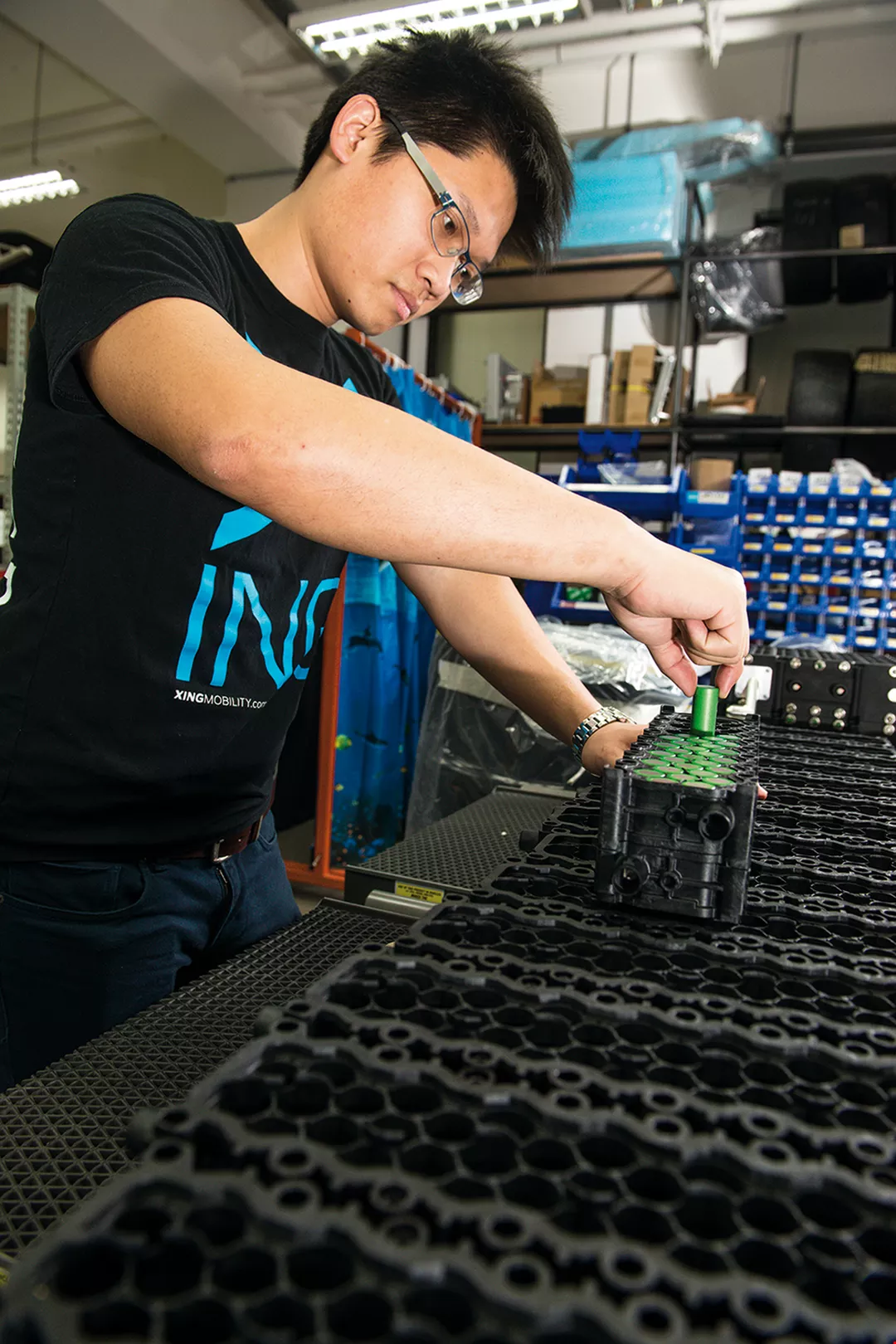
Xing Mobility’s battery modules were its first successfully developed product. They feature outstanding heat dissipation and stackability.
Fastest in the world
Hong’s unusual background adds a humanistic element to the hard-nosed engineering that typically characterizes a company specializing in automotive R&D.
He reveals that when they were about to release 3D renders of the Miss R, they incorporated examples of Tong Yang-tze’s calligraphy into the vehicle’s exterior paintwork. Such creative flourishes grow out of Hong’s insight into cultural value.
Hong has known Tong for years, yet, as a mark of his respect, always refers to her as “Master Tong.” He admires the explosive power of her calligraphy, and the way in which her use of line has aligned her calligraphy with contemporary art in a way unique in the Greater China region. “I think that Master Tong’s calligraphy embodies the special character of Taiwan’s culture.”
That connection led to the idea of cooperating with Tong, and to Hong’s attempt to incorporate calligraphy into automotive design.
For this endeavor, he chose to use a non-standard calligraphic style filled with tension and a contemporary aesthetic. Hong views calligraphy as an art that condenses time, and sees it echoing the motion of a vehicle speeding through time and space. Tong’s calligraphy is dynamic, like a car, and its incorporation into Taiwan’s first electric sports car generates a high level of cultural tension. Hong says, “Calligraphy moves. A car moves, too. This is without doubt Master Tong’s ‘fastest’ work.”
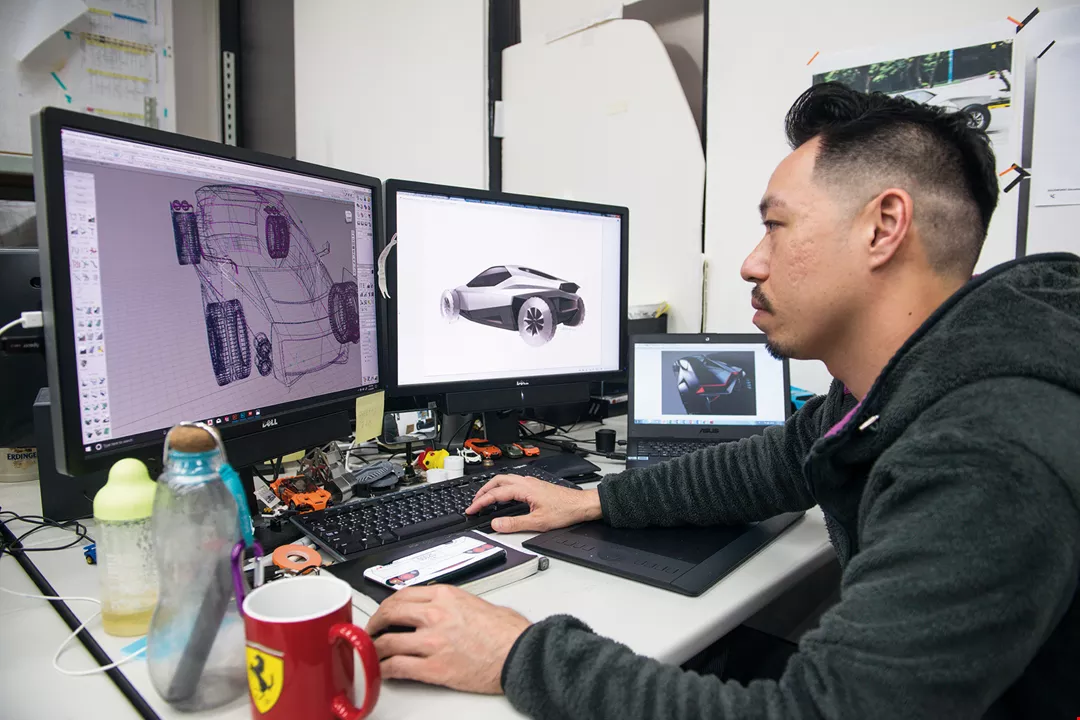
One of the Xing team’s major challenges was using local resources to produce a distinctive and distinctly Taiwanese vehicle.
Patented tech
Though just two years old, Xing has already enjoyed R&D successes. Electric cars rely on battery power, but discharging power to run a motor generates large amounts of heat. If the battery temperature exceeds a certain threshold, the heat can shorten the battery’s life and even become a safety issue. This makes heat dissipation a key issue for electric car companies. Xing’s Tucker came up with the idea of immersing batteries in 3M’s “Novec Engineered Fluid,” an electrically non-conductive, corrosion-resistant liquid. Xing’s immersive cooling stands in contrast to the approach of companies like Tesla, which cool their batteries by wrapping them in coolant-filled metal pipes, and is much more efficient.
Working from this idea, the team developed a modular, stackable, sealable, pressure-resistant battery pack that has attracted attention from customers in Europe, the Middle East and Japan interested in applying it to commercial vehicles, such as trucks and excavators.
Hong’s favorite quote is a remark often attributed to Albert Einstein, that play is the highest form of research. In his journey from car lover to electric car entrepreneur, Hong has transformed from an “innovative” consumer to a trendsetter, and come to exemplify this insight.
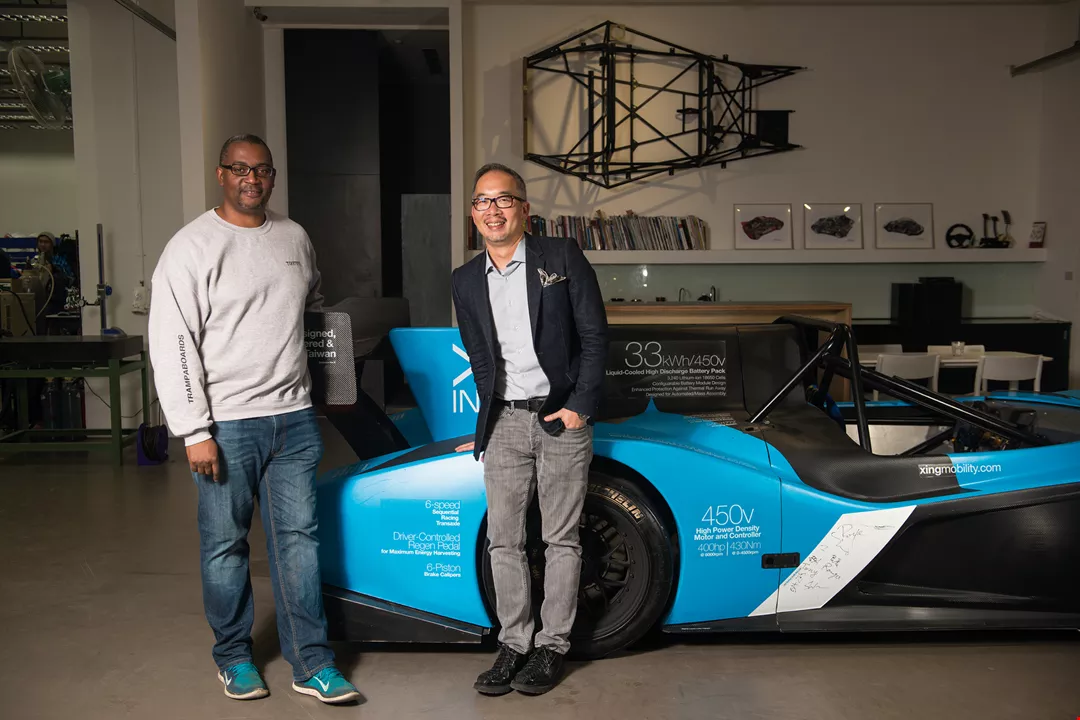
Royce Hong (right) and Azizi Tucker (left), Xing Mobility’s cofounders, come from very different professional backgrounds, but have assembled an outstanding team. (photo by Chuang Kung-ju)
@List.jpg?w=522&h=410&mode=crop&format=webp&quality=80)
@List.jpg?w=522&h=410&mode=crop&format=webp&quality=80)


