

A hi-tech company uses an Internet platform to match farmers up with company employees to sell surplus fruit. A retail chain brings a whole national network into play to raise funds for non-profit organizations on a long-term basis. A drinks manufacturer mobilizes volunteers from within the company to go and teach English to children in remote areas. In more and more cases, Taiwanese firms doing public service do not simply come up with chunks of cash, but integrate their public service activities with their corporate resources and core capabilities. Moreover, they "internalize" and "institutionalize" these activities to achieve maximum efficiency.
There's nothing new about the idea "if you take from society, put back into society." But under the impact of globalization, what new ideas and trends are there in today's acts of corporate social responsibility? Where is there room for improvement in the public service activities of Taiwanese firms?
Though it is only just after eight, the Neihu Technology Zone is already packed with cars snaking their way to work. In a quiet lane away from the crowded trunk roads, meanwhile, already over 30 volunteer moms have gathered in a classroom at Wenhu Primary School. The special weekly classes to train volunteer guardians, sponsored by Lite-On Technology Corporation, are now in their ninth semester.
On this day in early March, a brand-new course entitled "Story Therapy" is underway. Yu Chen-min, a lecturer in psychology at Soochow University, is telling a story about a little turtle to demonstrate how one could use a "metaphorical tale" to help children whose movements are slow and stilted. Next comes an introverted girl with a gaps between her teeth, who tells the role her problem has played in the relationship with the boy that she loves. Everyone sits on the hardwood floors, listening intently, and occasionally peals of laughter ring out of the room....
"We have organized six classes of students in Neihu," says Nora Wu, administrator of community volunteer training at the Lite-On Cultural Foundation. Volunteer guardian classes like this have been going on for many years at 39 primary schools across northern Taiwan, with the aim of helping schoolchildren who have slight or moderate behavioral problems as a result of dysfunctional family lives. Over the last ten-plus years more than 1000 volunteers have undergone training.
"The strength of the guardian system at Lite-On is that it brings together the power of parents," says Yu. Based on his own observations, he says that even the best-intentioned elementary school teachers are generally too busy to spend extra time with the one or two students in each class who have "issues." Volunteer moms trained as guidance counselors can stand side by side with these high-risk kids as they pass through the confusing years of youth. Through the efforts of these volunteers--some of whom even go so far as to spend time with their charges in the kids' own homes--many children suffering from neglect have been pulled back on track.
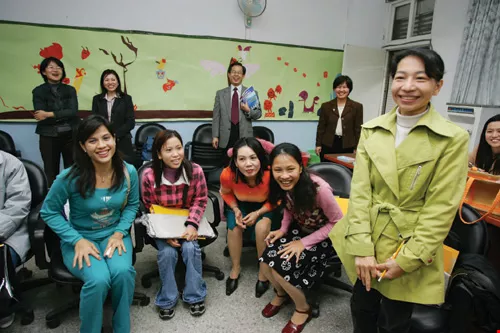
Lite-On Technology takes a long-term, low-profile approach of getting deeply involved in the community. Besides its program of volunteer guardians to help troubled schoolchildren, it has also recently gotten involved in helping foreign spouses in Taiwan. The photo shows a class for recent women immigrants, held at Fuhsing Primary School in Chungho.
Quiet cultivation
In fact, there are more than a few firms out there which, like Lite-On, invest long-term efforts in specific problem areas. Take for example Wonderland Nursery Goods, a maker of baby carriages and child safety seats, which has been involved for many years in education for hearing-impaired children. Chairman Kenny Cheng and his wife, themselves parents of a hearing-impaired child, established the Children's Hearing Foundation and brought in the most advanced foreign instructional methods to achieve their ambitious wish--that within 20 years there would be no hearing-impaired children in Taiwan without the ability to speak.
Also, Taiwan Cement has for many years now been supporting nature photographer Liu Yan-ming's work in making documentaries about birds, a subject to which few people pay much attention these days. And, says Liu gratefully, "They don't go around blowing their own horn about this, either."
Getting firms to agree to low-profile long-term commitments in one problem area is not easy since "most businesses want to see rapid results," often leaving public service groups disillusioned by their cooperative experiments with the private sector. From the firm's point of view, the hope is that the company will reap a better image or media attention from philanthropy, so naturally they prefer to "invest" in attention-grabbing new issues or one-off high-profile events. To a business, it is a sign of ineffectiveness to spend five or ten years on the same thing. The problem is that most of the people or causes that need financial support need long-term investments of manpower and money to yield lasting results.
Long-term low-profile commitment demonstrates the sincerity of a firm's desire to give back to society. But most of the public service activities done by Taiwanese corporations are an extension of the personal desires of the leadership, and are still considered "external" activities. This is why so many people are now advocating "internalization" of the acceptance of social responsibility by corporate citizens.
"Corporations need to integrate their public service actions with their core capabilities, and creatively restructure their corporate operations," says Niven Huang, secretary general of the Business Council for Sustainable Development, who has been promoting "corporate social responsibility" for many years now. Because expectations from the outside community are constantly rising, yet firms cannot continually increase their donations as if they had bottomless pockets, "internalization" is a sustainable approach. As for how it works out in practice, there is no single model. "However," says Huang, "it is certain that a great deal of creativity and innovative thinking is needed, because Taiwan still has a lot of room for development" in this area.
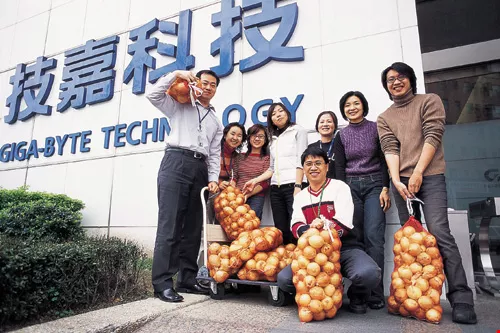
Gigabyte uses an Internet platform to match farmers who want to sell surplus fruit with company employees who want to buy it. This not only helps farmers, but also nurtures a philanthropic corporate culture and gives employees a greater sense of loyalty to the firm.
Internalization
Looking at foreign companies, IBM for example is able to mobilize 40,000 employees willing to do volunteer work to bring technology into communities. In Los Angeles, Dreamworks jointly organizes classes with local community colleges and high schools to provide low-income kids with knowledge that may help them get into the entertainment industry; the curriculum includes internships and direct transmission of experience from teachers to students. These are models for how companies can utilize internal human resources to do something for society while simultaneously shaping a corporate culture of philanthropy and service.
Taiwan's highly creative and innovative hi-tech firms have also recently begun to orient their brainpower toward public service.
Gigabyte, a manufacturer of motherboards and mobile phones, has been using an Internet platform to get farmers together with corporate purchasers, creating a new public service model in the process.
"At first it got started just because it was something that the employee benefits committee wanted," says Gigabyte executive director Mitchell Liu. But after the 1999 earthquake, as a result of a chance meeting, the Gigabyte Education Foundation got Gigabyte's 2000-plus Taiwan employees involved in buying persimmons to help fruit farmers in badly damaged Hoping Township in Taichung County to rebuild their homes. The employees ended up buying over 1000 cases.
Not long after, Liu found out that overproduction of oranges had caused a glut on the market, and he again got the notion to do something. Gigabyte helped sell tens of thousands of kilos, and invited other high-tech companies to get involved.
Once the precedent was set, it gradually evolved into a regular thing for Gigabyte to help farmers sell their surplus products direct to consumers, from guavas to pears to onions....
"Most special was the rush harvest of peaches in the face of an incoming typhoon." Liu recalls that in August of 2004, on the eve of a typhoon, the principal of an elementary school in the Kelahe Aboriginal community in Taoyuan County's Fuhsing Township became concerned that the farmers would lose so much income that they wouldn't be able to afford school lunches for their kids, so he sought help from Gigabyte. He wanted Gigabyte to purchase the peaches in advance, so that farmers would rush to harvest them before the typhoon. Only with an advance order would the farmers know that a rush harvest would not be wasted effort.
"Our 'Public Service Platform' combines the flows of information, money, and products," explains Liu. If you want to sell something, just post an article on the website and the information will circulate in a flash. Also, employees who order online don't have to pay cash, but will simply have the purchase price deducted from their personal benefits fund by the human resources department, thus saving the administrative costs of collecting payments one at a time. Finally, in terms of product flow, the buyers are all company employees, so everything can be shipped to one location, greatly reducing transport costs.
This creative sales channel allows farmers to escape being exploited by middlemen, and decreases the losses from natural disasters. For the company, this is not only a fringe benefit for employees, encouraging employees to behave generously in their daily lives; it also improves the corporation's image.
Further, to do even more to help the public, in some cases where collective purchasing saves tens of thousands of NT dollars, this money will be donated to help even more people. Gigabyte has also invited companies with which it does business to join in, going so far as to give away free the purchasing software and management techniques it created. The scale of operations of this platform is still continuing to expand.
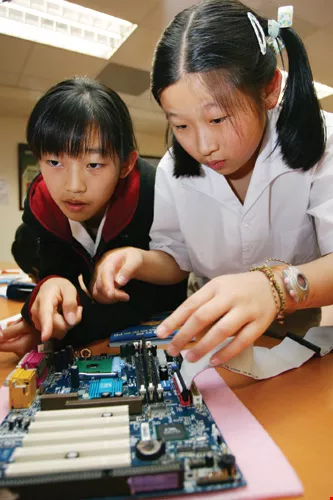
Taiwanese tech firms often adopt public service strategies based on "closing the digital divide," and mobilize volunteers from among employees to help, to bring about the "internalization" of public service. The photos show a camp for primary school kids called "Discover the Mystery of Computers," with company employees serving as teachers.
Profit goes both ways
Internalization of public service is likely to prove most durable if it is integrated with the search for commercial opportunities and with operational strategy.
Take for example the case of Hewlett-Packard helping women create a "mobile photo studio" in India, memorably reported in the book The World is Flat.
It started with an experimental joint program bringing together HP and a local government in the search for answers to the questions, "What do poor people need the most?" and "What can we sell?" Visiting a certain rural village to talk to people, they discovered a demand for photography, for such things as ID cards, licenses, and commemoration of important family events.
HP responded by providing a digital camera and portable printer manufactured by the company. Also, because the local electrical supply was unreliable, the company fitted a solar panel onto a wheeled backpack, and the "mobile photo studio" was born. HP also supplied the necessary consumable materials (like paper) but shared the profits with the villagers. The mobile photo studio was an instant hit, and women in the photography training class were able to double their household incomes.
When the experimental program ended, and HP came to reclaim its equipment, naturally the village residents were unhappy about having to part with it. So in the end the villagers decided to rent the equipment. From there they expanded to other villages, opening branch studios. Later HP began working with an NGO to train more women to use the mobile studio. In the process, the company sold ink and other consumables, so that both sides profited.
We are the world
"The problem of poverty cannot be solved just by giving away money to poor people," said the late Sayling Wen, but requires an "algorithm." Wen spent three years searching for this algorithm. He put it into practice in a poor rural town in China named Huangyangchuan. He helped the local vocational school set up a website and an e-commerce system, and by selling local farm produce over the web, the residents lifted themselves out of poverty.
"In one winter, they sold US$30,000 worth of products. They earned this money themselves, so it was much more meaningful than if we had given it to them," Wen said. He had originally envisioned setting up 1000 Huangyangchuans in China's northwest in order to help eradicate the poverty that has plagued the loess plain for generation upon generation. Unfortunately, after Wen died suddenly at the end of 2003, the plan was not continued.
In contrast with Sayling Wen's achievements in China, it seems that few other Taiwanese firms show concern for things beyond their own backyard. This is why it sounded so unusual when Evergreen Group chairman Chang Yung-fa recently talked about his wish to get involved in "international public service."
Dismayed by this state of affairs, Niven Huang wonders: How can Taiwan, with its financial power and its ranking in the 20% of the world that has 80% of the wealth, not participate in the issues of poverty and human rights that are being so intensely discussed internationally, or not extend a helping hand on problems like avian flu or AIDS?
Take Taiwanese firms in China, for example. In recent years the huge gap between rich and poor there has led to violent incidents and a backlash against capitalism. Have Taiwanese firms, which have had so much to gain from capitalism in China, thought to give something back to society to lessen the sense of relative deprivation of their workers and local residents? Niven Huang admits that Taiwanese companies in China face heavy competition, and are by no means in the best of situations, but he sees public service as part of meeting the overall challenge of operational strategy.
For example, in terms of the competitiveness of Taiwanese firms, a recent survey of graduates of the mainland's finest schools offered a list of some major multinational firms (including Taiwanese firms) and asked the grads where they most hoped to find a job. No Taiwanese firm came even within the top ten.
Huang cautions that Taiwanese firms shouldn't just play "follow the leader," engaging in progressive business practices only when their Western or Japanese buyers require them to do so. In order to reverse their negative image, Taiwanese firms should strike out on their own and invest in public service activities. From a more positive angle, this can also be the starting point for "brand differentiation."
The challenge of globalization is increasing, not abating. Corporations increasingly must not only do well, but do good. They must find ties that bind them to society, and make the community's welfare their intimte concern. That's the only way to really soar in this day and age.


