Green Gold: Farming Enterprises Take Root
Cathy Teng / photos Jimmy Lin / tr. by Scott Williams
February 2017


Agriculture may not be as flashy an industry as tech, but no nation survives without it. Taiwan’s own world-class agricultural technology includes many crop varieties that deliver improved yields and pest resistance. We have also drawn on our deep well of agricultural experience to help many nations resolve problems involving their staple crops.
Taiwan’s agricultural prowess could prove helpful in rooting the stronger bilateral ties we are now seeking to establish with the nations of Southeast Asia.
Visitors to the offices of the All Cosmos Bio-Tech Holding Corporation (ACBT) in Johor Bahru, the capital of the Malaysian state of Johor, are greeted by three large paintings as they make their way up the stairs. In the first, a frightened elephant calf hides behind an adult elephant in the midst of a dusty, bloody battlefield. In the second, the calf, now grown, stands shoulder to shoulder with the adult elephant. The third depicts the face of an adult elephant, its aged skin wrinkled and its spirit suffused with the wisdom it has acquired over its long life.
Company chairman Tony Peng says the paintings represent his and his father’s entrepreneurial journey in Malaysia.

A frightened elephant calf hides behind an adult elephant on a dusty battlefield. Tony Peng says the painting represents the early part of his and his father’s entrepreneurial experience in Malaysia.
Tony Peng: Adding value to fertilizer
Tony Peng was just 23 when he moved to Malaysia with his father in 1997. After weighing opportunities related to what were then Taiwan’s two dominant industries—electronics and agriculture—Peng decided to seek his fortune in the latter.
Malaysia is an agricultural powerhouse with a farming sector that excels at running large-scale operations. In contrast, Taiwan’s small geographic footprint has encouraged it to focus on precision agriculture. Peng’s business began as an effort to apply Taiwanese precision agriculture and biotechnology to Malaysian-style large-scale farming, to maximize the strengths and minimize the weaknesses of both approaches.
Running a farm requires juggling six key elements: crops, climate, soil, management, pest and disease control, and fertilizers. Peng began with fertilizers, first seeking assistance from relevant agencies and organizations in Taiwan, then applying his own hard-won knowledge to refining what he learned from them. He had a lot to learn and studied his then bible—Academia Sinica scientist Young Chiu-chung’s Soil and Fertilizer—from cover to cover. He also studied biotech, soil science, crop nutrition and pest control, in effect working through a university-level course of study on his own. Peng diligently applied himself to his textbooks and also carried out experiments in the field, meanwhile slowly shifting his product line away from purely organic fertilizers to “functional fertilizers” containing organic, chemical, and microbial elements.
What is a “functional fertilizer?” Peng compares it to the Android smartphone ecosystem, explaining that his fertilizer includes a variety of microbes and fungi, which extend its functionality in much the way that apps extend a phone operating system’s functionality. Spelling his analogy out further, he says that supplementing a nutrient-only traditional fertilizer with organic matter and fungi results in a smarter and more functional fertilizer.
“What we’re doing is applying biotechnology to traditional agriculture,” continues Peng, explaining that while anyone can make fertilizer, his company’s unique processing adds value to its products.
Founded in 2001, ACBT didn’t break even until 2008, but has since gone on to become Asia’s largest chemical‡organic fertilizer maker, with more than 80% of the Malaysian market. Its products have not only been certified by the Malaysian government’s palm oil, rubber, and pepper boards, but are also exported to the Philippines and Indonesia. In 2009, one of Malaysia’s sultans awarded Peng the honorific title of “Dato’” for his contributions to the Malaysian state and designated him a consultant on green agriculture. Taiwan, meanwhile, named Peng an overseas model entrepreneur in 2010.
Peng’s words mask his pride in achievements gained through genuine hard work and strength of character. The value-added he has created with his functional fertilizers also points to the future of the industry.
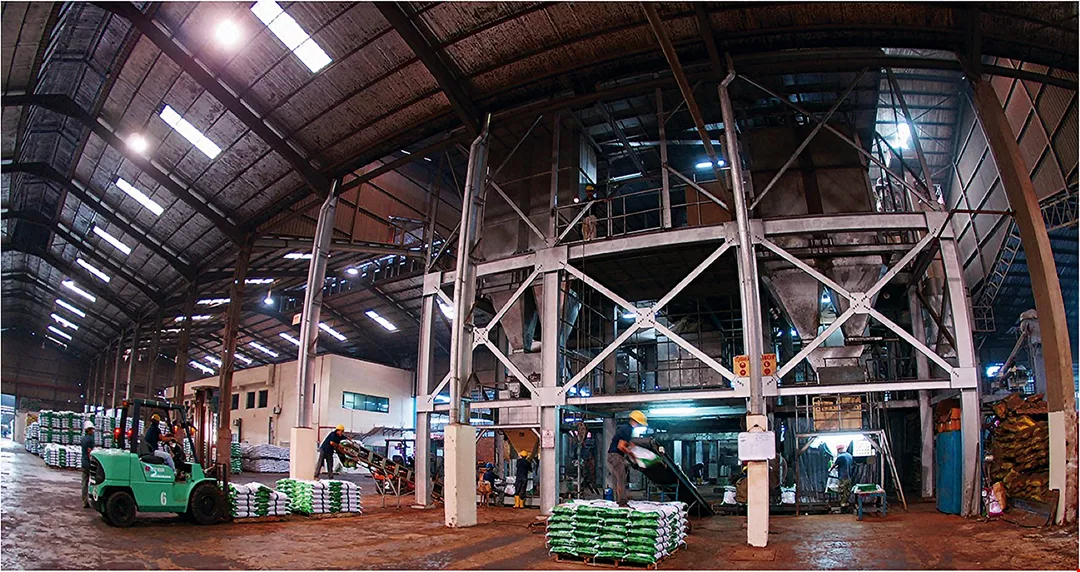
All Cosmos Bio-Tech Holdings is Asia’s largest manufacturer of chemical–organic fertilizer. (courtesy of ACBT)
Wong Yew Kai: Producing good food
Wong Yew Kai has worked as a building contractor and as the manager of Kuala Lumpur’s tallest revolving restaurant, but he has struck out in a complete new direction in recent years: farming.
“It’s important to me that my company doesn’t just make money, but also produces good-quality food for more people to eat. I think that’s something everyone should get involved in.” To that end, Wong rolled up his trouser legs, pulled on his rain boots, and joined the ranks of those engaged in eco-friendly aquaculture. He raises fish in recycled water to reduce his consumption of water and guarantee its quality. He also grows fungi and algae to feed his fry even though it means more work for him, explaining that it is healthier and more environmentally friendly.
Wong’s connection to Taiwan originated with his orchards. While Malaysia is a major agricultural producer, the country is dependent upon food imports because most of its farmers focus on cash crops like palm oil and rubber. Seeking to address that shortfall, Wong began growing food crops, starting with pineapple and papaya. He traveled to Taiwan intending to find a partner for that venture. Though the trip failed in that respect, it did introduce him to the concept of a social enterprise.
Just as in Taiwan, Malaysia’s agricultural communities have been suffering from a “labor drain” as residents have moved away in search of work. Wong decided to attempt to counter this trend by contracting out the cultivation of a large tract of land to local farmers, which he felt would create business and job opportunities for locals and draw some young people back to the community. Having gone on to apply Taiwanese food processing and brand management expertise to the venture, he now wants to take advantage of Singapore’s international trade expertise. Wong hopes that drawing on the combined strengths of Malaysia, Taiwan and Singapore will enable him to sell his products around the world.
“Everyone wants to eat good things, so there has to be a market,” says Wong. He adds, “It’s also a joy to watch crops and fish grow and mature. It’s that experience that draws people to farming.” Social pressures and other matters can eat away at this primeval joy, which is why Wong hopes not just to make money but to enable people to develop a new way of life while continuing to farm and produce good food for more people.
Many people see farming as a high-risk industry, but Wong believes that by combining Taiwanese precision agriculture techniques with Malaysia’s environmental advantages, he can integrate resources and create a win-win situation.

ACBT’s chemical–organic fertilizers account for 80% of the Malaysian market; they are also exported to many other ASEAN nations.
New southbound agriculture
Food is enormously important to humanity. What can the agricultural technology and experience Taiwan has acquired over the years do for the world? How can Taiwanese agriculture remain competitive in the international market? How can Taiwan’s agricultural sector continue to build on its strengths and resituate itself as the global economy splits into regional blocks? The New Southbound Policy, which aims to strengthen Taiwan’s sharing of resources and deepen its relationships with Southeast-Asian nations to the benefit of all, may offer a fresh perspective on these questions.
Wong Yew Kai believes that Malaysia’s natural resources and Taiwan’s precision agriculture technology can complement one another and, together, have tremendous potential for development. Tony Peng says that the ROC government’s concern for Taiwanese who work and do business abroad, and the latter’s concern for Taiwan, makes the New Southbound Policy the perfect way to strengthen ties between Taiwan and Southeast Asia.
But how will Taiwanese agriculture further develop its strengths under the New Southbound Policy? Where will it find foreign partners?
Wong recommends that Taiwanese businesses start small and engage in genuine cooperation with Southeast-Asian partners. He believes that in this way both partners will learn from one another and enjoy mutual success. Wong is convinced that Taiwan and Malaysia have the potential to work together, and that they can become good partners.
For his part, Peng encourages Taiwanese to regard themselves as citizens of the world rather than of a particular location. Noting that there are already Taiwanese all over the world, he argues that Taiwanese needn’t limit themselves to pursuing their fortunes in Taiwan. He observes further that many Taiwanese businesses have, through years of hard work, already gained opportunities, established niches, and achieved success around the globe. Peng adds that he would be happy to help Taiwanese farmers and biotech firms come to Malaysia, and to partner with them there.
Taiwan’s history makes plain that the island wasn’t built exclusively on farming, and that it owes even more to its maritime endeavors. It is only natural that who live on an island look to the sea and take the whole world as their market. This is Taiwan’s role and its natural gift.
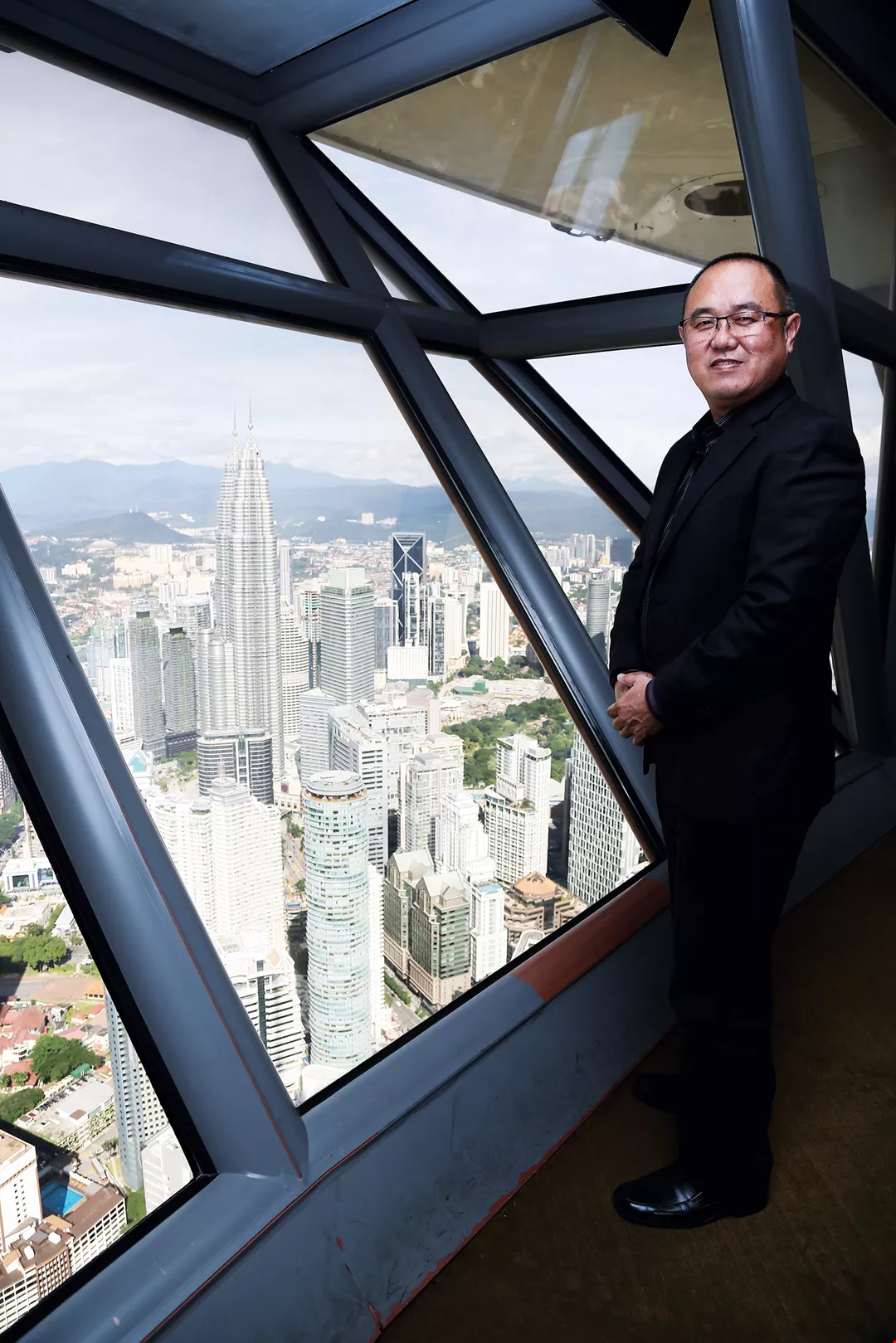
Dato’ Wong Yew Kai stands in the Kuala Lumpur revolving restaurant he once managed, the city and its famous Petronas Towers visible outside the windows.
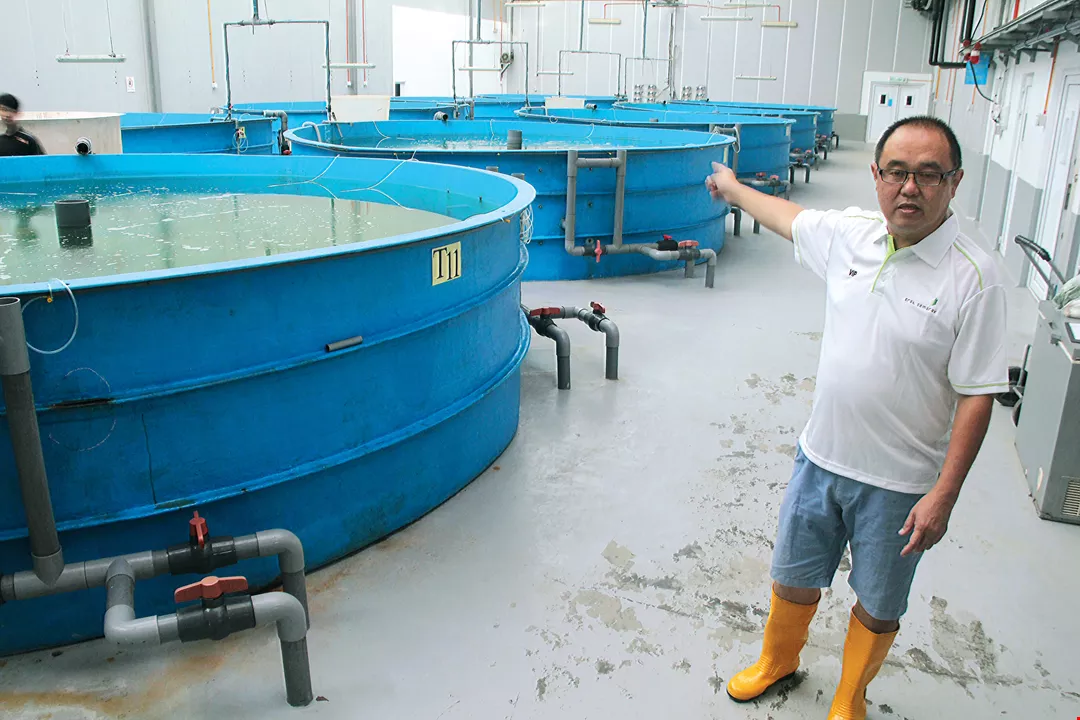
From importing technology and constructing an aquaculture facility to raising fish and developing a market for them, Wong Yew Kai has built his business with his own two hands. (courtesy of Wong Yew Kai)

Asian sea bass fry raised on microorganisms are as golden as pumpkin flesh. (courtesy of Wong Yew Kai)


