Shanghai or Bust! Taiwanese High-Tech Descends on Eastern China
Laura Li / photos Jimmy Lin / tr. by Phil Newell
June 2001


Thirty years ago, Taiwan traders spreading out over the globe, and Taiwan manufacturers sweating in their corrugated-steel-walled factories, drew on international resources to create an economic miracle that made Taiwan famous.
Today, the spirit of enterprise is still alive and well in Taiwan, but now the resources are moving in the other direction: from Taiwan outward. Local residents are divided in their assessments of this trend.
The information industry, which accounts for more than 40% of Taiwan's GNP, has been storming into mainland China in recent years. What heights are they attaining in (and for) the mainland? Are they harming Taiwan in the process? How are they going about developing in a new land? What kinds of problems do they face? Is the mainland a shining dream? Or a black hole?
Whether you are inclined to approve or oppose the exodus of Taiwan firms to mainland China while the two sides remain at political loggerheads, you had better first understand what is really happening.
In the Bund area along the Huangpu River at the end of Nanjing Rd. in Shanghai, financial buildings stand in ranks, and for 100 years this area has been known by the inviting moniker of "museum of international architecture." These days, the Bund is still jammed with people, but their eyes are looking 180 degrees in the opposite direction: the old buildings of the Bund are but mere background for the crowds gazing upon the Lujiazui Finance and Trade Zone across the river.
In Chinese the name Lujiazui has a country-bumpkin ring to it, and there is nothing of importance to mark its past. Nevertheless, in less than a decade, this stretch of farmland has been covered over with skyscrapers and highrises going up at a frantic rate.
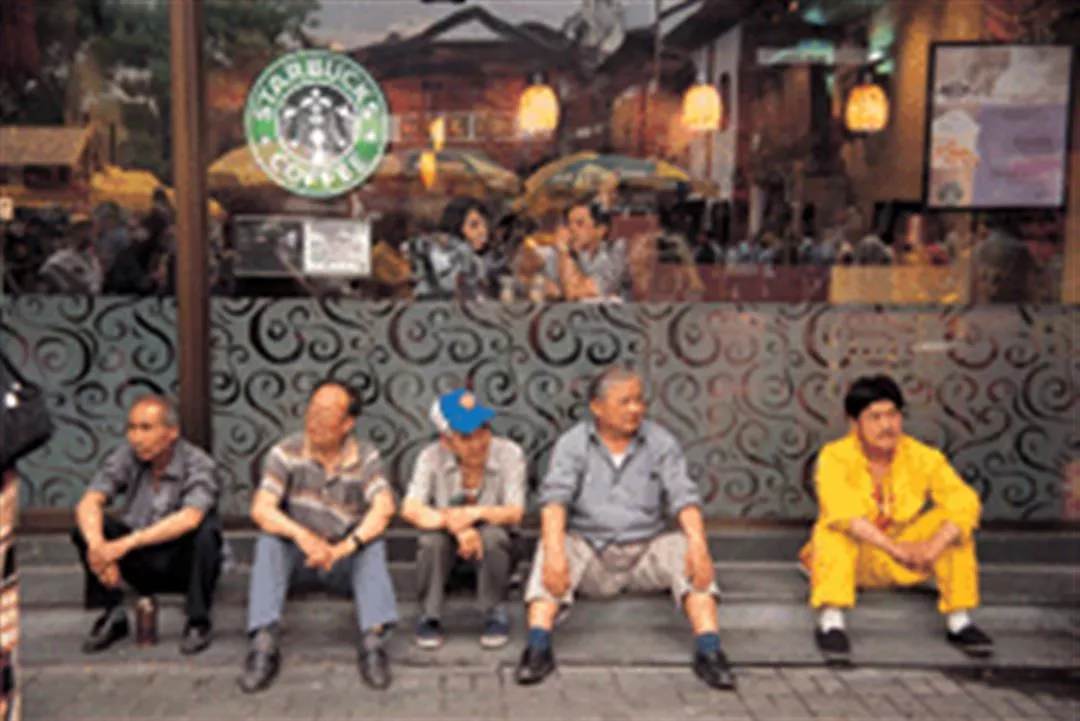
Starbucks, brought into the mainland by Taiwan's President Enterprises, is a new symbol of fashion in Shanghai. It makes an interesting contrast with the passers-by taking a rest outside.
Shanghai-ed!
Lujiazui is just the tip of the newly developed Pudong District beyond the Bund. Going further out, the Waigaoqiao tax-free zone, the Jinqiao export processing zone, and the Kangqiao industrial park open out in a semi-oval shape. At the center is the Zhang-jiang High-Tech Park. Though currently still empty space, the potential of this industrial zone to become "China's Silicon Valley" should not be underestimated. Going even further beyond, there are farms covered by dust raised by workers rushing to complete the day's construction work before nightfall, until the farmland finally blends into the deep blue of the East China Sea in the remote distance.
Pudong is not only the latest symbol of China's economic reforms, it is a new battleground being fought over by foreign firms. Taiwanese companies, advancing northward from their bases along the mainland's southeast coast, are in the vanguard.
Dai Haibo, director of the Zhangjiang High-Tech Park Development Corporation, is seen by outsiders as having a sharp eye and fast reflexes for his success in getting a slice of several of the primest cuts of the Taiwan corporate world. In 1999, the PRC government decided to go all out to develop Zhangjiang into a national economic bastion. Since then, the high-tech park has established its reputation in rapid order by attracting two major Taiwanese firms-Semiconductor Manufacturing International Corpora-tion , led by Richard Chang, and Grace Semiconductor Manufacturing Company, led by Winston Wang-to commit to projects in the park totalling US$3 billion. Though the latter is still just preparing land for construction, while the former has yet to begin actually investing money in production, the IC industry has felt the shockwaves. Now Chinese and foreign high-tech firms that handle everything from design to testing to packaging have come one after another to explore the possibilities.
While SMIC and Grace have only just begun to settle in to the new district, in the older parts of the metropolis many Taiwanese firms have already set down roots. According to the Office of Taiwan Affairs of the Shanghai People's Municipal Government, thus far Taiwan firms have invested in a total of 3,900 projects in the city, second only to companies from Hong Kong. The total amount of Taiwanese investment in the city is US$6.3 billion, fourth behind only Hong Kong, Japan, and the US. But, given the habit of many Taiwan businesspeople to invest anonymously by going end-around, total Taiwan investment is certainly not limited to the figures given.
Leaving Pudong behind, take the outer ring road to the expressway heading west, and before you know it you've driven straight to the border of Jiangsu Province. There you will find Suzhou, an administrative district covering one city and six counties, which was recently listed by Newsweek as one of the nine most important new high-tech industrial cities in the world. In the Suzhou New District, rows of company signs adorned with the complex forms of Chinese characters (as used in Taiwan, but not the PRC) glitter in the sun. It hardly needs to be said that this place has already become a second home to many high-tech companies from Taiwan (a subject explored in the accompanying article "A Tale of Two Parks").
Kunshan, which falls within the jurisdiction of Suzhou, now has more than 40 listed Taiwan firms gathered here-half of them rushing to complete new factories and thus deepen their commitment-and has gained the nickname "Taiwan Town." The area of Wujiang, despite lacking any nationally backed high-tech industrial park, is really getting down to business thanks to the arrival of Arima Computer Corporation, one of Taiwan's leading makers of notebook computers, and power-supply leader Delta Electronics.
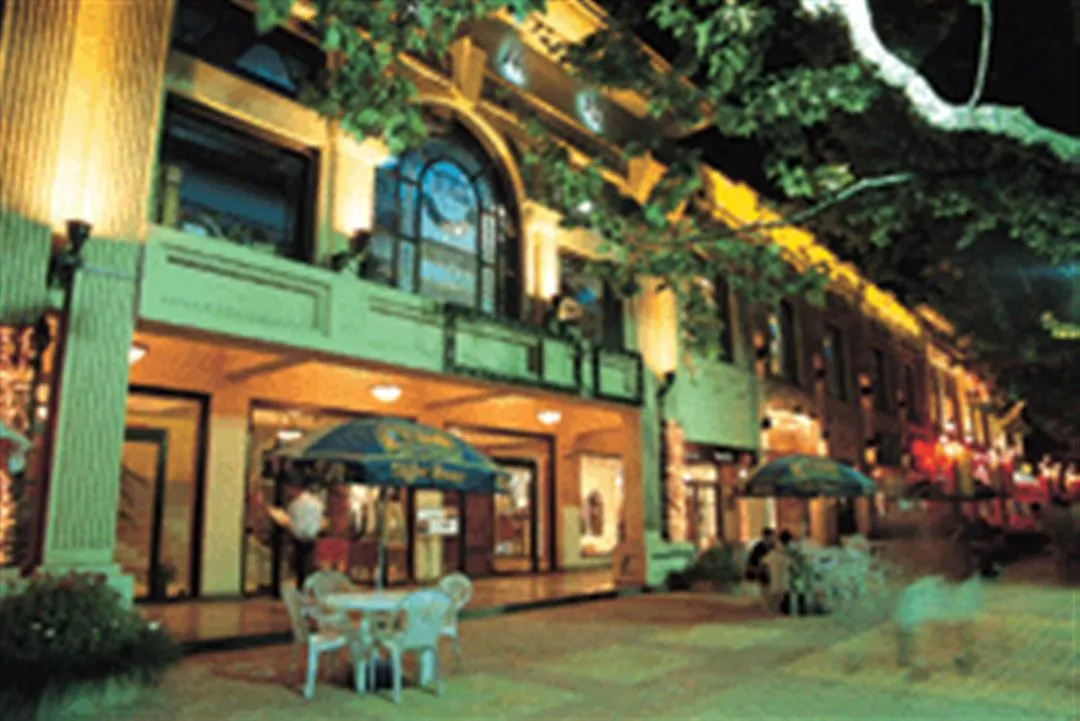
Hengshan Road in Xuhui District is famous for its bars. The shadows cast by the plane trees recall the French concession of yesteryear.
As bad as I wanna be...
There's no need to ask why Taiwan firms have come here, because the answer is so obvious: The first wave of Taiwan firms came seeking to drive down production costs as profit margins in high-tech thinned. And over the last two years, as the mainland market has boomed, market share has been a magnet attracting still more Taiwan outfits.
Wus Printed Circuit Group set up a factory in Kunshan in 1992, and is now the model firm for Kunshan's high-tech industry. The channel surrounding the plant has goldfish in the water and banks lined with willow trees. Wus' Kunshan operation began last year to wean itself from its parent company and become an independent enterprise. After the completion of the expansion program this year, production volume at the factory in Kunshan will equal that of the Wus plant in Kaohsiung.
"Though production volume will be the same, the profit margin in Taiwan is only 6%, whereas here we have 13%!" proudly declares Mike Li, vice president for administration and finance, and one of the old hands from the opening of the factory.
Count the reasons: One-that labor is cheap-could go without saying. But another reason is that printed circuit board manufacturers, who require a lot of water and generate a lot of polution, find the burden of paying for water and cleaning up their waste much heavier in Taiwan than in the PRC.
"Water charges in Taiwan keep going up, and with the cancellation of the Meinung reservoir project, even water for household use will become a problem, so who is going to help us out?" But in Kunshan, Mike Li has set aside a small part of his 200,000 square meter factory space to build a small water-purification plant, and he can draw water right out of the river by sticking out a pipe only ten meters long. Not only doesn't he pay a penny for his H2O, but the water quality is better than in Kaohsiung.
As for the frightening pollution generated by electroplating, handling one ton of waste costs NT$8000-9000 in Taiwan, but here in Kunshan you can get change back from NT$1000. Considering that Wus generates more than 400 tons of toxic sludge a year, that's an annual savings of NT$40 million.
"PCBs were the second most important product in Taiwan's electronics industry, behind only integrated circuits, but the government's attitude to us was always 'good riddance.'" Li, who has been living in Kunshan since 1992, adds that these days Taiwan is "out of sight, out of mind" as far as he is concerned.
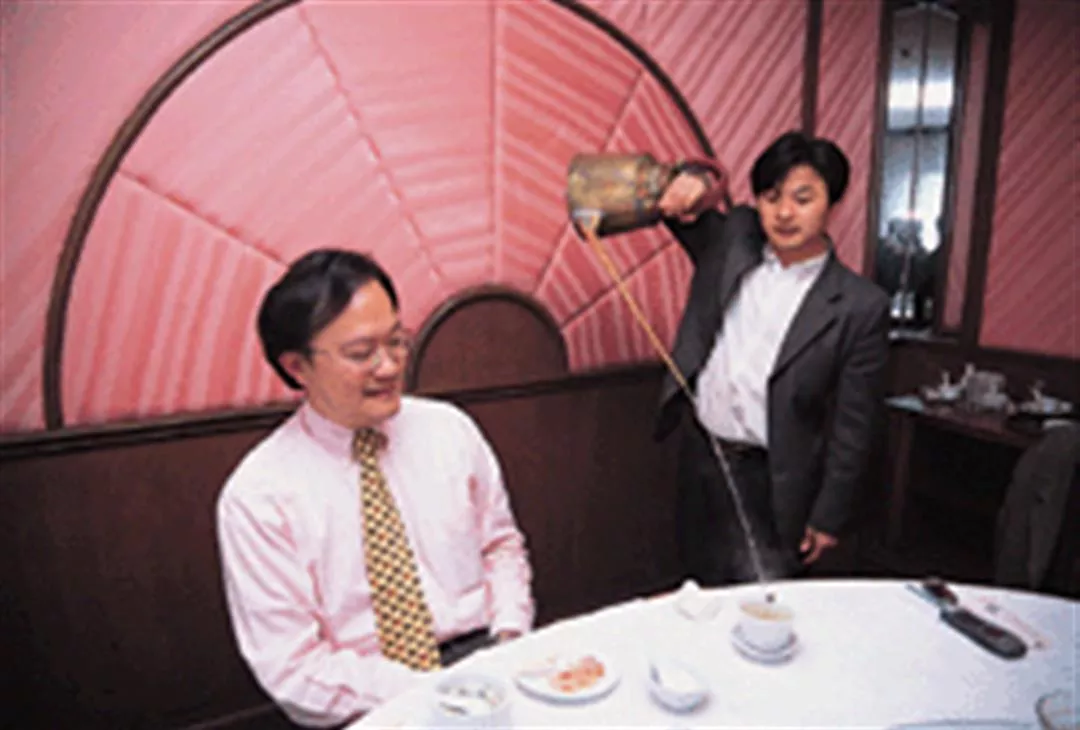
Elegant tea service is the boast of many a Shanghai restaurant. At left in the photo is Taiwan businessman Bruce Wang, head of Elegant Molecular Sieves.
Fiefdoms
Beyond the fact that the water, power, and environmental protection costs are all low, land can be acquired for next to nothing. Every Taiwanese businessman who comes here feels like a prince-complete with his own fiefdom. Acer Communications and Multimedia (formerly Acer Peripherals) has leased 840,000 square meters of space, with an exclusive 50-year lease, at a cost of only US$20 or so per square meter. And Acer no longer can even boast that it has the biggest operation here. Two years ago, Nanya Plastics settled into town with 1.1 million square meters!
"The average monthly salary for the more than 3000 employees of Acer here in Suzhou is RMB1200, which is about NT$5000. Labor costs are one-fifth of what they are in Taiwan, and you never have to worry about finding workers," says C.M. Wu, managing director of Acer Communications and Multimedia. A 20-minute drive away, at the Wujiang Industrial Park, which is a cut below Suzhou, staff salaries are virtually halved. In the Wujiang industrial park, after deducting RMB120 for food and RMB30 for lodging each month, the actual amount paid out by a company to each worker can be as little as RMB300 (about NT$1200).
For industries like motherboards and notebook computers, with more added value, costs are not such an important consider-ation. Asustek's deputy finance director says that investing in mainland China can cut total manufacturing costs by 30-50%. This would ultimately allow a 5% cut in the retail price of the product. "But such a narrow margin is not worthwhile if there are quality control problems, which can drain away a 20% profit margin."
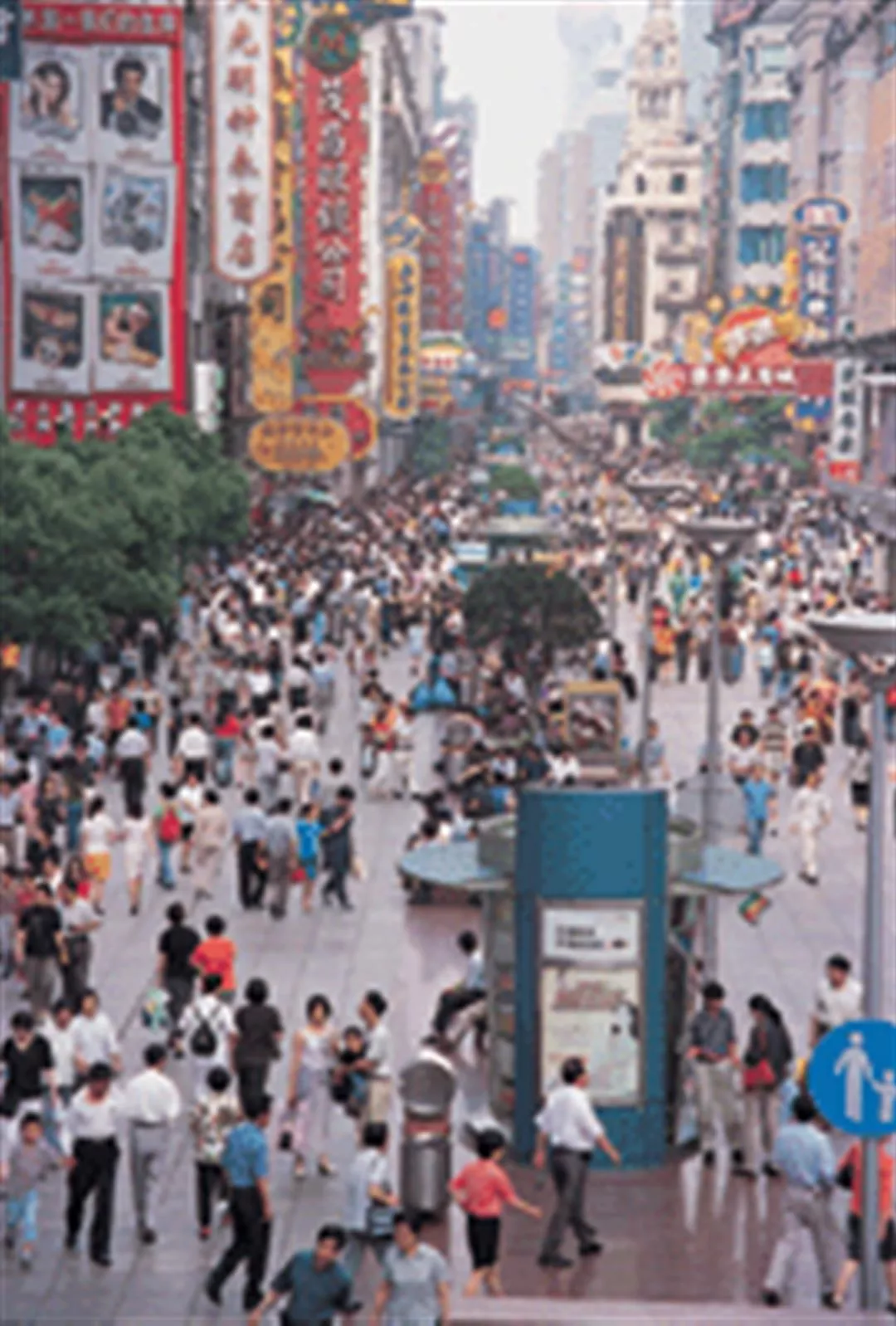
In the Shili Market-Nanjing Road belt there are new Hong Kong style shopping centers as well as century-old buildings. It is one of the most bustling neighborhoods in Shanghai.
The market in command
Yet, even Asutek has finally come to the PRC. After observing the situation for a long time, they began investing at the end of last year. They come not for lower costs, but for the market.
"Until three years ago, Taiwan firms thought of mainland China as a secondary market, with their eyes still focused on the US and Europe," says Kao Charng, a research fellow at the Chung Hua Institution for Economic Research. But in April 1999 PRC premier Zhu Rongji, visiting the US to negotiate terms for mainland China's entry into the WTO, made numerous market-opening concessions. With restrictions on this once-sealed super-sized domestic market relaxed, you can imagine how multinational corporations have rushed in to get a piece of the action. Taiwan companies have to follow suit, or they might not only miss out on a share of the mainland market, but could even lose existing OEM and other contracts to new companies set up by the multinationals themselves in the mainland.
The limited market liberalization policy has been like a rain shower on drought-stricken soil: flowers are blooming everywhere. It is expected that within three years the PRC will surpass Japan to become the second largest IT market in the world. This year, despite the global economic downturn, the mainland has been carrying forth its policies according to plan. This year PC sales in China could reach nearly 10 million. (See more on page 17.)
By 2005, when the PRC completes its 10th five-year plan, it is estimated that Chinese consumers will purchase another 170 million mobile phones and 110 million broadband modems, and that another 120 million users will go online. Looking just at cell phones, last year the mainland market was already five times larger than the Taiwan market. Because many mainland consumers get subsidies from the state one way or another, mainland cell phones have the latest styles and functions. The Tianjin factory of the US company Motorola has already become that firm's golden-egg-laying goose.
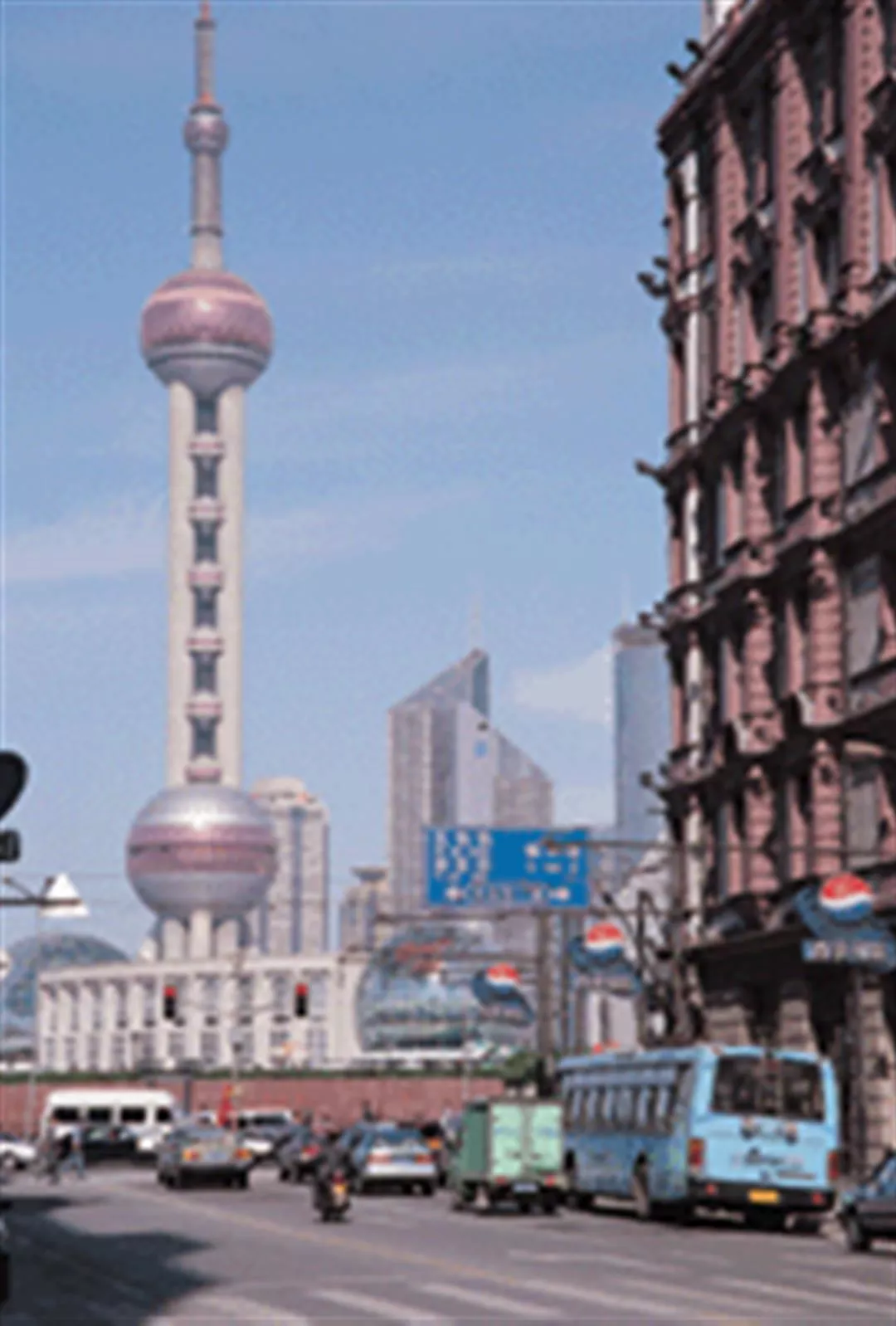
The Peace Hotel is a favorite among old Shanghai vets, while the Orient Pearl Tower on the opposite bank is a new landmark. The juxtaposition of old and new defines the mood of today's Shanghai.
Market-driven production
Of course, the opening of the market comes with numerous caveats, yet even these are driving more and more Taiwan firms to "go west" for fear of losing out. "For example, the PRC requires that companies that wish to sell to the domestic market must give first priority to using parts manufactured in the country, to the level of 60% of total purchasing," says Mike Li, VP at the Kunshan plant of Wus Printed Circuit Group. Under the principle of import substitution, "It is very difficult for Taiwan-based firms to win contracts across the strait. The way it works out is that whereas Wus' Taiwan operation couldn't get contracts to, say, make parts for the Motorola plant in Tianjin, we can."
Li points out that in the past, 100% of Wus' production was for export, but this year they expect to sell about 30% in the mainland domestic market. Despite the fact that products going to the domestic market attract a 17% value-added tax, the margin for profit is still higher than in Taiwan.
The PRC is even more of a critical opportunity for Taiwan companies seeking to establish their own brand names.
Microtek, a company with its own brand name and strong R&D capability, has a more than 40% share of the mainland scanner market, far ahead of any other competitor.
"In Taiwan, do you know how hard it is to sell 2000 scanners? But in the PRC, even if you just give scanners as display products to each of the more than 400 sales outlets, you've got at least 2000 right there!" says Steve Chou, general manager of Shanghai Microtek, from his office building in the Caohejing Industrial Park in Shanghai, another major center of Taiwanese business.
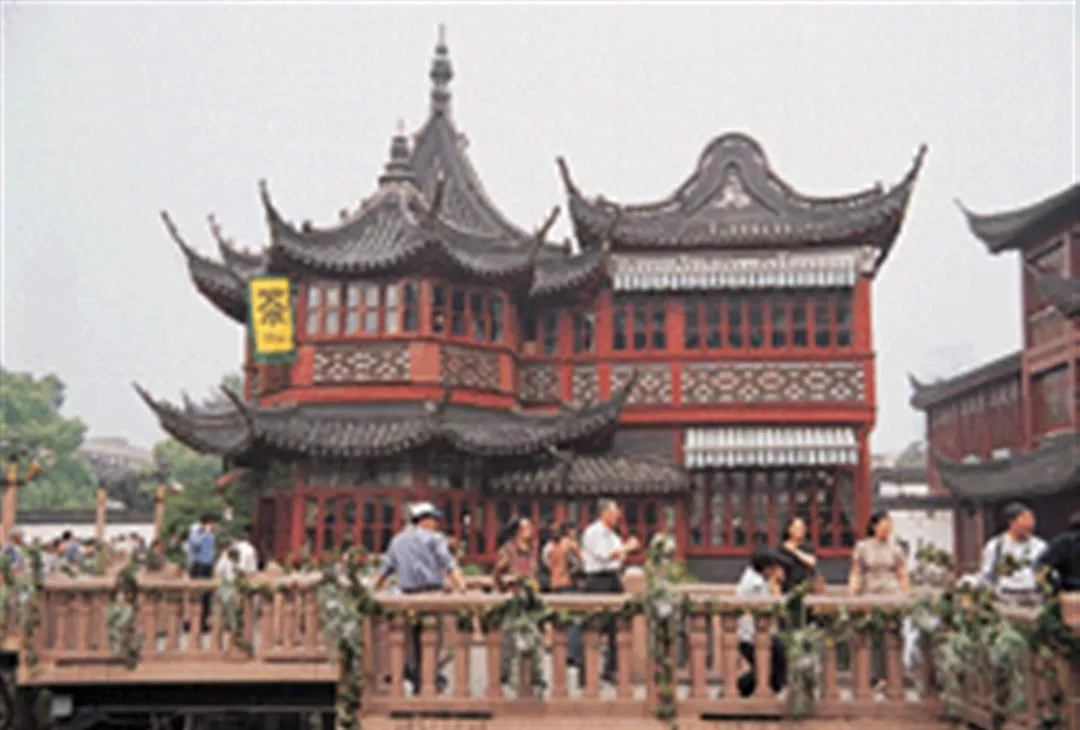
This tea house in the Yuyuan Gardens is two hundred years old. Visitors can admire the view from the zig-zag footbridge.
Dream market?
Says Chou, who has been here seven years and even married a woman from Shanghai: "The Taiwan market is too small, the US market is too far away, and the European market is too poorly understood." He understands very well the dream of Taiwan firms to establish their own brand names. He says that many Taiwan companies, having explored the globe, are now turning around to find that the market they have always dreamed of-enormous, close, and familiar-a market that could serve as their "home market," is right here in the mainland.
"With a home market, companies can advance when possible, and pull back when necessary. They can build up their resources using the home market, and then expand step-by-step into the international market, without any need to rush." Steve Chou offers as an example the case of the PRC "national brand" Haier Group, with US$4 billion in domestic sales alone. Legend Computer, which is as famous as Haier, doesn't even need the overseas market. The domestic market alone has been adequate to propel it into the ranks of the top ten computer companies worldwide.
Acer Communications and Multimedia, which is currently number five in the mainland monitor market, decided last year to drop the "Suzhou" from its name in order to build up a "Chinese brand name" that didn't obviously come from outside. Recently Acer has poured a large sum of money into a plan to lower prices for its LCDs in order to compete with Korean companies.
But what do companies with their own brand names do about the problem of pirating? There is little they can do.
Acer's C.M. Wu relates that "a lot of our products were being pirated, so to make sure people could tell one from the other, we gave retail shops alligator dolls to give away with the real thing. But then we were afraid the alligator dolls would be pirated, and we had to apply to register their design." Though the PRC has issued repeated orders to crack down on pirating, as Wu explains: "In the final analysis, in a market with a weak conception of intellectual property rights, establishing brand names will always be problematic."
And that's not the only problem. While the advantages of the PRC are undeniably clear-the market is huge, labor costs are low, and firms can easily move into both the domestic and international markets-this swarming of Taiwanese investors, each seemingly determined to outdo the ones before in size, has generated its own ill-effects which are now gradually coming to the surface.
As one setback after another has rocked the global information industry this year, many Taiwanese firms that were busy expanding when they were intoxicated by the excess of demand over supply are now overproducing. The result is a savage price war. The old game of cutthroat competition seems to have been resumed.
The tourists in the pedestrian area on Nanjing Road have themselves become a medium for advertising.
Searching for mainland treasure
Besides considerations of costs and markets, many Taiwan firms simply feel that they have outgrown the resources available in Taiwan, much like growing trees consuming all the nutrients in a forest. They need new sources of people and technology in order to keep expanding.
Steve Chou notes that after years of making producing scanners, Microtek found it difficult to make a technological break-through. Upon arriving in the mainland, they discovered that telescope and guided-missile technology were highly developed there, with optical technology that could produce resolution 10,000 times sharper than the company's existing scanners. The mainland was already making zoom lenses decades ago, while Taiwan still has to buy the technology from Japan. Currently Microtek is moving in the direction of developing technology cooperatively with the mainland.
Drawing on the "nutrients" in the mainland, not only can a company grow stronger, but it sometimes even discovers very pleasant surprises.
Elegant Molecular Sieve, the first Taiwan company in the Zhangjiang High-Tech Park (it will move into the park in July) is a case in point. Originally the firm designed and built turnkey steel smelting plants. After arriving in Kunshan in 1992, the firm found, much to its surprise, that the technology for making molecular sieves (a critical component needed for the oxygen plant, one element in a steel plant) already existed in Shanghai, and that vital raw materials like wollastonite and kaolin could be procured locally. That inspired the company to open a molecular sieve plant in Zhangjiang.
Bruce B. Wang, director of Shanghai Elegant, explains that molecular sieves are necessary for making insulated windows, and are also essential for handling of gases for all kinds of petrochemical and industrial uses. Sales at the company are already RMB50 million, with net profit margins ranging from 20 to 200%. It is the classic "small and beautiful" company.
"There is a lot of technology in the mainland not available in Taiwan, and Taiwan firms will find it worthwhile to go looking for buried treasure," says the scholarly-looking Wang. Their business is a family enterprise, run by three brothers who divide up responsibility for the Kunshan and Taiwan operations. They have not cut back their Taiwan activities, while they have found a new source of profits in the mainland. They offer an excellent example to those entrepreneurs who want to develop in the mainland without sacrificing the jobs of their workers in Taiwan.
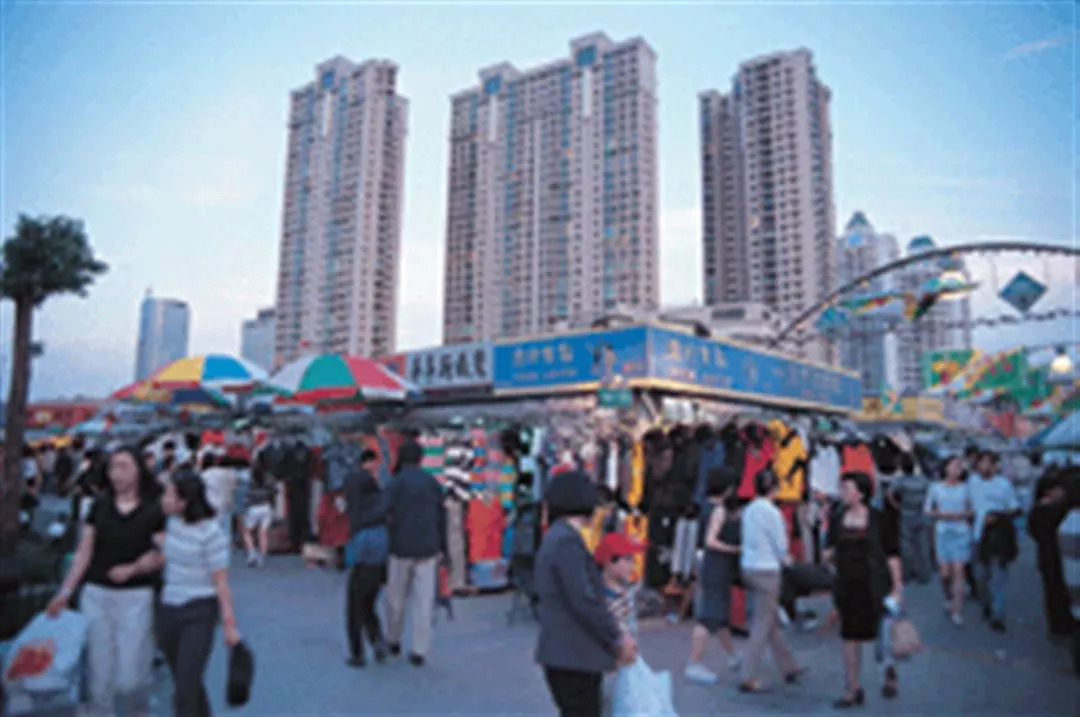
In the Xiangyang Market on Huihai Road in Xuhui District, you can find all kinds of genuine and fake designer goods. It is now one of the most popular shopping spots in the city.
Can't keep pace
The massing of so many firms from so many countries has generated a highly competitive environment.
Grow Lin of YCF BonEagle notes that every level of government in the PRC, from central to local, and the various high-tech parks, are all very sensitive to what businesses want, and the incentives they offer to attract firms change correspondingly fast. Anything that doesn't fit demand, or industries for which the market is already saturated, are likely to be left with nothing but the bones to chew on.
Ten years ago when Walsin Lihwa went to the Yangtze River delta to invest in optical fibers, the mainland market was a vacuum. Walsin Lihwa quickly expanded to 10 factories, taking advantage of government incentives. Now the value of production of the optical fiber communication industry in the mainland ranks third in the world, and the technology and the scale are both far ahead of Taiwan. If you are a Taiwan firm and are only now thinking about going to invest in this "star of the future" industry, forget it-you aren't welcome here!
At the same time Grow Lin points out that Taiwan firms must certainly not assume that everything in the mainland is worse than in Taiwan. These days the mainland always is looking to "jump straight to the head of the queue." For example, the US telephone giant AT&T, starting from copper wires, dominated its market for half a century. But the mainland has skipped right over this stage. In Shanghai, most houses are directly linked to the fiber-optic network, while mobile phones are omnipresent in the city. The idea that many Taiwan firms formerly had of "sending low-end production to the PRC while keeping high-end production at home" is no longer necessarily the best option.

Hanging their dirty laundry out in the street!? Putting up new buildings is easy, changing old habits is hard.
Economic integration, or rivalry?
Last year, when the value of information hardware production in the mainland grew by 38%, surpassing Taiwan for the first time and making the PRC the world's third largest IT producer, many people in Taiwan began to panic, fearing that Taiwan had lost its edge. But Kao Charng of the Chunghua Institution for Economic Research sees the two sides of strait as sharing in growth and profit; there is no need to insist on comparing the two to see who is "winning" and who is "losing."
Kao points out that of the mainland IT industry's US$25.5 billion worth of hardware production last year, 70% was generated by foreign firms, and 70% of the foreign total was generated by Taiwanese firms. In other words, Taiwanese companies account for half of that US$25.5 billion. So when you say that the PRC is now third in the world in IT production, in fact what that really means is that Taiwan firms are even bigger and stronger, and that Taiwan is simply extending its capabilities.
To carry the analysis further, last year Taiwan exported more than US$30 billion worth of goods to the mainland via Hong Kong, with a trade surplus of US$29 billion. That not only makes the mainland Taiwan's number two export destination, it also provides a larger trade surplus than any other customer country. And most of those exports are in fact IC and PC parts needed by Taiwanese enterprises in the mainland.
Since this is the way things are, Taiwanese business people are frustrated by the problems hobbling cross-strait interaction and by the question of national identity. One businessman complains: "We've already more than made back in trade for Taiwan the amount we invested in the mainland. So why do people keep calling us 'traitors to Taiwan'?" He feels that Taiwanese business people are not "defecting" to the mainland. On the contrary, by helping the mainland to develop, they are a "stabilizing factor" in cross-strait relations.
While cross-strait relations are at a low ebb, Taiwanese companies caught in the middle are just trying to keep a low profile and sidestep legal complications. For example, the Grace THW Group has announced that neither the group itself nor Winston Wang as an individual will invest their own money in Shanghai Grace Semiconductors before the ROC Ministry of Economic Affairs formally gives permission for semiconductor manufacturers to invest in the PRC. Several notebook computer makers from Taiwan have begun setting up in the Yangtze River Delta in the past year, but most say that the mainland factories will make nothing more than the computer casings; none will admit to "jumping the fence."
Stuck on Taiwan
The policy of "no haste, be patient" cannot, it seems, resist the tide of economic logic. There is nothing to be gained by being overly sentimental when it comes to leaving Taiwan. Yet Taiwanese business people are not wholly economic animals either.
Steve Chou, who fits in like a fish in water in the mainland, emphasizes nonetheless when describing the cross-strait division: "Taiwan is where our roots are. Our management and the R&D for our advanced products are definitely going to stay in Taiwan."
Chou notes this is not only a sentimental choice, but a rational one as well. Taiwan has a higher degree of integration with the outside world, there is freer flow of information, intellectual property rights are better protected, and the financial system is more stable.
Edward Chen, vice president of manufacturing at the Shanghai Grace Fabric Company (part of the Grace Group), says, on the other hand, that Taiwan's only hope is to keep upgrading. "When eight-inch wafer production moves to the PRC, then Taiwan has to go all out to develop 12-inch wafers." If you keep moving forward with all your might, then you don't have to worry about trying to block the other guy from catching up.
Taiwanese businessmen are nostalgic, and their honest advice comes from the heart.
"Every time I go back to Taiwan I feel uncomfortable. Everything is crap, terrible, and everyone is complaining and moaning." Steve Chou says that the information industry sells the dream of a better tomorrow. How can people with no hope, who have lost their will, do well in this field? For this reason he often encourages his friends from Taiwan to follow his example: "Why complain? Come to Shanghai and prosper!"
Pro-active liberalization
Kao Charng, who is disappointed at the lack of success in turning Taiwan into an Asia-Pacific Regional Operations Center, says that the opening of the "three links" can be delayed no longer. Although many foreign firms have stormed into the mainland market, a large number have also come back with their tails between their legs. They need the help of Taiwanese business people who know the ropes. The recently expressed desire of several Japanese firms to work with Taiwanese companies in tackling the mainland testifies to this.
Even mainland companies themselves find it helpful, as they grow, to recruit Taiwanese managers with more international experience. Taiwan firms have connections in the mainland, Europe, the Americas, Japan, and Southeast Asia. If no-one takes advantage of this strength right now, a really great opportunity for Taiwan will be lost.
If Taiwan companies can survive and prosper, it will be as a result of finding their niche in a global setting. Having put forward the idea of "pro-active liberalization, effective controls" as the new basis for Taiwan's economic policy toward the mainland, President Chen Shui-bian, on his recent stopover in New York, invited American corporations to work with Taiwanese companies to engage in joint business ventures in markets around the world-including mainland China. As for Taiwan's future, the goal is to turn Taiwan into a "knowledge-based island."
Kao Charng approves of this positive approach of letting Taiwanese firms make their mark in the mainland and then bring their rewards back home. Taiwan, meanwhile, should concentrate on R&D, education, improving the quality of life, and attracting a qualitatively higher level of international investment.
"The strengthening of Taiwanese firms in the mainland will help guide economic development there, and also spark the transformation of the economy in Taiwan," says Kao. Think back to the heady days of the Taiwan miracle, which was built on Taiwanese business people spreading out over the world step by step. Today, Taiwan firms in the mainland share the old dreams, and a new stage is opening up there for them to play their roles. As Taiwan companies look to catch the wave and ride it, we can only hope it leaves us all on a safer shore.


@List.jpg?w=522&h=410&mode=crop&format=webp&quality=80)
