

Travel aficionados throughout Taiwan are sure to have stayed at one of the many homestays that have sprung up in recent years at scenic places and in tourist towns. But the places that only serve up a meal and a place to sleep are no longer adequate to the yearnings of seasoned travelers-now the so-called "themed homestays" get most of the attention.
Themed homestays are exactly what the moniker suggests: residences whose design deliberately manifests a theme that may be reflected in aspects such as architecture, style of service, cuisine, room decor, ambience, or hands-on activities. Not only are there Japanese, European, retro, fairytale and literature-themed homestays, there are even those dedicated to themes as variegated as photography, tea connoisseurship, calligraphy, weaving, and trains. These homestays are exciting examples of what happens when entrepreneurial creativity combines with unique regional flavor.
The best travel season is just around the corner in March, when temperate breezes and flowers chase away the winter chill. That's the best time to leave city troubles behind and go discover these delightful and diverse themed homestays!
One sunny weekend in an otherwise gloomy January, university student Li You-chen, fresh from her semester final exams, and her boyfriend, Wu Po-keng, just recently released from compulsory military service, head off to the popular "Prince and Princess Home" in the town of Wuchieh, Ilan County.
"There were a lot of nice recommendations that made it sound so dreamy. We've been meaning to check it out for a while-too bad this time we couldn't reserve the 'Snow White' suite! Well, better luck next time," says Li with a smile.
In Sanyi, in the mountains of Miaoli County, two career women, Huang Shu-mei and Chen Ya-hui, journey together to the quaint, outdoorsy Zhuo Ye Cottage. They say this homestay truly harkens back to the past with its series of separate cottages amid a bamboo forest. With classes in traditional indigo dyeing and wooden figurine painting, it is more than just a place to stay, but a destination in itself, somewhere to unwind and experience a refreshing change of pace.
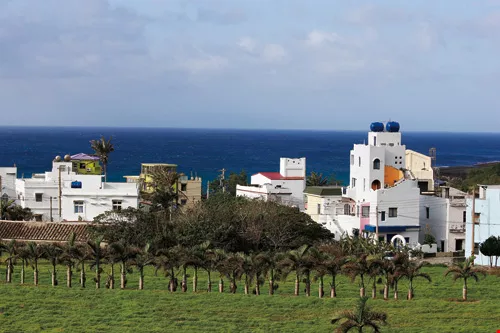
Many of the themed homestays in Kenting go for an exotic feel. In recent years, developers have accentuated the laidback seaside resort ambience by building white-walled, blue-roofed Mediterranean-styled villas.
Not your typical B&B
More and more vacationers are gravitating towards these colorful homestays with clearly articulated themes.
According to a Tourism Bureau study, of the 107,540,000 leisure journeys in Taiwan in 2006, 61% were day trips not involving overnight stays. In 17% of the trips, travelers stayed in traditional hotels, 14% stayed with friends or relatives, while only 6% chose homestays.
By the raw numbers, homestays appear to occupy only a small share of the market; but this analysis belies the fact that the figure is up two and a half times from 2003. Statistics also show that as of December, 2007 there were 2,301 legally registered homestays-300 more than at the same time in 2006. Homestay owners unofficially estimate the true number at anywhere between 8,000 and 10,000, if one includes all the unregistered businesses in Taiwan and the satellite islands of Kinmen, Matsu and Penghu.
The studies confirm that homestays are one of the hottest toics in the travel industry. But as they spring up in towns and villages islandwide, they augur the arrival of a fierce turf war. No-frills guesthouses providing just lodging and meals no longer measure up to holidaymakers' standards, and face the threat of gradual extinction. Yet themed homestays have staked out clear market niches, and that specialization may help them capture distinct consumer subgroups. With 6% of the pie, homestays can't rightly be considered mainstream just yet, but their steady growth bodes well for these industry upstarts.
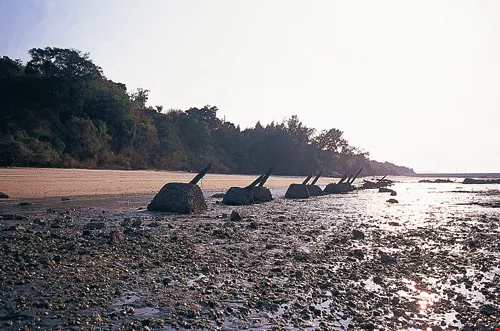
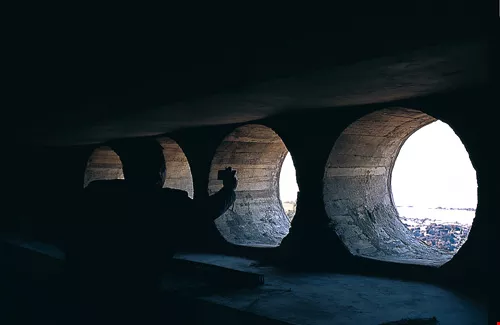
In Kinmen, wartime relics such as propaganda loudspeakers and artillery batteries litter the landscape. The remnants of the conflict between Nationalist and Communist forces are a focus of many visitors' attention.
Exotic tinges
Themed homestays often apply their theme on multiple levels-architecture, room furnishings, ambience, service, etc.-to give the image a crafted and comprehensive integrity. Occasionally they offer guided tours or other special activities to help guests fully immerse themselves into their surroundings and let the burdens of their everyday lives slip away. It is a chance to be something entirely different, if only for a brief while.
In his capacity as director of the Taiwan Country Lodging Association, Wu Chien-cheng is widely respected as an industry guru. He observes that homestay themes have mainly gone in two opposite directions: toward the exotic allure of foreign lands, or toward Taiwan's local culture and experience.
Exotic themes usually focus on the building's physical appearance. There are places modeled on European villas, manors, or castles; there are those suffused with a Japanese minimalist aesthetic; and there are seaside homestays that simulate Southeast-Asian island paradises.
The homestays around Chingjing Farm in Nantou County are the most representative example of the European-styled homestays. With expanses of green grass, densely layered mountain chains, and herds of insouciantly grazing sheep, the area is already unmistakably reminiscent of the Alps. Developers embellish the resemblance by adding white-walled villas with sloping roofs, French windows, and individual sun balconies.
At Taiwan's southern tip, Kenting is home to a number of homestays going the exotic route. Homestays here capitalize on the area's seaside scenery and laid-back resort atmosphere. In recent years, there have been more than a few establishments patterned after white-walled, blue-roofed Mediterranean villas or small Balinese houses.
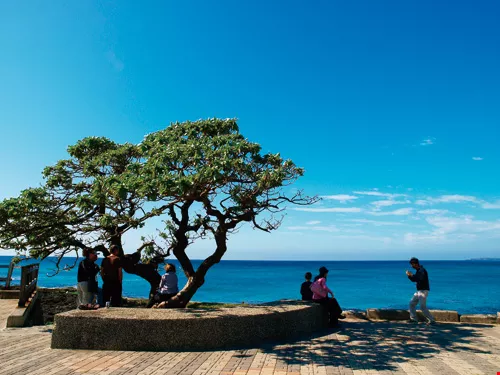
Homestays have become extremely popular in the last few years, springing up everywhere from major scenic attractions to little hamlets. In Kenting, an ever-popular holiday destination, there is quite a dense concentration of them.
Local flavor
The emergence of homestays with themes drawing on local culture and industries is closely connected with the community regeneration projects that have been popular in the last few years. Under joint promotion from local and central government authorities, many young people have left the cities and returned home to get involved with grassroots community revitalization efforts. Much of the movement's focus has been on stimulating tourism and consumer activity to help revive local industry. Themed homestays that call attention to regional products and points of interest fit neatly into the equation.
Locally themed homestays usually center on geography, history, culture, and ethnic (non-Han) culture, to achieve astonishingly original results.
For instance, homestays in Chinkuashih and Chiufen in Taipei County have taken advantage of renewed interest in the region's history as a goldmining center, thanks in part to director Hou Hsiao-hsien's nostalgic tribute A City of Sadness. Rukai Aboriginal culture takes the stage at homestays in Pingtung County's Wutai Township. The traditional slate-slab architecture adorned with Rukai totemic symbols such as the hundred-pace viper and lilies adds great cultural verisimilitude. Guests dine on sumptuous meals that Rukai customarily offered to chiefs. Special tribal rituals, songs and dances immerse visitors deeper into the Rukai world. Handcrafted souvenirs made by Rukai women such as boar-tooth necklaces, glazed tiles, and millet alcohol are also available. Kinmen has homestays set in traditional Fujianese villages; homestays in Taomi, Nantou County showcase the local ecosystem; Chenchu in Ilan encourages guests to acquire hands-on knowledge of the vibrant agricultural life. It isn't at all difficult to recognize the momentum the local-themed homestay movement has built, as well as the tremendous variety expressed therein.
Wu Chien-cheng notes that in the past, domestic travel led invariably to big-time tourist destinations like Sun Moon Lake or Kenting, while interesting sites off the beaten path languished for lack of attention. Fortunately, the homestay surge has helped to remedy all that. Homestays have taken on the role of visitor centers, where knowledgeable locals guide people on tours of local culture and industry, bringing vitality to places that most guests have only read about in school.
"That is what meaningful travel is all about," avers Wu, "and also what makes these homestays so appealing."

Wavy stone walls decorated with blue and yellow hues are a fine example of homestay developers' creativity. The photo shows Little Path Guesthouse at Kenting.
Shared interests
Besides the exotic and the familiar, homestays also take as their themes personal hobbies or aesthetic pursuits.
For instance, at Raisinay Guest House in Nanchuang, Miaoli, owner Lin Shree has built a business around her interest in traditional Atayal dyeing and weaving. Originally from Taipei, Lin married an Atayal man and opened a homestay that promotes these endangered art forms. Visitors learn to create vivid, authentic Atayal warrior bands and headgear.
On the other side of the island in Taitung's Chihshang Township, renowned calligrapher Hsiao Chun-shan has opened his Huan-e Cottage, which naturally has calligraphy at its core. Home to many brilliant pieces by different masters, Hsiao's temple is a place for students to study the venerable art under the owner's tutelage. Some lucky visitors even return with one of Hsiao's own works.
Photographer Tsai Hsien-kuo's Shihsanchien Image Guesthouse on Kinmen is a must for lovers of photography. Near the National Center for Traditional Arts in Ilan, travel author Chi Tzu-hung maintains a guesthouse, Book Walker Inn, that overflows with books and CDs. The rooms' names derive either from the titles of books written by Japanese author Haruki Murakami-the owner's personal favorite-or the songs of popular female singer-songwriter Cheer Chen. As such, his place has quite a following with young intellectuals and artists.
Chi wrote a book specifically about running a homestay and even started a class on the subject at Chinese Culture University's Extension Program. He believes that since legal restrictions on the size of homestays limit the scale of the business, it is better to define a narrow target audience rather than try to appeal to more catholic tastes. Thus homestays that are an outgrowth of the owner's personal interests and tastes manage to connect with a suitable crowd. "It isn't just the travelers that pick the homestays; homestay owners pick their guests." Boisterous personalities aren't going to seek out places intended for literature junkies, after all.
"The homestay market revolves around deeper connections between owners and guests-the right people finding the right place. And that's fine by me," Chi says.
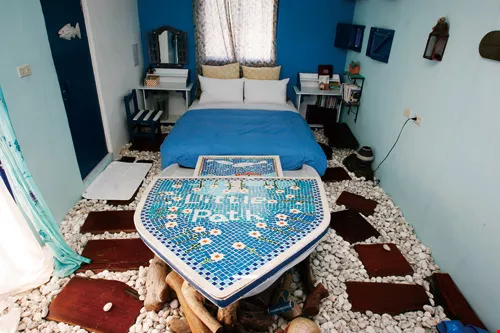
The most popular room at the Mediterranean themed Little Path Guesthouse in Kenting is built like a ship's cabin. The clever design centers on a boat-shaped bed decorated with blue and white mosaic tiles and petite flowers, and pathways of cypress wood amid pebbles on either side.
Keep it real
Naturally, successful homestays must contend with imitators trying to steal their thunder. Chi Tzu-hung feels a herd mentality is prevalent in Taiwan-as soon as one place starts to make money, it's not long before the area gets flooded with knock-off artists, as is the case with the European villas at Chingjing Farm.
"But themed homestays aren't so easy to imitate. A lot of people whose hearts aren't really wrapped up in the theme do a good enough job replicating the external traits, but can't reproduce its authenticity of spirit, the very thing that keeps customers coming back," warns Chi.
Fairytale-themed Prince and Princess Home in Wuchieh, Ilan is a big hit with young lovebirds, but it too has had its share of headaches over cheap imitators. A lot of competitors cook up some pretense for visiting, take ample mental notes, and before you know it they've got their own homestay looking just like Prince and Princess, right down to the opulent beds and gauzy curtains. Strangely enough, when people bring their dreams of being fairytale heroes or heroines to Ilan, they inevitably eschew the imitators and head straight over to the genuine article. Some even change their travel dates to get a reservation. Proprietress Chiu Shu-cheng herself can't exactly explain the success of her establishment, but she does comment," I just try to take all the things I really like and put them into my homestay-perhaps customers can sense that sincerity."
Chi Tzu-hung feels that Chiu is able to pull off her role with such aplomb precisely because of her lifelong fascination with fairytales. "Homestay owners have to put a lot of themselves-their passion and earnestness-into both operation and service. Prince and Princess definitely delivers on that count. You can't just use the theme as a money-making gambit and expect people to respond. If the owner isn't excited about the theme, how can guests be expected to care about it?"
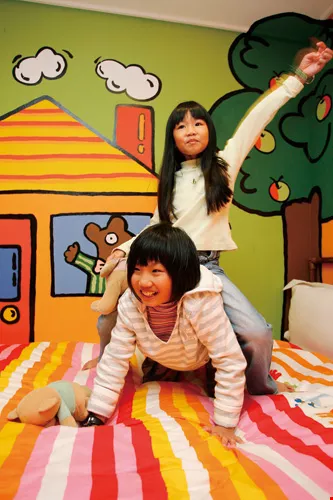
At most themed homestays, room designs display as much ingenuity as the exterior, as is evidenced by this family suite at Farm Guest House Kenting whose cartoon murals and colorful sheets delight children.
Rewriting the rules
It's still anyone's guess whether the increasingly popular themed homestays will usher in a golden age for the industry; in the meantime, legislators are doing what they can to help things in the right direction. The Legislative Yuan has already amended the legislation on business registrations, formally exempting homestays from registering as a business and therefore from paying business tax.
In addition, the Tourism Bureau is proposing to change this year the seven-year-old regulations governing homestays, to merge the "standard" and "special" homestay categories into one comprehensive category. The existing five-room, 150-square-meter limit for standard homestays would be expanded to ten rooms and 200 square meters. But the "special" category allowing homestays with up to 15 rooms on Aboriginal reserve land, at tourist spots, on outlying islands, and on officially designated leisure farms would be scrapped entirely.
Huang Yu-chen, director of the Tourism Bureau's hotel inspection and supervision center, explains that for years homestay owners have protested that the five-room upper limit is rigid and inadequate to business realities, necessitating a more lenient policy.
A number of problems exist with the 15-room, "special" homestays. First, the fact that granting special status is the province of local authorities has led to wide discrepancies. Second, many local authorities have been lax about enforcement, not wanting regulation to hamper commercial development. Finally, there have been instances of entrepreneurs using unscrupulous tactics such as getting local representatives to lobby for special status, or trying to achieve it by reregistering land. This has resulted in an explosion of homestays in mountain and scenic areas, which is not only an administrative nightmare, but also detrimental to the natural environment.
Huang Yu-chen says that the plan is to bring special, standard, and the current industry darling, themed homestays, all under one blanket category. However, the changes would not be retroactive, so that those who had already built legally approved special homestays could continue with their business unimpeded.
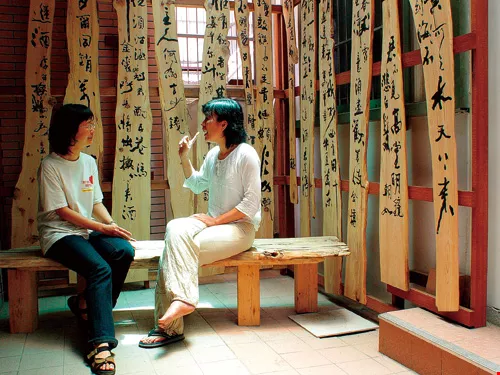
Calligraphy is the centerpiece at Huan-e Cottage in Taitung's Chihshang Township. Here, besides practicing their own calligraphy, visitors can admire works by famous masters and experience a deep connection to this venerable art.
Voicing complaints
Not everyone is thrilled with the proposed changes. Wu Chien-cheng believes that all the regulations currently in place stem from the notion of treating homestays as an economic stimulus for Taiwan's far-flung rural areas: let farmers and fishermen use their residences to support a secondary business, free from the burden of paying additional taxes.
"But this is just shooting ourselves in the feet. Homestay owners won't work hard if they treat their establishments as some kind of side venture. Good results will only come about if they put all of themselves into it, and get their families into the act, too," he says pointedly.
Others in the business have similarly called the proposal to do away with the special homestay category "a step backward" and "not conducive to progress." Huang Yu-chen responds that the Tourism Bureau will assemble a team of experts and business owners to iron out the details of the proposal. But she also says that those wishing to add more rooms and expand their business into their primary source of income really ought to apply to build a proper hotel, which incidentally has much more stringent building, fire, and hygienic codes. It just isn't cricket to run a large-scale business like a hotel or resort and call it a homestay.
"Let's maintain a clear distinction between hotels and homestays," says Huang. "That's the only way to keep things fair."
Change of values
Dissatisfaction with policy changes aside, people in the industry are resoundingly optimistic about the future. Wu Chien-cheng believes there may be as many as 20,000 homestays ten years from now, of which themed homestays might make up more than 10%. Themed homestays will continue to get more and more specialized and varied, to appeal to different consumer groups longing for fresh experiences.
"The rise of themed homestays points to a shift in values. A lot of people are returning to their hometowns to open homestays, not to make a lot of money, but to realize an ideal, or to pursue an idealized way of life. They want to share their values and perspectives with others," he says. With ideals leading the way, there is sure to be a proliferation of urbanite homestay owners sharing their skills and experiences with homestays themed around dentistry, legal practice, architecture, or fine cooking.
Themed homestays are a new force energizing the competitive travel industry with their niche-oriented market strategy and potential to appeal to diverse consumer interests. Are the owners justified in their optimism for the future, or will the herd mentality lead to a surfeit that will ultimately squeeze out the last drops of freshness?
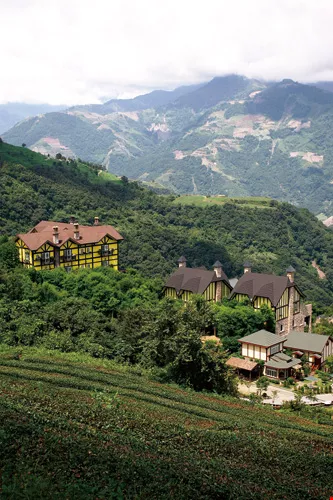
Nantou's Chingjing Farm has vast grassy plains and dense undulating mountains that look like the Alps. In order to capitalize on the resemblance, developers built European-style villas with slanted roofs. Pictured here is Provence Rose Lodge.

Unique themes taken from the owners' special interests, local culture, or the natural environment are the wave of the future for Taiwan's guesthouses. Pictured here are cormorants against a Kinmen sunset.
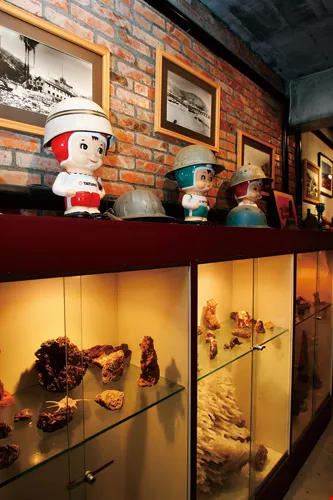
In Taipei County, Chiufen and Chinkuashih have channeled their towns' goldmining legacies into nostalgic homestays that teach visitors about mining culture. Here we see Cloud Village Lodge in Chinkuangshih.

@List.jpg?w=522&h=410&mode=crop&format=webp&quality=80)


