It’s Great to Have Known-You!
Lin Hsin-ching / photos Chuang Kung-ju / tr. by Jonathan Barnard
November 2012


Those who have had a chance to travel in Myanmar will certainly recall the sight of women out in the bright sun selling watermelon slices or carrying the fruits on their heads. A careful taste of those large, juicy and sweet Myanmar watermelons would reveal flavors that hardly differ at all from the world-famous watermelons of Taiwan!
In fact, more than 90% of the watermelons in Myanmar are Taiwanese varieties. The behind-the-scenes player that has brought these Formosan varieties to poor Myanmar farmers (who have in turn used them to generate US$30 million in foreign exchange) is none other than Taiwan’s Known-You Seed Company.
In Myanmar more than 70% of people are farmers. Apart from views onto endless expanses of rice paddies, countryside vistas in Myanmar offer the sight of scattered huts raised off the ground on stilts. With pillars of wood, panels of rattan, and sogon-thatch roofs, these huts are the most common form of housing in Myanmar. Most lack water and electricity. They are vivid demonstrations of the state of poverty experienced by farmers in Myanmar.
At a time when foreign businesses are eyeing Myanmar for its cheap labor, anticipating that reforms will allow the market to show its true potential, very few have been concerned about the country’s social needs. An exception is Taiwan’s Known-You Seed Company, which has long been working hard to improve the lives of Myanmar farmers.
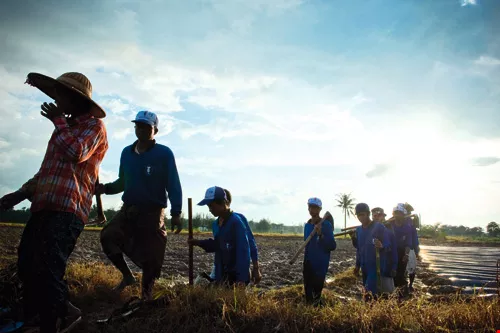
As the sun sets, hoe-carrying students in an agricultural training class prepare to go home. They are the best hope for the future of agriculture in Myanmar.
Established in 1968, Known-You was founded by Chen Wen-yu, who bred Taiwan’s first seedless watermelon.
By now Known-You’s seed bank has grown to encompass more than 60,000 plant varieties. Its collection includes more than 1000 wild strains of watermelon alone—allowing it to breed watermelon varieties to suit the individual tastes and conditions of any national market.
Known-You has already developed nearly 300 watermelon varieties itself, with production that accounts for about one-fourth of the global market for watermelon seeds. It exports to more than 50 nations.
In 1994 Known-You began sourcing seeds in Myanmar. It found a nation that was well suited to growing fruit, with fertile flood plains, a warm climate and ample rainfall. Consequently, it targeted Myanmar as a location for doing business.
Yet with Myanmar’s command system of economic planning, promoting high-value cash crops hasn’t been easy. The military government long exercised strict control over the crops planted on the nation’s agricultural land and mostly dictated that rice and other cereals be planted “to fill hungry bellies.” It has been hard to find agricultural land available for any other purpose.
“Early on I communicated with Myanmar’s then minister of agriculture in the hope that we could hold discussions about obtaining more land for fruit plantings,” says Known-You’s Myanmar general manager Kuo Kun-shih, who has worked in Myanmar for 15 years and is called the “underground minister of agriculture” in Taiwanese business circles there. “All we got was an unfriendly single sentence in response: ‘People die for lack of rice, not for lack of fruit.’” Kuo can’t help but shake his head at the recollection.
Known-You eventually found a few scraps of land not controlled by the military to provide to farmers interested in growing fruit. It thus gradually built a foundation for the fruit industry in Myanmar.
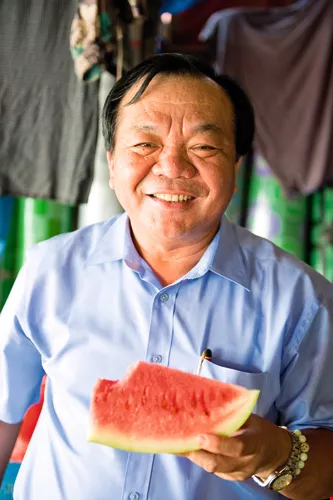
Known-You’s Myanmar general manager Kuo Kun-shih is a master of marketing Myanmar’s watermelons.
Having overcome massive obstacles to finally obtain some land, Known-You immediately faced a second hurdle: changing the extremely backward conceptions and techniques of Myanmar farmers.
Kuo points out that Myanmar farmers had been simply taking the seeds of eaten fruit, burying them in the soil, and giving them water. Not only were farmers reluctant to spend money on purchasing top-quality seeds, they didn’t even use water-buffalo manure or chicken droppings as fertilizer.
In order to advance the techniques and technology employed by farmers in Myanmar, in 1997 Known-You worked with the Ministry of Agriculture to establish the nation’s first agricultural training center in the suburbs of Yangon. The center, which charges no tuition fees, features two four-month sessions and widely recruits farmers to attend. Its curriculum matches theory with practice, teaching its students how to sow seeds, apply fertilizer, promote germination, fight disease and pests, cull young plants, thin young fruit, and choose the right time to harvest. More than 800 students have studied there so far.
At the end of their studies, farmers receive seeds worth NT$5000 from Known-You. Graduates are asked to pass along what they’ve learned to their friends and family, thus expanding the impact of the program.
Kuo says that students can start making profits from growing fruit only a few years after graduating. Many have specially come back to thank him and to show off their success. “The vehicle I drove here today I paid for myself!” one graduate pointed out. Because Myanmar hasn’t liberalized its auto market, cars are extremely expensive. A typical second-hand car goes for NT$1 million, far from what regular citizens can afford.
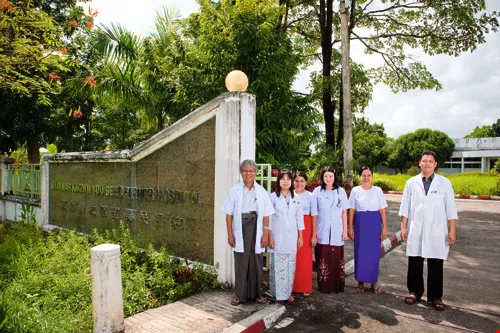
Known-You put up the money to establish a hospital for farmers in Myanmar, which has saved many lives. The photo shows the hospital’s superintendent (left) and medical staff.
Because of Myanmar’s climate, technological level and other factors, watermelon has been Known-You’s best-selling fruit seed there.
Kuo points out that the people of Myanmar are poor, and only a few at the top of the economic pyramid can afford to buy expensive top-quality fruit. Consequently, in marketing watermelons Known-You’s Myanmar branch has had to look beyond the domestic market to the vast potential market of mainland China next door.
Particularly during the dry season of November to March, when harvests of watermelon peak in Myanmar and mainland China is short of fruit during its winter, Myanmar producers have been able to meet some of China’s demand. And the future looks bright with the potential for high profits.
Having settled on their plan to sell watermelon to the Chinese market, in 2000 Known-You held a watermelon festival and competition in the town of Muse, just on the Myanmar side of the border. The company brought in five truckloads of watermelon from Myanmar farmers, and asked more than 100 mainland fruit distributors to participate as judges.
But because of the ongoing civil war in northern Myanmar, foreigners could not pass through. To manage the festival, Kuo had to take a circuitous route, flying to Kunming in southwestern mainland China and then driving to Muse via the Chinese border town of Ruili.
Nevertheless, because the watermelons that had been imported from Myanmar to mainland China had previously been of such poor quality, when the Chinese fruit dealers saw for themselves the blemish-free watermelons with perfect color, they were dumbfounded and no one dared to shout out a bid.
The quick-thinking Kuo immediately arranged for an undercover bidder to enter the room and shout out a price that was twice the going rate for retail watermelon in mainland China. The strategy worked: The price rose high during the festival, and it didn’t take long for watermelons from Myanmar to gain a high reputation in the mainland generally, with commensurately high prices. Myanmar is annually selling about US$30 million worth of watermelons to China, and the amount is rising by about 10–15% per year.
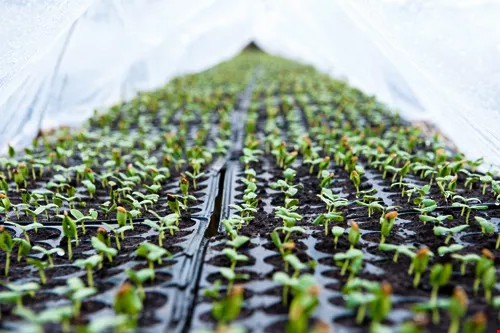
By teaching proper methods of gathering seeds, planting and picking, Known-You has helped raise the competitiveness of Myanmar’s farmers. The photo below shows tomato seedlings.
In addition to introducing advanced agricultural techniques and technology and helping to develop the market for fruit and fruit seeds in Myanmar, Known-You has also overcome numerous difficulties to build a free hospital for local farmers.
Kuo points out that when Known-You first entered the Myanmar market, he found unimaginable deprivation among local rural dwellers. Upon reading Kuo’s reports, Known-You founder Chen Wen-yu, who has always been filled with the ambition to help the rural poor wherever in the world they may be found, came up with an idea of building a hospital in Myanmar to serve their needs.
Yet doing so was challenging in Myanmar, where the ROC lacks formal diplomatic ties and government bureaucrats aren’t particularly friendly to Taiwan. The company hit numerous obstacles in the permit process, and the military even suggested at one point that a Taiwanese company would only display such generosity if it were secretly planning on carrying out trials of untested drugs, turning the people of Myanmar into guinea pigs.
At one point Chen almost lost hope about being able to build a hospital there, and considered shifting the focus of his charity to next-door India, “where there are a lot of poor people too.” But word of his change of heart got to the grandson of the famous general Ne Win, who volunteered to mediate between Known-You and the Myanmar government. The plan to build a hospital for poor Myanmar farmers came back to life.
In March of 2001, the farmers’ hospital, costing NT$100 million, was completed in Aye-yarwady, to the west of Yangon. It features departments of internal medicine, surgery, pediatrics, dentistry and obstetrics, and has 30 beds, an X-ray machine, a biochemistry lab and an operating room.
Open for 11 years now, the hospital has treated more than 800 patients for snakebites alone. It has also treated many for conditions and diseases that might well have previously killed them, including difficult births, pneumonia and cellulitis. Countless lives have been saved by the free treatment that the hospital provides.
Operating as a foreign company in Myanmar for many years, Known-You Seed may not be plying its trade in the sexiest of fields, but it has captured a place in local people’s hearts and earned the respect of Myanmar’s Ministry of Agriculture. At a time when the ROC and Myanmar lack formal diplomatic relations, Known-You has already written for Taiwan a moving real-life tale of “watermelon diplomacy.”


