Black Gold: The Rise of Black Tea
Chang Chiung-fang / photos -Chuang Kung-ju / tr. by Chris Nelson
October 2010


It's said that the high-mountain oolong teas of Taiwan are unmatched in aroma and flavor; no others come close. Yet despite their reputation and quality, there aren't that many mountain areas in Taiwan fit for growing tea, so yields are limited. As such, a new quest arose: to develop distinctive teas other than high-mountain oolong that can grow at altitudes under 1,000 meters.
Since you can't change the elevations of available land to grow more oolong tea, why not try something else? How about growing more affordable black teas-the fully fermented kind-at lower altitudes?
Over the past several years, Sun Moon Lake Black Tea has made a name for itself. And Rui-sui and Ming---jian Townships, respectively in Hua-lien and Nan-tou Counties, are hot on its tail, conspiring to form a new wave in Taiwan's tea lore: a new "black gold."
Though Taiwan is famous for its delicate, semi-fermented oolong and pou-chong teas, black tea reigns supreme in the global mainstream tea market, accounting for over 80% of sales.
Interestingly, Taiwan mostly produced fully fermented black teas and unfermented green teas during Japanese rule.
Back then, the Japanese introduced a large-leaf variety of Assam black tea from India, planting in places in Nan-tou -County such as Yuchi, Puli and Sun Moon Lake, to be sold in Japan. The subsequent Kuo-min-tang era saw the glory days of black tea exports.
Says Taiwan Tea Manufacturers' Association advisor Jackson Huang, who traveled to 67 countries in Europe, North America and northern Africa with one suitcase (and whose father founded ABC Tea in 1945), exports made up 75-85% of Taiwan's total production of black and green teas in those days.
In the 1970s, labor costs skyrocketed with the booming economy, and growers of black and green tea in Taoyuan, Hsin-chu and Miaoli were unable to compete internationally. Tea growers gradually moved southward thereafter, and production of high-value-added oolong tea began to increase. And with continuing growth in domestic demand, Taiwan tea makers started to turn from exports to domestic sales. Now exports account for only 15-20% of total production as black and green teas were gradually replaced by oolong tea.
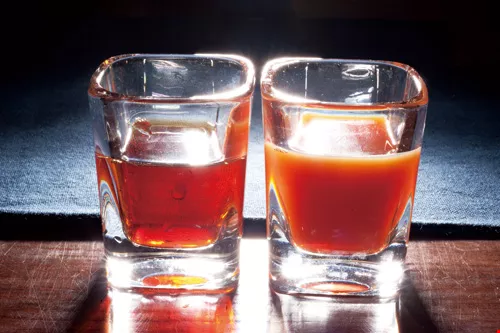
A good black tea has a strong astringent flavor, and the amber, transparent brew (left) starts to emulsify after cooling, becoming turbid (right).
With three decades came changing fortunes. During the tumult engendered by the popularity of high-mountain oolong, sales of low- to mid-altitude oolongs were slack, giving rise to thoughts of how to adapt. In the case of Jinxuan, a well-loved Taiwan tea, the makers shifted from the oolong manufacturing process to that of black tea. All of a sudden, every-thing old was new again.
Lan Fangren, who heads both the Ming-jian Farmers' Association and the Association of Taiwan Tea, explains that the Japanese were fond of Western-style black tea. But since the high latitudes of Japan were poorly suited for growing black tea, they decided to open a black tea research institute in lower-latitude Yang-mei, Taiwan, to try growing different tea varieties with the intention of producing black tea.
In 1945, at the close of World War II, Wu Chen-tau, known as the Father of Taiwan Tea, came here from a Fujianese tea village and took charge of the experimental tea facility in Yang-mei. He selected three varieties-Nos. 2027, 2028 and 2029-from among 4,300 tea bushes the Japanese had planted. The first two of these became Taiwan Tea No. 12 (Jin-xuan) and Taiwan Tea No. 13 (Cuiyu) respectively.
As Taiwan's economy boomed in the 1980s, domestic demand for oolong tea rose accordingly, with prices jumping to NT$2,000 a kilogram. Tea farmers started switching from making fully fermented black tea from their Jin-xuan tea, instead producing semi-fermented oolong. Jin-xuan's characteristic creamy, sugar-cane aroma was an instant success, and people started thinking that Jin-xuan had always been a type of oolong.
In the olden days, Ming-jian (Nan-tou -County), Wen-shan (Tai-pei City), and Dong-ding (Lugu, Nan-tou -County) were Taiwan's three major growing areas for high-quality tea. In the last two decades, oolong tea has been growing not only in high-altitude regions (over 1,000 m) in Mei-shan, Lu-shan and Ali-shan; it has even extended beyond the sea where it's grown in Southeast Asia and China. And Ming-jian Township, Taiwan's largest tea-growing area, located in the foothills of the Ba-gua-shan Range in Nan-tou County at an elevation of merely 300-400 m, is home to the celebrated Songbo Evergreen Tea (an oolong so named in 1975 by Chiang Ching-kuo after the region's Songbo Peak), which has fallen steadily from its former wholesale price of NT$1,600 down to just NT$360 per catty (600 grams).
Lan Fangren admits that some tea farmers, amid their pursuit of the distinctive creamy bouquet, would add artificial flavorings during processing to cover up poor-quality or improperly roasted leaves, giving the tea an unnatural aroma. This is one of the reasons why the price of Ming-jian Township oolong tea kept falling.
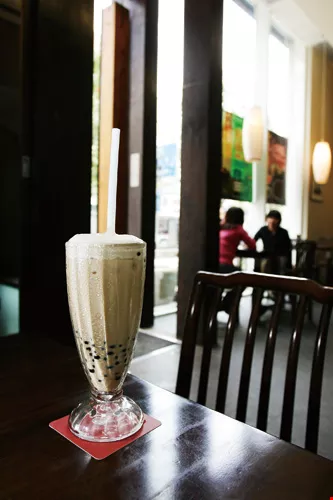
For years,"bubble tea," in which sugar, cream and tapioca are added to black tea, has been trendy in Taiwan. More recently,"kung fu tea"has become popular, highlighting the subtle aftertaste of plain black tea.
Instead of dealing with the hardship of competing with high-mountain tea, many Ming-jian tea farmers decided to switch to pineapples and Chinese yams. Lan thought back to the intention of those Japanese researchers in developing Jin-xuan black tea, and spent three years studying ways to try to force up the price range of Ming-jian Township tea.
The total tea growing area of Ming-jian Township is 2,300 hectares, and four main tea varieties are grown: Qing-xin Oolong, Four Season Spring, Jin-xuan and Cuiyu. Says Lan, around 30,000 people in Ming-jian depend on tea for their livelihoods, 10,000 among them being actual growers. At present, some 50-60 farmers have begun producing black tea.
To promote the tea, the Ming-jian Farmers' Association launched a patent sharing system, requiring farmers to use Taiwan Tea No. 12 (Jin-xuan), harvest May through September, allow a leaf growing period of 30 days (a short growing period means no pesticides are needed), grow in soil with an organic content of 3%, and use black tea production methods developed by the Tea Research and Extension Station (TRES). Tea farmers can apply to the farmers' association for permission to use the patented packaging style, or have the association buy their tea at a guaranteed price of NT$2,000 per catty.
Li Qing-lin, who runs a tea business in Ming-jian's Songbo Village, is one who gradually changed from oolong to black tea production. Six years ago he joined the Lu-ming Organic Farmers' Association, and now on his six hectares on either side of Songbo Peak he applies a natural eco-farming technique in which weeds are allowed to grow alongside tea bushes without pesticides or herbicides; plus, recently he has been making black tea. And since there are no pesticides, the leaves are chewed by the green leafhopper (Ja-co-bi-asca for-mos-ana), which gives the finished tea an added honey aroma. "What's left over after the bugs eat it is mine!" he says.
Li gave his homegrown Jin-xuan black tea a distinctive name, which translates as Black Gold Honey. Last June, it was a big hit at the 2010 World Tea Expo in Nan-tou, selling for NT$4,800 per catty. And this year so far, the tea has won five golds and six silvers at competitions organized by the farmers' association.
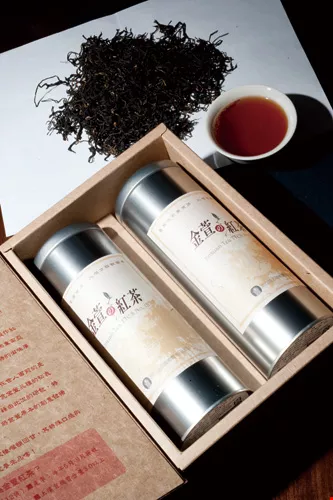
Will Jinxuan black tea become Mingjian Township's "black gold"? This past June it received excellent reviews as soon as Mingjian Farmers' Association put it on the market.
When it comes to black tea, Ming-jian Township is just an up-and-comer. But Mi--xiang ("honey scented") Black Tea, promoted in recent years by producers in Rui-sui Township, has been enthusiastically received around the world for its quality.
Gao Zhaoxu, who defeated 15 participating countries at the 2006 World Black Tea Competition to take the championship, is the creator of Rui-sui's Mi-xiang Black Tea.
Ten years ago Gao began experimenting with making Mi-xiang Black Tea and Mi-xiang Green Tea. He notes that back then, the main reason he wanted to make black tea was to break into the booming global market for this kind of tea. To accomplish this, he sought the help of the TRES.
Rui-sui is not a big tea producer: there are less than 20 tea busi-nesses, and with stagnating prices for low-altitude oolong, the township's tea plantations have shrunk from the 200 hectares of yesteryear to just around 60 hectares today. Rui-sui Township Farmers' Association promoter Gan Xian-zhang says that the tea fields on either side of Mt. Wuhe are now increasingly being used for growing day lilies and pineapples.
Over 90% of the tea grown around Mt. Wuhe is of large-leaf oolong varieties. While in the past there was no summer harvest, recently with the growing popularity of Mi-xiang Black Tea, tea farmers have added three summer leaf-bud harvesting periods to supplement the winter and spring leaf harvests. And because the summer teas are often bitten by green leafhoppers, giving Mi-xiang Black and Green Teas a unique contrasting quality, Rui-sui's tea production is experiencing a revival.
The green leafhopper is the reason for Mi-xiang Black Tea's success. Tea bushes chewed on by the green leafhopper produce amino acids as a defense mechanism, creating the requisite honeyed scent.
Green leafhoppers are not common, but like fireflies they live chiefly in hot, humid mountain hollows with little airflow, meaning they tend to congregate only in tea growing areas where pesticides aren't used. In general, their peak times of activity are May to June and September to October.
Tea store owner Ye Fashan, whose Hong Yu Black Tea was conferred a top-ten specialty teas award by the Council of Agriculture in 2007, says that he didn't carry out summer harvests in the past because the tea was too bitter for the delicate flavor of oolong. Spring and winter, without the green leafhopper, was better for oolong tea. But the green-leafhopper-bitten summer-harvest tea is just right for making Mixiang Black and Green Teas. As such he enjoys the best of both worlds.
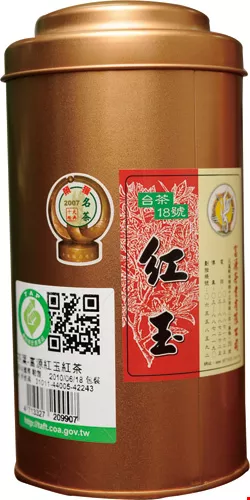
A classic-style tea from 2007: Red Jade Black Tea.
As tea farmers thought hard and worked tirelessly to pull themselves out of their predicament, black tea prices started showing a profit, as they had hoped.
Rui-sui black tea prices range from NT$1,600 per catty for the most common varieties to NT$12,000 for the choicest types. And Gao's championship tea from 2006 sold at an astonishing NT$50,000 per catty.
There are reasons for such high black tea prices. Gao explains that most oolongs take about 8,000 "two leaves and a tip" to make one catty of finished tea, but the new leaf buds after the spring harvest, especially after being chewed on by the green leafhopper, add up to between 16,000 and 24,000 per catty, raising the unit cost and the price.
As to the future of black tea, Lan Fang-ren is optimistic. He explains that the fine flavor of high-mountain oolong teas, with a 3-5% degree of fermentation, is not necessarily suitable for every-one: some people get a "tea buzz" after drinking, while others may experience stomach aches. On the other hand, black tea that has achieved a 97% degree of fermentation is more readily accepted by the general public.
And since summer and fall tealeaves are highly astringent in taste, they aren't fit for making oolong teas, but are quite suitable for making black teas. Says Lan, most people like to add cream and sugar to black tea. If the tea isn't mouth-puckering enough, the tea's flavor will be masked by the cream and sugar. And the "kung fu tea" that's become popular in Taiwan recently has similar brewing and drinking styles to oolong: no cream or sugar is added, so you can enjoy the original flavor of the black tea. There's a slight bitter taste when it enters the mouth, but it's followed by an aftertaste, sweet and fragrant.
The transformation of oolong into black tea may be a means to breathe new life into low-elevation tea farming, but it's also a way for consumers to have a choice of something beyond just oolong.
| Degree of fermentation | Color | Types of tea |
| Unfermented | Green tea | Longjing, Bi Luo Chun, Sencha, Gyokuro |
| Semi-fermented | Blue-green tea | Oolong, Ti Kuan Yin, Pouchong, Oriental Beauty |
| Fully fermented | Black tea | Assam, Red Jade, Mixiang Black Tea |
| Post-fermented | Dark tea | Pu'er, Tuocha, Hunan Dark Tea |


