Getting Local Governments Out of the Red
Andre Huang / photos Jimmy Lin / tr. by Jonathan Barnard
July 2008


Poverty brings the press for change, and the press for change brings solutions." People struggling to make ends meet aren't the only ones with money worries. Local governments, which in Taiwan have been burdened by debt for many years, also struggle with finances. In the six years since the Act Governing Local Tax Regulations took effect in 2002, what new taxes have local governments come up with? And how far are these local governments from "financial autonomy," a necessary component of local self-rule? Let's take a look.
On April 30, mayors, county commissioners, vice county commissioners, and finance bureau chiefs from Taiwan's 23 counties and municipalities gathered at the Legislative Yuan. Among them were Taipei mayor Hau Lung-bin, Taipei County commissioner Chou Hsi-wei and Chiayi mayor Huang Ming-hui. This impressive group of local government leaders had gathered for a discussion on draft amendments to the Law Governing the Allocation of Government Revenues and Expenditures.
The local government representatives at the meeting cried poor and argued that they should be allowed to levy a broader array of taxes. The central government, meanwhile, similarly pled that it lacked resources, explaining that increasing local government's share of centrally allocated tax revenues would simply shift local debt to the central government. Moreover, urban local governments staked out markedly different positions from rural ones. The meeting revealed virtually no common ground.
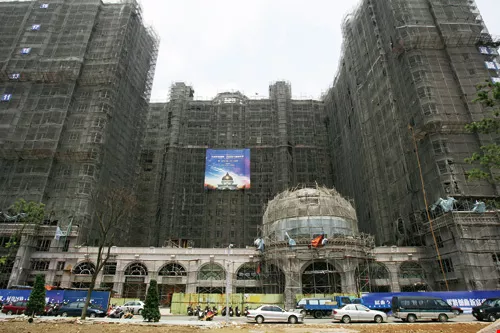
After rezoning, the area around Chiehshou Road and Chungyung Street in Taoyuan County's Pate has seen real estate values rise with the construction of luxury towers.
Financial war
A change of setting: On the third day after assuming power the new ROC cabinet proposed measures to strengthen local development and spur domestic demand. NT$114.4 billion would be divided among local governments for construction projects based on their share of the population. The aim was to ease financial pressures on local governments and stimulate the economy. But the plan was criticized by chief executives of local governments from the Democratic Progressive Party, led by Kaohsiung mayor Chen Chu. Long-standing central government polices favoring the north over the south had resulted in a drain of southern population to the north, they argued. Dividing the pie on the basis of population at this point would thus be unfair to southern counties and municipalities.
Taoyuan County commissioner Chu Li-lun of the KMT shot back that during the last eight years of DPP rule the central government had clearly favored local governments under DPP control, so that they were now "crying out for a larger piece of the pie after already getting more than their fair share." With these battles raging between different local governments, it would seem that the well-intentioned idea of giving local governments development funding had once again led only to disputes about the structure of the government financial system. It was an unexpected turn of events.
The periodic financial wrestling matches between the central government and local governments, as well as among the different county and municipal governments, do indeed involve many complex issues, such as the limits of central versus local authority, the design of the tax system, and basic economic differences between the cities and the countryside. But these disputes also reflect the harsh realties of local governments' long-term financial distress.
How poor are local governments? Statistics show that only Taipei, blessed with the advantages of the capital, is able to shoulder all of its financial obligations. The local revenue of other counties and municipalities is simply insufficient to meet their outlays. There are many examples where local revenue doesn't even meet 50% of expenditures. Taitung, Hualien and Penghu, for instance, can only fund about 40% of their budgets from their own sources. That means that for every four dollars they gather locally, they spend ten dollars. They are utterly dependent on subsidies from the central government. (See chart.)
In addition to the administrative expenses that those local governments have always borne, they have recently taken on growing social welfare obligations, which have caused the debts of counties and municipalities to rise across the board. If you set aside the two special municipalities of Taipei and Kaohsiung, the average debt as a percentage of a local government's annual budget is already pushing the legal limit of 45%.
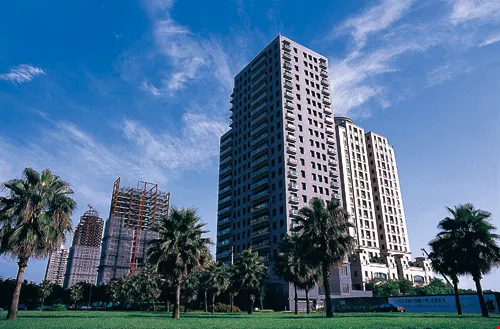
Luxury apartments in Taichung's Seventh Land Redevelopment District. Public appropriation and rezoning of land can create new public spaces, increase real estate values and bolster the tax base.
A lack of nerve to raise taxes?
After setting aside money to repay debts, and paying salaries and other regular budget expenses, some local governments are so hard pressed that they have little or nothing left over. In fact, counties and townships in the most serious financial straits sometimes even have difficulty issuing paychecks. For instance, in 2000 Neipu Township in Pingtung, as a result of unpaid debts for public works, became the first local government to have its bank accounts frozen. And in 2008 year-end bonuses for Tainan City Government employees had to be paid in two installments. If these were private businesses, their checks would be bouncing.
What can be done? Apart from tightening their belts as much as possible and carefully examining expenditures on personnel, supplies and so forth, what can local governments do? Can they also push from the other side and seek to increase revenues? Well, as the Chinese expression goes, if an old lady is going to give birth, she's going to have to work really hard at it!
The Tax Reform League, which has long been pushing to change the tax system in Taiwan, believes that the problem is an outgrowth of Taiwan's long-term focus on economic development. In a multiparty democracy, calls to reduce taxes and offer tax breaks come frequently. On the other hand, policies that would result in an increase in taxes, negatively affect economic development, or cause public displeasure rarely if ever get discussed. As a consequence, the tax burden in Taiwan (taxes as a percentage of GDP) stands at only 13.7%, the lowest of all industrialized nations.
With the trend of taxes being cut but never raised, and a tax system based on central power and centralized collection of revenue, local governments couldn't get by without massive central government support even if they wanted to.
A first try: the "mayor's tax"
In 1995 Liao Hsueh-kuang, who used "social justice" as a catchphrase and cultivated an image as a rebel, was mayor of Hsichih in Taipei County. When he saw large construction projects sprouting up all over town, he reflected that the construction industry was reaping extreme profits there and that the central government was gaining revenue from the business tax and corporate income tax, but all the townspeople got was the noise and dust and rumbling of heavy machinery and cement mixer trucks. Consequently, he sought to levy a "mayor's tax" on developers to restore the damage that development was causing to public facilities and to the environment. Because there was no legal basis for imposing such a tax, however, he was prosecuted-much to his surprise-under the Anti-Corruption Act. The case has been wending its way through the justice system for ten years, without any final verdict as yet.
In the years that followed, townships in Taipei, Ilan, and Nantou Counties also pushed to establish their own local taxes. Although all of these attempts were unsuccessful, the cat was out of the bag and calls to give local governments the right to levy taxes could no longer be ignored. Eventually, the Act Governing Local Tax Regulations, giving local governments limited rights to impose taxes, was passed in 2002.
Dreams of financial autonomy
Since 2002, the taxes local governments have levied have mostly been focused on the construction industry, either as a form of compensation for damage to roads and the environment, or as a fee for the disposal of construction spoil-the sand, gravel, soil and so forth that is left over from the construction process. These taxes, in fact, bear a lot of similarity to Liao Hsueh-kuang's "mayor's tax." Taoyuan County, for instance, has levied a temporary tax on construction spoil since 2005-2006 that has added NT$30-40 million to its coffers each year. And in 2005 Miaoli County instituted a similar tax, adding NT$5-6 million per year to the NT$8 billion or so in revenue that the county is able to raise itself.
But even with a legal basis for levying taxes, local governments that had been crying that they were poor and powerless have largely been reluctant to move on this front. In the six years since the Act Governing Local Tax Regulations passed, only six counties and four townships have been successful in levying half a dozen kinds of taxes. There are various reasons for these shockingly small numbers.
Yunlin County, which has various major petrochemical plants, including Taiwan's Sixth Naphtha Cracker plant, once pledged to impose a "carbon tax." Nevertheless, because communication with local industries was rushed, and because Taiwan is not a signatory to the Kyoto Protocol, domestic carbon reduction control measures are not comprehensive, explains Chen Chin-chi, who heads the county's finance bureau. Consequently, the county council thought that it should first receive central government approval in this case. Yet the central government has requested that the tax first be approved locally. With both sides trying to avoid responsibility, the tax has ended up dead on arrival.
Two steps forward, one back?
Various locales with strong tourist industries, including Kinmen County, Pingtung County's Wutai, and Taitung County's Green Island, looked into levying temporary taxes in the name of environmental protection, and the local councils passed the proposals with little difficulty. But the Ministry of Finance ended up rejecting the proposals, for a variety of reasons. For one thing, authority for levying taxes on natural resources falls under the purview of the central government. It remains unclear whether local governments would be exceeding their powers by imposing these kinds of taxes. Furthermore, there are fears that targeting tourists from outside may hurt the tourism industry. And in light of the existing business tax, house tax and income taxes, all of which are already levied on the local tourism industry, a tax targeted at that industry specifically raises the issue of double taxation.
A rather unusual local tax is Taichung County's special consumption tax.
According to the Taichung County Revenue Service Bureau, the county government originally planned a 5% tax on revenue at leisure businesses, such as girly bars, dance clubs, gaming arcades, golf courses, KTV karaoke clubs and so forth. It was estimated that the tax could bring in more than NT$40 million per year. But because it was specially targeted, it had much the flavor of a "sin tax," and during county council discussion, it was suggested that KTVs and golf courses were forms of healthy entertainment and shouldn't be included. Once they were excluded, the tax passed. The first special local consumption tax, it has generated more than NT$10 million per year.
Backlash
Yet even after being approved by county councils (which typically have close ties to local business interests) and by the Ministry of Finance (which strictly guards against local governments overstepping their authority), many local taxes are rendered ineffective due to the controversy they subsequently create.
For instance, from 2005-2007 the town of Tucheng in Taipei County implemented a temporary tax on construction sites. Over those two years it collected more than NT$40 million. Various townships including Tanshui, Yingke and Wuku followed suit, but each of those taxes was protested by the Taipei County Developers Association.
Yang Tien-kuei, the general secretary of the association, points out that developers already have to pay to restore the damage they've caused to roads and to water and sewer lines. How then, he wonders, can local governments simply decide to hit them up for it once more? Moreover, these taxes get passed along to consumers in the form of higher prices. Their effect, he argues, is simply to depress the real-estate industry. Yet local governments are adamant that they are administering the taxes legally. The standoff has attracted a lot of attention.
The special tax on soil and stone extraction passed by the Kaohsiung County Government in 2006 has proven to be even more problematic.
Chien Chen-cheng, head of the Kaohsiung County Finance Bureau, explains that after approval from the county council and the Ministry of Finance, a tax of NT$30 per cubic meter has been levied on businesses that extract soil or stone within the county. In 2006 the tax yielded more than NT$90 million, and in 2007 it brought in almost NT$30 million. But the county hasn't been able to spend the monies because the legality of the tax is being challenged by the Ministry of Economic Affairs' Water Resources Agency.
The agency's River Management Office dredges rivers in Kaohsiung County, mostly under contract to local township offices. Yet surprisingly the Kaohsiung County Government targeted the RMO to pay the tax. The RMO argues that it is administering a public service and providing a public benefit by dredging rivers, and that all the money it receives for those contracts goes back into the national treasury. How, under these circumstances, it wonders, can it be expected to pay this tax? It filed an administrative appeal and then pursued administrative litigation, and the case is pending before the High Administrative Court. This is one of the most dramatic cases of a central government agency fighting with a local government over money.
Rocks into gold
A tax that ends up landing both the local and central government in court benefits neither side. It is an altogether regrettable situation. Rolling up their sleeves to go into the gravel business themselves, and thus turn rocks into gold, has proven to be a smarter way for local governments to earn revenue. Ilan and Hualien have blazed this revenue trail.
Ilan County was the first local government to move into "public production" (publicly administered for-profit production) of rock and gravel. It has been operating this line of business for more than eight years. Profits have increased from NT$130 million in 2005 to NT$410 million last year. Money from gravel is now one of the county government's main financial pillars, accounting for 9.76% of revenue in 2007.
The gravel business in Taiwan has long been controversial. River beds in Taiwan are wide with relatively little human habitation, and governments have long issued permits to private firms for gravel collection in them. But with a lack of effective control over these firms, there was a lot of illegal extraction, collusion between government officials and private firms, the involvement of organized crime, and other black marks on the industry. Apart from wanting to dredge rivers and add to the public coffers, one reason that Ilan County embarked on public production of gravel was to gain control over the entire process and thus stamp out crime and corruption.
The carrot
In Hualien County, where gravel resources are likewise abundant, the dredging of rivers had previously been outsourced to private firms, which would keep all the gravel themselves. Although the county was spared the expense of dredging and made money on the contracts, its take paled in comparison to what the private firms made. Consequently, in October of 2007 the county government went into the gravel business for itself. Now the Public Works Bureau contracts firms to handle the dredging, but the Bureau of Civil Affairs collects the gravel, which it then sells. This new revenue stream for the county is expected to bring in NT$330 million this year.
Meanwhile, because the county sells the gravel at below market price, private firms buy it, and then wash, grade, and process it before reselling it. With gravel processors swarming to get a part of this business, the county government has used it as a bargaining chip to push the processors to obtain legal certification for their facilities. With these policies in place for just one year, the government has already induced three gravel plants to clean up their act. The original "stick" of fines hadn't worked, but this new carrot has. It has thus also served to strengthen enforcement of relevant laws.
Killer app
Public production of gravel is best suited to remote locales with abundant gravel resources, but rezoning has turned out to be a "killer app" for highly urbanized counties and municipalities.
Classic examples are Taipei City's Hsinyi Planned District and Taichung City's Seventh Land Redevelopment District. By taking possession of land and then carrying out framework planning, local governments not only greatly add to the value of these districts; they also retain substantial amounts of land for public use, which can be released for development at a later date, or-even better-can be rented out to generate long-term revenue.
For instance, Taipei 101, the world's tallest building, was the fruit of cooperation between the Taipei City Government and the private sector. The government provided the land and the private developer put up the money, leasing the rights to the land for 70 years. For those initial rights, the developer paid the city NT$20.6 billion up front. It is also paying 2% of the assessed value of the land every year, which amounts to another NT$100 million.
Yet this model is of little help to rural districts, which lack land with similar potential for appreciation in value.
Take Yunlin. Even in Touliu, its most prosperous city, there is little potential for appreciation-with or without rezoning. And there is also little potential profit for the private sector to reap. In such places, the public appropriation and rezoning of land is done only for planning purposes and to acquire land for public use.
Land taxes
Another tax related to the value of land that highlights the difference between urban and rural areas is the land value increment tax, the source of much debate a few years back.
In 2002, so as to stimulate the real-estate market during hard economic times, the Executive Yuan announced that the land value increment tax (a tax on capital gains from land sales) would be cut in half during a three-year period. When that period ended, the rate for each band of the tax was permanently reduced by 20%. The original purpose of these cuts was to stimulate the market and ultimately bring in more tax revenue. But in retrospect, the intended effect has only been realized in those urban markets that already boasted relatively strong real-estate markets. The cuts have had little impact on the real-estate markets of other counties and cities.
What's worse is that the land value increment tax (80% of which goes to the local governments and 20% to the central government) had long been an important source of revenue for local governments. A result of the central government's generosity with this cash cow of local governments: during the five years in which the tax was cut by 50%, Yunlin County's tax revenue dropped by NT$4.1 billion, and Taoyuan County lost about 10-20% of its total funds-a loss of several billion per year.
On the other hand, to compensate for the loss in tax revenue and to bring more fairness to the levying of taxes, the Department of Land Administration in the Ministry of the Interior introduced a policy to raise land value assessments in 2005. Its goal was to bring all assessments within 90% of market value within ten years, so as to help the counties and municipalities gain more tax revenue. But the financial results of this policy have once again favored cities where the land values have been steadily rising. In rural areas, where the value of land has been declining, bringing assessments closer to market value hasn't helped to increase revenue.
Follow the money
To close the gap between rich and poor, turning wasteland into skyscrapers may be a stretch, but turning wasteland into a factory site isn't quite so farfetched. Indeed, many local governments have spent a lot of energy trying to attract this kind of investment. Apart from providing jobs and improving the local economy (thus increasing the ability of local residents to pay taxes), it has also been hoped that new factories and businesses would directly bolster local government coffers.
The problem is that under the current system, most of the tax revenues that a new factory or business generates, such as from the business tax and the commodity tax, go to the central government's treasury. For a local government, attracting investment has little more than symbolic value. The money that comes back via the Tax Redistribution Fund has always been entirely inadequate.
For instance, Taoyuan County has recently had an outstanding record in attracting investment. Numerous major domestic companies have established factories there. Tax revenues in the county have steadily grown, from NT$91.1 billion in 2001 to more than NT$197.4 billion in 2006. That figure places it third among all counties and cities, behind only the special municipalities of Taipei and Kaohsiung. Yet only NT$20 billion of that made it into the county coffers. The rest went to the central government. The disparity has frustrated county citizens, leaving them feeling that all the work they've done to attract investment has been for others' gain!
In economically depressed Yunlin County, the situation is much more dire. With little industry and commerce, Yunlin has been experiencing an outflow of population. About 46% of its residents are disadvantaged farmers, seniors, children and others with low incomes who pay no taxes. It should thus come as no surprise that the county faces financial difficulties. In the 1980s, lacking other options to overcome poverty, Yunlin broke ranks with Ilan, Taoyuan and other counties that opposed the Sixth Naphtha Cracker project. Liao Chuan-yu, who was then county commissioner, decided to welcome the project, hoping that the county would benefit economically.
The plant has been established in Yunlin for 12 years, and has paid an average of more than NT$40 billion a year in taxes. But only about NT$470 million from land and real estate taxes has been returned to the local government. The rest of the money has gone to the central government. Yunlin has tried various methods to keep more of those tax revenues in the county, but none have worked. Citizens of Yunlin can't help but complain that what they thought was a golden goose has turned out only to lay poop!
Expectations for change
On June 4, during discussion of amendments to the Act Governing the Allocation of Government Revenues and Expenditures, the central government finally achieved a kind of nascent consensus when it agreed to give local governments a bigger piece of the pie by redistributing one-tenth of specified tax revenues from the central to local governments. Deputy Minister of Finance Liu Teng-cheng explains that after the law goes into effect, local governments (excluding Taipei and Kaohsiung special municipalities, as well as Taipei County, which is soon to be raised to that same administrative level) will see the share of their budgets funded locally rise from 50% to 72%. Local governments should no longer be so poor that they can't issue paychecks.
But as far as the counties and towns are concerned, reaching an agreement on how central and local governments split tax revenue is only solving half of the problem. The other half involves overcoming the huge disparities between the cities and the countryside via economic development. As a Chinese expression puts it, "A fat goose naturally has more feathers to pluck." Bringing "fat geese" to rural locales may be the only true way of resolving these issues.
Percentage of local government budgets self-funded in 2007
| Local government | Percentage self-funded |
| Taipei City | 113.55 |
| Kinmen County | 85.39 |
| Kaohsiung City | 28.91 |
| Taichung City | 80.12 |
| Taipei County | 73.24 |
| Hsinchu City | 63.76 |
| Taoyuan County | 61.66 |
| Tainan City | 59.13 |
| Nantou County | 56.19 |
| Taichung County | 54.95 |
| Keelung City | 54.35 |
| Tainan County | 51.14 |
| Changhua County | 50.90 |
| Kaohsiung County | 49.62 |
| Yunlin County | 49.60 |
| Miaoli County | 49.11 |
| Chiayi City | 48.27 |
| Hsinchu County | 47.51 |
| Pingtung County | 44.33 |
| Ilan County | 44.18 |
| Hualien County | 39.75 |
| Taitung County | 38.26 |
| Chiayi County | 36.94 |
| Penghu County | 32.86 |
| Lienchiang County | 21.73 |


@List.jpg?w=522&h=410&mode=crop&format=webp&quality=80)


