Putting Down New Roots--Taiwanese Agriculture Embraces Technology
Teng Sue-feng / photos Hsueh Chi-kuang / tr. by Scott Williams
January 2008


Summertime in subtropical Taiwan means heat and humidity, often punctuated by typhoons and floods. Such climatic conditions are tough on farm crops and can lead to uncertain harvests.
When Typhoon Krosa struck the island in October 2007, heavy rains and wind pounded farms in central Taiwan. Damaged by the pounding rains, vegetable crops went on to rot in the soaked fields, leading to substantial losses. Prices for leafy greens such as water convolvulus (Ipomoea aquatica) and bok choy took a bite out of consumers' pocketbooks as they soared to more than NT$100 per kilogram. Farmers responded to the potential windfall by rushing in a new crop, and soon flooded the market. Prices then collapsed to only NT$10 a kilo the next month, leaving farmers unable to recover their costs.
Taiwanese fruit and vegetable prices swing wildly every year. As the saying goes, farmers sow with sweat, reap in tears, and plow their crops under. Is there no way to improve their lot? Can modern technology help?
In 1992, the prospect of abundant winter sunlight drew EuroFresh Farms to Willcox, Arizona. EuroFresh began with ten acres, and has since grown to 165 acres of greenhouses. Tomatoes flourish year-round here, growing to six meters tall in the desert sun. Equipped with fans to keep them cool in the summer, EuroFresh's greenhouses collectively produce 113 tons of fresh tomatoes daily, year round. That's about 37,000 tons, or more than 6 million tomatoes, annually.
Perhaps the most interesting thing about this greenhouse farm is that all its operations, with the exception of harvesting and packaging, are automated. Everything, from the amount of sunlight to the administration of fertilizers and the management of the irrigation system, is computer controlled. When the weather is cold, the skylights are automatically closed. When it is warm, the fans come on. The upshot is that you hardly see a soul on the farm.
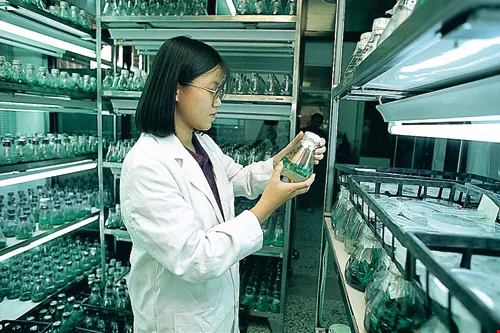
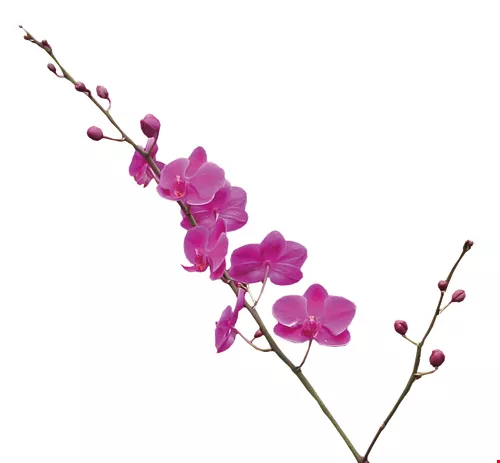
Technology is bringing about a revolution in agriculture. Selective breeding and genetic modification are creating better quality crops with better yields and more regular harvest times. The photo above shows Taiwan Sugar's Orchid Propagation Center, located on the grounds of the Wushulin Sugar Leisure Garden in Tainan County (photo by Diago Chiu). The photo below shows one of Taiwan's leading exports-greenhouse-grown moth orchids (Phalaenopsis) that blossom for a month (photo by Jimmy Lin).
An indoor field
"We tend to think of Kenya as being backward in terms of agricultural technology," says Fang Wei, a professor in National Taiwan University's Department of Bio-Industrial Mechatronics Engineering. "But five years ago, the Dutch helped locals build greenhouses and begin growing roses. Kenya's revenues from cut-flower exports are 30 times those of Taiwan." Fang, who specializes in agricultural engineering, says that the Dutch have determined that parts of Columbia, Zimbabwe, Ethiopia, Uganda, Indonesia, the Philippines, and China are ideal candidates for such "installation agriculture" because of their abundant sunshine, cool climate, available water, and 1,000-meter elevation. "Taiwan should also be developing highly efficient installation agriculture operations," argues Fang.
What is installation agriculture?
Fang explains that our Chinese ancestors showed great intelligence in the creation of characters, noting that the character for "wealth" or "abundance" depicts a field under a roof. Installation agriculture is simply the growing of crops in a semi-enclosed space. Installations can range from fields "roofed" with netting to greenhouses to multistory precision greenhouses. With the addition of environmental control systems, greenhouses permit farmers to maintain microclimates, manage water quality and irrigation systems, and control levels of carbon dioxide, oxygen, temperature, humidity, and even sunlight. This enables them to produce crops of consistent quality and yield at a consistent pace. It also reduces the negative effects of weather.
Installation agriculture is on the rise. The crops under cultivation now including damp-loving mushrooms, such as king oysters and enoki, which are grown in a dust-free 5oC environment. Some of Taiwan's mushroom farms produce 200,000 tons per day for the export market. The chrysanthemum growers of Yulin County's Huwei Township, also exporters, are another case in point. Huwei's growers began moving their crops indoors with the installation of 0.2 hectares of greenhouses in 1999. By 2007, the township's indoor cultivation had grown to cover 16 hectares. The move inside enabled growers to increase their productivity by 50%, from 30,000 flowers per tenth of a hectare outdoors to 45,000 indoors. It also improved their yield of high-quality flowers and leaves from 50% to 80%. Growers around Taiwan are now producing many other common supermarket vegetables, including bean sprouts, snow-pea leaves, and cabbage in greenhouses as well.
Fang says that many people are under the misapprehension that installation agriculture is more suited to nations that tend to large farms, such as the US and Australia. But the US has already heavily automated to raise its productivity. In Fang's view, installation agriculture is actually more efficient in places with high population densities and small farms. In fact, the Netherlands, which, with an area of 42,000 square kilometers and a population of only 15 million, is about the same size as Taiwan, makes extensive use of installation agriculture.
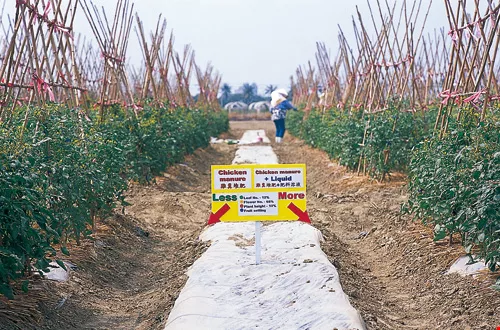
The Asian Vegetable Research and Development Center located in Tainan's Shanhua Township employs agricultural researchers from 12 nations. In this test field, researchers are comparing the effects on plant growth of chicken manure fertilizer spread dry versus liquid fertilizer.
New ideas in agricultural technology
Ever since human beings began to till the soil, agricultural reformers have fretted over the question of how to raise enough food on the world's limited supply of arable land to fill its seemingly innumerable bellies.
In 1798, the British scholar Thomas Malthus predicted in his An Essay on the Principle of Population that food production would never catch up with the exponential growth of the world's population. He concluded that the explosive growth of global population would eventually lead to famine, poverty, and war.
Fortunately, the massive famine Malthus predicted failed to materialize in Europe. Just as the Industrial Revolution was kicking off a wave of automation, new farming methods that increased agricultural productivity emerged. These included crop rotation, crop breeding, land management, improved irrigation, and the use of chemical fertilizers.
In the 1940s, US agricultural scientist Norman Borlaug kicked off the Green Revolution with his development of disease-resistant varieties of plants. Borlaug's hope was to use technology to meet the basic daily nutritional needs of every person on the planet by the end of the 20th century.
The Green Revolution has been yielding miraculous results since the 1960s, but the environmental community has its doubts about the approach. Excessive use of fertilizers and pesticides is exhausting the soil and polluting the water, and new pests are emerging. There are other issues as well. Global warming, shrinking tropical rainforests, the loss of topsoil, the loss of farmland to rising seas, and pollution are all reducing the amount of arable land and presenting agricultural researchers with new challenges.
Influenced by ideas about preserving the ecosystem, modern agriculture has refocused on issues such as making appropriate use of technology and controlling crop yield and quality. Installation agriculture and precision agriculture have also come into fashion.
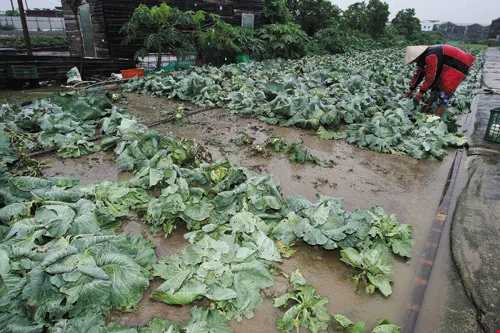
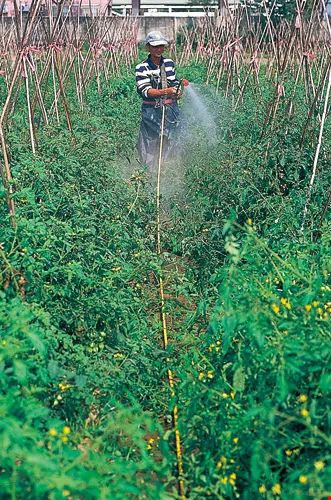
Typhoons can spell disaster for Taiwanese farms and send vegetable prices soaring. Greenhouses that keep out the weather reduce losses. In the photo, a farmer in Taipei's Shetzu, a low-lying area between two rivers, is harvesting what he can from his vegetable before it gets flattened by a typhoon.
Managing crop yields
Paddy rice occupies 39% of Taiwan's arable land, more than any other crop on the island. If government agricultural agencies could predict the coming year's harvest, they could prevent prices from fluctuating violently by importing or exporting an appropriate amount of rice in advance.
"Taiwan's farmers typically apply 50% to 100% more fertilizer to their paddies than is recommended," says Shen Yuan, a professor in the Department of Soil and Environmental Sciences at National Chunghsing University. "If the nitrogen in the fertilizer isn't absorbed by the plants, it gets into the surface water and the groundwater. There, it breaks down into nitrous oxide, a controlled greenhouse gas that has a major impact on the environment." Shen explains that in the case of paddy rice, precision agriculture's goals are to understand the rice's growing conditions, control the amount of fertilizer used, and forecast the coming year's harvest.
Precision agriculture involves pinning down the precise location of a field with GPS and GIS equipment, then analyzing the field using remote sensing techniques on aerial or satellite imagery.
Remote sensing devices, which consist of a carrier, a sensor, and a processing system, measure electromagnetic radiation, including visible light. Their structure is similar to that of the visual system of a human being, which could be said to consist of a pair of sensors (the eyes) mounted on a carrier (the body) and connected to a processor (the brain) that rapidly compares incoming images to others in memory to identify distinguishing features.
Returning to Taiwanese agriculture, Shen argues that one problem it faces is the low cost of fertilizer. "Because it's so cheap, farmers buy it as insurance and think that the more they spread the better," he explains. "Excess nitrogen doesn't visibly affect plants and there isn't much effect on yields unless the levels are absurdly high." But, says Shen, too much nitrogen causes plants to grow too densely, making them more vulnerable to rice blast. This makes the rice far more vulnerable to storms-heavy winds and rains can blow down an entire field of infected plants.
In 2006, Shen began looking at remote sensing data from Taipei's Kuantu plain, Taoyuan, Changhua, Taichung's Waipu Township, and Chiayi's Taipao Township. He analyzed 500 hectares, studying the spectral reflectance of the soil and the leaves. The data allowed Shen to calculate the size, arrangement, and number of cellular layers in the plants' leaves, which told him how well the plants were growing and whether they were diseased, as well as the water and nutrient content of the soil. The method works because the spectral reflectance of the leaves varies with the amount of chlorophyll they contain, and the amount of chlorophyll corresponds to the amount of nitrogen in the soil. If the spectral reflectance were high, indicating that the chlorophyll levels were low, the farmer would want to apply a nitrogen fertilizer.
Shen's method is as accurate as that currently employed by the Agriculture and Food Agency, but less time consuming and less resource intensive. Shen gets his figures by analyzing aerial photographs to determine the area of paddy fields, then estimating per-unit yields. In the future, he plans to apply his method to measuring the growth of paddy rice. If he discovered too much nitrogen in the paddies, he'd then be able to recommend to farmers that they use less on their next crop.
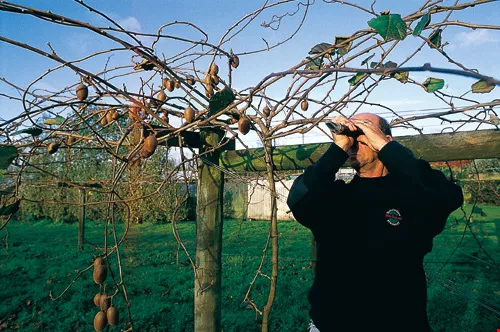
Satellites help kiwifruit growers estimate the area of land-in-cultivation and forecast harvests, enabling them to keep production in line with sales. In the photo, a New Zealand farmer checks the sweetness of his kiwifruit with a specialized instrument.
Technological aid
But precision agriculture helps not at all with the weather, which always plays a critical role in outdoor agriculture. Weather events, such as winter typhoons, are completely beyond our control. This begs the question: can we apply this new method to greenhouse farming? What kind of results could we achieve if we combined precision agriculture with installation agriculture?
Three years ago, NTU's Fang Wei worked with Nantou County's Tounan Farmers' Association to install cameras with sensors to measure temperature and moisture in three boroughs. The project's objective was to precisely manage irrigation times for potatoes and carrots, and help manage disease. But study participants were worried about theft. The sensors cost NT$500,000 and would be sitting in open fields.
Fang rethought his approach and decided to locate the sensors in a layer chicken facility, where the high levels of nitrous oxide released by the birds' fecal matter are a health concern. The sensors, which are linked to a warning system able to detect excessive levels of nitrogen dioxide, send an alarm to the manager's cellphone, and take action to resolve the problem, freed chicken farmers from the need to spend all day in the coops.
Scholars see greenhouses as offering several advantages, including an excellent growing environment, time and manpower savings, and simplified disease management. But the bulk of Taiwan's agriculture still consists of farmers in galoshes out sweating in the fields. They earn their living as they always have, and are poorly compensated for their labors.
Taiwan's farmers earn an estimated average of only NT$200,000 per year, barely enough to provide life's basics and certainly not enough to fund the construction of installations. A basic greenhouse, one which keeps out the weather and reduces pest problems by 80%, costs more than NT$10,000 per 36 square feet and more than NT$2 million for a tenth of a hectare (about 10,500 square feet). When you also consider the fact that steel prices have soared in recent years, it's easy to see that greenhouses just are beyond the financial reach of the average farmer.
"Taiwan's agricultural industry must invest to reduce risk," says Fang. "It needs to invest in equipment and manpower if it is going to achieve its goal of stabilizing quality, yield, and harvest times." Fang cites irrigation methods as a case in point. Land subsidence south of Taichung has resulted in fields that don't drain well because they sit too low. Farmers therefore use a furrow irrigation method to ensure that their crops develop good roots. But this traditional method, in use for more than a century in Taiwan, wastes water, fertilizer, and pesticides. Drip irrigation, a newer method, uses buried pipes to deliver water directly to the plants. The technique requires no furrows, leaving farmers with more land on which to plant. It also provides small amounts of water at regular intervals, conserving resources.
But switching to the newer technique requires first fixing the drainage problem. If the drainage issue were left unaddressed, the first heavy summer rain would soak fields and rot crops. There would be vegetable shortages and prices would soar. In winter, on the other hand, the government actually pays some farmers to plow their crops under. The reason is that winter's more stable weather leads to larger harvests, which push prices down. The government payments are an effort to support prices by keeping produce off the market.
Fang says that since you are paying subsidies to farmers anyway, why not use the money to help farmers improve their facilities by covering their fields with netting, replacing netting with simple greenhouses, or converting simple greenhouses into precision ones? Doing so would address the root of the problem and make our farmers more competitive.
Fang uses moth orchids (Phalaenopsis), which blossom in winter's chill, to illustrate his point. To get budding orchids to market before the Lunar New Year's holiday, orchid growers hire contractors to take the orchids into the mountains, where the chilly evenings force budding. The method takes two months to grow a seedling into a plant with a flower stalk, and costs about NT$25 per plant in labor. Air-conditioned greenhouses represent a more cost-effective alternative: the electricity needed to cool a greenhouse for three months costs the grower only about NT$12 per plant.
Fang believes that the way to get farmers into installations is to have Taiwan's agricultural agencies do what our science parks do-rent facilities to those who want them. The government could build greenhouses of guaranteed quality in a "greenhouse agricultural park," which would help farmers produce high-quality agricultural goods by renting them greenhouse space at low cost.
Advocating for energy-intensive installation and precision agriculture in this era of rising energy prices and falling oil reserves may well draw criticism from environmental groups. But taking the larger view, ending losses stemming from natural and man-made disasters would make production more efficient and further stabilize local agriculture, helping it resist the predations of global competition and reducing the volume of food imported from halfway around the world. Appropriate use of the tools and technologies at our disposal could help us get more out of the earth, and hasten the day when Taiwanese agriculture becomes a new high-tech industry.
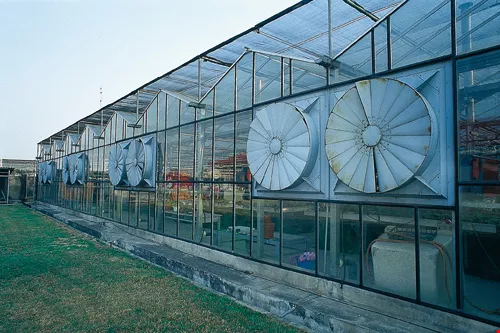
Greenhouses can reduce the negative effects of weather on farmers' incomes, and are particularly suitable for the cultivation of high-value flowers. But the tendency of frames to rust makes regular maintenance crucial.
Typhoons can spell disaster for Taiwanese farms and send vegetable prices soaring. Greenhouses that keep out the weather reduce losses. In the photo, a farmer in Taipei's Shetzu, a low-lying area between two rivers, is harvesting what he can from his vegetable before it gets flattened by a typhoon.
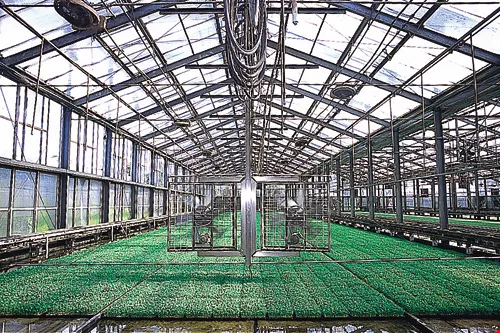
The small size of Taiwanese farms and their labor-intensive planting and management methods translate into high costs. Automated irrigation systems, which administer regular amounts of water at regular intervals, represent one area where farmers can save both labor and resources.
The small size of Taiwanese farms and their labor-intensive planting and management methods translate into high costs. Automated irrigation systems, which administer regular amounts of water at regular intervals, represent one area where farmers can save both labor and resources.


