You Can Take It With You!Taiwan Leads the Way into the Mobile World of Tomorrow
Vito Lee / photos Chuang Kung-ju / tr. by Chris Taylor
August 2005


From Helsinki in Finland to Philadelphia in the US, and from South Korea's Seoul to Taipei in Taiwan, telecommunications and IT firms, along with all other digital enterprises, have a shared dream in recent years: a wireless dream.
With the rise of WLAN (wireless local area network), the world's near 70,000 wireless hot-spots are converging to form city-size "hot areas." As transmission areas grow ever greater and people carry devices with increasingly greater capacity, it is becoming possible to access the Internet anywhere and everywhere at will.
Imagine for a moment if all wireless networks and mobile phones were integrated, and if all the information and number-crunching power of fixed networks, satellites, and cable television networks--all the underground and aerial networks--were added. What would the picture be for the daily lives of human beings?
With its experience in the manufacture of high-end IT products, Taiwan is better placed than anywhere else to stake a leading place in the race to a wireless future. After all, Taiwan produces 90% of the world's WLAN equipment and 40% of the world's mobile handsets. When it comes to enthusiasm for mobile phones and the Internet, Taiwan's mobile penetration rate is 110%, while the island also takes the crown in terms of hours per person spent online. Meanwhile, with the world's second highest population density, there are cost advantages in terms of maximizing the spread of wireless technology. The Taiwan government's "M-Taiwan Program," which started two years ago, has the twin objectives of establishing and popularizing mobile networking to establish a mobile life culture.
Rolling out networks is easy, but finding good application content is a challenge. Taking Taipei as an example, it is hoped that 90% of the city's residential areas will have wireless Internet coverage by 2006, making it the world leader. But the number of people actually using wireless Internet still lags far behind the rollout, with present utilization at less than ten percent.
In actual fact, while not a few governments and enterprises around the world are throwing themselves into wireless Internet, when it comes to commercial models and other aspects of the mobile era, all are equally groping in the dark.
It seems the only certainty is that there will inevitably be further convergence of what today is clearly a dual network, with wireless and fixed-line networks integrating and simultaneously redefining the future.
The telephone, which was invented in the 19th century, came to symbolize the 20th century. In the 21st century, will wireless liberate us from wires and at the same time lead us into a mobile era of integrated networks in which the face of life, study and commercial activities are changed? Confronted by such questions, Taiwan, which is engaged in a brave experiment, needs to come up with some answers fast.
For Taiwanese addicted to their mobile phones, their handsets often don't leave their hands, even in museums that demand still and quiet.
When Hsiao-shan takes her American husband to Taipei's National History Museum, she takes out her mobile phone, but it's not in order to make a phone call. Hsiao-shan's phone is receiving an RFID (radio frequency identification--an increasingly popular wireless identification technology) transmission. Immediately a string of information about the aged bronzeware in front of her, with its mottled patina, is appearing on a screen about the same size as a PDA's. "Cloud Dragon Urn ... origin Zheng Tombs, Xinzheng, Henan Province, China ... the urn is in the form of a wine pitcher, and can also be filled with water ..." But what's that in English? No problem; translate the explanation into English. Hsiao Shan gives the mobile to her husband so he can read it for himself.
The National History Museum, which has been striving to digitize its exhibits for years, is one of the most successful museums in Taiwan's digitization push. Today, using RFID to connect to mobile phones, PDAs and notebook computers so that they can serve as tour guides, is just the first step in this program of implementing mobile technology. In future, the museum's vast digitized databank will join forces with Taichung's National Museum of Natural Science, Kaohsiung's National Science and Technology Museum and Taitung's National Museum of Prehistory to form a huge, mutually supportive knowledge network.
One day, visitors to the museum will be able to identify the Cloud Dragon Urn and other artifacts of great antiquity and then connect with information from other museums to find out other applications for bronze in ancient times, the qualities of the metal and its scientific applications. Visiting the museum will become an educational journey through the distant past into the present.
For teachers in large primary and middle schools, this kind of mobile service is an educational godsend. In future, when teaching courses, teachers can take their students to any of the four museums, and mobile phones, PDAs, notebook computers, or the screens provided by the museum itself can all play the role of teaching materials. Before starting the lesson, teachers can input the lessons they have prepared themselves into the museum network, saving them having to take anything to the museum. Once there, they can enter the system and call up the lessons they have prepared beforehand.

From coffee-shop hot spots to museum guides, new opportunities for wireless broadband are being found everywhere. Pictured are the 4am Cafe in Taipei's eastern district.
Seeing wireless
From digitalization, to the Internet, to wireless, the National History Museum's course has actually paralleled that of Taiwan's technology sector. Moreover, the wireless broadband technology and the dual-mode mobile telephony used by the museum are precisely the same agents that are developing Taiwan's mobile society.
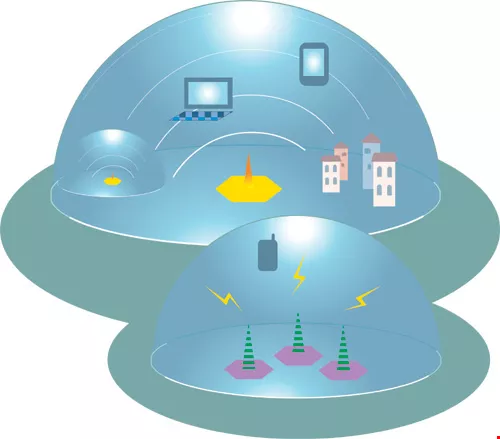
With their huge data transmission capacities, broadband WLANs--when combined with mobile phones--compensate for the low transmission speeds of mobile phones, which are expensive, slow and have small capacity. This is precisely the concept behind dual-mode: using broadband wireless networks and cellular networks to complement each other. All that's needed is a personal accessing device, and the door is opened to a vast mobile world.
Although notebook computers and PDAs are frequently used tools for accessing wireless networks, the go-anywhere-you-do mobile phone is probably the device mostly to inspire people's imaginations. Looking back at the development of the cellular phone, it has actually taken the path of convergence with other technologies all along: from single-band to dual band and triple band; from pure voice capacity to the integration of images and the addition of notebook functions, MP3 and radio capabilities; all the way to integrating digital photography, the Internet, e-mail, and so on.
For this reason, as WLAN becomes more common, energy consumption becomes increasingly efficient and devices continue to shrink in size, the network integration of mobile phones has come to seem like the natural Next Big Idea.
Meanwhile, Tung Chun-liang, managing director of Dopod--the first company to launch a domestic dual-mode phone--says he thinks that Internet phones are even more convenient than notebook computers. They are more portable and have an irreplaceable superiority in a mobile networked world.
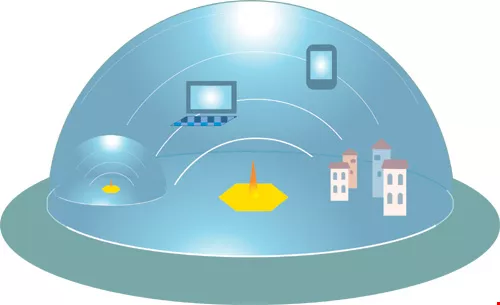
Through electromagnetic waves, information can be freely transmitted through the atmosphere. The coverage for mobile telephony with GPRS (a telecommunications standard for mobile phones) is wide, but transmission is not so good. WiFi, on the other hand, provides smaller areas of coverage but provides much better transmission capacity (bandwidth can be as much as 54 Mbits). "Integrating these two kinds of network is the heart of the mobile future," envisages Yu Shiaw-shian, managing director of the iB3G Office for the government's National Information and Communications Initiative.
Now, that vision is slowly becoming a reality. Using local area networks to chat is bringing steep reductions in mobile phone charges, it is possible to send large volumes of data, and wireless networks are making online games even more exciting. It is possible to download MP3s, pictures, movie clips and TV broadcasts anywhere. Meanwhile commercial applications include mobile video telephone and conferencing and stock market services. Reality is becoming increasingly like a science fiction movie.
Shortcut to information
Wireless local area networks as a tool for transmitting data are no different from computer networks, except in one way: they are wireless. They don't need a telephone line with which to connect, and they don't need a TV cable. And because there is no need for cables, wireless networks possess portability.
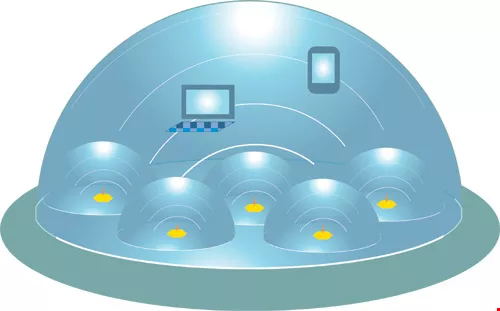
In terms of the main WiFi technology, wireless users are free to move within a 100-meter radius around the access point (AP) and receive data wirelessly at any time. The area covered by an AP is known as a "hot spot". These hot spots are very suited to mobile white-collar workers, and hot spots in cafes and offices are becoming a trend.
By the end of 2004, there were more than 60,000 recognized hot spots worldwide, and nearly 3,000 of them were in Taiwan. Most of those were in coffee shops popular with white collar workers.
No matter whether it is Taipei's trendy eastern district or the Shihta and Kungkuan areas popular with artistic types, almost all the coffee shops offer Internet access charged by the minute. The charge is less than NT$1 per minute for wireless Internet. Moreover, the main fast-food chain stores like McDonald's and coffee chains like Starbucks and Dante Coffee all provide wireless Internet access.
Coffee shops aside, because wireless networks allow rapid transmission of data using radio waves, and assembly and maintenance is very convenient, they can be set up in situations in which it is difficult to lay down cables or where a temporary solution is needed. They can be used wherever they are needed, which is a great advantage over fixed lines.
For this reason the number of APs in Taiwan is growing ever faster, particularly in the main cities of Taipei in the north and Kaohsiung in the south, where hot spots are converging to become "hot areas."
Along Taipei's MRT routes, city residents have long been able to enjoy wireless Internet services, but by the end of the year it is estimated that coverage will reach 90% of the population. Meanwhile, residents of three administrative areas of Kaohsiung--Lingya, Chienchin and Hsinhsing--will soon be able to enjoy free Internet services in their homes.

Driven by 3G mobile phones, early July's 2005 Taipei International Telecommunications & Networking Show was busy in terms of both crowds and sales. Taiwan's high mobile penetration and replacement rates have provided momentum for mobile services. In terms of the trend towards convergence of mobile telephony and the Internet, it is worth watching 3G in the local market closely.
The 3G dream
On another front, the idea of "dual network integration" first put forward by Taiwan is slowly getting a response. Since the beginning of 2004, the foreign telecommunication giants have been introducing dual-mode products. Meanwhile, apart from making parts on order for foreign companies, local companies like BenQ and Dopod last year introduced own-brand dual-mode products. Among them, a light and stylish Dopod handset aimed at women became, to everyone's surprise, a hit with white-collar men. Despite a price tag of NT$25,000, it still achieved a pretty good sales record.
The basic network foundations are forming and portable devices are gradually becoming more mature. Is the "mobile society" upon us? Perhaps, but there remain many obstacles in Taiwan, as noted in this year's Networked Readiness Index for 104 countries, produced by the World Economic Forum.
In terms of overall grades, Taiwan ranks number 14 in the world; looking only at Asia, it is fourth behind Singapore, Hong Kong and Japan. But it ranks third and fifth worldwide in terms of governmental information technology "readiness" and "application" and number 11 in private enterprise application.
Nonetheless, says Lin Feng-ching: "What's really worth a thorough investigation is that in terms of private Internet usage Taiwan ranks 27th, indicating that the capabilities of domestic content providers are severely inadequate."
The Internet is there, the hardware is there, but where are the users? How is it possible to attract consumers to get online? Without content service providers and commercial support, it's clear that the mobile dream will remain just that, a dream.
It is a situation that recalls all the excitement of 3G (third-generation mobile technology) three years ago. At that time, 3G lifestyle advertisements portrayed a situation of anywhere, anytime access to data, photo transmission, video clips, video conferencing, and so on with your mobile phone.
3G transmission speeds are roughly in the middle between GPRS and WiFi. In 2002, when WiFi was still not prevalent, and Taiwan had its first bids for 3G licenses, it resulted in frenzied competition and five licenses were sold for more than NT$40 billion. But today, three years on, most people are still stuck in the 2G era.
"Where's the content? Where are the services?" worries James Ku, sales vice president of eASPNet, which is assisting the Kaohsiung City Government with laying out wireless networks.
Mobile life
Current telecommunication services cannot compare with the effectiveness of wireless-broadband data transmission. But while the mobile wireless era may not have arrived yet, it is eroding the old order--particularly the telecommunications industry.
The wireless transmission industry first attacked the voice revenues of telephone operators. On this front, Professor Mao Chih-kuo of National Chiao Tung University's Institute of Business and Management and formerly director of Chunghwa Telecom, gives a vivid description: "Within a very short space of time, the telecommunications industry has begun losing a hundred billion in voice revenues every year, to the point it is evaporating away." Meanwhile, the WiMAX technology, which has been around just two years, will cover areas several hundred times bigger (with a 50 kilometer radius) than WiFi while offering faster download speeds (75 Mbits). As soon as WiMAX starts to be widely used, "telecommunications operators' revenues from broadband services will disappear," says Mao.
The emergence of WiMAX and the roll-out of 3G services will lead to a new integration between the various WLAN systems and the cellular network systems that will then include PHS, 3G and GPRS, with the advantages of each system providing complementarity. The "dual network" is about to become a "multiple network."
Wireless technology is evolving at a rapid pace, but Yu Shiaw-shian emphasizes that it is relatively easy to foresee the development of the basic hardware and technological breakthroughs. The real issue is applications and services. "But this aspect is really much more difficult to make predictions about."
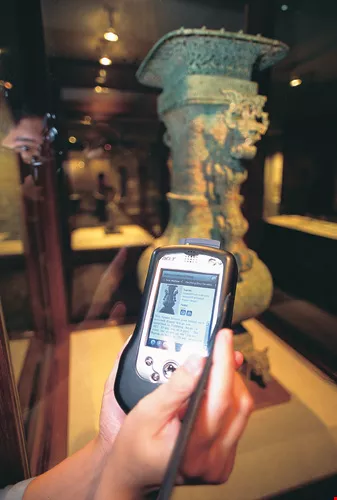
From coffee-shop hot spots to museum guides, new opportunities for wireless broadband are being found everywhere. Pictured are the National Museum of History.
Filling in the blanks
Taiwan, which has played the role of a follower in terms of industry and technology applications, this time has taken a leading role with its "dual network" concept. But Japan and South Korea, with their diverse telecommunications experience, are catching up so fast it is frightening.
Japan and South Korea are both leaders in terms of broadband roll-out. When it comes to 3G there are few countries to match them in the world. No matter whether it is South Korea's 40 million total users or Japan's 20 million, both countries have been outstandingly successful in terms of wireless applications and service.
"We particularly need to learn from the services offered by Japan's DoCoMo," points out Yu. By the end of 2004, the companies that had signed contracts with DoCoMo to offer wireless online shopping, e-mail, movie clips and online games numbered more than 3,000. Companies that had not signed contracts but who were providing such services all the same numbered more than 60,000. And apart from making money in Japan, the world's most successful data services company has been exporting its service model through partnerships and stock buyouts with telecommunications companies around the world, forging a total of 26 partnerships.
"Looking at Taiwan's mobile operators, no matter whether it's 2.5G or 1.3G, the services and content are pitiful. The difference is glaring," says Yu.
Following in the trajectory of Taiwan's development, in 2004 Japan and South Korea also started to produce mobile phones that integrate with wireless networks. They are integrating the originally independent 3G technology with broadband. South Korea in particular has skipped the mainstream WiFi to jump straight into developing WiMAX.
The ultimate concept
According to the international market analysis company In-Stat, it can be predicted that the nascent dual-mode mobile phone market of 2004 will be developing fast by 2007. By the year 2009 production will have reached 200 million units a year. By that time one in three of the world's mobile phones will be dual-mode. If you factor in the Taiwanese love of mobile phones, the local market growth will definitely be faster than the rest of the world.
"The prices of mobile phones and accessories are falling all the time, and the operating revenues for applications services are rising. They are both maturing with time," says Lin Feng-ching. "When Taiwan surpasses the world in terms of Internet roll-out it will be a big advantage. As cities all around the world are installing network hardware, the experience of wireless Taipei is becoming an essential reference."
Apart from the Asia-Pacific region, which has long been a telecommunications hub, Philadelphia, New York, and London are all pursuing the next dual mode and wireless technology milestone. It's almost as if worldwide several laboratories have been opened to test the ability of countries to envisage the future and their ability to implement that vision.
What will come after dual mode networks? Looking ahead to the next 10 to 15 years, the fast developing cable broadband network, wireless networks and the Internet will all have converged by 2010. By that time the world will have 150 million fixed-line Internet users and two billion mobile phone users. No matter whether it is 1G, 3G or PHS, they will have converged and interfaced with local area networks, before going underground into optical fibers or perhaps other more advanced circuits that are even faster. We will see networks with 100 Mbits capacity, even linking up with home information technology like digital TVs, allowing you with the tap of a password using your portable device to converge all of life's needs. It will not only be a way of carrying out work and play, and of paying the bills, but will also be a way of carrying on social interactions, opening up communication with the world and offering the keys to a new era.
On the other hand, at the same time that industry and government push to put in place an aerial and underground network, one thing to be careful of is that it does not drive us into the Big-Brother society described by George Orwell in 1984. When transactions are carried out over wireless networks, how can security be ensured? Should wireless networks' localized functions be used to fight crime? How can personal privacy be maintained? And even more importantly, will the mobile world put us further apart from each other or closer together? These are all questions for which answers are anxiously awaited.
When the aerial and fixed-line networks converge and unite several billion people, this will not only transform the face of commercial activities, and therefore we should not look at this future simply in terms of the needs of commercial development. Business development should be a driving force for social development, and not an end in itself.
When the time comes, we will have really entered a new epoch, and will be able to use technology to do some very different things than before.
Facing the uncertainty of a new era, leaders have to bring their imaginations into full play and come up with ideas. When it comes to providing the leaders of the mobile era, is Taiwan ready?
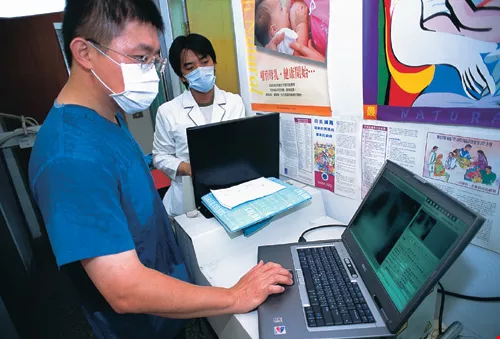
In Hualien County's Hsiulin Township, which has Taiwan's highest rates of tuberculosis, a traveling doctor using a combination of a medical vehicle and broadband wireless is able to immediately access clinical histories from the hospital while doing the rounds of mountain areas. It is also possible to consult with the hospital specialists when making diagnoses, making the treatment of tuberculosis, with its long recovery time, easier.
GPRS/3G
The functions of mobile phones continue to expand, and with the emergence of GPRS technology, the boundaries of voice and packet-switching with the Internet were broken, making mobile phones even more convenient. The speed of GPRS has made it the most common mobile interface with the Internet. It's usually known as 2.5 G mobile telephony.
Regarding 3G, which is a contraction of the term "third generation," it refers to third-generation communications technology. Its transmission speeds and volume are even greater than GPRS. But with the exception of Japan and South Korea, other countries generally don't have mature 3G industries. As for Taiwan, the leading 3G firm, Asia Pacific Broadband Wireless Communication Inc (APBW), started operations in July 2003, and as of July this year a number of other companies have followed it into the business.
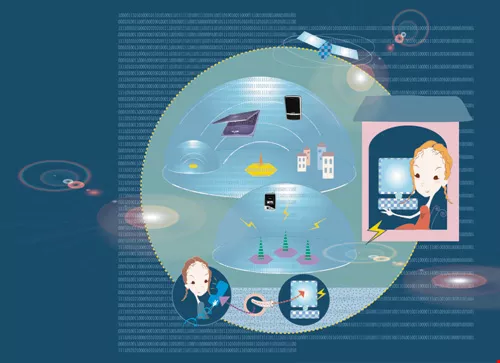
The future will see the integration of multiple networks. Everything from wireless areas networks, mobile phone networks, underground cable and fixed-line networks, and even satellites, will be combined into one vast system, meeting the need for communications and infomation transmission in daily life.
WI FI/WIMAX
With several decades of development behind it, there are many faces to wireless communications. But the most important of them is wireless local area networks (WLAN), also known as wireless fidelity (WiFi). This technology can lower the high overheads of traditional wiring. Its biggest bandwidth is 54 Mbits). WLAN was first installed in Taiwan in 2001 at the Chiang Kai-shek International Airport and other places. Today the applications for the technology in Taiwan and elsewhere around the world are increasingly common. As for the emerging WiFi technology WiMAX, it possesses even greater bandwidth and covers a larger area, among other advantages. In future it will play a leading role on the market. In Asia, countries including Japan, South Korea, Singapore and China are all beefing up their research into WiMAX applications. In Taiwan's "M-Taiwan" initiative, WiMAX has been nominated the leading area of development.
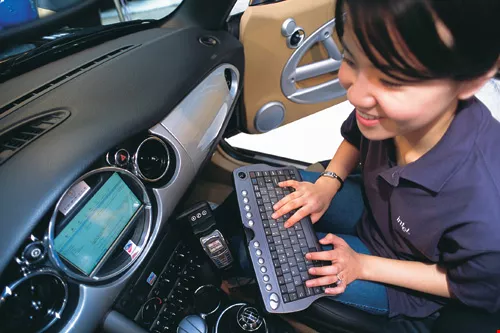
Speeding on the highway, speeding on the internet. Wireless communications giant Intel exhibits a wireless internet car, suggesting that transportation will be the next thing to be revolutionized in a mobile world.
Hot Spots/Hot Areas
Using a WLAN access point, it is possible to access wireless Internet from anywhere within a 100 meter radius. This is a so-called "hot spot." This is particularly attractive to white-collar workers who want anytime-access to the Internet. Today there are more than 60,000 hot spots around the world, mostly in coffee shops and offices.
Once problems with "roaming" from one access point to another are resolved, there will be an evolution from hot spots to hot areas, with hot spots overlapping to expand the area of their wireless Internet coverage.
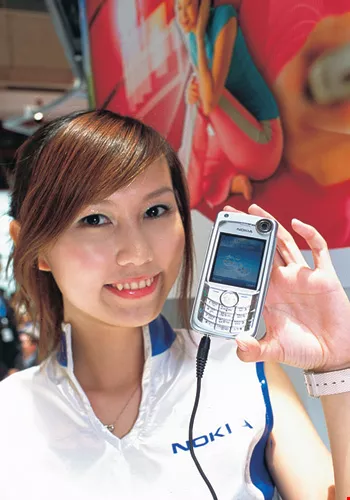
Dual-Mode Integration
Dual-mode refers to the integration of mobile phone networks (GSM/GPRS, PHS or 3G) with wireless Internet areas (WLAN).
Allowing mobile phones to simultaneously use WLAN and GPRS/3G through dual-mode integration is a concept that Taiwan has taken the lead in. By using dual-mode phones to transmit image and sound data, transmission speeds can be raised from current GPRS rates of 30 Kbits to 4 Mbits. Clearer images, faster downloads, portability, and lowered call costs are all among the advantages. It will be more convenient and economical when you can use a notebook computer to access a wireless local network, or simply use a 3G mobile phone to get online. (compiled by Vito Lee/tr. by Chris Taylor)
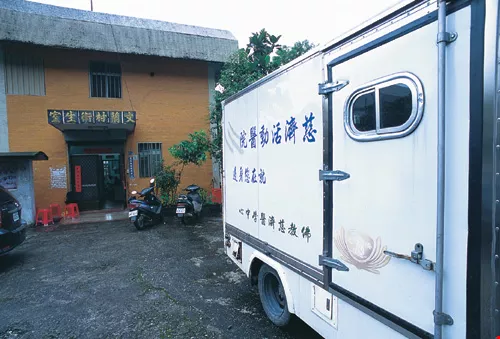
In Hualien County's Hsiulin Township, which has Taiwan's highest rates of tuberculosis, a traveling doctor using a combination of a medical vehicle and broadband wireless is able to immediately access clinical histories from the hospital while doing the rounds of mountain areas. It is also possible to consult with the hospital specialists when making diagnoses, making the treatment of tuberculosis, with its long recovery time, easier.

@List.jpg?w=522&h=410&mode=crop&format=webp&quality=80)


