No Bones About It --Taiwan's Bone Marrow Donor Registry Benefits Chinese Everywhere
Chang Chung-fang / photos courtesy of Tzu-chi Foundation / tr. by Christopher MacDonald
December 1994


In August 1993, National Taiwan University Hospital launched a drive for HLA (human leucocyte antigen) blood tests, then in October of the same year the Tzu-chi Foundation set up the Taiwan Donor Registry. In little over a year since then, more than 50,000 people have undergone HLA blood tests to volunteer as bone marrow donors. The Taiwan Bone Marrow Donation Center already has the largest databank of donors in Asia, ahead of Japan and Hong Kong, and is in a position to benefit potential marrow recipients in ethnic Chinese communities throughout the world.
Since Taiwan's database of bone marrow donors was established in October of last year, there have been five operations performed in Taiwan to transplant bone marrow between non-relatives. One of the recipients has since died, but the other four are still alive and under medical observation. Although there is no guarantee for the success of their marrow transplants, each is one of a lucky few, because prior to the establishment of the database there was virtually no chance of a lifeline for any of them.
Chen Po-ming, head of the Department of Hematology at Veteran's General Hospital, explains that at present, bone marrow transplants are mainly used to treat blood diseases. Traditional treatment by drugs and transfusions tend to be ineffective against blood diseases such as leukemia and aplastic anemia, says Chen, and "bone marrow replacement is currently the only method that is relatively effective."
Among patients with acute leukemia, for example, the traditional treatment enables only around ten percent to live for a further three years, whereas the corresponding survival rate with a bone marrow transplant is over 50%. In cases of aplastic anemia, up to 80-90% of patients can be successfully treated.
In view of moral and ethical considerations, ROC law stipulates that a living organ donor must be related to the recipient, and this used to apply also to donors of bone marrow for transplantation. If there was no suitable donor amongst the patient's relatives, the only option was to await death.
In May last year, however, the law was changed, following calls by leading ematologists and a campaign by a Chinese-American leukemia victim who had returned to Taiwan. The lifting of the ban on bone marrow transplants between non-relatives has created a new lifeline for sufferers of blood diseases, but it is still far from easy to find the right bone marrow for transplantation. The key is whether or not a donor with an identical HLA pattern to the recipient can be found.
The HLA genes carried on human chromosomes have a vital function in the immune system, defending the body against foreign intrusion. The precondition for bone marrow transplant is that donor and recipient have matching A, B and DR types of HLA. Otherwise, the recipient's body will reject the new marrow.
HLA type is inherited, with siblings having a one-in-four probability of an identical HLA pattern. Among non-kin, the probability is around 10,000-to-one.
According to Cheng-kuang Shaw, assistant professor at the Public Health Department of the Tzu Chi College of Medicine, existing bone marrow database statistics indicate that there are more than 450 million possible permutations of A, B and DR-type HLA pairings. This means that in theory there will only be two identical permutations among every 400 or so million people.
"Fortunately, some permutations are fairly common," says Shaw, and the chance of finding a match is not that remote. Where do you look, however, among the mass of humanity, to find the person with the right HLA match? It was in answer to this question that the bone marrow database was set up.
"The more information there is in the database," says Shaw, "the more chance there is of finding a match." With a database of 10,000 people, there is a 15% chance of finding someone with matching HLA. With 100,000 people the chance rises to 45%, and with one million people it reaches 70%.
These probabilities are similar to those that apply in the West, but far lower than in Japan. With a database of 10,000 people in Japan, there is a 50% probability of making a successful match, and with 100,000 people it rises to 90%.
The main factor in the wide disparity between the ratios for Taiwan and Japan is blood stock. As Shaw points out, the Japanese have a relatively "pure" ethnic composition, whereas Taiwan is home to people from every province in China, in addition to its own indigenous people, which makes for more difficulty finding HLA matches.
Due to differences between the HLA types of different ethnic groups, it is virtually impossible to find suitable bone marrow donors from among people of another ethnic type. This means that with its wide database of Chinese volunteers, the Taiwan Donor Registry is in a position to benefit not only people in Taiwan, but also ethnic Chinese throughout the world.
In May this year, the first bone marrow transplant between non-relatives in Taiwan was carried out, enabling the life of a critically ill youngster to be saved. The donor was a twenty-year-old student, who insisted on going ahead with the operation in the face of strong objections from her parents. Vindicating her decision, the young woman, a former student of nursing, wrote: "There is no form of medical treatment that saves a patient at the expense of another's health. I am confident that I will receive the very best care and attention."
That donor's knowledge of medical treatment strengthened her courage, but for many others, uncertain about the difference between normal bone marrow and spinal marrow, serious misgivings are inevitable.
As Chen Po-ming explains, marrow is located in the bones and is responsible for producing blood cells, such as red and white corpuscles, and blood platelets. Marrow cells for transplant are extracted from the ilium (part of the pelvis), and not, as some people imagine, from the core of the spinal column.
According to Cheng-kuang Shaw, marrow in the bone can be said to be in a state of "hibernation." with no active function. It only begins to take on a function once it matures and moves out into the bloodstream. For a marrow transplant, around 5% of the marrow cells are extracted and transplanted to the body of the recipient. The extracted marrow gets replaced within around ten days through cell division and regeneration, so the donor is not harmed by the loss of marrow.
"In the past, no amount of general health education or explanations by doctors made any difference," says Chen Po-ming. In his medical experience, up to a third of suitable donors--including many well-educated individuals--refuse to give their marrow, even to siblings.
That gives an indication of how difficult it can be to alter deeply entrenched preconceptions that people hold on the subject.
In preparation for setting up the bone marrow database, the Department of Health held consultations with major medical schools, before finally deciding to entrust the project to the widely respected Buddhist Compassion Relief Tzu-chi Foundation.
"At the time we thought it would be an achievement if we could build up a database of ten or twenty thousand donors, but we had no idea that there would be more than 50,000 in less than a year!" says Chen Po-ming. "That's the power of religion for you!" he adds admiringly.
During the last year, the foundation has used television adverts and a barrage of media publicity to win attention for the notion of bone marrow donation, holding over 5,000 meetings and presentations in the process.
Chen Nai-yu, northern district general secretary with the Tzu-chi Foundation, says that every single opportunity was taken to explain marrow donation to organizations, schools, groups and individuals. "Wherever there are people," says Chen, "there is the chance of a marrow match."
Touching scenes occurred every time blood samples were taken. Wu Ching-chi, a member of a Tzu-chi bone marrow donation team, recalls that on one occasion in Taichung, a woman whose arteries were hard to find had to be pricked seven times on her arms and legs until blood could be drawn. The woman's determination to proceed made a deep impression on Wu.
On the other hand, team members are often dismayed by the negative phone calls and mail that comes in after the end of a blood-testing event. Sometimes it is the parents of a volunteer calling to have the information removed from the database without the volunteer's knowledge. In circumstances such as these, the team will respect the wishes of the original volunteer, making a record of the call but taking no action.
In comparison to donating blood, giving bone marrow is both more difficult and more dangerous. Chen Po-ming points out that although there is no danger in extracting marrow, the operation requires a general anaesthetic, which does carry some intrinsic risk, so that bone marrow donation is never completely safe.
It is very rare for an anaesthetic to cause problems, however, so according to Chen Po-ming there is no need for anyone to be deterred by that possibility. "After all, it's dangerous just crossing the road, but you don't let that stop you."
The physical requirements for bone marrow donors are simpler than for giving blood. You have to be over 18 and under 55, weigh at least 45kg if you are male or 40kg if you if you are female, and be in good health.
Unlike in other countries, carriers of hepatitis B are accepted as bone marrow donors in the ROC. In Taiwan, this is a matter of practical necessity.
As Cheng-kuang Shaw points out, around 90% of people in Taiwan have been infected by hepatitis B, and 20% are carriers of the disease. Since the probability of finding a donor with matching bone marrow is already so low, doctors simply cannot afford to exclude hepatitis B carriers.
Chen Po-ming explains that according to clinical experience, hepatitis B has a relatively minor effect on the marrow recipient. For someone faced with imminent death, the possibility of being infected with hepatitis B is a small price to pay for a transplant.
There are two types of bone marrow transplant: autografts (extracting marrow from elsewhere in the same body) and allografts (using another donor). The latter can also be divided into transplants from related and from non-related donors. The patients for whom a donor has to be found through the bone marrow donor registry are those for whom it was impossible to perform an autograft, and for whom there was no suitable donor among their relatives.
To date, there have already been 73 pairings made through the donor registry, including 11 in which the registered volunteers backed out of donating marrow after being informed that a successful match had been found. Those who refused did so out of a last minute change of heart, or due to family opposition.
There is nothing unusual about this, according to Chen Po-ming. Statistics from overseas indicate that up to 50% of volunteers change their minds about donating marrow once a match is found. It may be regrettable when someone refuses to donate their marrow, but it is understandable. What is startling, however, is that more patients refuse to receive marrow than donors refuse to give it.
Statistics from the donor registry reveal that there have been 17 cases in which patients refused to go ahead with a transplant after a successful pairing had been made.
According to Chen Po-ming, the success rate in marrow transplant operations involving non-relatives is lower than for those involving relatives. In the case of apalastic anemia, the success rate for transplants among relatives is 80-90%, but drops to 30% among non-relatives. Faced with this apparently low success rate, some patients or families opt not to take the risk.
Chen Yao-chang, a physician at National Taiwan University Hospital's Department of Laboratory Medicine, says that some patients in the early stages of a disease do not want to risk a failed transplant, and decide to wait until the illness becomes critical before accepting a marrow donation. Other patients only find a suitable marrow match after long years of searching, with their condition deteriorating. The worse an illness becomes, however, the lower the success rate for transplants.
After one donor completed the operation to extract marrow, he told the medical team: "I didn't realize it could be so easy to save someone's life. Find some more matching people for me and I'll donate marrow a few more times..."
At Veteran's General Hospital they refer to the day that the patient receives a bone marrow transplant as "day zero," and count the subsequent days as the beginning of a new life. It is also the beginning of a new trial for both doctors and patient.
Some people have compared saving someone's life by donating marrow to giving birth, since it creates, or rather extends, a life. One difference is that after bringing a child into the world, it may be ten or twenty years before that child plays a productive part in the world, whereas mature adults given new life through marrow donation can very quickly resume their roles in society. So in some sense, marrow donation contributes more rapidly to society than childbearing.
At present, the only databases of bone marrow information on ethnic Chinese are in Hong Kong and Taiwan. Hong Kong's database was set up two or three years ago and carries information on around 20,000 people. Taiwan's database had gathered 56,018 registered volunteers as of the end of October this year.
Since the setting up of the bone marrow donor registry in Taiwan, more than 200 people have used it to seek suitable donors, around 20% of them from abroad, including patients from the US, Canada, Australia, Singapore, Hong Kong, mainland China, Malaysia, Japan and Korea.
The first overseas recipient was a 16-year-old girl from Singapore. Chen Nai-yu, who personally transported the bone marrow for the operation in its cooling container, says that in order to prevent the marrow from solidifying he had to hold the container in his hands and shake it all the way to Singapore.
The day the marrow was delivered, the patient's brother was at CKS airport in Taiwan and her father was at the airport in Singapore, while her mother was waiting at the hospital. "Everywhere we went, all eyes were concentrated on that container in my hands," recalls Chen. The anxiety felt by families of sick people is the same everywhere.
Taiwan has been criticized in the past for being an "island of greed," but from their readiness to donate bone marrow we can see that the people of Taiwan also know the joy of giving.
[Picture Caption]
p.109
Marrow transplants between non-relatives have only begun being performed in Taiwan during the last six months. The photo shows a marrow recipient recuperating after the transplant operation. (photo by Hsueh Chi-kuang)
p.110
The recipient has a tube inserted into the right side of the chest, through which the bone marrow is injected. (photo by Hsueh Chi-kuang)
p.111
Marrow is extracted from the ilium (see photo), and not, as some people imagine, from the spinal column.
p.112
After waking from the general anaesthetic, the donor feels no discomfort apart from a slight ache where the marrow was extracted. The photo shows marrow being extracted.
p.113
A marrow recipient watches the life-saving bone marrow being injected drop by drop.
p.114
"Donating bone marrow does not harm the donor." The Tzu-chi Foundation held presentations and blood-test drives to raise awareness about bone marrow donation.
p.114
Marrow Donors Registered with the Taiwan Donor Registry
Source:Tzu-chi Foundation
(Chart:Lee Su-ling)
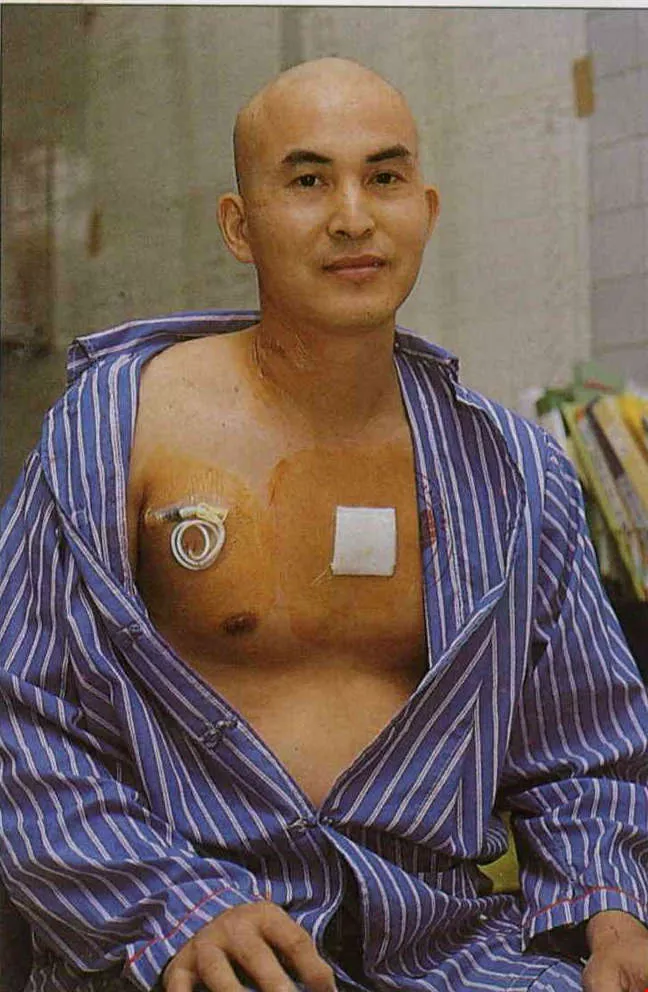
The recipient has a tube inserted into the right side of the chest, through which the bone marrow is injected. (photo by Hsueh Chi-kuang)
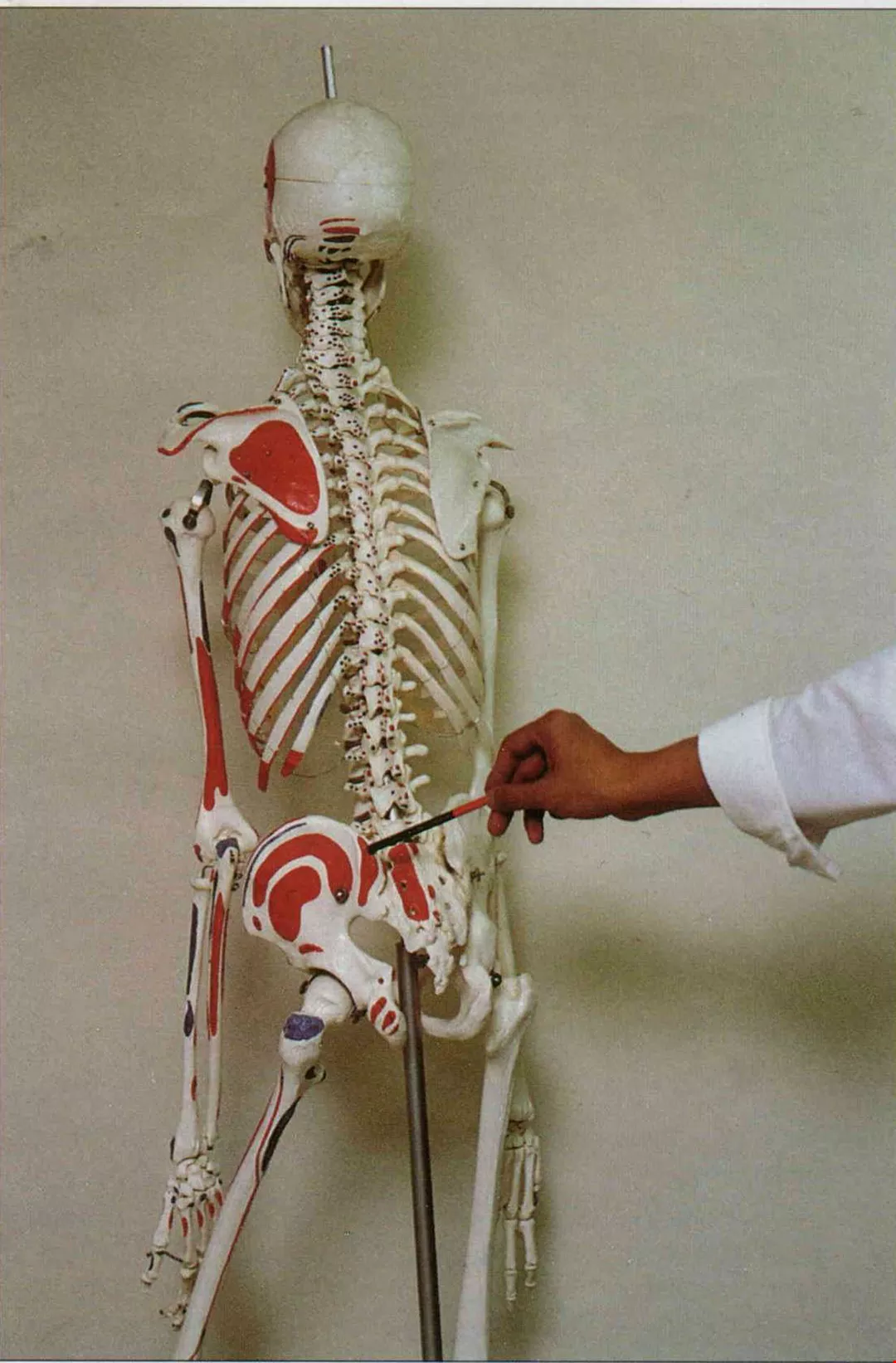
Marrow is extracted from the ilium (see photo), and not, as some people imagine, from the spinal column.
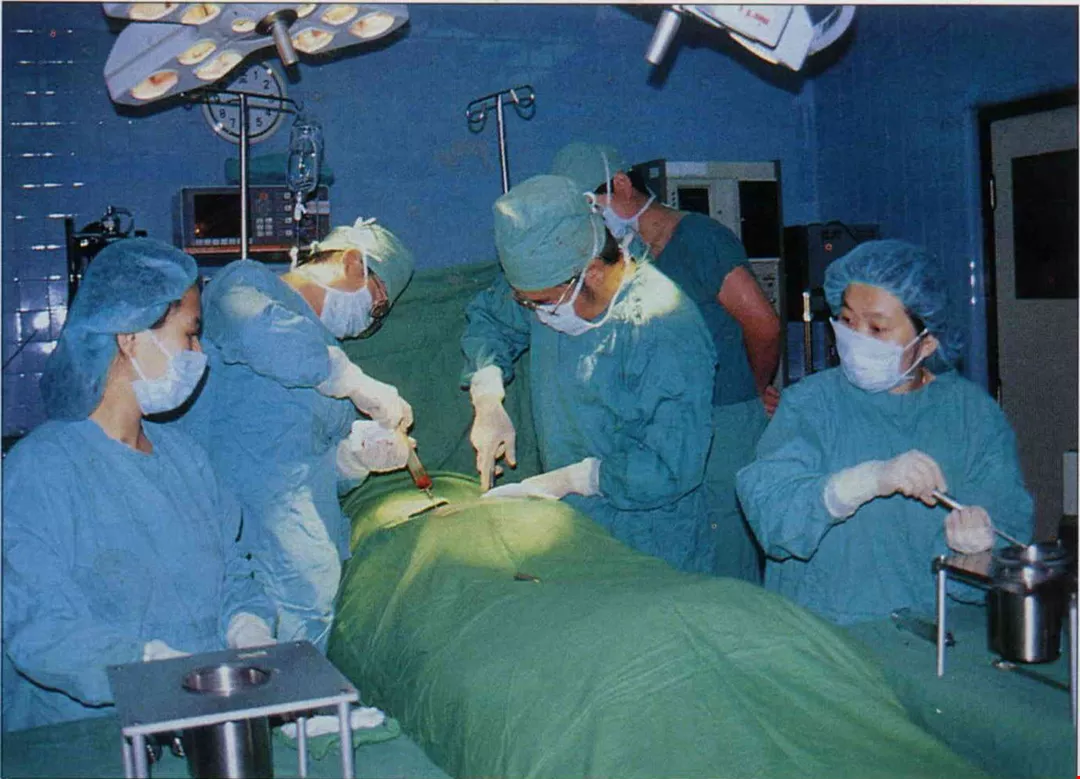
After waking from the general anaesthetic, the donor feels no discomfort apart from a slight ache where the marrow was extracted. The photo shows marrow being extracted.
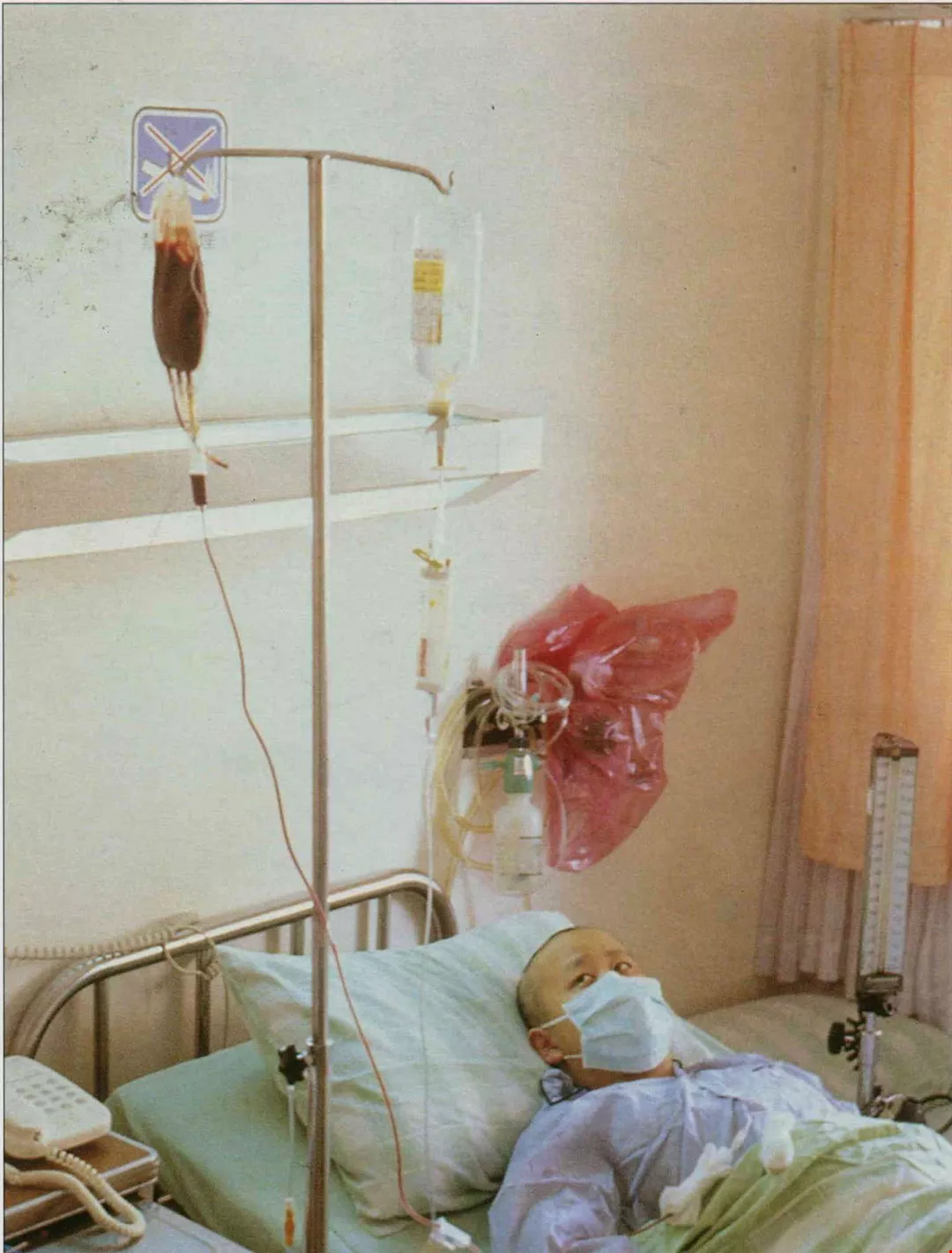
A marrow recipient watches the life-saving bone marrow being injected drop by drop.
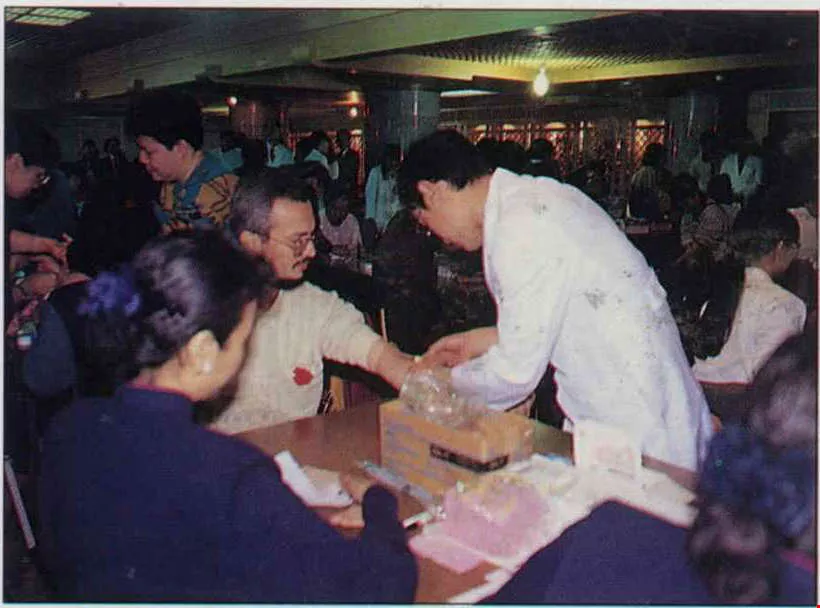
"Donating bone marrow does not harm the donor." The Tzu-chi Foundation held presentations and blood-test drives to raise awareness about bone marrow donation.
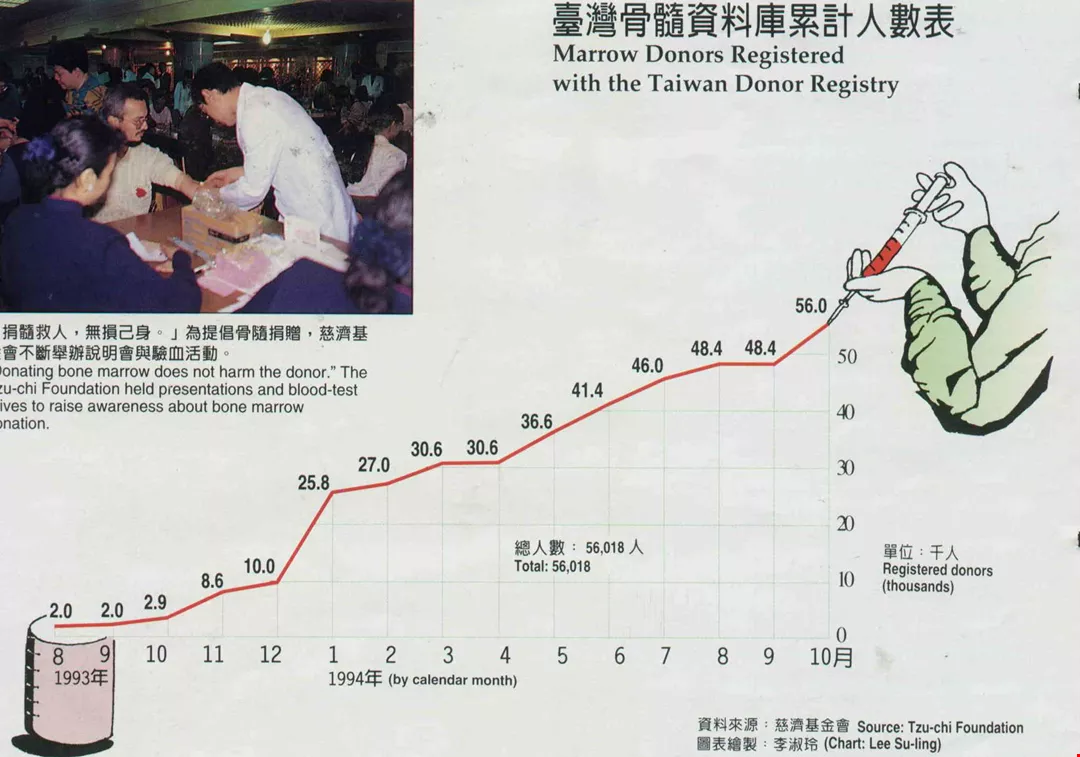
Source:Tzu-chi Foundation (Chart:Lee Su-ling)


