Asia's Superyacht Supremo:Horizon Yachts Creates -Maritime Mansions
Yang Ling-yuan / photos courtesy of Horizon / tr. by Geoff Hegarty and Sophia Chen
January 2011


Owning a luxurious seagoing mansion, a sumptuous super-yacht, is the dream of many who have "made it." Though you would never guess the fact-Taiwan-built yachts are rarely seen in Taiwanese ports-the nation is in fact a major producer of large yachts (over 80 feet). Ranked first in Asia and fifth globally for export volume of mega-yachts in 2008, Taiwan is not far behind the major traditional manufacturers of Italy, the US, the Netherlands and the UK.
According to statistics from the Yacht Industry Association of Taiwan, the value of the nation's yacht exports soared from NT$10.69 billion in 2008 to NT$14 billion in 2009, and around one third of this impressive growth can be attributed to the Horizon Yacht Company in Kao-hsiung. In 2009, when orders in the industry were falling because of the global financial crisis, Horizon was able to buck the trend, growing 60% over the previous year. How did they achieve it? And how has this Kao-hsiung-based company captured the title of "Asia's superyacht supremo"?
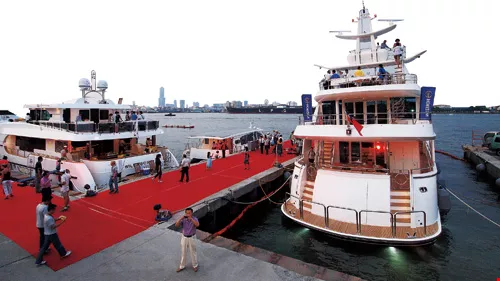
On a bright sunny day in August, 2010, a fleet of luxury vessels appeared in Kao-hsiung's Qi-jin Harbor, a sight never before seen in Taiwan. Nine megayachts with a total value of more than NT$1.3 billion (more than US$40 million) were docked in the harbor on display for the first time, revealing their beauty and extravagance for all to see.
The most notable (and the most expensive) among this elite collection was a long-distance cruising yacht which had cost NT$350 million to build: 105 feet (32 meters) in length, with three upper deck levels, one lower deck, and twin 1200 horsepower engines giving a maximum speed of 12.5 knots (nautical miles per hour). With full tanks, this craft could sail over 3000 nautical miles without refueling.
Boarding the yacht for an all-too-brief visit, one can imagine the luxurious life of a millionaire owner, with master and guest cabins, living and dining rooms and an open-style galley, adorned with leather sofas, timber decks and marble-topped tables. There's even an open-air spa on the third level allowing users to gaze at the stars while enjoying their evening bathe.
From left to right: a trim fishing boat with flying bridge; a four-deck luxury catamaran yacht with full facilities; and a green-energy solar-powered catamaran featuring an advanced energy-saving design.
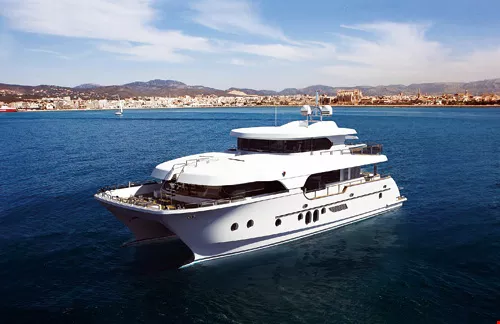
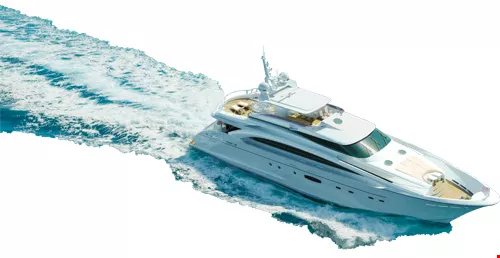
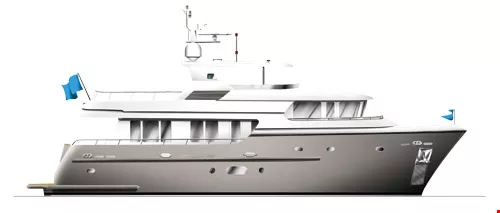
Another Horizon masterpiece, the 88-foot European-style yacht Elegance 88 won the Taiwan Excellence Award in 2010. The craft has a neat, streamlined design which underwent hull resistance testing in Sweden, confirming its sea-keep-ing characteristics and comfort. Its elegant superstructure was designed by internationally renowned yacht designer John Lind-blom, the yacht exuding ease and a carefree lifestyle.
Horizon Yachts had never previously shown its products in Taiwan, and these nine luxury craft not only displayed the company's diverse manufacturing capacity, but were also a step towards opening up the domestic yacht market.
Luxury boatbuilding in Taiwan has roots that go back over 40 years. In fact, in bygone days it used to be one of the big-growth manufacturing sectors. In the 1980s, sales flourished with exports of around 1500 yachts per year worth US$200 million, gaining Taiwan the reputation of being at the hub of Asia's luxury yacht industry.
However, with a sharp appreciation of the NT dollar in the 1980s, domestic wage increases, rises in raw material costs, escalating sea freight charges and the imposition of a luxury tax in the US, exports experienced a dramatic decline, plunging from US$180 million in 1987 to only US$50 million in 1994. In this period, around 70% of the nation's yacht industry shut down: only 20 yards survived.
In 1987, under these less-than-fortuitous circumstances, Horizon was established as the Jia-hong Yacht Company. It was a very brave venture indeed.
Born and raised in Kao-hsiung, John Lu, the company's founder and CEO, has had a passion for the endless sea and blue sky, and yachts, since childhood. After graduating from the Department of Naval Architecture at National Taiwan Ocean University in Keelung in 1980, he returned to his hometown and worked in the shipbuilding industry as an engineer. In 1987 Lu, in cooperation with his former employer, Kha Shing Enterprise Co., a leading shipbuilder of the time, established Jia-hong, which initially undertook mainly contract work. The following year, they were hit by a recession.
Horizon, Asia's superyacht supremo based in Kao-hsiung, has built 700 luxury vessels to date. In addition to its export business, the company has plans to open up the domestic market. The picture shows Horizon CEO John Lu relaxing in the comfort of the cabin of one of Horizon's boats.
Fortunately, being a newcomer to the industry, they were flexible enough to diversify quickly. Lu shifted focus from traditional markets in the US and concentrated instead on Europe.
This was new territory. Taiwan's yacht builders had shown little interest in the European market until that time because it was such a different scene from the US: European customers were looking for a functionally different style of yacht, yachts with different lines bought for different reasons.
American clients generally liked functional space, and a simple decor featuring lots of raw wood, and from a business perspective, the US had a relatively open market. European buyers, on the other hand, preferred a more stylish and streamlined design. Taiwanese builders lacked the design tradition of Europe, especially the Italians, which had developed over many years from the region's geography and yachting culture. To take on Europe, they were faced with exorbitant redesign costs, something perhaps approaching NT$10 million, if they were to gain a foothold.
Most of the rather conservative Taiwanese manufacturers of the time were simply not prepared to take the risk. Lu, on the other hand, braved the op-por-tun-ity. He invited a Swedish designer to create a series of European-style streamlined yachts. In the first year after the shift to Europe, the company received five orders from Sweden.
The move had gained Jia-hong enough orders to keep them busy for the next three years-Lu had clearly judged the market well. But he was still concerned about the future.
Even today, Lu notes that the luxury boats currently built in Taiwan are generally restricted to around 80-110 feet in size, while major foreign manufacturers regularly produce large yachts of over 120 feet. Although the difference in length may seem unimportant, the asking price for the larger boat can be double that for the smaller because of changes to decor and safety requirements.
"The top clients don't stop to think about the price. In the yacht industry, quality is the key to winning the major customers." Lu says that Taiwan has many natural advantages which support the production of top-quality yachts: a high standard of craftsmanship in -wooden boat building, the ability to recognize the importance of quality, and a positive work attitude. In addition, the industry is efficient, adaptable, has a well-developed hardware sector, and is able to gain the cooperation of internationally known designers.
One of Horizon's most popular products, the 110-foot luxury yacht allows buyers to fit out the boat to their own requirements, including an owner's cabin, flying bridge, separate dining room and galley. Any sailor would be proud to navigate this yacht through the mighty seas.
Entering the company's boatyard in Kao-hsiung, one cannot help but notice the rather grand superyacht currently under construction: 136 feet long, and as tall as a four-story building.
The yacht is waiting to be fitted out, with interior spaces that resemble a three-level townhouse including a salon, dining room, galley, owner's cabin and study. On the upper levels, there's space for sunbathing- on deck, a wheelhouse, a bar and a gallery with sweeping views. On the lower levels, there are cabins for the captain, guests and crew, and a galley and dining room for the crew. All of the accommodation features en-suite bathrooms, although the interior can feel slightly oppressive because of the low ceilings. Despite this, the interior design gives a feeling of strength and solidity, with anti-shock flooring and anti-noise materials used for partitions, and fire doors that can hold back a fire for 15 minutes. With all this equipment providing a luxurious but safe environment, the yacht is no less impressive than an exclusive mansion on land.
"It takes at least two to three years to build a luxury superyacht." Xie Quan'an, boatyard manager for Horizon, says that generally yacht hulls of 60 to 70 feet can be made from existing molds, so they can be built in three to four months. A larger yacht has to be constructed manually, however, and as each stage is completed, the hull structure has to go through a process of international accreditation. Thus the process takes much longer. This NT$100-million boatyard specializes in large yachts of over 105 feet; the record is 136 feet. During its heyday before the recent recession, the yard often had six yachts under construction at the same time; even during the recession in 2009, there were two boats on the slips.
"Building a large luxury yacht is in some senses bringing a customer's dreams to reality; we are the architects of fiberglass dreams." Lu notes that luxury yacht construction is an extremely complex operation, with myriad components that need to be sourced at the appropriate times from different suppliers. Therefore Lu has set up a dedicated section to produce molds for fiber-reinforced plastic (FRP) yacht hulls, separate boatyards for building yachts of different size ranges, and a specialized cabinet maker, thus integrating the company's supply chain.
"Building yachts is different from general shipbuilding because customers sometimes change their minds about exactly what they want, and we have to be flexible enough to respond to their requirements quickly." Lu says that shipbuilding is an industry that utilizes sophisticated technology, so forward planning is critical. If a customer changes their mind, the company has to modify the design. Some customers even send the builders information about their favorite appliances, tableware, or upholstery materials that they want to include. It's as if they were decorating a new home, so it's quite natural that they want to participate in the whole process.
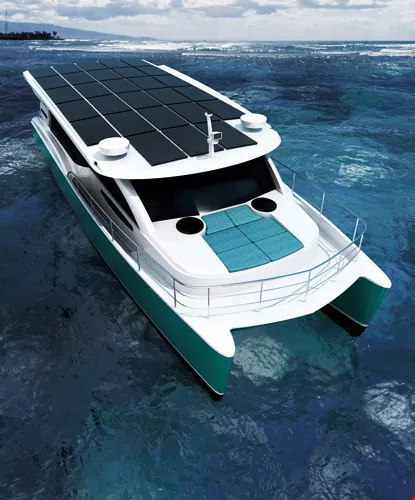
From left to right: a trim fishing boat with flying bridge; a four-deck luxury catamaran yacht with full facilities; and a green-energy solar-powered catamaran featuring an advanced energy-saving design.
Although Jia-hong's order book was always full, Lu was not satisfied that their position in the European market was secure. Their agents in Europe were tending to promote a couple of the larger manufacturers before the newcomer from Taiwan, so it seemed that the company was always living on the edge.
"Only if Jia-hong could create its own brand would it be able to take the initiative away from the agents to be able to compete freely with the larger European builders." Lu believed that Taiwan had many important advantages, like lower wage and technology costs. If his company could build on their productivity and efficiency in the short term and promote their own brand name, they would be able to stake out a solid position for themselves in the global marketplace.
In 1999, the company adopted "Horizon Yacht Company" as the English name for its new global marketing campaign. To cater for diverse markets and customer needs, the company gradually introduced three model series: Elegance, Vision and Premier. One of their first steps towards making their own brand a success was to attract respected European and US designers with large fees to design yachts that would satisfy market trends.
To become more competitive, Horizon's engineers utilized a new technique, Seeman Composites Resin Infusion Molding Process (SCRIMP), developed by the US Navy to enhance hull strength and durability without increasing weight or unduly affecting performance. In 2004, the company also developed a new resin infusion technique, which was not only more environmentally friendly but could also reduce bubble defects in the FRP material, a common problem in manual construction.
In recent years, Horizon has been researching the development of zero-pollution, green-energy solar-powered yachts. After the completion of Taiwan's largest FRP yacht (136 feet) in 1998, the company went on to develop Taiwan's first solar-powered yacht (the SunCat 23), which is designed for calm-water lake service, and the world's first luxury solar-powered yacht (the SunCat 46), which can be used as either a private or passenger craft. The two designs have FRP hulls and are equipped with solar panels mounted on deck canopies, providing sufficient power for eight hours' cruising endurance. These yachts are extremely silent in operation with very low fuel consumption, and represent perhaps the future of luxury yachting.
Horizon's 2005 turnover hit NT$1.6 billion, but then more than doubled to reach NT$3.5 billion in 2008. Annual export volume is running at 50 yachts, with Europe the most important export region, followed closely by North America, Hong Kong and Australia.
According to data released in December 2009 from ShowBoats International, the world's luxury yacht industry received 752 orders in 2010. Italy, at No. 1 in the world, produced a total length of 44,944 feet, followed by the US, the Netherlands, Germany, the UK and Turkey; Taiwan's share was 4432 feet, ranking seventh in the world.
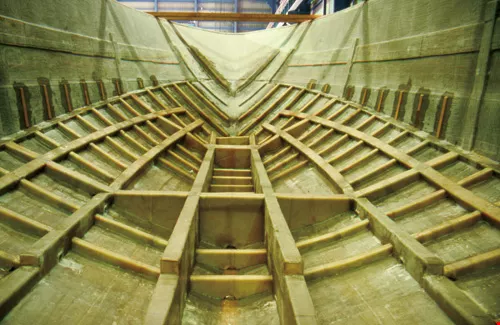
A luxury megayacht is being assembled at Horizon's Xiaogang boatyard in Kaohsiung. Almost every stage of this vessel has to be constructed by hand, so it will take at least two to three years to complete.
One of Lu's hopes for the future is to see the island people of Taiwan take to yachting as a leisure activity.
"The yachtbuilding industry is truly a Taiwanese miracle, because it enjoys zero domestic business, relying entirely on exports." Lu thinks that there is an irony here, as Taiwan is surrounded by the sea, yet it is the only country that builds yachts for which there are no public facilities. While it is a major yacht manufacturer, it does not allow yachting in home waters.
There are a number of good reasons for the lagging domestic market. The government has little apparent understanding of the yacht business, and because the general Taiwanese population lacks a close relationship with the sea, many believe that the sea is a dangerous place-not somewhere they go to have fun. Because of this lack of demand for yachts or yachting, it's difficult to attract government attention or support for the industry.
To open up a domestic yacht market, so many things would have to change; it would be difficult to predict results in the short term. Current yacht ownership in Taiwan is around only 100, so any boost to local yachting still has a long way to go.
Lu, who is also chairman of the Yacht Industry Association of Taiwan, has been lobbying the government in recent years to increase investment in the boatbuilding industry, to relax regulations and allow the building of slipways and other facilities.
"The global yacht market is valued at US$40 billion annually. There are currently more than 10 companies in Taiwan that can produce yachts of over 80 feet, so the industry is no longer a minor one in terms of output or production capacity," says Lu.
The good news is that in 2010, the Kao-hsiung City Government finally determined to further facilitate the development of the yacht building industry. A government project called South Star with funding of NT$2.4 billion has been launched and is expected to reach completion in 2015. The government will allocate 105 hectares of land as a yacht manufacturing base that will attract all the associated industries. They will also construct a low-carbon solar-powered industrial park, providing the needs for large-scale boatyards close to ports, wharves and yacht launching facilities, hoping Kaohsiung will become the Asian center of luxury yacht building.
Because of its diverse and flexible management strategies, Horizon Yachts has grown from a small, risky venture with only 30 staff into a respected and established enterprise group with four subsidiaries and more than 1,000 employees. In 2007, Horizon received the Taiwan Superior Brand award, created by Ministry of Economic Affairs to recognize outstanding local enterprises. Horizon has to date manufactured over 700 luxury yachts; from Miami in the US to the Riviera in Europe, one may see the brand name "Horizon" engraved on the sterns of many of the world's most luxurious craft.
As 2010 comes to an end, Horizon has introduced a new slogan, "Define your Horizon," to promote a quality image for its Taiwanese products. As a result of the new marketing campaign, Horizon hopes to graduate into the very exclusive club of the top four yacht manufacturers in the world, bringing Asia's yacht supremo to a level of success and prestige unforeseen only a few short years ago.
Established: 1987
Capital: NT$1.5 billion
Total revenue: NT$3.5 billion in 2008
Product range: Yachts, luxury yachts, solar yachts and fishing boats
Enterprise group: Horizon Yachts, Atech Composites, Vision Yachts, Premier Yachts.
Market share: One third of Taiwanese superyacht exports
Employees worldwide: 1040
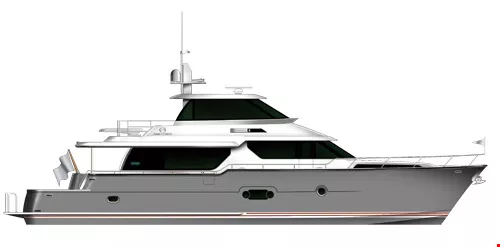
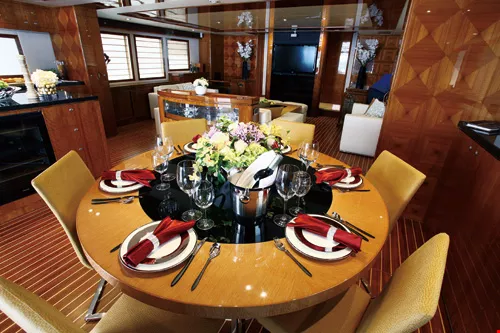
One of Horizon's most popular products, the 110-foot luxury yacht allows buyers to fit out the boat to their own requirements, including an owner's cabin, flying bridge, separate dining room and galley. Any sailor would be proud to navigate this yacht through the mighty seas.
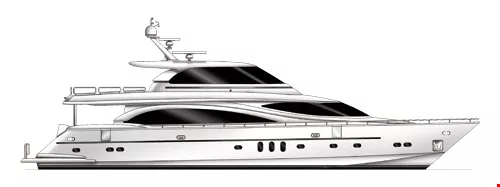

One of Horizon's most popular products, the 110-foot luxury yacht allows buyers to fit out the boat to their own requirements, including an owner's cabin, flying bridge, separate dining room and galley. Any sailor would be proud to navigate this yacht through the mighty seas.
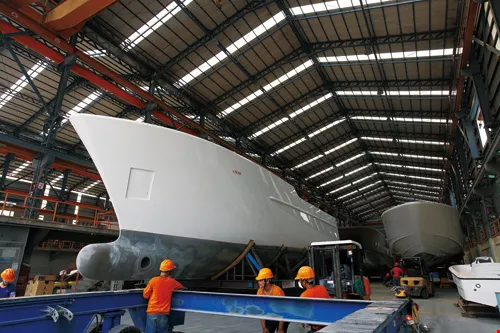
A luxury megayacht is being assembled at Horizon's Xiaogang boatyard in Kaohsiung. Almost every stage of this vessel has to be constructed by hand, so it will take at least two to three years to complete.

Horizon, Asia's superyacht supremo based in Kao-hsiung, has built 700 luxury vessels to date. In addition to its export business, the company has plans to open up the domestic market. The picture shows Horizon CEO John Lu relaxing in the comfort of the cabin of one of Horizon's boats.
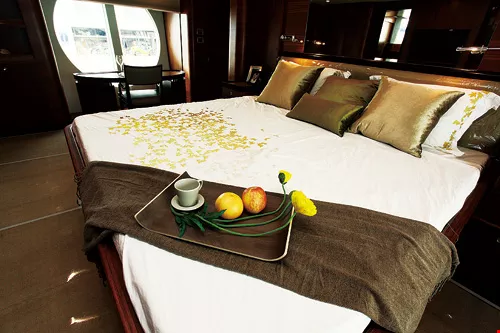
One of Horizon's most popular products, the 110-foot luxury yacht allows buyers to fit out the boat to their own requirements, including an owner's cabin, flying bridge, separate dining room and galley. Any sailor would be proud to navigate this yacht through the mighty seas.

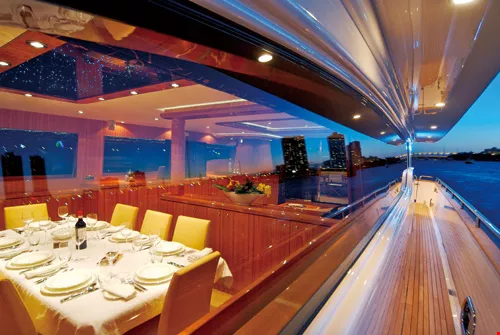
Define your Horizon-the com-pany has created a miracle in Taiwan's yachtbuilding industry, opening the world to Taiwanese enterprise. The picture shows a Horizon-built yacht berthed in Sydney Harbour.


@List.jpg?w=522&h=410&mode=crop&format=webp&quality=80)


