An Old Building Revitalized
Lin Hsin-ching / photos Wang Meng-hsiao / tr. by Scott Gregory
March 2008


Look at Taiwan's guesthouses and you will notice that most feature European architecture or local nostalgic style as their selling points. Shihsanchien Image Guesthouse on the island of Kinmen, however, avoids the cliches and has a photography theme. The proprietor, renowned photographer Tsai Hsien-kuo, has mixed photography with traditional Fujianese architecture to create a warm and evocative feel. He's also given new life to a century-old building.
Chiunglin Village, in the heart of Kinmen, has over 800 years of history. One of the island's oldest settlements, it is a Class 2 national historical site. The 12th-century Neo-Confucian scholar Zhu Xi is said to have visited the island to inspect its schools. He greatly influenced the local culture, and many scholars from Kinmen won success in the imperial examinations. Chiunglin was at its height during the Ming and Qing Dynasties (roughly the 16th through the 19th centuries), and boasted many ancestral halls, family temples, and private academies. Walking among them, one would see nothing but Fujian-style official residences with red brick walls and swallowtail roofs. Though they faded over the centuries, one can still imagine their former glory from the intricate carved beams and painted pillars.
Among these characteristically Fujianese buildings, there is a 2,000-square-meter open courtyard house with red lanterns above the door reading "Shihsanchien" in red characters. This is Taiwan's only guesthouse with a photography theme, the Shihsanchien Image Guesthouse.
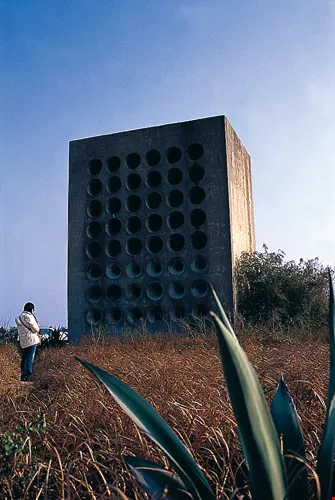
Walls of loadspeakers on the beach of Kuningtou were once used by Nationalist troops to broadcast propaganda to the "1 billion suffering compatriots" on the mainland.
New life for old buildings
The 48-year-old proprietor, Tsai Hsien-kuo, is a little heavyset and his hair is thinning. But this unassuming man-next-door is in fact a renowned photographer who's had many solo exhibitions. "Photographer" and "guesthouse proprietor" would seem to be two completely separate vocations-how did he end up combining them in such a remarkable way?
Tsai laughs and says, "At first I was only looking for a spacious place that could serve as a venue for me to exhibit my work and also become a place for local artists to get together. But when my friends came to Chiunglin to visit, they all complained that they couldn't find a place to stay. I started to think, 'Why not open a guesthouse?'"
Once he had the idea, he had to find the ideal spot. Tsai originally had his eye on an old building that was owned by his elementary school teacher and had sat vacant for years, but his teacher was unwilling to give it up. In 2004, the Kinmen National Park Administration promoted a plan to revitalize historic buildings, signing agreements with the owners of some 50 Southern Fujianese buildings. The administration would fund the restoration of these long-abandoned buildings in return for the right to use them for 30 years. It then accepted bids from the public for their use. Tsai grabbed the opportunity and put in a successful bid for "Chiunglin #153." He started his dream guesthouse in 2005.
Funnily enough, the building Tsai bid for just happened to be owned by his uncle. Tsai felt that fate had determined that he was to protect his ancestors' property. The building had a 150-year history, and in the Qing had been a well-known private academy. The name, which means "13 spaces," refers to the number of spaces in the house, its courtyard, and its two side wings. "Also," Tsai says with a smile, "the word 'space' in Kinmen dialect is very different from what it is in Taiwanese, so it has some special local flavor."
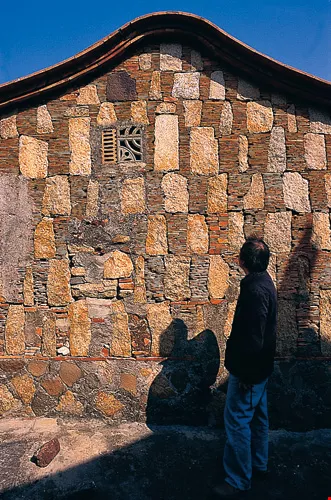
It is said that during the Koxinga era, it was difficult to obtain building materials on Kinmen and people had to make do with what leftovers they could find from older buildings. Walls made of a mixture of brick, tile, and stone are a uniquely local sight.
Image and space
Tsai, who graduated from the Fu-Hsin Trade and Arts School in Taipei County, is good at creating atmosphere. Taking Kinmen's wartime history as a theme, he cleverly created a "Coffee Battlezone" in the guesthouse. Its walls are covered in camouflage material, and there are photos of soldiers, bunkers, training drills, and other such military subjects. There are also uniforms, helmets, shovels, canteens, canvas chairs, mine warning signs, military post boxes, artillery shells, ammunition cases, and other such military historical relics on display, adding to the unique military flavor.
In the three years the guesthouse has been open, many old ex-soldiers who'd been stationed on Kinmen have come to stay here and reminisce. There are also younger travelers who've never seen battle-to them, sitting here over coffee gives a taste of what it was like to man a bunker on the front lines during the tense military standoff between ROC and PRC forces.
Tsai has turned the main hall of the building into the "Image" meeting room. There he has displayed series of his own work on local subjects such as cormorants and Kinmen's "wind lion" god. One elementary school student who came with his mother was so inspired that he spent the next few days finding and taking photos of more than 60 of the wind lion statues hidden away in streets and alleys around Kinmen. Tsai says with a smile, "I offered to take him around and show him where they were, but he insisted on searching them out himself. In the end, he really did it!"
In addition to exhibiting his photographs, Tsai takes full advantage of the building's open space to project films. He set up a projector in the courtyard and uses the back hall, where it's dark even by day, as a mini movie theater to show guests his footage of traditional weddings, temple ceremonies, cormorants, and other such subjects.
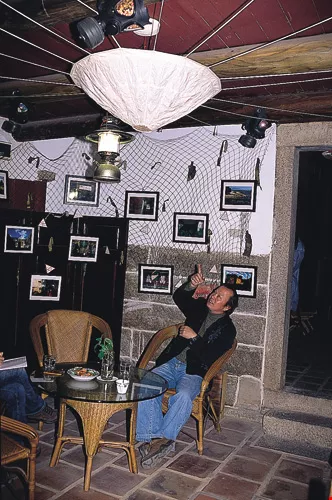
Tsai Hsien-kuo created a "Coffee Battlezone" in a corner of the guesthouse. On the walls are photos with military themes as well as various military memorabilia. The white object hanging from the ceiling is the parachute from an illumination flare.
A glorious past
Shihsanchien has eight guest rooms, including two-, four-, and six-person rooms, and dorm-style accommodation. The decor is simple, but the rooms have all mod cons and are kept very clean. They are named after official positions from the imperial examination system, such as Province, Governor, Assistant Administrator of the Left, Minister of the Right, Metropolitan Graduate, Provincial Graduate, and Licentiate. Tsai himself lives in a room called the Proprietor's Quarters. It's like entering another era.
These titles were not just pulled from thin air. Chiunglin was once called Pinglin. During the Ming and Qing, there were six metropolitan graduates and seven provincial graduates from the settlement. For this reason, the Ming emperor Tianqi renamed it Chiunglin, after the place emperors feasted new graduates of the examination system. At the height of its glory, it was known for its seven temples and eight ancestral shrines. "These official titles have all been held by people from Chiunglin," Tsai says, "and I hope that visitors who stay here will be able to appreciate Chiunglin's long cultural heritage."
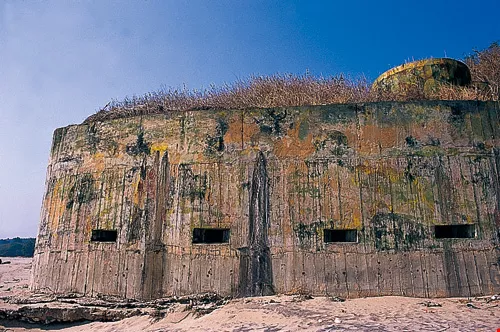
This boat-shaped bunker on the beach at Chunglin was once an important military installation. Only licensed oyster harvesters were allowed access to the shoreline here.
A perfect score
Asked to rate his own guesthouse, Tsai says, "The guesthouse only gets 50 points, but the tour also gets 50 points. Add them up and that's a perfect score." This shows his confidence in his own abilities as a tour guide.
Shihsanchien currently offers tours of Kinmen's historic settlements, old military installations, and natural environment. Tsai will also design new tours around guests' own interests. Most items on his itineraries are things you won't find in a guidebook or on other operators' tours.
For example, he took this reporter on a trip "through the minefields," showing the now abandoned walls of speakers that were once used by Nationalist troops to broadcast messages to the "1 billion suffering comrades" on the mainland. In the area bombarded by the People's Liberation Army during the Taiwan Strait Crisis of 1958, Tsai suddenly headed into a public restroom in a small grove of trees. We thought he must have been in a hurry to relieve himself, but he called us in to show us a secret cave underneath. It had once been a fortified bunker and ammunition storage depot-an amazing sight.
During the tour, we spotted many signs reading "Danger: Mines." But Tsai could always tell which were "fake" (meaning the mines had already been cleared) and which still really had live mines and should be avoided. This is a skill that only a native of Kinmen would have.
Born in 1960, Tsai is a living part of Kinmen's history. He was there at the height of tension between the ROC and the PRC, for the island's opening to tourism after the lifting of martial law, and the opening of the "three small links" with the mainland. Tsai is full of fascinating stories about the changes Kinmen has gone through. He is often interviewed in the media, and even the Discovery Channel asked him to put together a documentary called "Fun Kinmen." Travelers who love photography or have special interests also seek him out to show them "another side of Kinmen." Tsai and his "Image Guesthouse" have become two of Kinmen's greatest attractions.
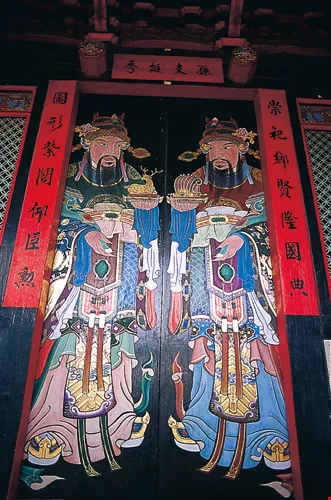
The Tsai family was one of the most powerful families in Chiunglin. Many of their ancestors were officials, so they have many ancestral temples here. Pictured here are gods painted on temple doors.
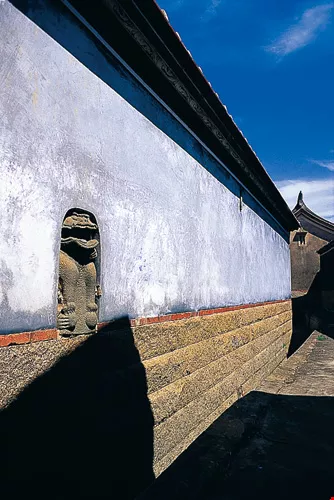
Kinmen residents have erected wind lion god statues to ward off the strong northeastern seasonal winds. Pictured is one of Chiunglin's four wind lion gods.
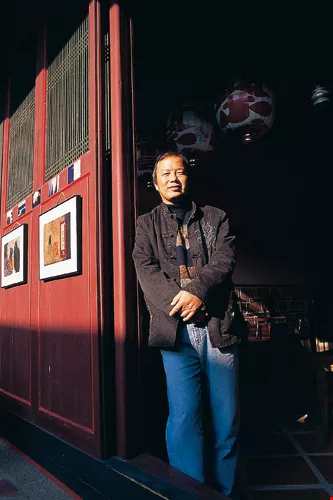
Tsai Hsien-kuo is a well-known photographer from Kinmen. He decided to open a themed homestay to promote the art of photography.
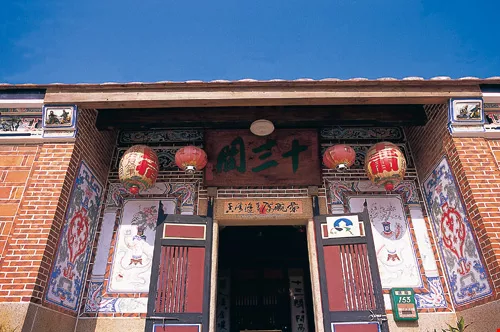
The Shihsanchien Image Guesthouse, a 2,000-square-meter traditional Fujianese building with a 150-year history, was a renowned private academy during the Qing Dynasty.


