Remembering Chiang, Selling Chiang
Teng Sue-feng / photos Lan Chun-hsiao / tr. by Chris Nelson
August 2008


"Under martial law, we erectedbronze statues in honor of our leaders. But now we have figurines that can be held in the hand," remarked marketing expert and author Wang Wen-hua on a radio program.
From the Grand Hotel offering Soong May-ling's favorite Western salads, coffee and red bean cakes for breakfast, to Taoyuan County's Chiang Family Cultural Park with its collection of over 150 Chiang statues toppled during a wave of anti-authoritarianism, and where one can buy Chiang bobbleheads and other souvenirs, the storied First Family of Taiwan, though its stature has waned, has become a lucrative cultural and tourism asset.
In a river terrace in a mountainous part of Tahsi Township in Taoyuan County, a stream trickles through a gully from a deep depression at the base of Mt. Paishih, first flowing into narrow Rear Tzuhu lake, then spilling over a curved ridge called Dragon Pass before flowing into Front Tzuhu.
The 30-hectare Tzuhu lake system is formed by a chain of three ponds, large and small. From upstream down they are Rear Tzuhu, Front Tzuhu and Niuchiaonanpi. The latter two ponds flank the Tzuhu Presidential Mausoleum, forming a natural water barrier in the woodlands surrounding the mausoleum and making for a shady, serene and secluded mountain landscape.
Rear Tzuhu sits nestled among the mountains of the Hsichou range. In the days before it was a restricted area, the locals called it Dragon Pass Hollow. The pond has a large capacity and serves as a natural reservoir. It still boasts fish aplenty, and locals used to fish here and sell their catch on the streets of Tahsi to supplement their family incomes.
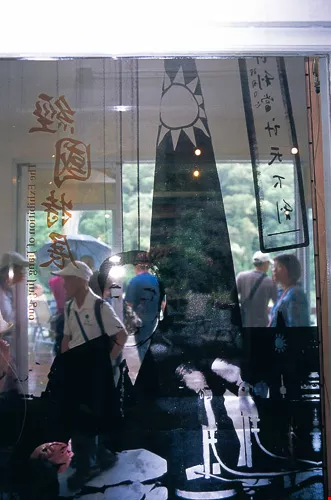
The Rear Tzuhu Office is currently exhibiting artifacts connected to Chiang Ching-kuo, and Chiang bobbleheads are in great demand in the visitor center gift shop.
Even shallow waters enchant
The route between Tahsi, where the Northern Cross-Island Highway begins, and the Paichi Tunnel was an important early transport route for quarrying, camphor logging and farming.
One day in 1949, after assuming office in Taiwan, President Chiang Kai-shek was on his way via Paichi Tunnel, finding it too narrow for his convoy to pass through. While bypassing the tunnel in sedan chairs, they found Tzuhu hidden in the forest. Its lake and mountain landscape reminded him of his birthplace of Xikou in Fenghua County, Zhejiang Province, and he ordered it purchased and had an official lodging house built there.
At the time, this veritable haven of a tract of lakeside woodland belonged to the Lin family of Panchiao. When the Lins learned that President Chiang had taken a liking to this gem of land with its fine fengshui, they promptly offered to make an unconditional gift to him of about 19 hectares.
But to avoid impressions of impropriety, Chiang declined the Lin family's gift, and after much to and fro it was decided that the government would lease the land rent-free and in perpetuity, thus securing land use rights. Only in 1975, after Chiang Kai-shek's death, did Chiang Ching-kuo agree to accept the gift, remembering the Lin family's good faith. But after the transfer was completed, Chiang Ching-kuo then donated it to the government, to be placed under the management of the Ministry of National Defense.
In 1959, the Retired Servicemen Engineering Agency built a small, red-tiled, traditional-style courtyard dwelling there. Each time Chiang Kai-shek visited this place, his mind was instinctively drawn to thoughts of his mother Wang Caiyu, and so he named it Tzuhu, or Lake Kindness.
After Chiang's death in 1975, it was decided not to inter him permanently in Taiwan because of his wish to be buried in Nanjing. The first site of temporary interment chosen was the Mt. Chiaopan Guesthouse in Fuhsing Township. But on closer inspection they found the mountain road narrow and winding, too difficult for a hearse to navigate. Additionally, the Mt. Chiaopan area was too remote, making it unfit for future official mourning ceremonies. So Tzuhu, on the same road in the same area, was settled on after much deliberation. The Tzuhu Guesthouse was thus transformed from a place of rest for the living into a resting place for the departed. It is now known far and wide as the Tzuhu Presidential Mausoleum.
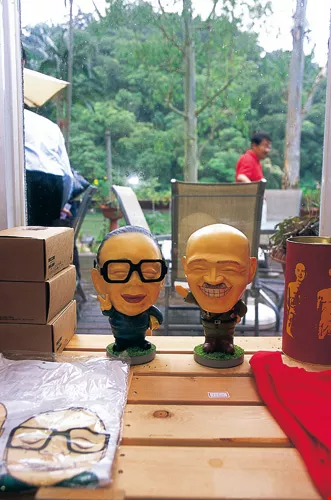
The Rear Tzuhu Office is currently exhibiting artifacts connected to Chiang Ching-kuo, and Chiang bobbleheads are in great demand in the visitor center gift shop.
The fate of the Chiangs
A mile down the road from Tzuhu is the Touliao Guesthouse, where the remains of President Chiang Ching-kuo lie. Completed in 1963, it was originally a repository for important presidential documents and files as well as Chiang family papers and genealogical data. In 1988, after his death, the younger Chiang was interred here, and the name of the place was changed to the Tahsi Presidential Burial Place.
But is a residence of a prosperous family fit for becoming a mausoleum for departed family members?
The remains of the elder and younger Chiang are kept in temporary above-ground sarcophagi. The fact that the coffins have lain unburied for so long has become a bone of contention for later generations of the Chiang clan, and has raised conjectures of poor fengshui from the man on the street.
Of Chiang Kai-shek's mausoleum at Tzuhu, one fengshui master says that the coffin points against the flow of "dragon qi" from the local mountain range: a so-called "reverse burial." Such opposition to the mountain's qi is like driving a car in the oncoming lane: quite dangerous in terms of the afterlife. On top of this, both the Tzuhu and Touliao locations are near water, breaking a major taboo of fengshui. These are the chief reasons the Chiang family was losing its male descendents, he claims.
A year after Chiang Ching-kuo's passing, his eldest son Chiang Hsiao-wen died of nasopharyngeal cancer, and his second son Chiang Hsiao-wu passed away two years later of heart failure. In 1996, Chiang's illegitimate son Chiang Hsiao-tzu suffered a brain hemorrhage while giving a lecture in Beijing. Despite returning to Taiwan to undergo therapy, he passed on some months later. The same year, Chiang's third son Chiang Hsiao-yung lost his battle with esophageal cancer.
In eight short years, Chiang Ching-kuo's widow Faina Vakhreva Chiang suffered the loss of husband and sons, a tragedy that left five widows behind. To see her grown sons pass on one after the next and to bury them while she was still living was especially unbearable. The Chiang family became more withdrawn as they quietly raised the fourth generation. In late 2004, Faina herself died after a long illness, bringing the string of painful family losses to an end.
Into the lives of ordinary folk
Paying respects at Tzuhu was for years a major event during KMT rule, with the president personally leading the heads of the five branches of government in solemn ceremonies of tribute. But as democracy flourished and a new party took over, government officials no longer did this.
In 2003, Chiang Kai-shek's widow Soong May-ling passed away in the US at the ripe old age of 106. The following January, Faina Chiang, the new head of the Chiang family, wrote to national defense minister Tang Yao-ming: "If the two late presidents can be re-interred at Wuchih Mountain Military Cemetery in Hsichih alongside their comrades and subordinates, it would not only placate the spirits of the two Chiangs, but also save on public funds and manpower. Their example would win the respect of future generations." Faina Chiang tapped Chiang Wei-kuo's son Chiang Hsiao-kang as the liaison in this matter, and, expressing respect for the opinions of the family members, the DPP government set aside NT$40 million to cover tomb construction and re-interment.
Nevertheless, at the end of 2007, KMT Standing Committee member Chiang Fang Chih-yi proffered the idea of re-interment in Fenghua, China-the Chiang family's place of origin. This caused a public furor and was swiftly opposed by Chiang Ching-kuo's son, legislator John Chiang.
Soon afterwards, Demos Chiang, Chiang Fang Chih-yi's eldest son and head of DEM Inc., wrote in his blog that the government should first determine whether the Chiang re-interment issue is a national or a family matter. If a national issue, then it should be carried out as was done with late president Yen Chia-kan: burial at the military cemetery at the government's expense. If a family affair, it should be left to family elders to decide whether to honor the late presidents' wishes and bury their cremated remains in their ancestral lands. As to transporting their ashes back to China, that would be for the family and the governments on either side of the strait to negotiate.
The opinions within the Chiang family are not unanimous. There may be no answer in the near term to the long-sidelined issue of re-interment. Over the last two years, the DPP government pursued a policy of downgrading the Chiangs' status, which included removing the Tzuhu honor guard, but this change in political winds did not diminish the popular nostalgia. The Chiang Family Cultural Park has become a tourist mecca, attracting 450,000 visitors a year.
During the authoritarian era, there was no way for the general public to look upon the First Family as ordinary folk. Now, long after the end of martial law and the declassification of documents, tourists from here and abroad can step into this once-restricted area, stroll along the invigorating cedar forest trails around Tzuhu, sip a cup of coffee in the guesthouse, and listen to a volunteer guide presenting the elegant history of Tahsi Township's woodcraft, camphor and ironware trades.
Those old luminaries are no more, but Tzuhu, with its mountain splendor, lives on: a cultural spot well worth a visit.


