Temp Labor Calls a New Tunein the Employment Market
Vito Lee / photos Chuang Kung-ju / tr. by Anthony W. Sariti
July 2005


In Taiwan labor history the year 2005 is truly worth writing about.
The new retirement pension system put into law last year will go into effect on July 1. The protective umbrella of a pension will hopefully cover more workers and allow those who have spent a lifetime of hard work to enjoy their later years in comfort.
On the other hand, the wave of "non-standard employment" that has accompanied the new retirement system has taken Taiwan by storm. Temp work, contract work and out-sourcing have become extremely widespread. Not only does this worry employees about threats to their right to work, but in the long run, squeezing this third element into the traditional employer/employee relationship might change the order and the ethics of the workplace. (See Table 1)
Against a backdrop of overseas business experience of nearly a century, with its emphasis on flexibility to solve manpower demands and to increase competitiveness, as well as its offer of alternative forms of employment, today's temp agency is like a "short-term relationship" employment matchmaker.
From the legal point of view, a situation originally involving two parties has become one involving three, and this has revealed the total inadequacy of traditional labor laws and regulations. With this in mind, a large citizens' conference will be held in August of this year that will focus on temporary employment legislation in order to clarify the triangular relationship between workers, businesses and temp employment companies.
"Men fear choosing the wrong profession, women fear marrying the wrong husband." With the addition of the temp worker, the always complex relationship between labor and capital, now a triangular one, has become even more complex than before. Will this relationship, seemingly unstable and involving no ties of loyalty, become the primary pattern? Will this new relationship enable the traditionally "estranged couple" of labor and capital to feel more comfortable and be more flexible, each getting what it needs, while at the same time providing more opportunities for those seeking employment?
This is the new age "love triangle."
In his sixth year of college, and no longer able to prolong his studies, Mr. Yu is soon to leave his job.
Two years ago when his classmates were about to graduate and were busy sending out their first resumes, Yu, then in a private university majoring in English, found work in a foreign commercial bank through a temp agency, which had earlier helped him find a part-time job. The salary was not at all bad for a beginner in the workplace, and then there was also the status of working for a foreign bank. Although the work was in a telephone center where he solicited people by phone to sign up for credit cards, seeing the brick wall his friends were hitting in their job search, Yu felt he had picked up a pretty good job opportunity and so made the decision to "delay graduation" for a couple years.
| Changing employment modes | |||
| Type | Definition | Example | Effect |
| Temp labor | Temp company sends worker to client company, where he/she works under the client's direction, supervision and management until the assignment is completed. Salary is paid by the temp company. | Bank call center | The lines between the three types are blurred, especially regarding differences in the worker/employer relationship. Their differing responsibilities and legal obligations are in urgent need of legislative definition. Enterprises often use a target system as a means to change the employment relationship. Employees who fail to meet the targets set are downgraded to contract workers. This is a grave threat to the work rights of career workers. |
| Contract | Contract defines task to be perfomed by one side for the other. Remuneration is paid on completion of the work. | Construction projects (e.g. high speed rail) |
|
| Outsourcing | Contractor provides service agreed with client and defined in contract. Client has no right to inquire as to how terms of contract are fulfilled. | Security, char force | |
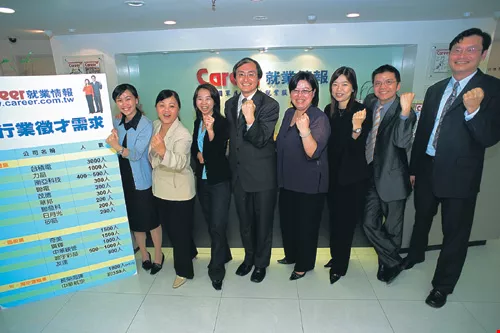
The age of multiple forms of employment makes job seekers feel insecure. But for temp labor agencies, multiple employment pushes their business ever higher. Pictured here is the team at temp agency Career, led by Christina Ongg (second from left).
The secret of delayed graduation
As a university diploma has decreased in value, many students have chosen to remain in school and do a fifth and sixth year before they sit for graduate school exams and increase their competitiveness in the workplace. In the triple-shift telephone center where Yu works there are many other fourth-, fifth- and sixth-year university students like himself who testing the waters at the workplace before graduating. Their name cards are printed up with the imposing name of the bank, they enjoy labor insurance and health insurance, yet the overwhelming majority of them are not regular staff members of the bank.
The gradual increase in this type of "temp staff" has made some fellow staffers in the financial industry feel extremely uneasy. This year these bank staffers, feeling their livelihood threatened, went into the streets om May 2nd, the day after International Labor Day. Labor union members participating in the demonstrations said if the situation continued, the expedients of temp staffing and outsourcing would threaten employment opportunities for regular workers.
More than 500 bank union representatives carried banners proclaiming "Oppose veiled wage cuts!" and "Reject cheap temp labor!" Bank employees from different banks who rarely meet each other took advantage of the occasion to swap information. One bank employee revealed that in the large bank where he worked 65% of the more than 8,000 staff were temp workers.
As a matter of fact, the day before this demonstration, the Taiwan Confederation of Trade Unions (TCTU) held an even bigger traditional May Day demonstration, and the "temp worker" problem was also a target of protests.
From the businesses listed with the various manpower agencies it is evident that the financial industry is certainly one of those most enamored of temp workers. Some banks have even created their own exclusive temp companies and have gotten into the matchmaking business themselves.
The biggest domestic online employment website, 104 Job Bank, recently published the results of a survey showing that 31.8% of the staff carrying out "non-core activities" in the financial industry, such as telemarketing, business promotion and debt collection, are temp workers. For administrative and general office work not requiring a high degree of specialization, the ratio jumps to 45.1%. Of all industries, the financial industry's demand for temp labor is steadily on the rise. From number eight on the list last year, the financial industry has risen this year to the number six position.
"There is a great deal of pressure in the financial industry, and for the most part it uses the performance award system. Staff turnover has always been high, and when short-term temp workers are used, both sides are "happy." So says a bank manager in defense of the yearly increase in the number of temp workers.
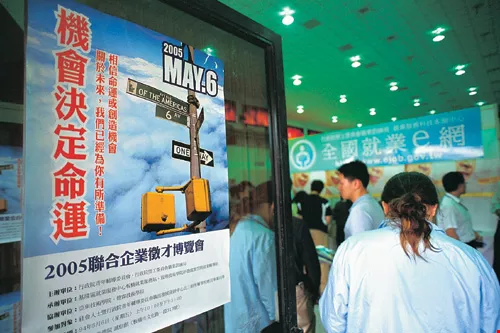
Take the opportunity, or trust in fate? In an age when working conditions are deteriorating, the workplace seems to have entered an era that makes things even more difficult.
Unturnable tide
After the new retirement system goes into effect on July 1, the cost of hiring staff for employers will rise and there will be no end to the tricks introduced to get around this, like disguised wage cuts, or firing people and then rehiring them to "reset" their seniority to zero, and many businesses will respond to the situation by hiring temp workers.
Is the new retirement system encouraging businesses to use temp labor? "Taiwan has had a temp labor market for years, like the insurance industry, cleaning and sanitary workers, nursing, and so on." Professor Joseph Lee of National Central University's Graduate Institute of Human Resource Management says, "The idea that the new retirement system has led to the popularity of temp labor is really an impression recently created by the media."
"In the long term, the ups and downs of the economy constitute the most important element in determining the temp labor market," says Christina Ongg, CEO of the employment agency Career. "I'd say temp labor is really a temporary fill-in during times of business prosperity; if the new retirement system has had any influence, it's as a short-term response."
"If industry is thinking about using temp labor to get around the new retirement system, this is really grasping at straws," says Li Chung-ling, general manager of Manpower Services (Taiwan) Co., Ltd. He goes further: "This is not how temp labor should be used!"
Although opinions differ, it is an undisputed fact that the new retirement system has encouraged some businesses to give priority to temp labor. And the burgeoning business levels of temp agencies has corroborated the growing prosperity of the temp labor market.
Steven Su, general manager of 104 Job Bank's Talent Search Group, points out that the company so far this year has seen a huge increase in telephone inquiries from businesses. As a result, the outlook for business growth for the year has been revised upward by 20%.
104 Job Bank has been in the domestic employment business for nine years and three years ago it expanded into the temp labor market. The number of temp workers it has been sending out has steadily grown the last two years, reaching some 1,000 people every month. Currently entrenched in the northern part of the country, 104 Job Bank's temp labor service is planning to move into the central and southern parts of the country next year.
Another local employment agency, Career, says the percentage of profits from the temp labor portion of their business continues to climb. Currently they are holding steady at about 1500 temp workers a day, comfortably making Career one of the three leading companies the temp industry today.
When you walk into any company office in Taiwan today you will see that the cleaning and security work is done almost entirely by people from outside. In fact, this is the territory first "occupied" by temp workers. "From the cultural and legal perspective, the various layers of sub-contracting in a project as well as 'fixed contract labor' stipulated in the Labor Standards Act provide a foundation for the development of temp labor," points out Lai Hsiang-ling, director of the Committee for Action for Labor Legislation.
From the market point of view, the move of foreign firms into Taiwan has undoubtedly pushed the entire industry toward economies of scale and a systematized approach to doing business.
The world's top two human resource market leaders, Adecco and Manpower, each landed in Taiwan in the late 1980s. Headquartered in Switzerland, Adecco earned a worldwide profit in 2003 of 16.3 billion. In Taiwan, Adecco's temp labor business has grown every year at a double-digit rate, and in the last two years has grown 30%. Every day as many as 4,000 people are sent out as temp staff. US-based Manpower claims to be the "biggest employer in the US" and has forged long-term cooperative relationships with a number of transnational companies, including Citibank.
With several decades of experience in human resource planning, these foreign companies stress that effective solutions to industry manpower needs, whether it's top-level management headhunting, ordinary recruitment and training or even temp labor to help industry with seasonal or temporary manpower needs, all fit within the scope of their service. A look at their list of clients reveals that they have "bagged" just about every important financial and high-tech company in the country.
"Because you have to put money up front, even for temp workers, the temp labor business is actually a capital-intensive one," says Manpower Taiwan general manager Li Chung-ling, explaining the advantage of the larger foreign firms. "Thus if you can have economy of scale, you are in fact able to guarantee reliable service."

Whither work? Temp workers are spread out among different companies, and it is quite difficult to set up a union in a temp agency. Rights are hard to guarantee.
Market disruption
Moving our focus from Taipei to Taichung, how is the temp labor craze faring in this, the country's third largest employment market, where some 390,000 people have labor insurance?
In front of the No. 2 city government office building in downtown Taichung there is a bulletin board completely covered over with notices of job openings. In addition to government agencies, this city of a million people has 164 different manpower agencies trying to do business by matching up employers with job seekers.
"The temp labor business today is just crazy," says Lai Shu-hui, director of the Taichung labor bureau. From "outsourcing" to "temp labor" and "contracting," new words people can't make head or tail of symbolize the coming of a new age. Whether it's the number of temp workers or temping companies, the temp labor craze has come to Taichung in a big way, penetrating every nook and cranny of the city. By March of this year there were 16,432 temp workers, including both Taiwan and foreign workers.
With the lack of relevant law on the books, the threshold for setting up one of these manpower agencies, which have an average lifespan of less than two years, is very low. A table, a telephone, and "one-man companies" suddenly flood the market.
A detailed inspection of data on the establishment of manpower agencies through the years reveals a small number of businessmen who are constantly registering under different names. Even the telephone number and address are fake. Their intention to avoid labor bureau inspections is obvious.
"They do every kind of business, from foreign labor to domestic contract labor," says Lai Shu-hui. "Also, they just need to apply to the Ministry of Economic Affairs and don't have to make any contact at all with local labor bureaus. When we do go to them to see exactly what's going on, we frequently get the brush off."
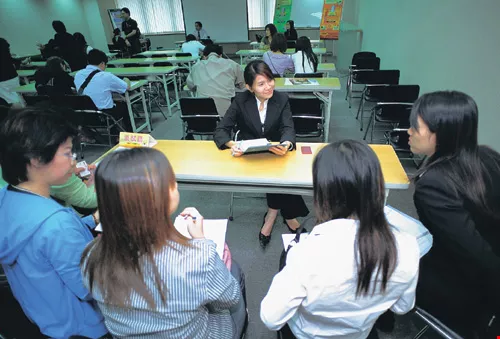
Up against the wall! Surveys show the highest percentage of those accepting temp work is in the 20- to 30-year-old working population. The photo shows young job seekers interviewing with a temp agency.
The new love triangle
The main reason industry uses temp workers is to lower their manpower costs. Three years ago a survey conducted by the Council of Labor Affairs on businesses that use middle/senior (45-65 years old) temp workers showed that they were used in adjusting manpower needs to jibe with changes in business or the overall economic situation, and by so doing companies were able to save on severance pay outlays and pension contributions.
Chen Wen-fen, general manager for Adecco Taiwan, thinks that during an age of intense competition in every industrial sector, costs must be continually reduced to meet falling profits. As a result, "On the one hand a business must spend more to retain core personnel and, as much as possible, invest resources in these people; on the other hand, one hopes to reduce resources spent on non-core personnel."
"In the past only the char force and security force were regarded as non-core elements, but today even the responsibility of keeping the books, work normally done previously only by relatives of the boss, can be farmed out or done by temp workers," says Christina Ongg.
Looking on the positive side, all this is evidence of a move toward the "rule of law" and away from the "rule of men" now that business management in Taiwan has gotten on track. On the negative side, no one person in an enterprise is any longer irreplaceable. The atmosphere of "one happy family" is yesterday's faded flower.
In the future "core personnel who get near the top of the pyramid and have key technical skills will become increasingly valuable. By contrast, the base of the pyramid will broaden without limit and people at that level will be replaceable at any time." Ongg thinks that the polarization into "core" and "non-core" personnel is already an inexorable trend in the workplace, and this trend is a harbinger of the continued expansion of the temp labor market in Taiwan.
"On the other hand, if a company has too high a proportion of temp workers, and staff without labor insurance are replaced willy-nilly, this is not really a reasonable situation." Chen Wen-fen emphasizes that "because talent is business's biggest resource, too high a proportion of temp workers means the company has no core competitive strength at all."
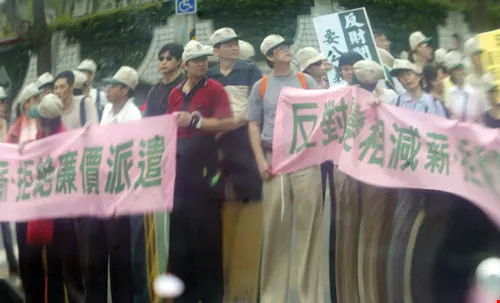
On May 2nd reps from bank employees' unions throughout Taiwan took to the streets to express their concern at the burgeoning use of temp labor.
Under the umbrella
After the new retirement system goes into effect on July 1, both temp workers and regular workers should all receive similar pension contributions (6% of their salary). "At first glance reductions in manpower costs via temp labor appear limited, except for severance pay," says Li Chung-ling. However, he adds, on closer study the difference in treatment given temp workers and regular workers is not hard to discover.
To take an example from the financial industry, these institutions regularly offer low-interest loans to employees with a certain seniority. Naturally, temp workers do not enjoy such a benefit. It's the same with the popular stock compensation systems used by Taiwan high-tech companies. Temp workers can "look but not touch." Added to this are the benefits under the Labor Standards Act: up to 21 days' special leave per year, employee travel, holiday bonuses for the Dragon Boat and Mid-Autumn festivals and Chinese New Year, and performance awards. Temp workers, who are mostly paid by the day, are not entitled to any of these things. Labor organizations' claims that "temp labor has caused a roll-back of working conditions" are not just idle posturing.
Aside from the material conditions that are not up to those of other workers, "you seem superfluous in the office, able to be summoned or dismissed by the boss at will. There is no sense of security at all, and almost no interaction with regular workers." These are the feelings of Ms. Chen, who worked in public relations in a large electronics plant.
Also, although the Labor Standards Act clearly stipulates that temp workers can organize a union within the temping agency they work for, because they are employed for different periods of time and are dispersed among client companies, it is difficult for them to find time to hook up with each other. "Setting up a union is just impossible. And this only adds to the weak position of temp workers," says Lai Hsiang-ling.
"Temp agencies often wait until they get a contract with a client before they go out and look for someone," says consultant Li Ming-yuan of Long-Term Management Consultancy Co. Ltd., who has attended many public hearings on legislation for temp labor held by the Council of Labor Affairs. Temp workers always face intermittent unemployment. "After the contract runs out, the temp agency very rarely takes an active role in seeking further job opportunities for the worker. Each month the agency receives compensation that amounts to 15% of temp workers' salaries, but they are not really living up to their responsibilities. Many workers still are never sure where their next meal is coming from.
Workers deeply fear the loss of their right to work. As for the companies that use temp labor, when they are enjoying the benefits of saving on manpower costs, they cannot help but be a bit alarmed themselves.
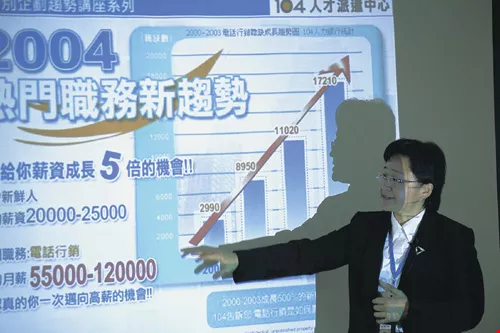
With a sudden change in work trends, manpower businesses quickly responded. 104 Corporation, one of Taiwan's leading recruitment agencies, also entered the temp labor market three years ago.
Maintaining market order
"We are very interested in the quality of temp agencies," says Chen Chao-ling, director of human resources at HannStar, one of Taiwan's largest LCD screen makers. Last year the company began using temp labor. The contracts stated clearly that, aside from basic benefits like labor insurance and health insurance, the salaries paid on behalf of the company by the temp agency had in all cases to be paid on time. "In the end, if a wage dispute should ever arise, a high profile company like us will certainly become a target."
This April while interpellating an official, a legislator pointed out that one OTC listed company had a workforce made up of 80% temp workers, and requested the Council of Labor Affairs look into the matter. Recently, media reported a temp labor group composed of independent doctors that specialized in temp labor needs for hospital emergency clinics. Extreme examples, too many to enumerate, not only bring forth doubts and fear among workers, everyday consumers who use services cannot fail to feel ill at ease.
"With so much temp labor in the banking industry, might not there be some holes in the management allowing customer data to leak out?" "Temp doctors in the emergency room-can they be as committed as permanent doctors? If there is a medical dispute, can they be found to take responsibility?"
In order to clarify the chaotic temp labor scene, at the national service industry conference at the end of last year, the Council for Economic Planning and Development concluded that it would develop a policy to guide the development of the temp industry and scheduled this year for drawing up the relevant legislation.
"Is it necessary to make more laws?" questions Joseph Lee. "Take the US for example. Since 1970 they have passed no new laws specifically dealing with labor at all. That's because they know that laws always have loopholes, and that the less modern government controls, the better. To control the minimum wage and maximum working hours and strictly enforce the law is enough."
Looking abroad, Japan, famous in the past for its "lifetime employment" system, today uses the most temp workers among Asian countries. Some 35% of its labor force is of the non-conventional variety, and about 11% of that is temp labor. And a look at Europe and the US reveals 15% for temp labor's share of the workforce. The Netherlands and Finland are at 50%.
In the long run, whether it is the open market competition approach of the US or the tight regulatory environment of Europe, the percentage of temp labor is for the most part holding steady at 10-15%. Against a percentage for Taiwan of less than 1%, room for future growth in this area is staggering.
May Day tragicomedy
On May 1, 1886, suffering under excessive working hours, American workers gathered in Chicago to hold a massive strike and, through a violent struggle, they won the "38-hour" work week. After this, May 1st was designated "International Labor Day" and every year on this day innumerable workers around the world go into the streets and fight for their rights from employers and government.
"Writing legislation is like writing an endorsement. I'm afraid it will only bring on another wave of temp labor itself," says Lai Hsiang-ling. On the evening of May Day this year she sat exhausted in her office. Lying on the floor in the corner was a placard bearing the slogan "Oppose Exploitation." But like it or not, the trend is so big it seems no one can stop it.
Gathering together on May Day, some people go into the streets to fight for their rights, while others stand up on platforms and are honored. On May 2nd Chang Chin-liang, who works in the I Hsin Machine Company in Taichung, mounted the platform of the labor service center and received the model worker award from the hands of Taichung's mayor, Jason Hu.
Chang Chin-liang, who turned 60 this year, has worked in the same company for 35 years. On the eve of his retirement, he continues to pass on his knowledge of the complex and delicate machines to new workers, for which he was nominated for the award.
Modern education teaches the sanctity of work. Work is not only necessary to sustain life, even more, it is a direct way of contributing to society, of realizing the self and of searching for identity.
The same May Day, differing manifestations-a story of changing times. Watching Chang Chin-liang as he left the platform, one could not help thinking anew about the meaning and value of work.


@List.jpg?w=522&h=410&mode=crop&format=webp&quality=80)


