The Powerful Sounds of Judy’s Harmonica Ensemble
Jojo Hsu / photos Judy's Harmonica Ensemble / tr. by Geof Aberhart
May 2017


Search for “Judy’s Harmonica Ensemble” on YouTube and you’ll find five young people in evening wear standing on stage, clasping in their hands harmonicas of various sizes. The first note rings out, sending a shockwave through the audience. The piece, entitled “Labyrinth,” certainly has the audience seemingly feeling lost, wondering how instruments so small could produce a sound on par with the majesty of an orchestra.
Judy’s Harmonica Ensemble was formed in the spring of 2002. The five members, average age 32, all come out of the Cozy Harmonica Club of the Affiliated Senior High School of National Taiwan Normal University, and together they form Taiwan’s oldest harmonica quintet. The quintet is made up of three chromatic harmonicas, one bass harmonica, and one chord harmonica. The chromatics are responsible for the main melody, the bass handles the bassline and rhythm, and the chord harmonica plays, well, the chords.
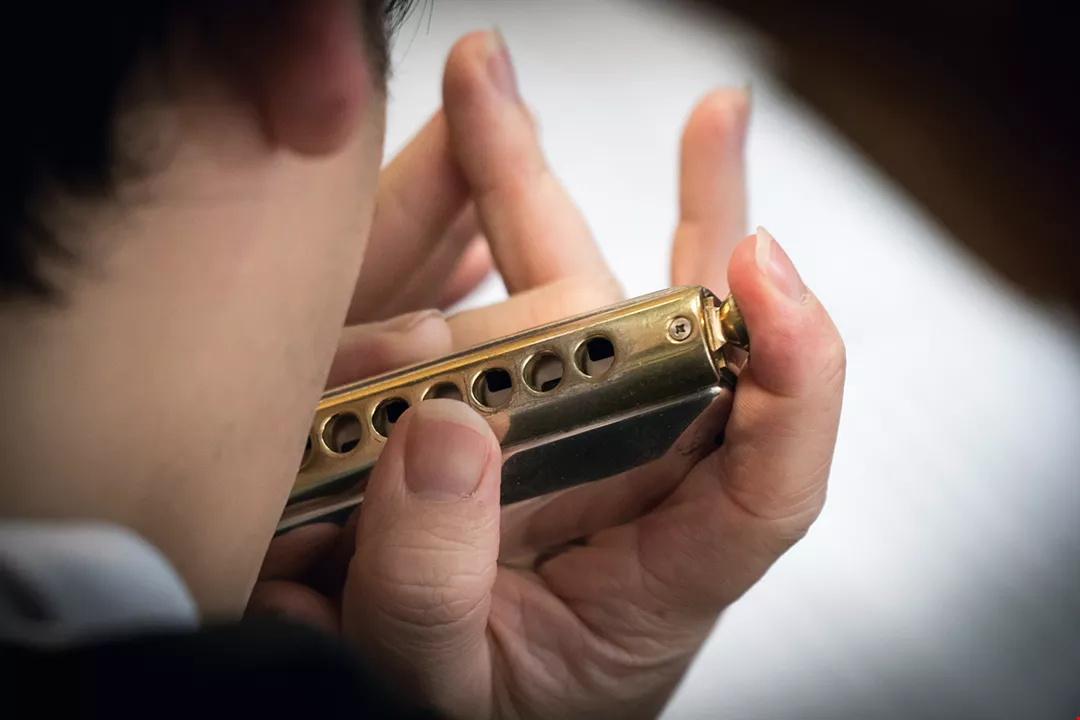
Harmonica groups use different kinds of harmonicas depending on the size of the group. Chromatic harmonicas (above, and upper left in photo below) are characterized by the button that enables players to raise or lower the key, and are usually used for the main melody; bass harmonicas (below, bottom left) take care of the bassline and rhythm; and chord harmonicas (below, right) are the biggest in the lineup. (photos by Lin Min-hsuan)
Beautiful misunderstandings
In their 15 years together, they have put on over 300 concerts, been buskers, toured Taiwan, and even stepped onto the world stage. They have been invited to tour Japan and South Korea, playing everything from classical to folk and jazz, as well as a few well-known movie themes. Judy’s Harmonica Ensemble has earned titles like World Champion at the World Harmonica Festival and Triple Champion at the Asia Pacific Harmonica Festival, becoming a world-renowned professional harmonica ensemble.
The members may all have been part of a harmonica club at high school, but their ties to the instrument itself could be considered beautiful misunderstandings. Yang Chih-hui, who plays the bass harmonica, originally wanted to join the traditional Chinese music club, while Lin Ying-chih joined because “most of the people in the guitar club were snobs.” Lu I-chen, who plays chromatic harmonica, was invited by another student and joined reluctantly, never expecting she would soon fall head over heels for the instrument.
Another chromatic harmonicist, Li Jang, joined because his father told him the harmonica was easy and didn’t require learning to read music, “which was definitely a misunderstanding.”
Meanwhile ensemble leader Chuang Chu-ti joined the club as soon as he got into the school, having been bowled over by his cousin’s harmonica skills. After seeing the world-famous harmonicists the Adler Trio perform in Taiwan, Chuang was astonished by their music and wanted to emulate them. He formed Judy’s Harmonica Ensemble with Yang Chih-hui the following year.
Even as an art major at college, Chuang continued to be mad about the harmonica, playing in competitions abroad and teaching the instrument on the side. Once he started making enough to get by, he decided to put his studies on hold. “I was already 100% sure I didn’t want to get into the arts,” he remarks. Fortunately for Chuang, in the group’s early days they won the ensemble division and placed second in the trio division at the Asia Pacific Harmonica Festival, which soon earned him his family’s support and understanding for his decision.
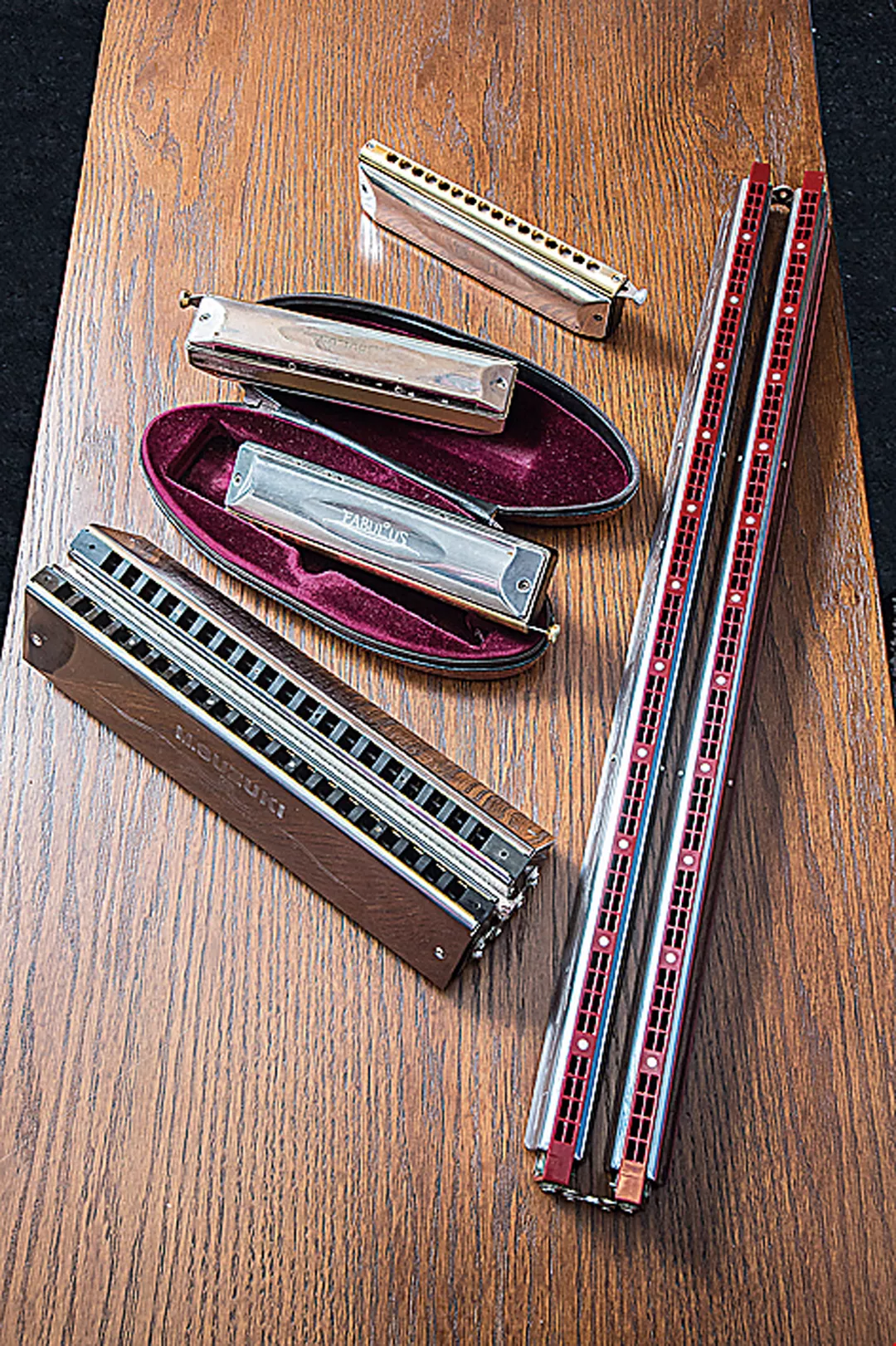
Harmonica groups use different kinds of harmonicas depending on the size of the group. Chromatic harmonicas are characterized by the button that enables players to raise or lower the key, and are usually used for the main melody; bass harmonicas (bottom left) take care of the bassline and rhythm; and chord harmonicas (right) are the biggest in the lineup. (photo by Lin Min-hsuan)
Not so simple
The harmonica is a young instrument, first coming into the world in Germany in 1812. Even more recently, it has expanded out into various kinds of harmonica, including chromatic, chord, and bass. Chuang says that the harmonica is light and easily portable, which are both strengths and weaknesses. “Harmonicas might be easy to play, but they’re quite quiet and there’s no resonance, which makes it hard to make them sound really nice.”
He also jokes that it’s an instrument very susceptible to the climate. The chromatic harmonica, for example, isn’t particularly easy to drain water out of, so that when it gets cold, the condensation tends to accumulate, blocking airflow and all but silencing the instrument. Before performing, he uses all kinds of measures to warm the harmonica up, from heaters and hair dryers to simply holding it tight and using body heat.
However, the difficulty of the harmonica is what makes it so appealing to many—the structural limitations of the instrument essentially make the player part of it. Li Jang, who has a special soft spot for the harmonica, excitedly comments, “Your mouth is the resonance chamber, so every player around the world produces a different sound, a sound that faithfully reflects the player’s own personality.” And while there isn’t really much in the way of music written specifically for harmonica, Lu I-chen, who has a foundation in piano, has spent a great deal of time exploring composition. On top of that, being so quiet, the harmonica needs the help of a sound system to amplify it, but most sound engineers aren’t very familiar with the instrument. Chuang has done intense study into the sound systems and technologies best suited to getting the most powerful sound from little harmonicas. The group take their own equipment to performances, as well as having their own recording studio in a small workshop on Jilin Road, Taipei.
Li Jang, meanwhile, went from knowing nothing about musical staves to becoming the group’s composer, writing their pieces “Oasis,” “Labyrinth,” and “The Map Painter.” The decision to form a quintet came because “adding one more person changed everything. Starting with four higher-pitched instruments, we added a rhythm instrument, and that let us produce more rigorously complete music. It opened up some new possibilities, and made both performing and writing more challenging and more fun!”

Li Jang, Chuang Chu-ti, Yang Chih-hui, Lu I-chen, and Lin Ying-chih (left to right) play a song in the relaxed atmosphere of their band office. (photo by Lin Min-hsuan)
Fruits of their labor
The hard work of Judy’s Harmonica Ensemble as both performers and promoters of harmonica music has begun to bear fruit across Taiwan. Lu notes that harmonica clubs have become increasingly common in elementary and junior high schools in central and southern Taiwan, with quintets the most mainstream form. 2016 was a landmark year for the ensemble, marking their debut performance at Taiwan’s premier music performance space, the National Concert Hall. Their concert was built around “The Map Painter,” with pieces as diverse as exciting Roma music, passionate Argentinian tango, vibrant Romanian music, and the debut performance of a suite specifically created for the concert. By the end, the ensemble had brought the house down.
The harmonica has come to be an irreplaceable part of the lives of the ensemble’s members. His voice full of emotion, Chuang says, “I like the harmonica to the point I couldn’t be apart from it. I’m so lucky to have found something I love so much while I was still in high school.” Lin Ying-chih, meanwhile, likens the harmonica’s charm to the hero of manga Case Closed, Conan Edogawa: “Conan looks like a child, but has smarts beyond most people. Similarly, the harmonica might seem structurally simpler than other instruments, but it’s a profound instrument. Pianos have so many keys and require so much fingering practice, but the most basic harmonica has just ten holes and, at most, a button to switch between two keys. That said, what really changes is your mouth shape, tongue position, and other things the audience just can’t see.”
What might be the greatest talent of Judy’s Harmonica Ensemble is their ability to take such a simple instrument and create such complex music.
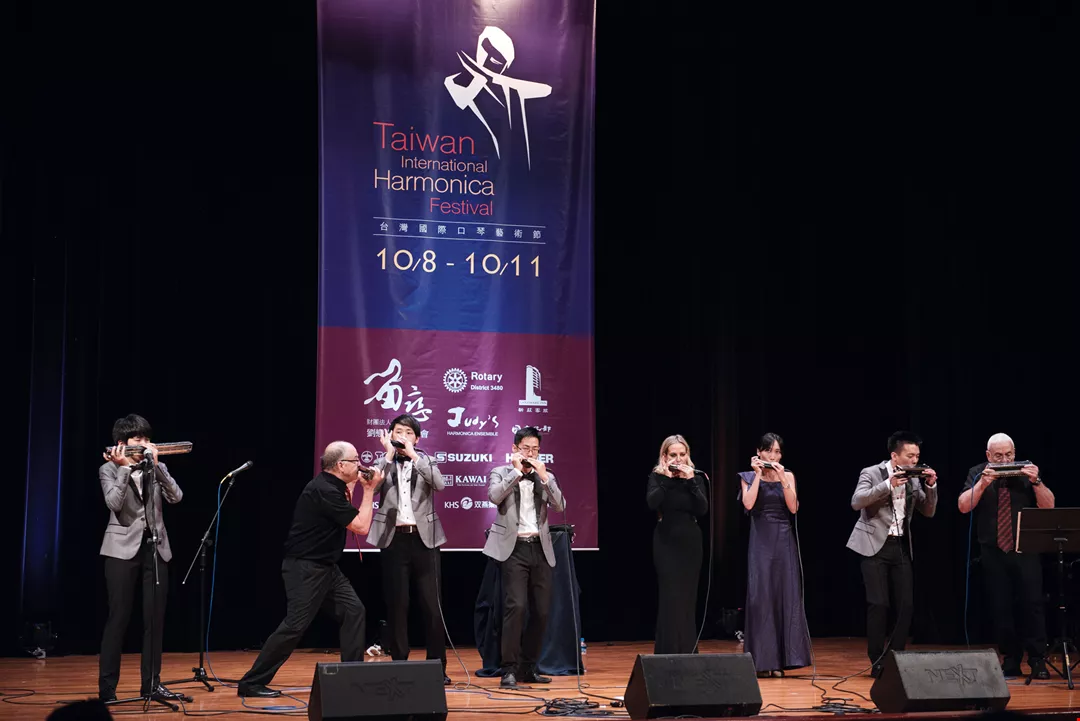
Years after seeing the Adler Trio put on a dazzling performance in 2001, Chuang Chu-ti and Yang Chih-hui were finally able to take the stage with their idols.
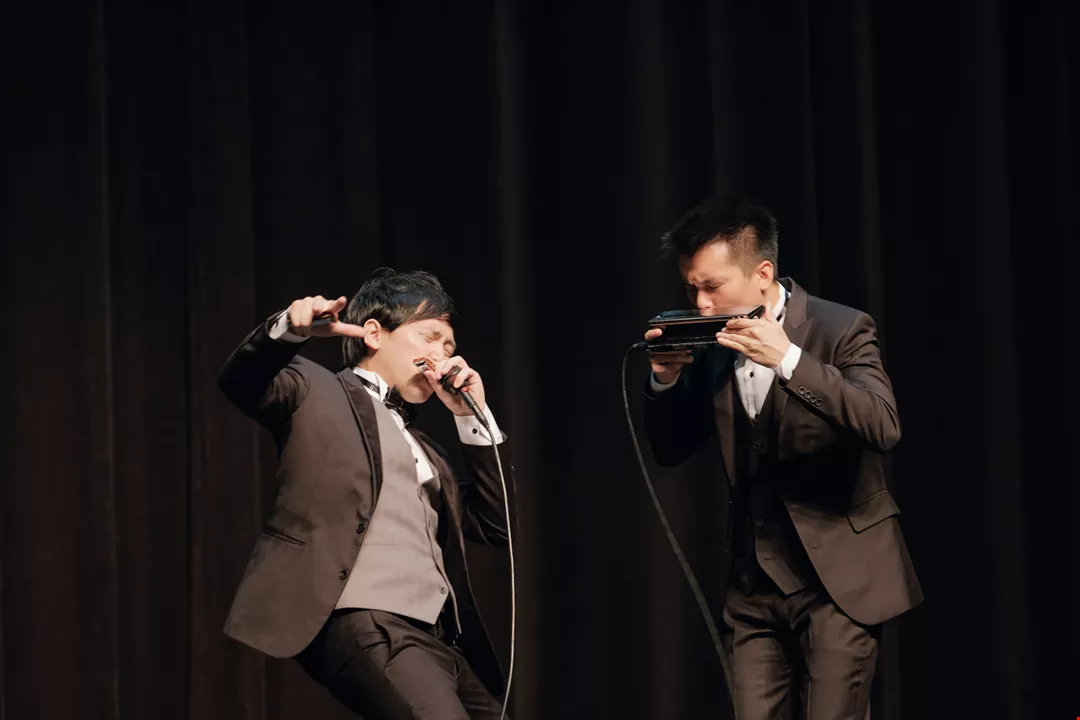
Li Jang (left) and Yang Chih-hui (right), letting the music take control.
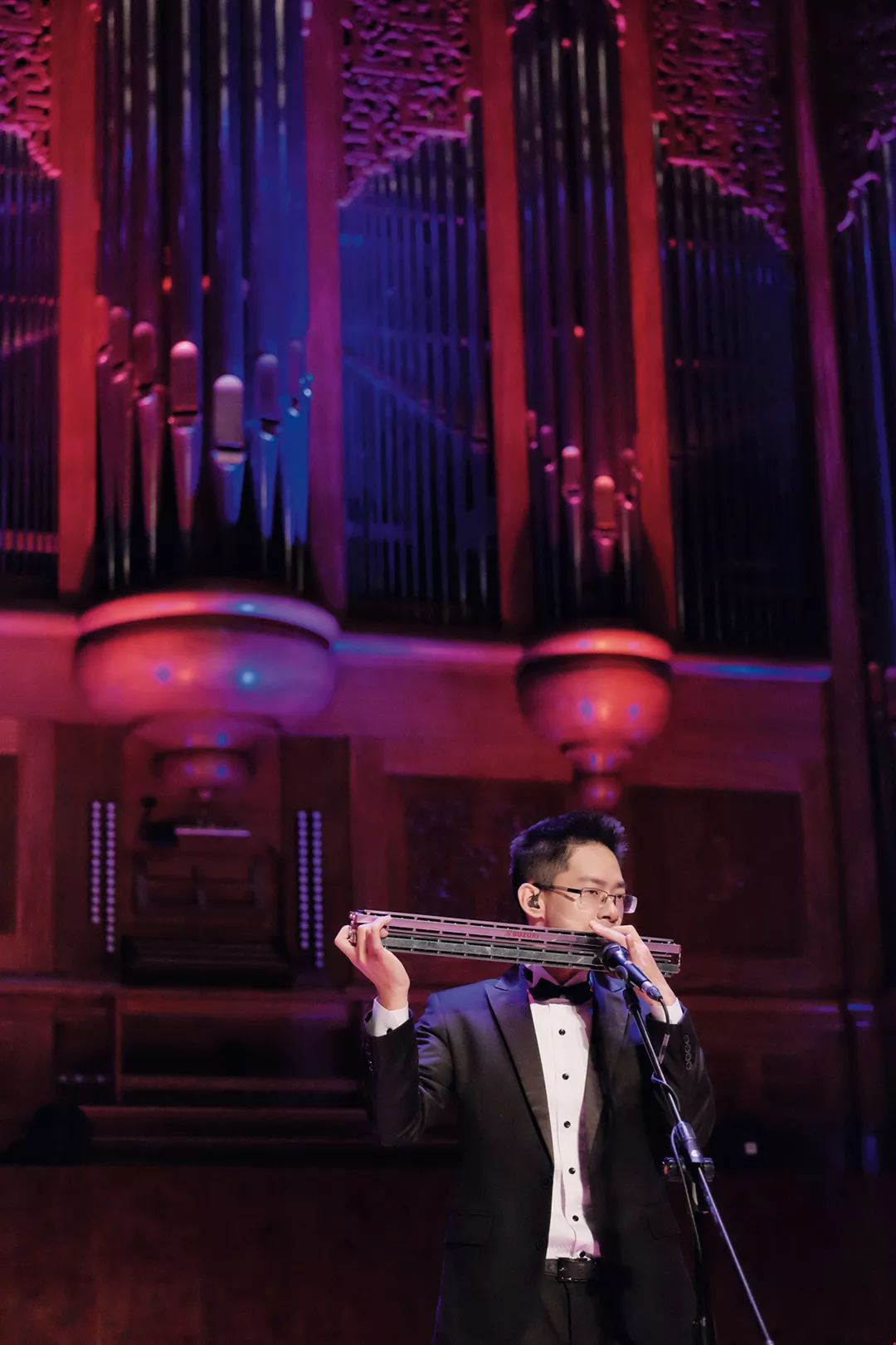
In the hallowed arena of the National Concert Hall, ensemble leader Chuang Chu-ti shows off his skills with the chord harmonica.

Judy’s Harmonica Ensemble has been together for 15 years, ultimately becoming Taiwan’s leading professional harmonica group. (photo by Lin Min-hsuan)


