Treating walls as blind boxes
In the past, cement work played only a supporting role in architecture. After a wall was finished with a smooth cement render, it was covered up by paint, tiles, or wood paneling. But with the rise of fair-faced concrete and the wabi-sabi style of interior design, which finds beauty in original materials, minimalism, and imperfection, white cement has become a center of attention.
Once a woodworker friend of Ah Hong’s invited him to teach a class in cement trowel painting on canvas. He began treating cement as a medium and his trowel as a paintbrush, with each step of layering and scraping leading to unique patterns.
For people who appreciate his style, he decorates feature walls with his artworks. Operating without a preliminary sketch, he ad libs on the spot. He says with a chuckle that each feature-wall artwork is like “opening a blind box.” The variations in depth as the cement dries, and the changes in light and shadow produced by light projected against each surface, are impossible to repeat exactly—they are creative products exclusive to the moment.
From his days as an overworked apprentice to his freewheeling troweled art of the present day, Ah Hong’s life is proof that “working a trade is a very cool thing!”

Ah Hong shares his skills and experience with the public. Working a trade enables him to live his best life, support his family, and make his days more colorful. (courtesy of Nijohn)
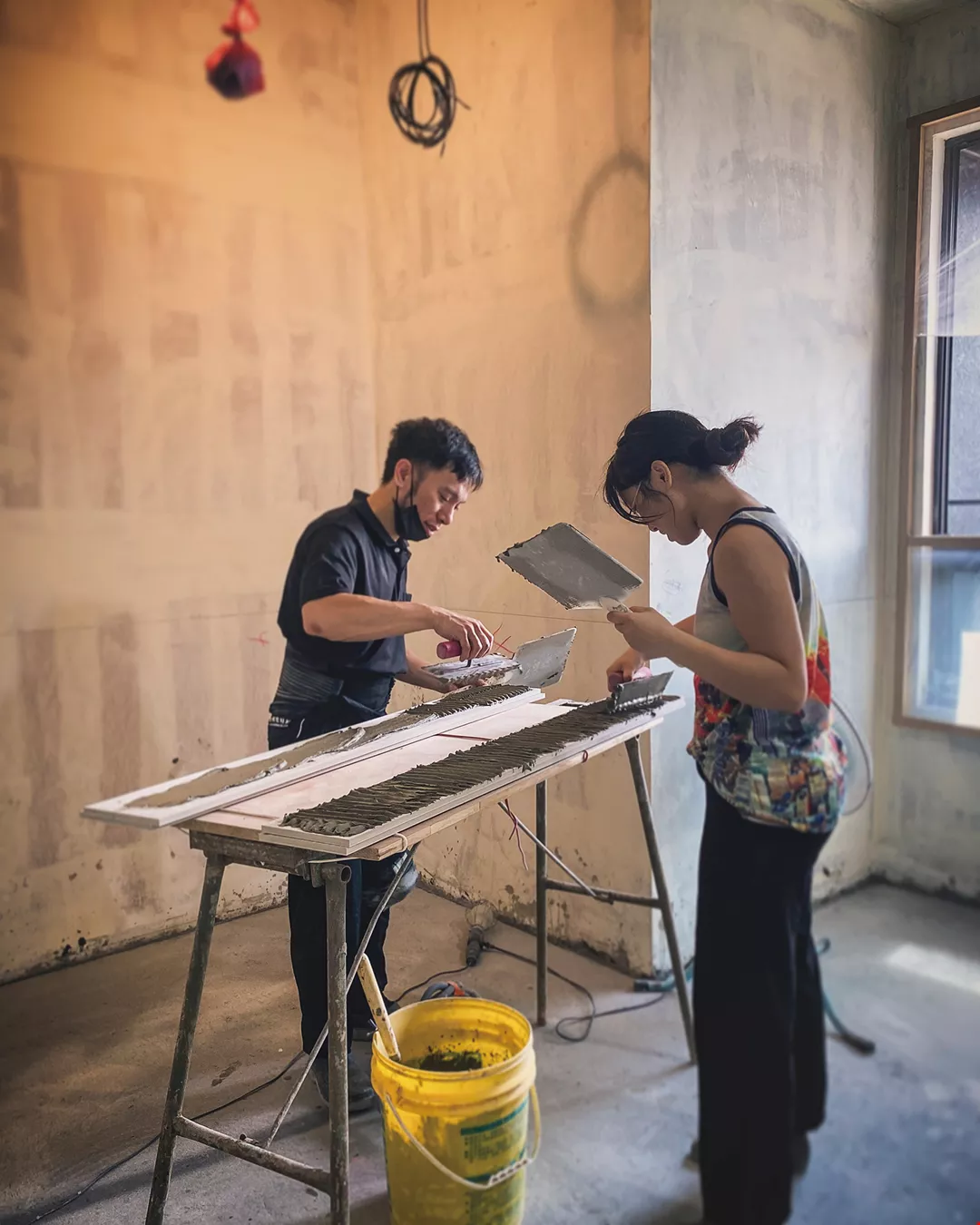
Ah Hong takes his children to worksites to learn masonry skills, how to stay grounded, and the value of hard work. (courtesy of Nijohn)

Ah Hong often jokingly refers to his son and daughter as “second- generation trade workers”; they are capable helpmates. The three are shown here happily posing in front of a completed feature wall. (courtesy of Nijohn)




@List.jpg?w=522&h=410&mode=crop&format=webp&quality=80)


@List.jpg?w=522&h=410&mode=crop&format=webp&quality=80)
