Reclaiming the Streets--The Graffiti Art of Bbrother
Chang Shih-lun / photos Chuang Kung-ju / tr. by Scott Gregory
October 2006


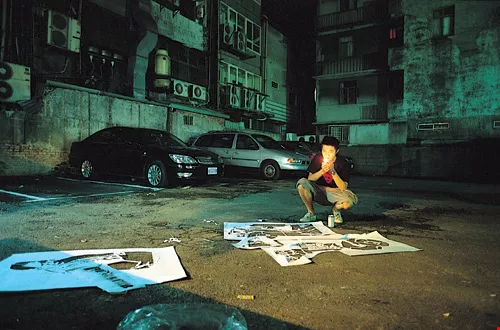
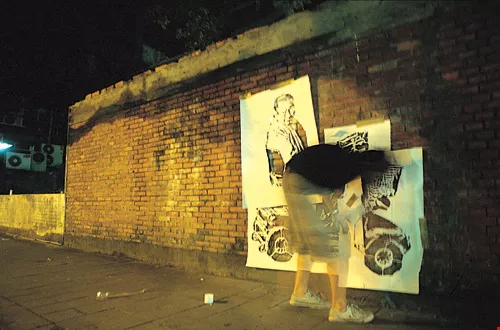
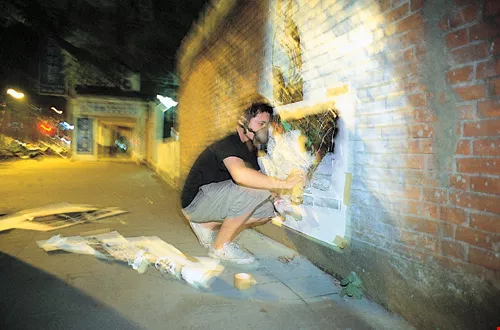
It's 3 a.m., and it's dead quiet on this street corner along Taipei's Hsinyi Road. The only light is from the headlights of the occasional passing car. In a roadside parking lot a tall youth wearing a painter's mask waves a can of spray paint through the air, looking back from time to time to make sure no one sees him.
It takes less than 20 minutes for his rattling spray can to leave its mark--a life-size portrait--on the brick wall. The subject matter is a pair of disabled residents of the recently condemned Happy Life Sanatorium. He double-checks the details such as the coloring and the outlines before signing his name, "Bbrother," and disappearing into the night.
"I used to get a little ridiculous and put my e-mail address to the side of my graffiti pieces. I thought that if people wanted to remove it or just make a friend they could at least drop me a line, but I never got any feedback," says the young man modestly after he pulls off his mask. But his socially conscious, rebellious graffiti works and his creative use of space have been getting good reviews from the underground crowd, who consider him the definitive figure in Taiwan's burgeoning graffiti scene.
People either love or hate graffiti art. Those who appreciate it say it adds a new element to the cityscape that reflects the creativity and provocative nature of the young. To its detractors, it is a defacing of the city and a sort of visual pollution. But graffiti is undeniably a global youth culture phenomenon, and it has recently begun to take hold in Taiwan.
To protect themselves, most graffiti artists conceal their true identities and adopt a pseudonym in their work. "As for the mask, it's because the smell of the spray paint is too strong. If you don't wear one, it's really overpowering," says Bbrother.
A graduate of National Chengchi University's Department of Advertising, Bbrother has soft features and speaks in measured tones--hardly the image of the rebellious, streetwise graffiti artist. While at university, he noticed that there were security cameras all around the NCCU campus. The students, he felt, were relatively passive and constantly monitored by teachers. For this reason, he began tagging his graffiti pieces with the slogan "Big Brother is watching you" from English novelist George Orwell's 1984. That was a little long, so he shortened it to "Bbrother."

Painting, photography, graffiti
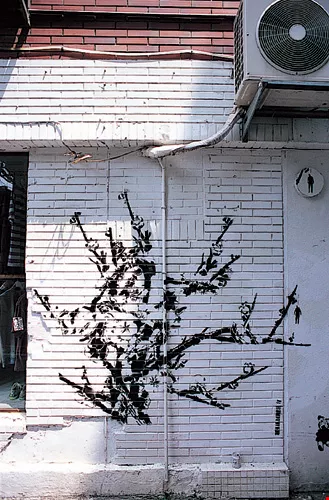
As a child, Bbrother studied sketching, watercolors, and the basics of Chinese painting. From far away, his piece Flowering Prosperity looks like an Asian-style ink-brush painting of flowers, but step closer and you will see that the stems and branches are actually the barrels of guns, and that hanging from them are dead bodies--a warning against the threat posed by the authorities to human rights.
Another of Bbrother's influences is traditional photography. While studying advertising at NCCU, he took some photography courses. He explains his conceptual, experimental style from that time: "I bought a big mannequin through an online auction and rode around taking 'his' picture all over the place like a madman."
While at NCCU, Bbrother felt the atmosphere there was stifling and that most of the students had no interest in public affairs, so he and a few classmates formed a group they called the Mountain Guerrillas that would use photography, posters, stickers, street theater, and graffiti to bring up campus issues in a creative way. They aimed to use the "guerrilla" tactic of striking quickly and then scattering.
Traditional works of art in an exhibition would mostly just sit passively in some corner of the campus waiting for visitors to come and view them. To escape this limitation, the group would develop large quantities of photos and paste them up all around campus to get their messages across. Bbrother made one called "It's fun to go riding on his scooter, but guys always brake too hard," which satirized the group dating practice called lianyi so popular among Taiwan's university students. But developing 200 pictures cost around NT$600, and they were all pulled down within just a few hours. Not only was it expensive, but it was also ineffective.
Bbrother only discovered graffiti by chance. Browsing in a bookstore, he happened upon a book introducing American and European graffiti artists that included a how-to section. His curiosity was piqued, and he gave it a try on his own.
Broadly speaking, graffiti is separable into two types, freehand and stencil. In the former, the work is done completely on the scene. In the latter, the artist first prepares a stencil to spray on various walls, allowing him to make duplicates quickly. Bbrother works with stencils.
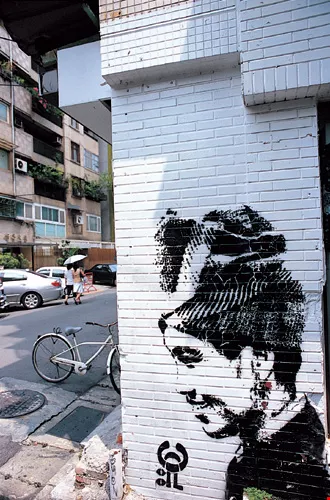
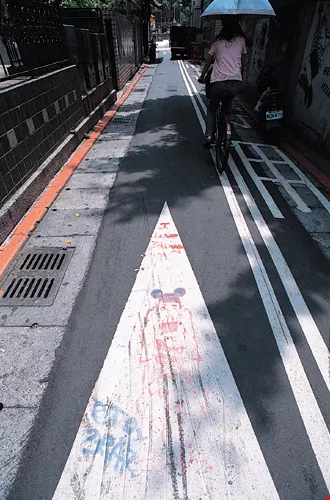
In recent years, graffiti has become a more and more common sight on the streets of Taipei as youth use public space to express themselves. To some, it's art, but to others it's vandalism.
Art warfare
Graffiti is all about using space in the city. How is it that Bbrother, who studied media, became interested in questions of space? It started in his senior year at university, when he worked with architect Chi Ti-nan and became aware of architectural approaches to space. Chi is the founder of a school of thought called "micro-urbanism," which advocates reform in the use of space in cities. Large-scale construction projects are not needed, according to the theory--when attention is paid to smaller elements, the space will change on its own. Changing space is a kind of urban warfare in which camouflage and deception are employed. Guerrilla-style graffiti art is thus a way to reclaim public space.
In 2005, a plan to build a golf course on the mountains behind NCCU created a lot of controversy. Bbrother's Mountain Guerrillas made up a "No Golf" stencil to be sprayed around. It pictured a man swinging a giant lollipop like a golf club, a satirical implication that only a privileged few would be able to use the proposed course. In addition to this, there were other stencils sprayed all around campus, such as a Chiang Kai-shek with a punk haircut, a Marilyn Monroe with a gaping mouth, and a Ronald McDonald with a sinister expression. The works were controversial.
Early in his graffiti career, Bbrother would return to the "scene of the crime" to check out students' reactions. He found that most of them were critical of his work. "Listening in on them, I'd often feel hurt," he says. The school authorities were intent on punishing the group, but in the end were afraid of being seen as limiting creative expression. The Mountain Guerrillas also compromised, agreeing to spray their stencils on calligraphy paper then paste the paper up. This kept them from leaving indelible marks, but it also meant that the group were able to paste their works in places where they'd be harder to remove, such as high on pillars.
The Mountain Guerrillas' art won them both praise and condemnation, but at the very least it brought debate to the campus about uses of public space. Bbrother was also led to the realization that graffiti art is an effective way of reclaiming public space.
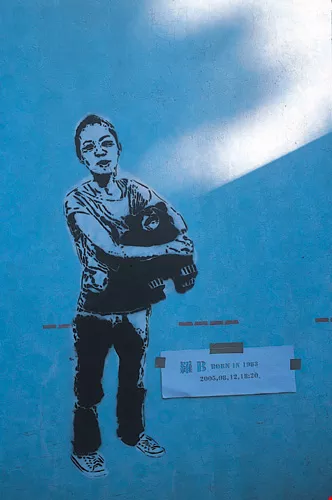
Bbrother's recent works, which feature friends' portraits along with their year of birth and the date the photos were taken, are records of friendship.
Put imagination in power
After graduating, Bbrother continued with graffiti, turning his focus to social issues. His street works carried short, sharp social criticism that left deep impressions on passersby.
His piece Cheap Rice Hurts Farmers, for example, features the shocking image of a farmer holding a gun to his temple. It was in protest of Taiwan's entry into the World Trade Organization, a move that threatened to lower prices of locally produced rice. Another piece protesting the Assembly and Parade Law showed a police officer holding a placard, and above him was written the satirical message, "The police are breaking the law--order them to disperse." For years, Taipei County has been mulling the question of whether to relocate the Happy Life Sanatorium to make way for the Hsinchuang MRT line. To speak up on behalf of the sanatorium's residents, Bbrother made a life-size stencil of them protesting and sprayed it all over. The action made it impossible for city residents to ignore the crisis the residents faced.
Graffiti art might not be able to change the world, and it can't be used to discuss an issue in as much detail as words can, but Bbrother believes that if it can shock passersby into thinking about an issue then it is a success. That's exactly the reason why he doesn't like to use slogans full of righteous indignation in his pieces: "If the message is too obvious, then it's just the same as [a loan shark] writing 'pay up or else' [on a debtor's home]," he says. In the case of the works centering on the Happy Life residents, for example, passersby only see the images of the dispossessed seeking help and are free to draw their own conclusions. To him, this is a better way.
Bbrother believes that graffiti is just a means by which one can express one's opinions. And since it's an art form of the street, it disseminates information to residents quickly, telling them what's going on in the city.
Bbrother mostly operates in areas in and around Taipei City's Ta-an District, such as Kungkuan and Shihta Road. As these areas are home to many institutions of education and the arts, their residents are more likely to be accepting of graffiti. When they spot him at work, they are mainly just curious about what he's doing. The police rarely interfere, and when they do, Bbrother just says in a matter-of-fact way, "I'm beautifying this wall!" Usually, that's enough for them.
It doesn't take him much time to spray a piece, either--a more complicated one might take just over ten minutes, while a small one can be done in less than a minute. He hasn't been completely without incident, though. Once, he was painting in an alley off Shihta Road in the middle of the night when an enraged local came out with a baseball bat, awoken by the rattle of the spray can. Bbrother took off.
The social significance of graffiti is in the artist's taking a risk and using his creative abilities to overturn people's habitual notions concerning public space. To describe the power of graffiti, many borrow a graffiti slogan from the May, 1968 student movement in France: "L'imagination au pouvoir" ("Put imagination in power!").
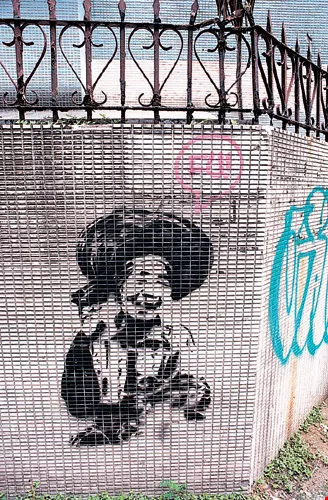
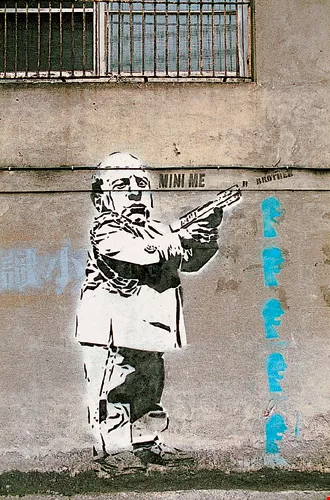
Bbrother's work touches on a variety of subjects. From left to right: Mini-Me from the "Austin Powers" films; Flowering Prosperity, an indictment of human rights abuses; Cheap Rice Hurts Farmers, which sympathizes with the plight of Taiwan's farmers under WTO rules; and a depiction of a friend.
Vanishing art
As graffiti uses public space as its platform, it is often covered over or removed. With luck, a piece might survive for a few months, but ones painted in too conspicuous places might last only a couple days before being painted over by residents or removed by public cleaning crews. Because of this, some think of graffiti as a "vanishing art form" that's only seen occasionally on the street by chance and cannot be collected and displayed in a museum like a traditional art work.
After creating a stencil, Bbrother will usually only spray it four times in different places. "If it gets seen, great. If it doesn't, that's OK too," he says. Since graffiti art is removed from time to time, graffiti artists have more incentive to keep at their craft, he explains, and the cycle of painting and removing is a joy in and of itself.
Bbrother says that graffiti artists should be accepting of the fact that their works will disappear, but to him the regrettable thing is sometimes the cover-up job citizens do is uglier than the graffiti. The whole wall ends up a messy patchwork.
With more and more graffiti in Taipei, some have advocated that the government designate a special area in which graffiti is permitted, then crack down on graffiti outside of that area. As a graffiti artist, Bbrother says he'd prefer anti-graffiti policies--"At least that way they'd be sure to paint the walls clean regularly so we'd always have new space to spray." A government-designated special area for graffiti similar to those set aside for posting bills would not only be insulting to artists but would also represent how other areas were off-limits. To the graffiti artists, that would be a step backward.
Graffiti artists seek total artistic freedom. Perhaps such freedom infringes on others, but this minor infraction against the public order is part of the art's appeal. To outsiders, graffiti might look like a bunch of random daubing on walls, but the artists understand that there is a sort of unwritten code. For example, their painting represents the reclamation of public space and a challenge to the authorities, so it is natural that they would primarily target public buildings and avoid damaging private property. At times, however, the line between public and private is not so clear. It is hard to say, for example, whether a publicly owned, privately managed parking lot is a fair target.
Bbrother acts as a lone wolf, and is usually consumed with his own work. But most graffiti artists notice others' pieces, and some will even make "changes." One artist, for example, carelessly painted over part of someone else's piece. In revenge, the other artist painted Xs over all his works and even wrote "Banksy Toy" to their side--implying that the works were derivative of the English graffiti master Banksy's style. Bbrother's works are well-received by his peers, so occasionally someone will spray "Good!" next to them.
To keep their pieces from "disappearing" too quickly, graffiti artists sometimes choose hard-to-reach locations to work in. For example, Bbrother often climbs up onto the roof of a one-story building and paints on the second story of the one next door. Not only is the work then harder to paint over, it is also more visible from below. And when an effective work is in a visible spot, it often attracts more graffiti artists. In a parking lot in a crowded alley next to the National Taiwan University area branch of Eslite Books, there is a wall that's become known as the "Holy Wall" of graffiti. New works appear all the time.
The controversy over the Mountain Guerrillas of National Chengchi University was covered in the newspapers. Bbrother's mother noticed how he'd go out in the middle of every night and grew suspicious. One night, she finally confronted him, asking, "You aren't the one they reported about in the papers, are you?" When his family learned of his graffiti activities they were completely opposed to it, but with time they came to quietly accept it. They'd even come home after seeing his graffiti on the streets and complain, "What are you doing spraying graffiti all over the place?" They'd advise him, "Don't stay up all night every night--it's bad for your health!"
A softer side
Bbrother believes that if an artist presenting his work to the world always maintains a "tough" attitude of defiance, he'll burn out quickly. That's why he occasionally mixes it up with some "softer" material.
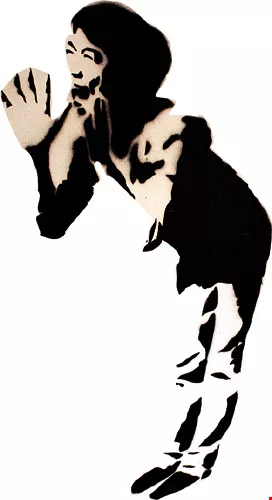
Now, as he waits to begin his mandatory military service, he's moved his focus onto his friends. First he photographs them, then makes a life-size stencil so they can make their "debuts" in public spaces. These works are something like "monuments" to ordinary people--people who haven't changed the course of history with great achievements but who live and breathe and make their lives in the city just as we all do.
Those graffiti artists who use the city as their canvas aren't really angry youths venting their frustrations, nor are they decorators beautifying the city, nor yet its destroyers. They are artists with something to say. Bbrother hopes that when people see graffiti, they will view it without prejudice. Overly praising or condemning it is really a distortion of the art.
Perhaps after his graffiti fade into the past, everything will be back to normal. It will appear as if nothing ever happened. But for those who happened upon his works, perhaps something will continue to resonate in their minds.
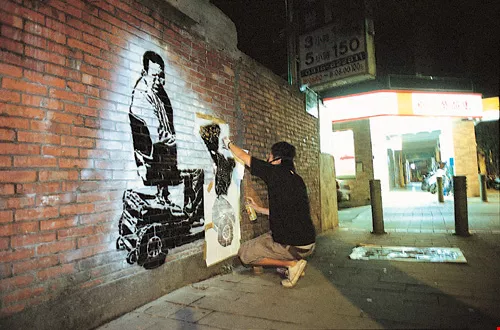
With the streets as his canvas, guerrilla artist Bbrother strikes in the middle of the night while the city sleeps.
Fact file
Handle: Bbrother
Education: NCCU advertising dept.
DOB: 1982
Graffiti style: Stencil
Web presence: www.wretch.cc/blog/bbrother
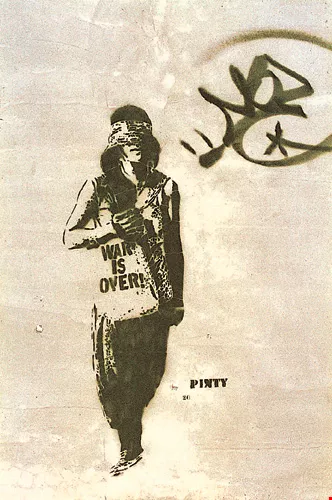
Bbrother's work touches on a variety of subjects. From left to right: Mini-Me from the "Austin Powers" films; Flowering Prosperity, an indictment of human rights abuses; Cheap Rice Hurts Farmers, which sympathizes with the plight of Taiwan's farmers under WTO rules; and a depiction of a friend.
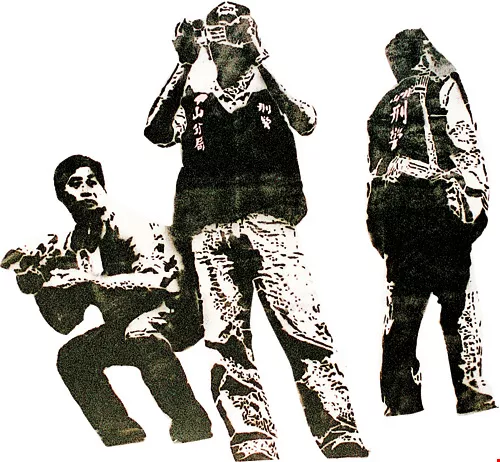
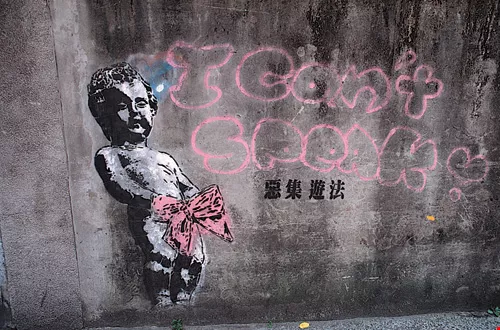
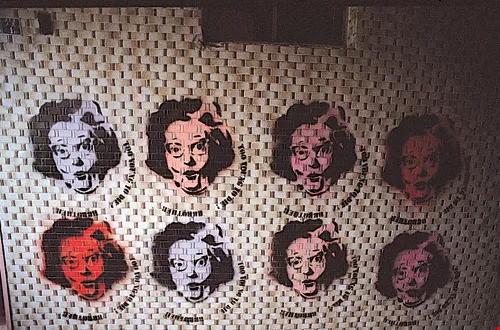
The cheekiness of Bbrother's works has a critical edge. At left is his version of the Manneken Pis, part of a call for the scrapping of the Assembly and Parade Law. At center is his "Eternal Youth" series featuring a modified image of former British prime minister Margaret Thatcher. At right is a graffiti work criticizing the Taiwan Railway Administration for forbidding people to use their disused buildings.
With the streets as his canvas, guerrilla artist Bbrother strikes in the middle of the night while the city sleeps.
In recent years, graffiti has become a more and more common sight on the streets of Taipei as youth use public space to express themselves. To some, it's art, but to others it's vandalism.
Bbrother's work touches on a variety of subjects. From left to right: Mini-Me from the "Austin Powers" films; Flowering Prosperity, an indictment of human rights abuses; Cheap Rice Hurts Farmers, which sympathizes with the plight of Taiwan's farmers under WTO rules; and a depiction of a friend.
The cheekiness of Bbrother's works has a critical edge. At left is his version of the Manneken Pis, part of a call for the scrapping of the Assembly and Parade Law. At center is his "Eternal Youth" series featuring a modified image of former British prime minister Margaret Thatcher. At right is a graffiti work criticizing the Taiwan Railway Administration for forbidding people to use their disused buildings.
With the streets as his canvas, guerrilla artist Bbrother strikes in the middle of the night while the city sleeps.
With the streets as his canvas, guerrilla artist Bbrother strikes in the middle of the night while the city sleeps.
Bbrother's work touches on a variety of subjects. From left to right: Mini-Me from the "Austin Powers" films; Flowering Prosperity, an indictment of human rights abuses; Cheap Rice Hurts Farmers, which sympathizes with the plight of Taiwan's farmers under WTO rules; and a depiction of a friend.


