Chen Kuo-fu--Back With a "Message"
Teng Sue-feng / photos courtesyof Huayi Brothers Media / tr. by David Smith
December 2009


Seven years ago, director Chen Kuo- fu sent of a jolt of life into Taiwan's flagging film industry with Double Vision, a thriller flick that topped all local films at the box office in 2002 by grossing NT$80 million. Seven years later he has again scored big at the box office, raking in RMB200 million in mainland China with The Message, the first Chinese-language spy film of the 21st century.
He is one of just a few directors from Taiwan who has operated successfully in both Hollywood and China, and has taken part in international cinematic collaborations. Having been through the baptism of the film renaissance that Taiwan experienced in the 1980s, Chen in the role of film producer has now brought Chinese-language cinema into a new realm.
Chen works out of Huayi Brothers Media, near Shunyi, an out-of-the-way burg about 40 minutes by car from Beijing Capital Airport. The company is headquartered in a two-story grey building with guards and a lawn. This is where he produced Assembly in 2007 and If You Are the One in 2008, each of which broke the box-office record in China for a domestic film. The man who has made it all happen is Taiwanese film director Chen Kuo-fu .
Chen at age 51 has now lived in Beijing for the past four years. The Message is the first film he has directed in seven years, for his career has led him in the meantime toward greater creative control as a film producer.
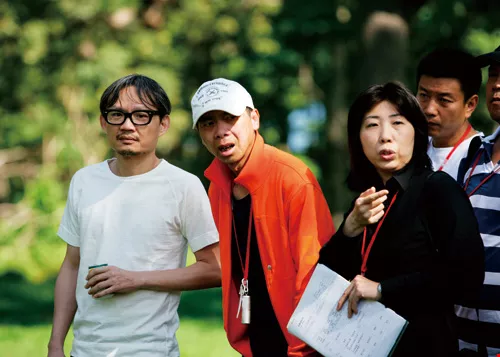
Chen Kuo-fu has collaborated with Feng Xiaogang (second from left) for many years. Each has produced a film directed by the other, and played a valuable role by providing objective feedback.
An edge on the competition
The news media in China describe Chen as "the Lee Kai-fu of the film industry" because of the similarity of Chen's background to that of Lee Kai-fu, the founder and former president of Google China. Both men hail from Taiwan, worked as representatives of Western companies, and capitalized on their bicultural strengths by acting as a bridge, then when conditions were ripe made a name for themselves in their respective specialties.
And there is another thing that Chen and Lee have in common-both are excellent judges of character, and know how to get the best out of people.
Made at a cost of US$10 million, The Message was filmed on location at a towering cliff near the northeastern Chinese city of Dalian. The dark, forbidding precipice makes for a striking visual that is at once majestic and creepy, and a perfect setting for a hidden chamber of horrors laid out with ropes, power saws, and other instruments of torture. Five persons who have come under suspicion are locked away in an eerie prison house atop the cliff, where they are forced to endure unspeakable terrors.
Chen got the ball rolling by adapting a script based on a novel by the mainland Chinese author Mai Jia, arranging a cast, and securing the support of various parties. Then he turned the director's job over to 33-year-old Gao Qunshu, while retreating himself to behind the scenes to handle post-filming tasks such as arranging musical scores, sound effects, and editing. Chen says that during preparations for the film he had seen Old Fish, a movie previously directed by Gao, and felt that Gao had done an excellent job of maintaining dramatic tension.
Chen isn't in total agreement with those who liken him to Lee Kai-fu: "You can't look at me as an example of the Taiwan expatriate doing business in the mainland. The expats come here with a specific goal in mind that they are working to achieve. That's not the case with me at all. I'm here because of connections to friends."
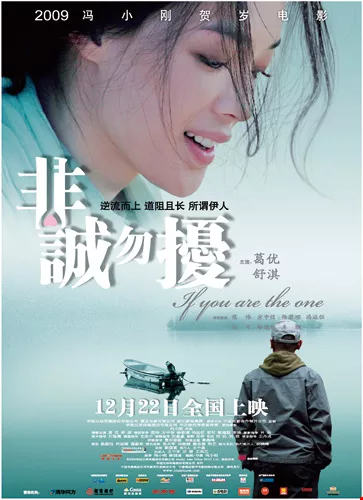
The storyline for If You Are the One by Chinese director Feng Xiaogang was adapted from The Personals, a film directed previously by Chen Kuo-fu. Witty dialogue, and the pairing of marquee names Ge You from the mainland and Shu Qi from Taiwan, helped the film rake in a stunning RMB350 million at the box office in China.
Opportunity seized
In 1998, Columbia Pictures of Hollywood established an Asian subsidiary in Hong Kong with the intention of making three to five Chinese-language films per year, and in 2000 hired Chen to head the subsidiary's production division.
He happened to know the president of Columbia Pictures Asia, Barbara Robinson, an American who had been hired years before as a language student in Taiwan to translate a film synopsis into English for a company set up by Chen, Hou Hsiao-hsien, and others. Robinson ended up staying in Taiwan, where she helped Era Corporation market Raise the Red Lantern overseas, and eventually worked her way to the top of Columbia Pictures Asia. On the strength of this personal connection, Chen was happy to take on the tough job.
Columbia Pictures Asia turned a string of successes by big-name directors from China, Hong Kong, and Taiwan, including Ang Lee's Crouching Tiger, Hidden Dragon, Feng Xiaogang's Big Shot's Funeral, Chen Kuo-fu's Double Vision, Tsui Hark's Time and Tide, and Stephen Chow's Kung Fu Hustle.
Double Vision, for example, cost NT$200 million to make and its film crew included members from Taiwan, Hong Kong, the US, and Australia. Shot completely in Taiwan, it represented the first major multinational cinematic collaboration ever carried out in Taiwan. New people joined the crew after that, and the company went on in 2006 to make Silk in an attempt to establish a commercial film style in Taiwan, but the effort eventually petered out.
Says Chen, "Columbia Pictures abandoned its 'Asian strategy' after the making of Kung Fu Hustle in 2005." But he feels that all the pictures done by Columbia Pictures Asia actually qualify as successes, and that the problem was that Columbia did a better job of producing the movies than distributing them. The company failed to invest resources into all the different markets in Asia, with the result that it didn't know how to market a small- to medium-scale romance flick like 20 30 40. After a few unprofitable ventures, Columbia Pictures decided to withdraw from the Asia market.
Because Columbia invested in a movie directed by Feng Xiaogang, Chen had to attend frequent meetings in Beijing. He wasn't very comfortable with the setup, because he felt he didn't really understand China but was still called upon to make decisions. It was all very risky. However, he could clearly see that the center of gravity in Chinese-language filmmaking was shifting to Beijing. After his job with Columbia Pictures came to an end, Feng Xiaogang started working seriously on Chen to get him to join Huayi Brothers.
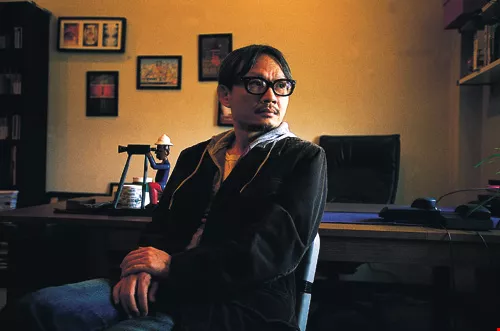
Chen Kuo-fu, described as the guiding force behind the scenes at Huayi Brothers Media, has parlayed his acute cinematic judgment into a string of films that have scored big with both critics and moviegoers.
Comes the producer
At a roundtable discussion between cinema directors from Taiwan and mainland China that was held in Taipei in June 2009, Feng Xiaogang said that ever since the making of A World without Thieves in 2004, Chen had worked together with him on all his scripts, helped him to find his main filming and artistic crew members, and found the right cast members who could be hired within budget.
Feng notes that "the position of producer didn't even exist in mainland China's film industry until Chen introduced the concept, but now people are starting to appreciate the advantages of having a producer."
Chen explains that he does two types of work as a producer. First, he decides on a general theme and develops a script, then he looks for investors, recommends a director, and gets a crew together. On matters of this sort he wields rather strong control. This was the model for his collaboration with Tsui Hark, for example, in making the martial-arts film based on the story of the famous Judge Dee.
Another form of collaboration is like that employed in the making of Mountain Patrol (a story about the efforts of rangers in Tibet to fight against poachers) or the movies of Feng Xiaogang, where the director comes up with an idea for a movie and Chen makes a judgment call regarding its feasibility.
When Feng was preparing to film Assembly, a story about the bonds of brotherhood between soldiers fighting in the Chinese civil war between the Nationalists and the Communists, he was originally considering having Hong Kong star Andy Lau in the cast, but Chen advised against it as soon as he heard about the idea, because he felt it would ring insincere to cast a Hong Kong actor in a movie where the lead role is a soldier from the People's Liberation Army.
"I often follow my hunches without stopping to question myself, and at times I get a bit nervous about that, and whether it might not lead me to really mess up a movie someday." But hunches are rooted in experience, and Chen's intuition seldom leads him astray. Feng took Chen's advice by casting Zhang Hanyu, who had always played in supporting roles. Zhang ended up winning the 45th Golden Horse Award for Best Leading Actor in 2008, which propelled him into the ranks of mainland China's top actors.
Aiming high
As a film-industry veteran who has spent many years shuttling quietly back and forth between Beijing and Taipei, Chen is often asked whether there are still opportunities for people in Taiwan's film industry to advance their career in mainland China.
Chen says that when he first arrived in the mainland, he felt that it would be impossible for him to carry through on a lot of his ideas unless Huayi Brothers had enough mid-level people. Mainland China, furthermore, was still an emerging film industry with insufficient personnel, while filmmakers in Taiwan and Hong Kong already had half a century of experience, so all the core people involved in marketing and production were hired in Taiwan.
However, some of the types of positions where the mainland is short on qualified people cannot be filled by professionals from Taiwan. In such areas as art, props, and costumes, for example, the mainland already has decades of experience in the making of television dramas, while specialists from Korea and Thailand are hired to fill positions that have been created more recently, such as computer graphics and special-effect makeup. Over the near term, Taiwan and Hong Kong will still be an important source of manpower for mainland China's movie industry.
As for the future of Taiwan cinema, Chen laments that "Taiwan's filmmakers feel contented to serve the Taiwan market rather than aim at the entire Asian audience." He feels that Taiwan movies ought to target the mainland China market. For example, a director from Taiwan who doesn't insist on using only actors from Taiwan, but is willing to also use actors from Hong Kong and the mainland, and is willing to film some scenes on the mainland, may be able to attract mainland or foreign investors.
"As long as you're ambitious," says Chen, "it doesn't matter if you meet with setbacks. You just learn your lessons and keep pushing forward."


@List.jpg?w=522&h=410&mode=crop&format=webp&quality=80)


