A-Go-Go to Go--Taiwan's Flower Truck Shows
Ventine Tsai / photos Cheng Jun-hua / tr. by Brent Heinrich
December 1994


In Taiwan folk customs, each time the birthday of a deity comes around,the faithful hold a festive parade around the temple area, with colorfully made-up folk artists and kaleidoscopic performance troupes, to express gratitude for divine beneficence.
These artists and performers are known collectively as yi-chen, which simply means "arts and troupes." Traditional yi-chen have deep religious significance, as well as admirable artistic skills. Modern troupes are mainly in it for the fun or interest, and reflect a slice of contemporary life. With traditional and modern yi-chen constantly evolving, Sinorama has undertaken a continuing series on Taiwan's arts and performance companies to leave a permanent record of where they are today.
In Taiwan, no performing art attracts more attention than "flower truck shows." Temple devotees, male and female alike, have fallen under their spell. But more than that, these colorful stages-on-wheels have come under the keen gaze of high-ranking public officials, such as the governor of Taiwan Province and a number of county magistrates. They have even stirred up the gods to come forth and speak.
Of all the performing arts, the flower truck show is the youngest, yet its power is the greatest; neither divine nor earthly authorities are able to control it. But in the last few years its incredible influence has appeared to be on the wane.
In Chinese it is called a "synthesizer flower truck." It's actually a small or mild-sized flat bed cargo truck, fitted with an electric organ or synthesizer, and the back end of its truck bed has been converted to a stage, on which girls dance and sing. Bedecked on a magnificent scale, the whole vehicle brightly sparkles. When the truck arrives at its destination, a larger stage can be pulled out and fitted with elaborate lighting and a sound system. It's like a little mobile theater, replete with all the amenities.
When flower truck shows were at their peak of popularity, the Taiwan provincial government established seven administrative guidelines to monitor these burlesques-on-wheels for criminal violations on a wide range of issues, including noise control, traffic regulations, modification of vehicle structures, operating a business without a license and the undermining of public morality. In an attempt to drastically curtail their prevalence, the former governor of Taiwan Province Chiu Chuang-huan even issued the stern manifesto, "If a flower truck show is observed performing nude dances in any village or rural township, that village or rural township will have its construction funds revoked for a year." And it was not only high-ranking government officials that rose up in noisy indignation; several temples held "demonstrations of disapproval," urging their worshippers not to support flower trucks and the world of noise and lasciviousness they carry in tow.
These days, flower truck shows are evidently as notorious as they were in times past. A short while ago, a report appeared in the newspapers of a 14-year-old girl who was spotted by her auntie not far from her home dancing striptease on the tailgate of a truck. The aunt, along with the young lady's parents, sued the show's proprietor for seducing underage girls.
The majority of Taiwan's population has come to equate flower truck shows with nude dancing, hence their bad reputation. Flower truck owner and musician Huang Wen-sheng objects strongly to what he claims are false accusations.
In their earliest from flower truck shows were used to accompany funeral services. The performers, dressed in plain white mourning attire, tearlessly pretend to weep, thus heightening the tragic atmosphere surrounding the family of the departed. Later on the artists arrived at a brilliant notion; they changed into light, dazzling costumes of celebration, and redecorated the flower trucks with multicolored backdrops, lanterns and beautiful ornamentations. The shows thus came to take part in both sadness and joy. They were the particular focus of admiration during birthday celebrations for various gods.
Huang Wen-sheng's protestations are far from groundless. From the beginning, the flower truck performers dressed in rather light clothing, but that is not to say that they were undermining public morality. Under pressure from the growing appetite of the audience and the competition of the market, they slowly moved from simply singing to performing topless dances. Finally some performers reached the point of not only dancing completely in the nude, as in most strip clubs, but even began performing special feats from the back of their trucks. Because there were a great number of entertainers of this steamier variety, flower truck shows became indelibly linked in the public mind with gratuitous sexuality.
The more than ten year history of flower truck shows is filled with countless crazy occurrences that must have left the gods at a loss whether to laugh or to cry. The shows first appeared around 1981, and within a short three years they had spread throughout the whole island of Taiwan. The year 1984 was particularly significant in the Chinese calendar, as it was the first year of the sixty year cycle, representing the harmonic convergence of both the Ten Heavenly Stems and the Twelve Earthly Branches. The whole population took part in rarely held temple festivals. Whether these festivals were held once every three, five, six, twelve or sixty years, they all were held in 1984, so it would have been hard for flower truck shows, which serve to praise the gods, to have not become popular.
Whenever a temple celebration took place, by the side of the glistening green rice paddies could be seen the strangest of processions: following in twos and threes behind the manically colorful flower trucks were old gents on bicycles and youngsters on motorcycles, as if under a magic spell, eyes fixed straight ahead on the dancing and twisting flower truck girls, to whom "wearing clothes and being naked is about the same thing." They expansively enticed the crowd, laughingly saying, "Come, come! Old folks have a look--a feast to keep you going to 120. Little kids have a look--a nutritious snack!"
The two age groups in fact reacted very differently to the event. The older generation felt that flower truck shows which use nude dancing as a method of appeal were inappropriate for worshipping the deities. The flower truck shows were very popular among the younger generation, however, which felt they helped liven up the occasion. Both sides maintained their own viewpoints. But it was up to the principal parties--the gods themselves--to pass the final judgement. What's interesting is that when lots were cast, the answer came back We love it!
There are a long string of funny stories concerning flower truck shows. Their appearance has not only triggered conflicts among temple officials, but has even sparked wars between humans and the gods. Folklore scholar Huang Wen-po recalls one incident which he witnessed first hand.
The story happened in a temple situated in the countryside in Tainan county. It was the most important moment of the night, when the spiritual medium was to select the official keeper of the incense burner for the next year. (Every year the keeper coordinates the temple's religious ceremonies.) But all of the villagers had gone to see a flower truck show. Only the medium and that year's keeper were left in the temple. It so happened that the keeper was hard of hearing and couldn't understand the medium's instructions. What was more irritating was that the flower truck show was making all kinds of noise on the outside. With a pompous air the host of the show said into his microphone, "Tonight our god is full of power, and all of us disciples can see some dancers take off their clothes." The medium was thoroughly infuriated. He held high his Seven Star Sword and, leaping out the front door of the temple, ran through the crowd and jumped directly onto the truck. He grabbed the microphone from the host and said, "It's not that we love to see striptease dancing; it's that you have been lusting too long."
Similar provocative, X-rated performances are seen at weddings, funerals and temple festivals, where whole families are forced to accept this 'sexual harassment." Therefore, scholars, government agencies and temples mounted a denunciation campaign. For example, the officials of Hsuehchia's Tsuchi Temple tried in advance to dissuade pilgrims from having nudes in their company when they came to worship. In Peikang, the goddess Matzu transmitted a message through the mouth of a medium: "I don't like to watch strip shows." Under the mandate of discouraging nude dance as a form of worship, electronically animated mannequins appeared at one point as substitutes. But though the mannequins' figures were no less shapely than real performers, and from time to time, they would un veil their gauzy outer garments, fakes, after all, were unable to invoke the same heated response. "Robot-style" flower truck shows soon faded out.
Perhaps the hour is not yet ripe for their demise. The shows are facing criticism from all sides, and one day the flower truck shows may indeed die out. But the recent craze for the numbers game has only made them blossom anew, like moistened bamboo shoots after a spring rain.
Many gamblers go to dark and mysterious little temples to pray for secret knowledge about lottery numbers. The gods most often prayed to are the ones least commonly seen in society, like the Giant Tree God, the Gift God, the Stone God or the spirits of those buried anonymously, who are thought to have special powers. Whenever anyone wins a prize, the way they offer thanks is naturally a little odd--by hiring a bawdy flower truck show for the pleasure of the spirits. The gamblers' thinking commonly runs that if you ask for help from a god, you should thank it, and then winning again won't be too hard. Around the first and the fifteenth of the month, quiet little nooks can suddenly become as hot and noisy as night markets, as people who win at numbers sponsor flower truck shows in gratitude. There are shows for days on end; sometimes they can go on until the next winning numbers are announced!
Why do numbers winners especially love to hire flower truck shows? According to flower truck owner Huang Wen-sheng, in the countryside, what other kind of performance is available to attract a boisterous throng, besides such a seductive show?
As for these special gambler-sponsored celebrations, Huang Wen-sheng feels that a self-administered rating system is in place. The audience has made a special trip to see the show, and those on stage perform their acts willingly. No one is coerced into an embarrassing situation, as some times happens at wedding banquets.
There are two kinds of flower truck shows--one for the day, and one for the night. Most of the day time shows wind around neighborhoods as part of religious processions during temple festivals, singing loudly along the way and only rarely having the singers undress for large crowds. Flower truck singer "Hsiao Ying," who is already a mother, began singing professionally when she reached 14 years of age. Originally, she just loved to sing, and she won both major and minor prizes at several singing competitions. In the past she held a job singing in a restaurant. Later on, the restaurant turned into a piano bar, so she took to singing in flower trucks.
On the average, daytime flower truck performers work long hours for relatively low pay. And the size of the paycheck depends on whether or not the singer sheds her clothes. "Hsiao Ying" does nothing on stage but sing. As a mother she naturally refuses to sell her sexuality for the sake of a high income. Furthermore, sticking strictly to singing just means she must contract more engagements, and she still does well on her earnings of NT$50,000 to NT$100,000 per month. Nevertheless, when following behind religious processions she must be very careful of the fireworks set off by enthusiastic worshippers in the crowd. "I could easily catch my hair on fire," Hsiao Ying laughingly states.
Daytime flower truck shows are nothing more than kiddie class compared with nighttime shows, which run without qualms or restrictions. As soon as a flower truck parks at the side of a temple and they start putting up the stage, the village members all know there will really be something to see tonight. One show usually lasts about 2 1/2 hours, with probably ten singers or dancers performing. The cost of the show depends on just how scantily clad the strippers become. The base rate is about NT$20,000, with an additional NT$3000 for every dancing girl whose costume is of the minimalist persuasion.
Each of the ten performers sings three songs, which start slow and build in tempo. As the music gets faster, the clothing disappears piece by piece. At the same time, the audience packs in closer and closer. On more than one occasion spectators have even mounted the stage and caused the whole show to collapse under their weight. At the zenith of their popularity, many shows bowed to the forces of competition and dispensed with singing altogether, having their girls disrobe as soon as the show began.
Meanwhile, traditional puppet shows and Taiwanese operas, which were already in a state of decline, found themselves helpless to resist the forceful assault of the flower truck shows. When they saw the countless heads craned toward the stage of their competitors, opera companies took note of their in magic ingredient to success and hired striptease dancers of their own. At first, puppet shows tried a gimmick of giving away puppets to people who could solve a riddle. Later on, they set up a catwalk in front of the puppet stage and, like everyone else, had real people perform. Naturally, these were young ladies, kicking up their heels, baring their bosoms and shedding their excess packaging.
Ten years after the flower truck show first appeared, it has already ceased to be as huge as it once was. Yet during the evening celebration of a temple festival, it is still bound to rank as the central attraction. Scholar Huang Wen-po feels the shows have a broad appeal because "they guarantee a wild time, and they also break the monotony of life in entertainment-starved farming villages." Proprietor Huang Wen-sheng points out that flower truck shows, in comparison to puppet shows or opera companies, have a strong ability to survive. The owner needs to spend only about NT$200,000 customizing the truck body. Musicians, singers, dancing girls and roadies are all hired performance by performance, unlike traditional forms of theater, which must support a school of actors on a daily basis.
After outsiders have witnessed a flower truck show, what they wonder the most is how people of all genders and ages, indeed whole families with children, can merrily join together and enjoy a show of this nature. Says Huang Wen-sheng, "Country people are probably more straightforward. They don't tend to be phony for the sake of face." In the view of Huang Wen-po, "People who live along the coasts have uncomplicated customs and conservative values, but by nature their level of tolerance is far higher than city people. They won't find this kind of sexually explicit performance especially repellant."
Such subject matter is in fact not unique to flower truck shows. During other celebrative occasions, such as "cow and plough" agricultural festivals, men and women give provocative, implicitly sexual performances with their bodies and tones of voice. Festival celebrations have always served the function of loosening taboos. During holidays, people could do things that they commonly are not allowed to do. To be libertine and indulgent are usually items on the agenda. If it is only an occasional occurrence, perhaps it truly can achieve the feat of dispelling heavyheartedness and relieving the pressures of everyday life. Nonetheless, when the shows are constantly used to thank the spirits for helping to strike it big at numbers, when acting approaches sex, and when the performers fail to alter the pattern, people are bound to grow weary of it after a while.
Huang Wen-sheng, who has worked in this field since its very inception, is most clear that the flower truck shows have seen their better days. He comments, "In the past, a crowd of people would always form at the tail of the truck. Nowadays when we perform, some young people would rather wander up front and watch the open-air movie that most festivals show. They don't necessarily want to hang out in front of a flower truck." Of course, this is related to the advent of cable TV; watching adult films is more and more convenient.
Furthermore, the customers footing the bill are no longer requesting that the show be filled start to finish with disrobing females. In the past half year when villagers gather to thank a god, it has become popular to hire a flower truck without the singers or dancing girls. The village members themselves climb onto the stage to belt out their own tunes in these "self-service flower trucks." Not only does it save money, it does honor to the gods, as well as entertaining the participants.
According to an investigation by the Taiwan provincial government, at their height in 1986 there were 315 flower truck troupes throughout the province. By 1991, surveys indicated that the number had dropped by half to 175 troupes. Not only had the numbers diminished; the content of performances had mellowed out as well. Most focussed on singing, striptease serving merely as an interlude.
Who would have thought that those salacious flower trucks that have warded off the combined at tacks of academics, government and temple officials, would under their own heat flare bright red, then char black, and in the end take to the road at dusk?
[Picture Caption]
p.117
The day's religious procession commemorating a god's birthday has finished. At night an ample feast is spread with plenty of entertainment for all our good friends. And while we're having our fill of food and spirits, we've arranged for everyone to watch a flower truck show.
p.118
Religious festivals, weddings, birthdays or funerals--they all are likely venues for a flower truck show.
p.119
Backstage in a flower truck, besides a small space for changing costumes, there is only room for the keyboard rack, a one-person band.
p.119
Daytime performances usually exclusively feature singing, and the performers' costumes are more conservative than evening shows.
p.120
A hearse filled with chrysanthemums, the distraught relatives of the deceased--and a manically colorful flower truck along for the ride. The weirdness of Taiwan's funerary culture is too common to raise any eyebrows. (photo by Vincent Chang)
p.121
At the break of day, hurry up with the makeup. In a while we'll be accompanying a religious procession. A flower truck performer may hurry behind a good many festive groups in a single day.
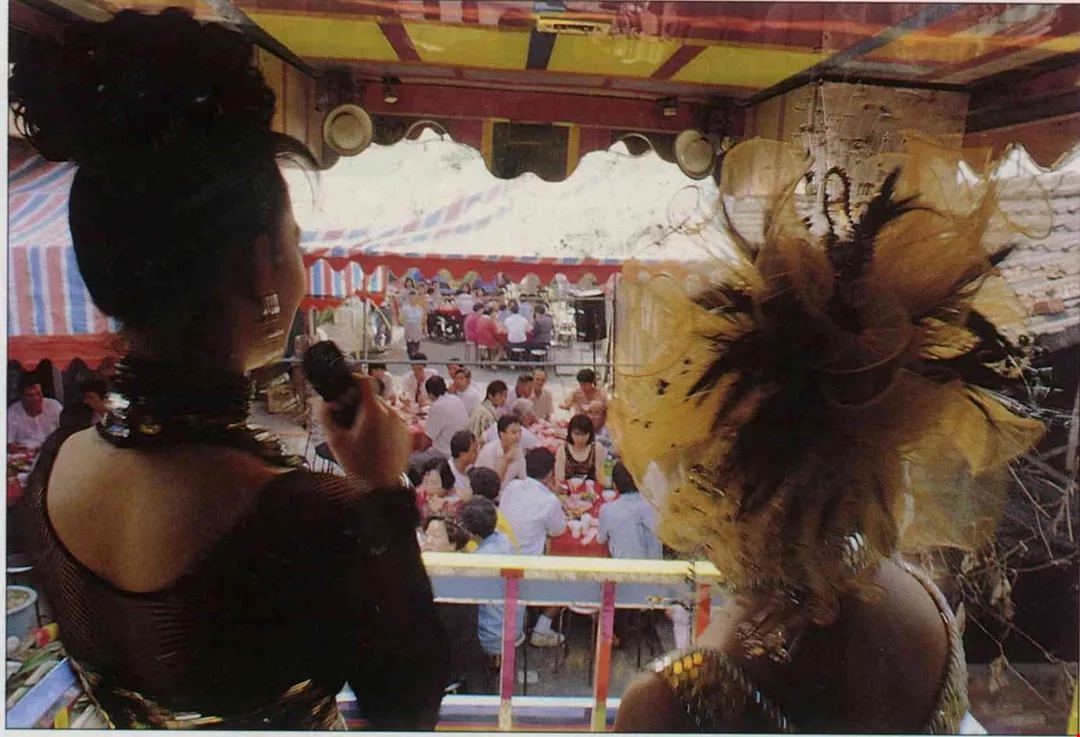
The day's religious procession commemorating a god's birthday has finished. At night an ample feast is spread with plenty of entertainment for all our good friends. And while we're having our fill of food and spirits, we've arranged for everyone to watch a flower truck show.
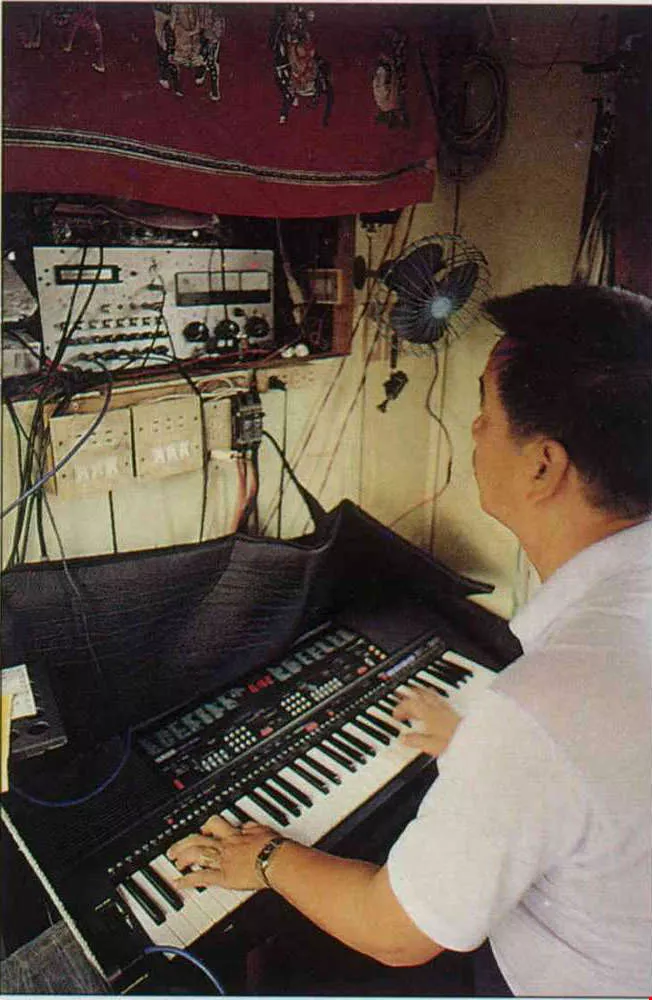
Backstage in a flower truck, besides a small space for changing costumes, there is only room for the keyboard rack, a one-person band.
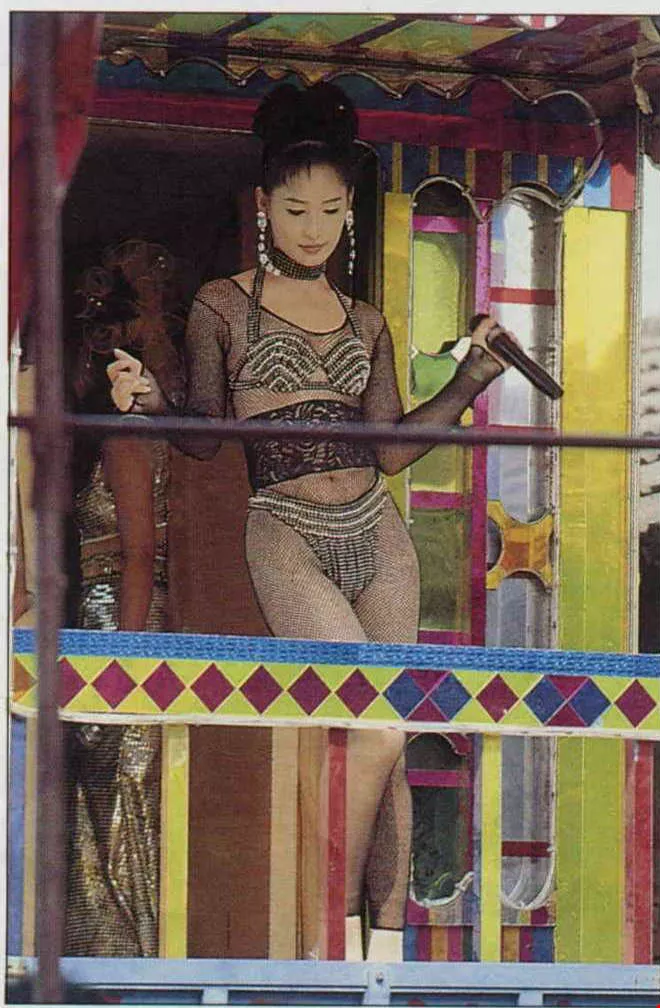
Daytime performances usually exclusively feature singing, and the performers' costumes are more conservative than evening shows.
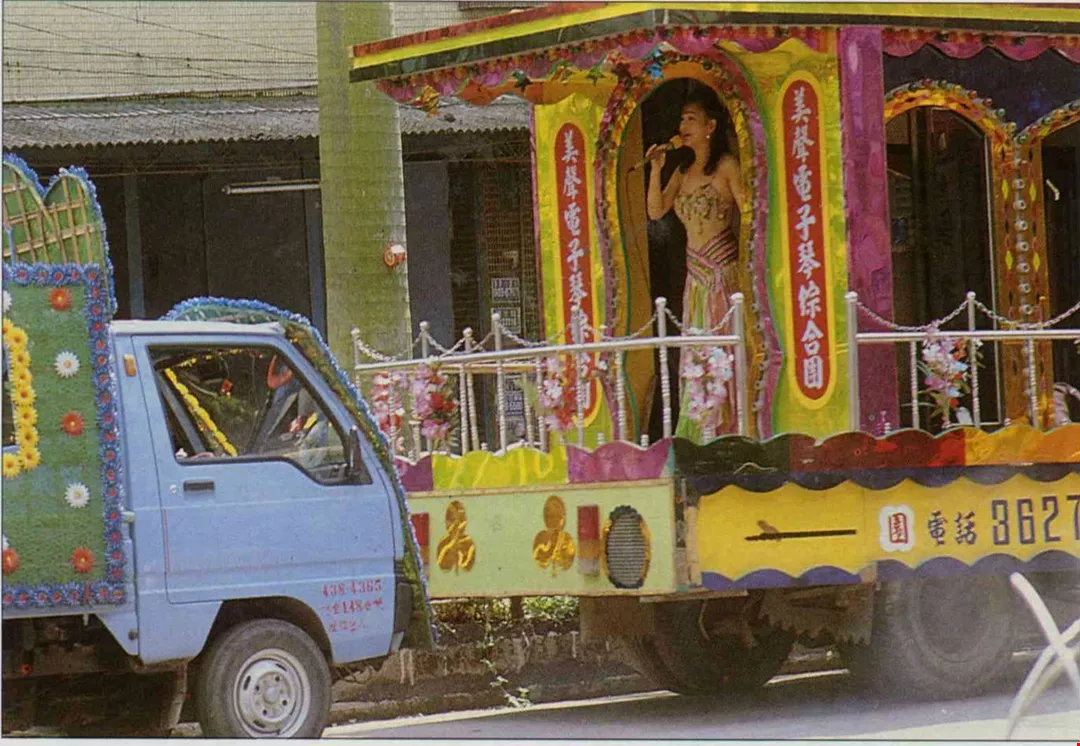
A hearse filled with chrysanthemums, the distraught relatives of the deceased--and a manically colorful flower truck along for the ride. The weirdness of Taiwan's funerary culture is too common to raise any eyebrows. (photo by Vincent Chang)
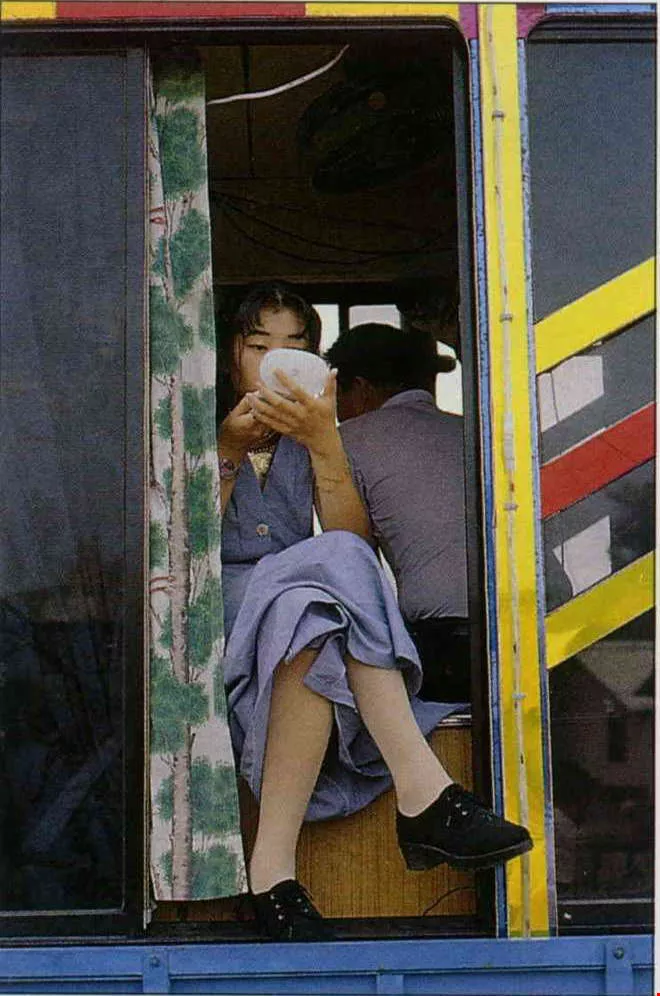
At the break of day, hurry up with the makeup. In a while we'll be accompanying a religious procession. A flower truck performer may hurry behind a good many festive groups in a single day.


