Crosstalk for Ever!
Liu Zengkai's 30-Year Performing Career
Lee Shan Wei / photos Jimmy Lin / tr. by Phil Newell
December 2018


Standing on stage in a long robe, with no other props than the fan in his hand, the performer brings the audience to laughter or tears simply by his words and the expressive movements of his eyes. “Crosstalk” (xiangsheng, or comic dialogue), an Asian performance art based on speaking and singing, with its origins among the common man, contains questions that make one think deeply hidden within its humorous talking, imitation, teasing, and singing.
Liu Zengkai, director of the Wu Zhao Nan Xiang Sheng & Theater Association, learned his craft from crosstalk master Wu Zhaonan, who was celebrated as a national treasure. For the past 30 years, Liu has steadfastly passed along the tradition and trained new talent. He has performed in Taiwan, Hong Kong, and mainland China. He has not only devoted himself to passing along this traditional art form, he has injected sustainable vitality into crosstalk with routines that keep up with current events and the times.
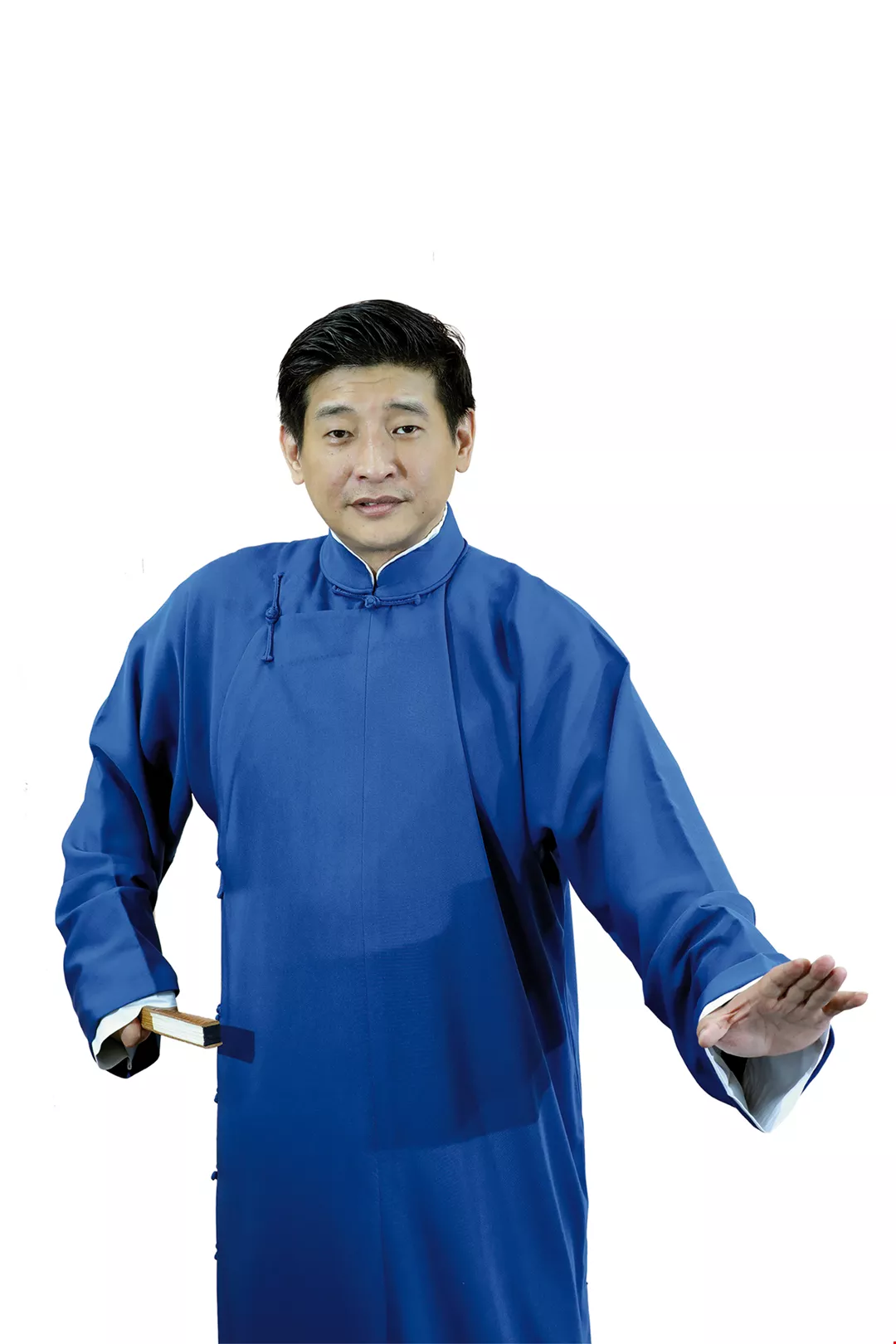
Dressed in a long robe, with a fan as his only prop, Liu Zengkai uses “crosstalk” to draw the audience into imaginary situations. (photo by Jimmy Lin)
Chosen by destiny
“The saying goes that for a man, the worst thing is to choose the wrong profession. I entered my profession without thinking clearly about it, and though it seems like no time at all, I’ve been in it now for over 30 years.” Offstage, Liu Zengkai’s expression is still playful. “My parents were both from Shandong Province, and my grandfather took me to watch Peking Opera from when I was small.” Despite being born in Taiwan, Liu grew up speaking Beijing dialect, and for him to take up crosstalk as his profession seems to have been the most natural thing in the world.
“When I was young I had plenty of confidence about taking up my pen to write, but next to none about opening my mouth to talk.” Liu, who got a virtually perfect score on his essay in the college entrance examinations, says self-deprecatingly that his ending up in crosstalk really was a quirk of fate. Nicknamed the “scholar of crosstalk,” after studying Chinese literature for three years at university he finally was fortunate enough to return to what he loved the most. He earned his master’s degree from the Graduate Institute of Folk Literature at National Hualien Teachers College (later National Hualien University of Education, now integrated into National Dong Hwa University), writing a 170,000-character thesis on the development of traditional mainland Chinese performing arts in Taiwan over the previous 50 years that was an important contribution to the field.
“In fact, I began to be a big fan of crosstalk when I was in middle school, but I really got into it thanks to an activity put on by the China Youth Corps.” One summer during his five years at junior college, he attended a camp for “narrative and singing arts.” After finishing that program, he was brought by classmates to have a look at the Hanlin Traditional Narrative and Singing Arts Group. Little did he realize that once he started on the crosstalk path, there would be no walking away.
“Zhao Zhongxing [a former actor with Hanlin] said ‘I’ll work with you,’ and a few days later I went with him to a park where we did an impromptu performance.” This was Liu’s first public appearance, and his routine was the classic “Four Categories of Work,” a bit that he has still not mastered to this day. “It was a total disaster!” he says. But having completely embarrassed himself his first time out, from then on he never worried about stage fright. And that’s the way he got going.
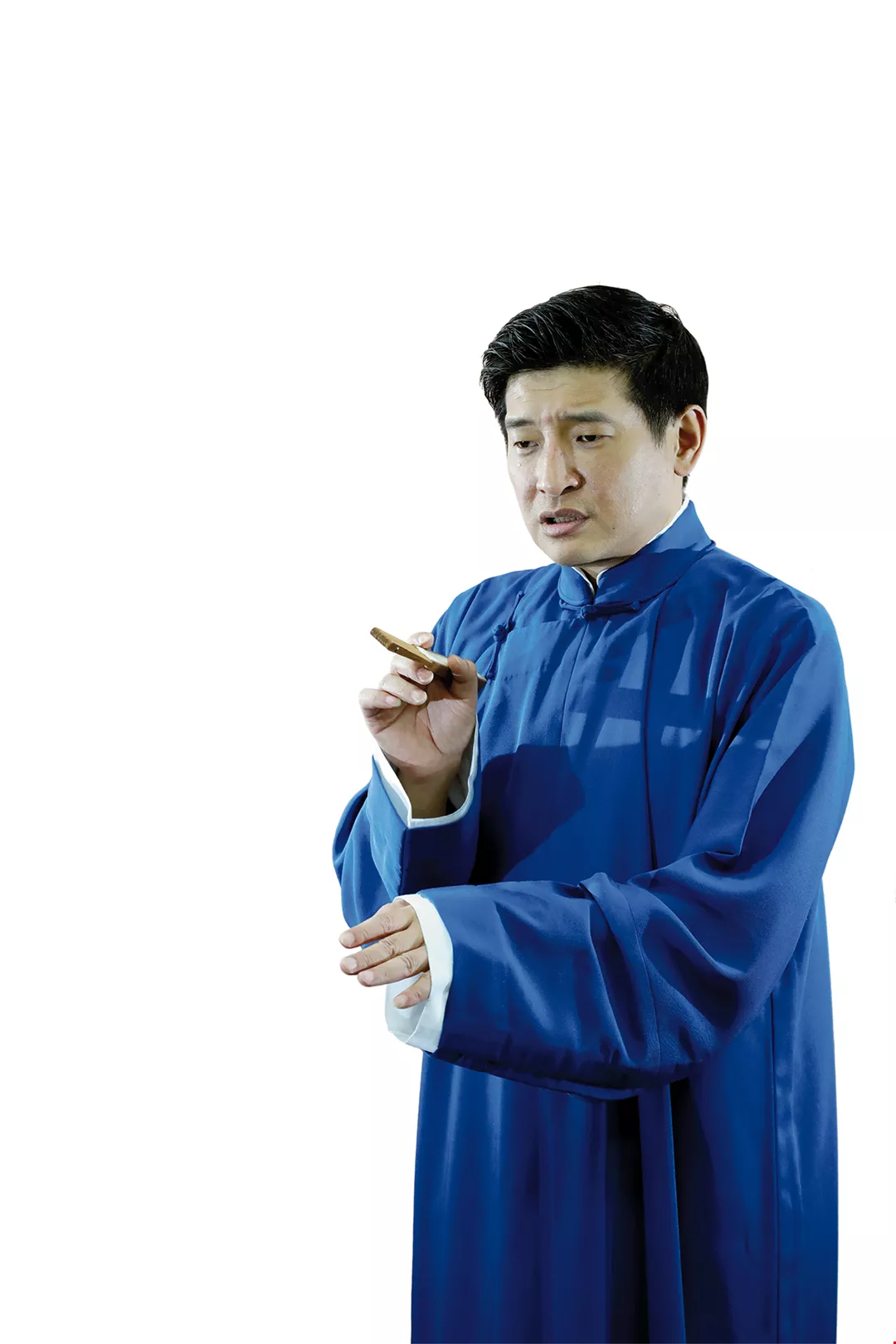
Dressed in a long robe, with a fan as his only prop, Liu Zengkai uses “crosstalk” to draw the audience into imaginary situations. (photo by Jimmy Lin)
The cream of folk performances
“For my military service I served in the performance troupe.” Destiny guided Liu Zengkai to study with masters like Wei Longhao, Wu Zhaonan, and Chen Yi’an, and in 1999 he became a formal acolyte of the “living national treasure” Wu Zhaonan, making his way in the world by following in his master’s footsteps.
In Taiwan around 1950, before the advent of television, what people most looked forward to were solo crosstalk performances by Wu Zhaonan at the Yingqiao Recreational Park on the banks of the Danshui River. Later Wu met Wei Longhao, and they began doing crosstalk double acts. They became enormously popular for a while at the Naliang evening parties and the Leyuan performance space at Yingqiao, and afterwards performed at the Lianyuan and Red House performance spaces in Ximending.
In the era when Wu Zhaonan was beginning to do crosstalk, there were no scripts to follow, so everything depended on his quick-witted writing. It was only later, when he joined with Chen Yi’an and Wei Longhao to do three-man crosstalk, that Wu dictated while Chen and Wei wrote down the dialogue. The three worked together to create a number of classic crosstalk works. In 1968 Wu released the first ever crosstalk record in Taiwan, and later he made audio tapes of more than 300 outstanding pieces, giving him the most crosstalk recordings of any performer on either side of the Taiwan Strait.
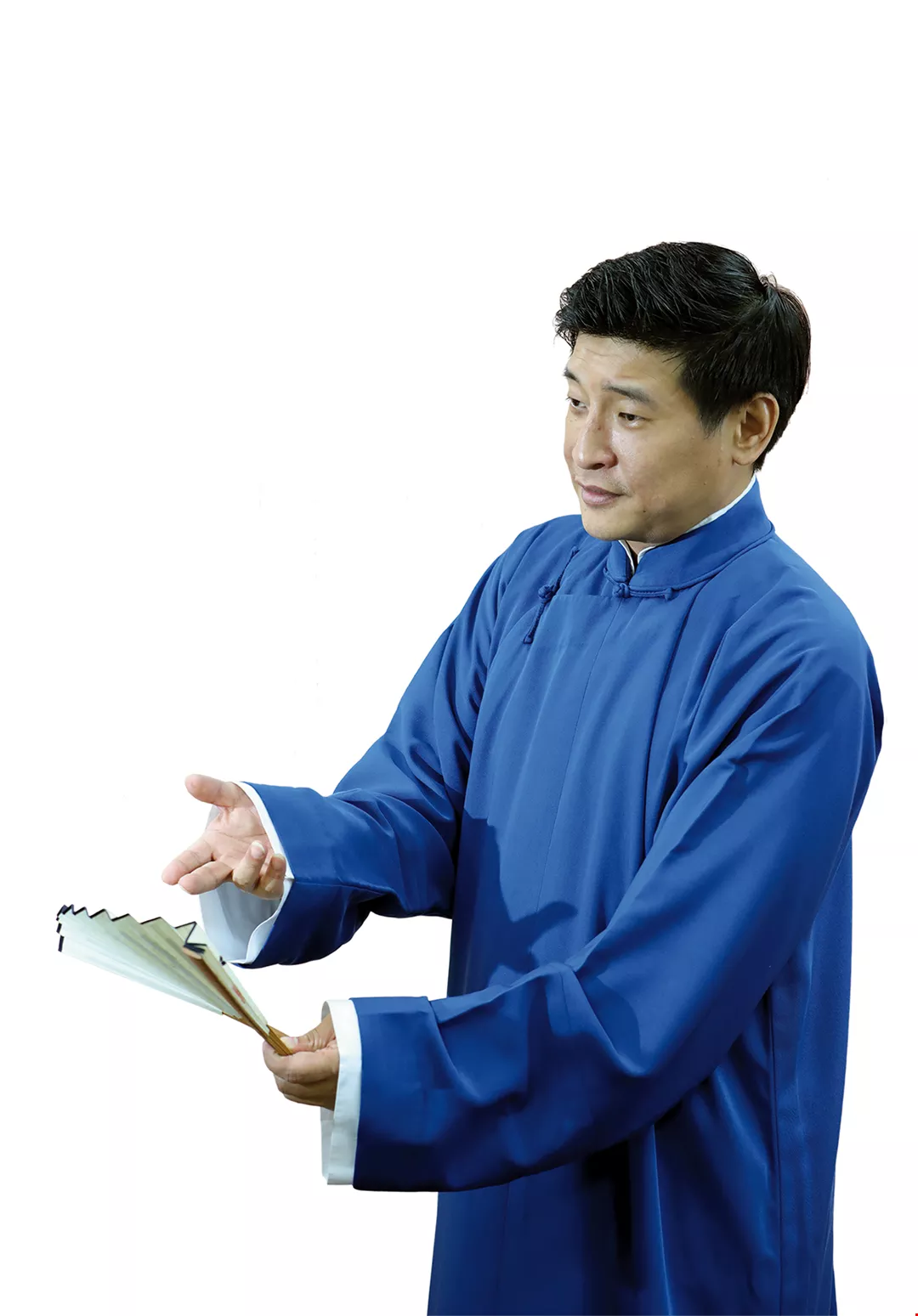
Dressed in a long robe, with a fan as his only prop, Liu Zengkai uses “crosstalk” to draw the audience into imaginary situations. (photo by Jimmy Lin)
Laughter tinged with tears
“My master’s crosstalk originated in his environment from when he was small, and was a part of his life from very early on.” Wu had mastered the 13 basic skills of crosstalk from a very early age, spontaneously and naturally as part of his daily life.
“If we look at the Chinese word for crosstalk, xiangsheng, the first character, xiang, means ‘facial expression’ while the second, sheng, means ‘voice.’ But I feel that the voice is far more important than the face,” Liu explains. In the early days, when people heard crosstalk on the radio, there were no images, but listeners still got engrossed in it. “Therefore crosstalk is voice with facial expression, and facial expression within voice.” The audience must rely on their imaginations to completely visualize the world that the actors construct with their voices.
“When you first start out in crosstalk you have to train your breathing. Everything is taught by personal instruction and example.” There are things that require strict attention, such as the speed of response in dialogue, the pitch of the voice, the urgency or relaxedness of tone, the joy or sorrow in facial expressions, or the depth of feeling. Liu believes that there are no shortcuts—you simply have to buckle down and work hard.
“Speaking, imitation, teasing, and singing are the four basic skills of the crosstalk performer,” says Liu. Crosstalk is an oral art form, and is a composite form of performance. Verbal skill is the prime requirement for being a crosstalk actor. Many skits also involve mimicry, which is “imitation.” Besides needing all-embracing general knowledge, covering everything from astronomy to geography, and having to be able to speak all kinds of local dialects and pronounce foreign loan words, while on stage crosstalk performers may be called upon at any moment to sing a famous melody, or to improvise rhythmic storytelling in time with a clapper. “That’s why they say that a good crosstalk performer can perform anything else too.”
“Experienced crosstalk performers need only look into the eyes of the audience and they will know what to say and when.” Performers need a tenacious memory and quick-witted ad-libbing skills on stage to use their eloquence to steer the mood of the audience and captivate them. This is a craft that has to be honed over many years.
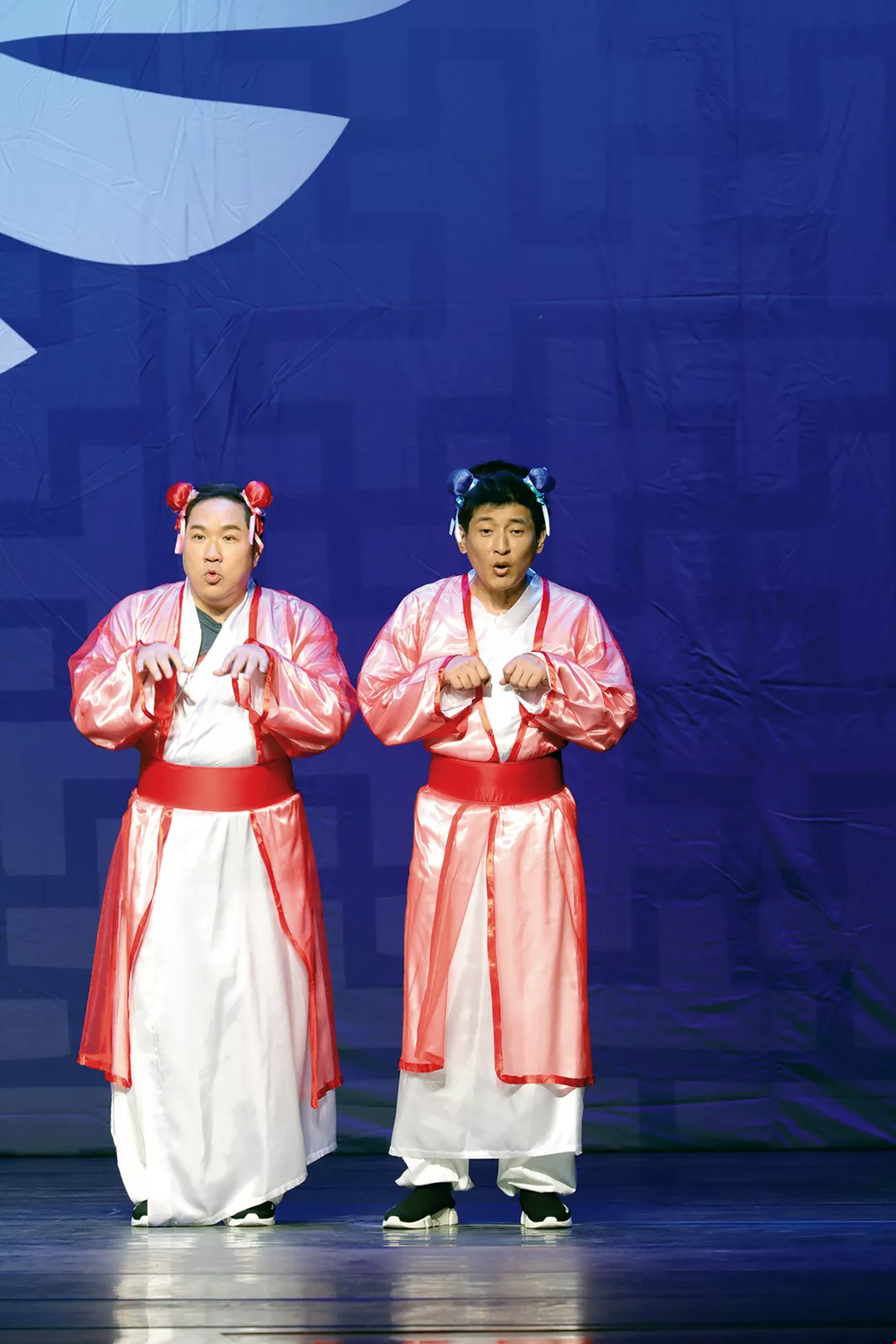
The show Thirty Years of Selected Works by Liu Zengkai was a retrospective on the 30-year career of Liu, who is director of the Wu Zhao Nan Xiang Sheng & Theater Association. During the show, Liu broke with his usual practice by performing dressed as a woman.
Using words to make people think
“I believe that crosstalk should not simply preserve the past, but must keep up with the times, as only then will it find resonance.” Since being involved in the creation of the Taipei Quyituan troupe and serving as its director since 1993, Liu Zengkai has always had his own ideas, and things that he insists on. “When the audience is done laughing, what will stay in their minds?” One has to use language to convey depth of insight and to inspire people to care passionately about what is going on in the world.
The show 30 Years of Selected Works by Liu Zengkai, performed on September 21, 2018, was a retrospective on 30 years in crosstalk for Liu, who has held true to the authentic flavor and mindset of this art form. These classic sketches that are still relevant today are drawn from life, and use sarcasm or self-mockery to communicate thought-provoking insights that linger in the memory.
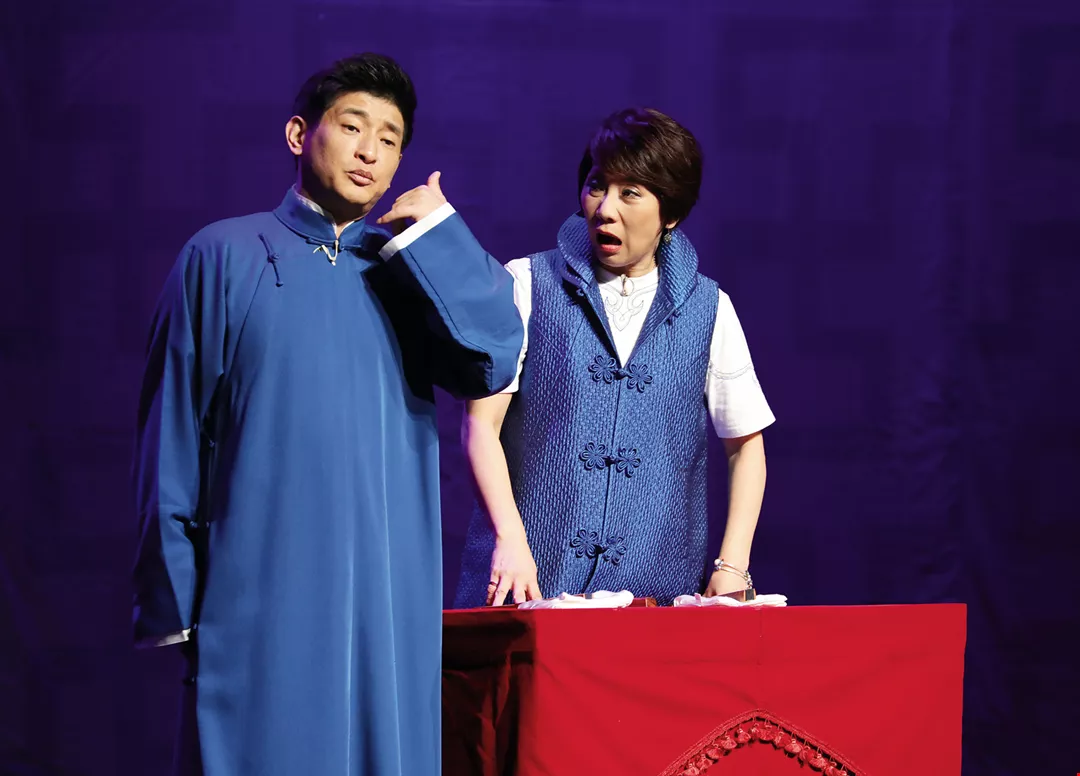
During the performance of 30 Years of Selected Works by Liu Zengkai, Liu Zengkai and Lang Zuyun did the classic routine “The Credit Card Holder,” which makes audiences both laugh and cry. (photo by Jimmy Lin)
Never leaving the stage
“The master has passed away.” On October 14, 2018, the 93-year-old Wu Zhaonan took his final bow and forever left the crosstalk stage that he so loved. His most famous remark was: “In the past I did crosstalk to live; today I live to do crosstalk.”
Starting in 1999, Wu took on a number of young performers as apprentices, including Hou Guanqun, Lang Zuyun, Liu Zengkai, Liu Erjin and Fan Guangyao, who would later become famous crosstalk artists themselves. He formed the “Wu Zhao Nan Xiang Sheng & Theater Association,” promoting the art of crosstalk at home and abroad. He won a Folk Art Heritage Award, a Golden Tripod Award, and a Golden Melody Awards Special Contribution Award, and he was honored as a “national treasure grade” crosstalk artist.
Liu Zengkai, who has stuck with crosstalk through thick and thin, has seen periods of prosperity for his chosen art form as well as periods of decline. Today there are three apprentices—Peggy Ji, Ai Tianyi and Millie Qiao—at Liu’s side, and it is his turn to repeat Wu Zhaonan’s admonition that “first you have to completely absorb every small routine.” This means that they must completely understand the content, as only with thorough understanding will their performances have flavor, which is the essential element for crosstalk to carry on into the future by continuing to make people laugh.
“The master once said that he wanted the epitaph on his grave to read: ‘This fellow used to do crosstalk, but now he can’t.’” The national treasure of crosstalk has left this world, but his chosen art form is being passed on from generation to generation, never leaving the stage, watching for the light of a new dawn of lasting popularity.
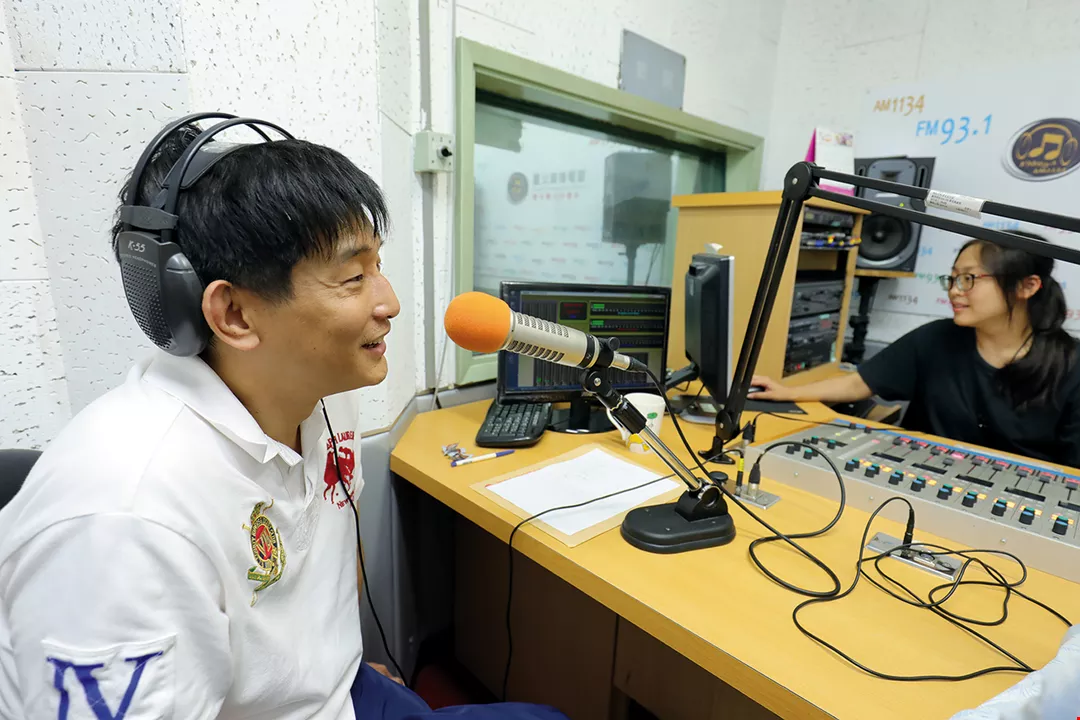
To boost the popularity of crosstalk, Liu regularly records programs for radio.
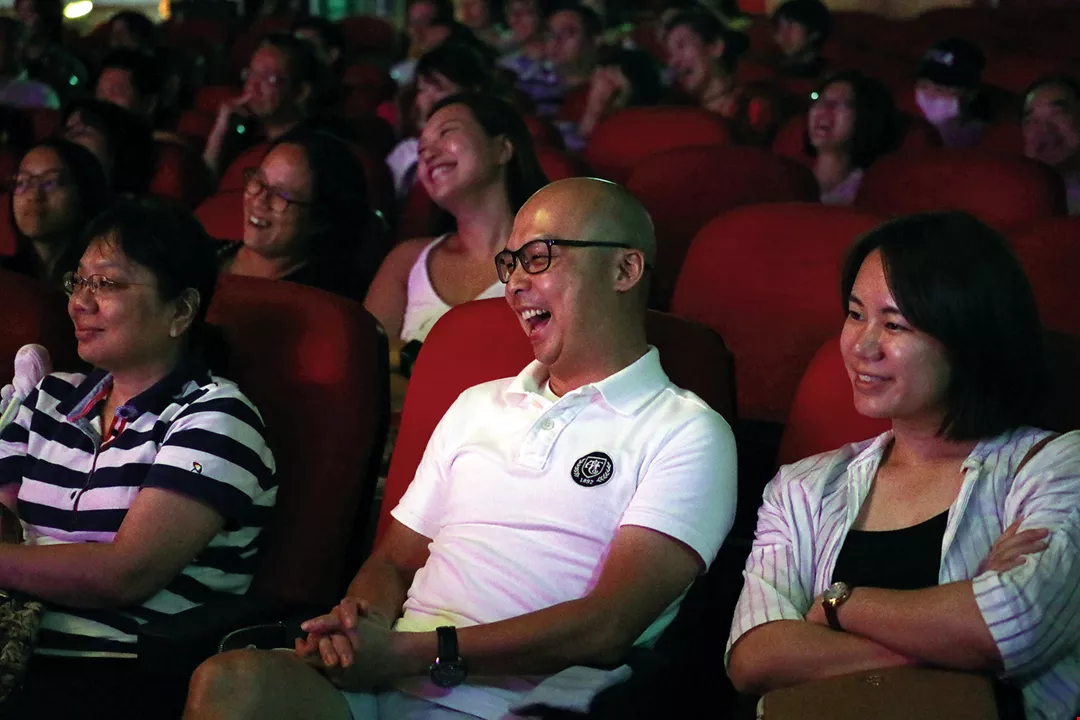
The eloquence and quick-witted ad-libbing of the crosstalk performers on stage steer the mood of the audience and cause ceaseless laughter.
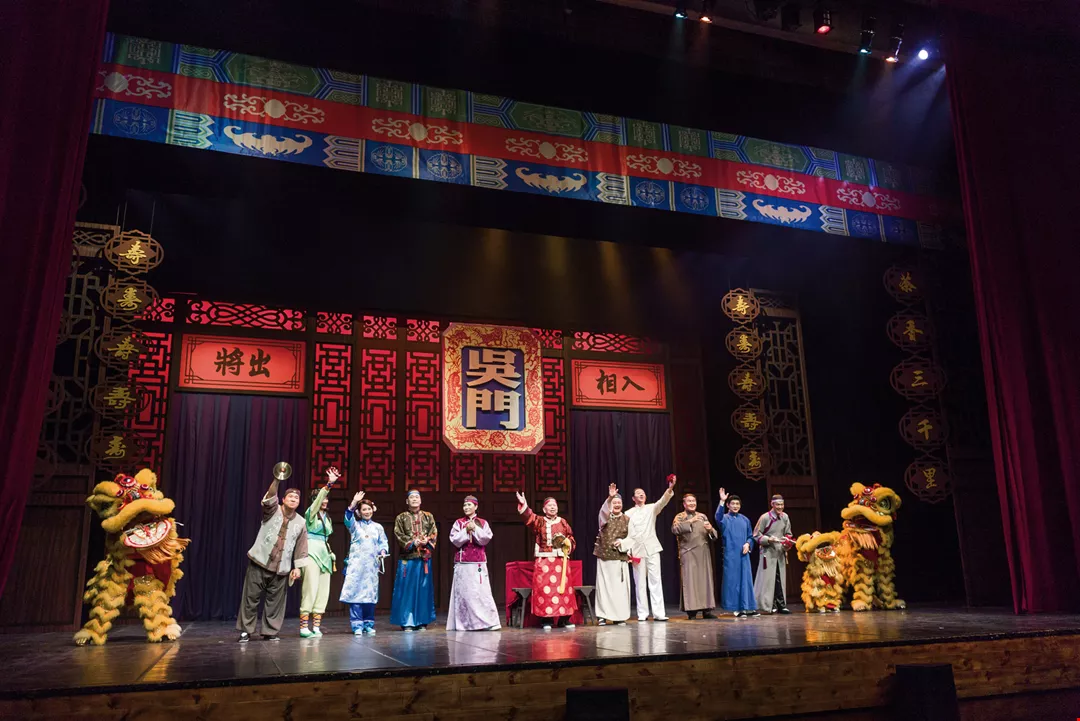
In 2014, to celebrate Wu Zhaonan’s 90th birthday, Wu’s apprentices and their students worked together to perform Surprises from the School of Wu: How Troublesome! (courtesy of Liu Zengkai)
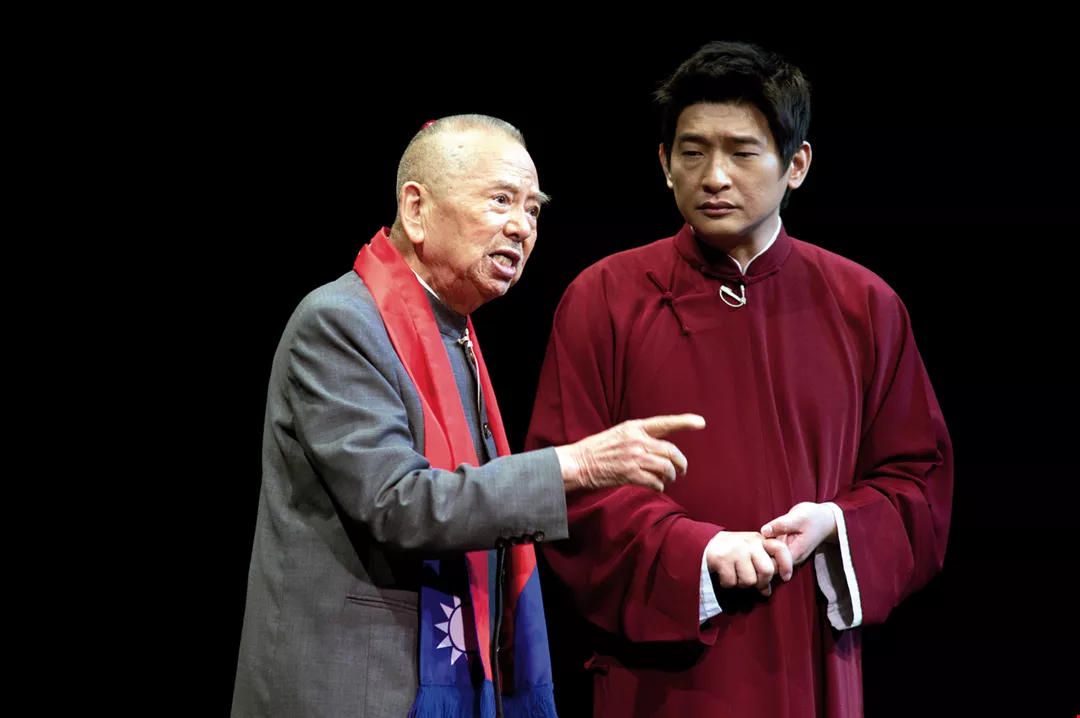
In 2011, Wu Zhaonan led his apprentice Liu Zengkai in a performance called 100 Years of History Through Crosstalk, hoping that this folk art can be passed along from generation to generation. (courtesy of Liu Zengkai)
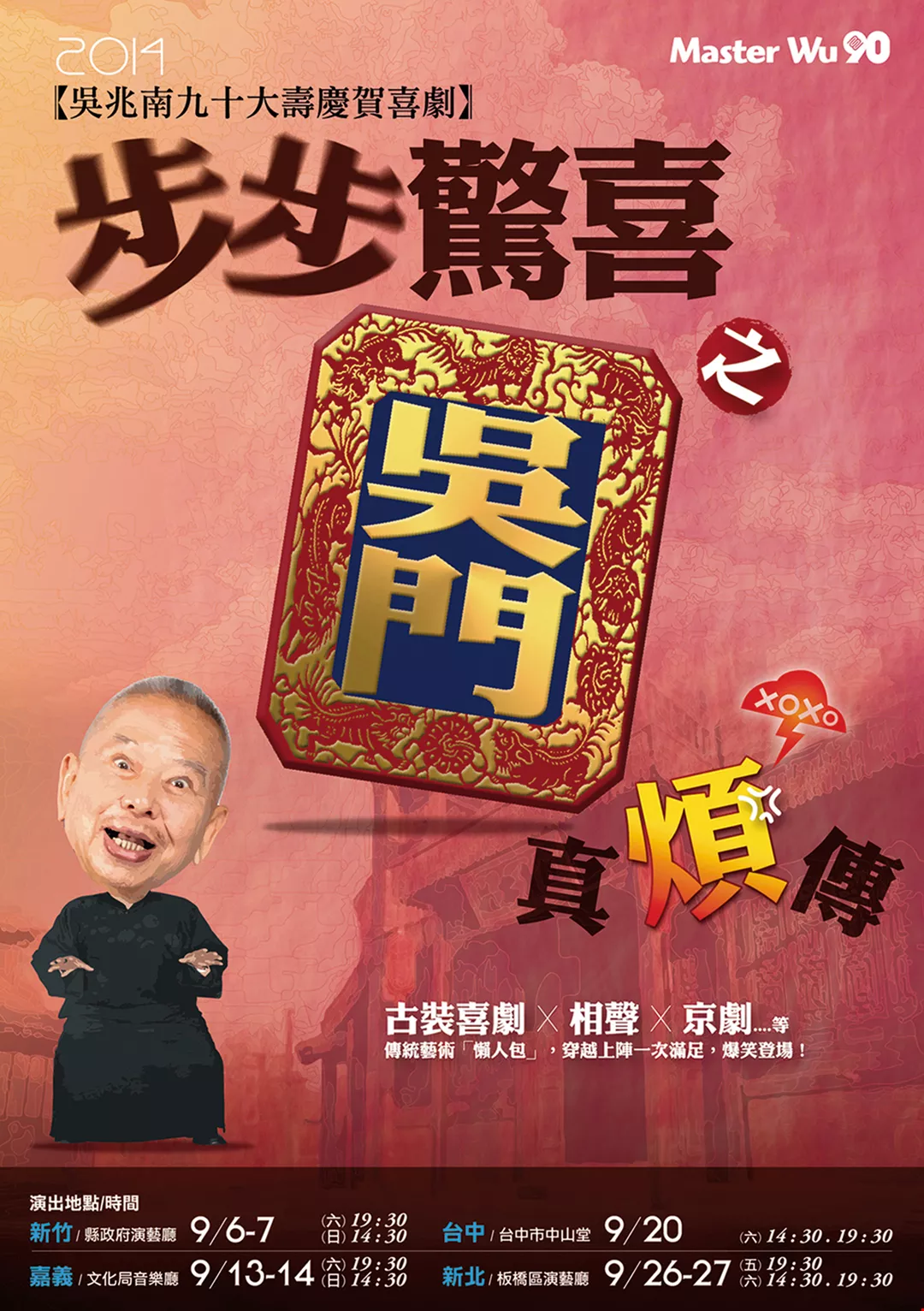
In 2014, to celebrate Wu Zhaonan’s 90th birthday, Wu’s apprentices and their students worked together to perform Surprises from the School of Wu: How Troublesome! (courtesy of Liu Zengkai)
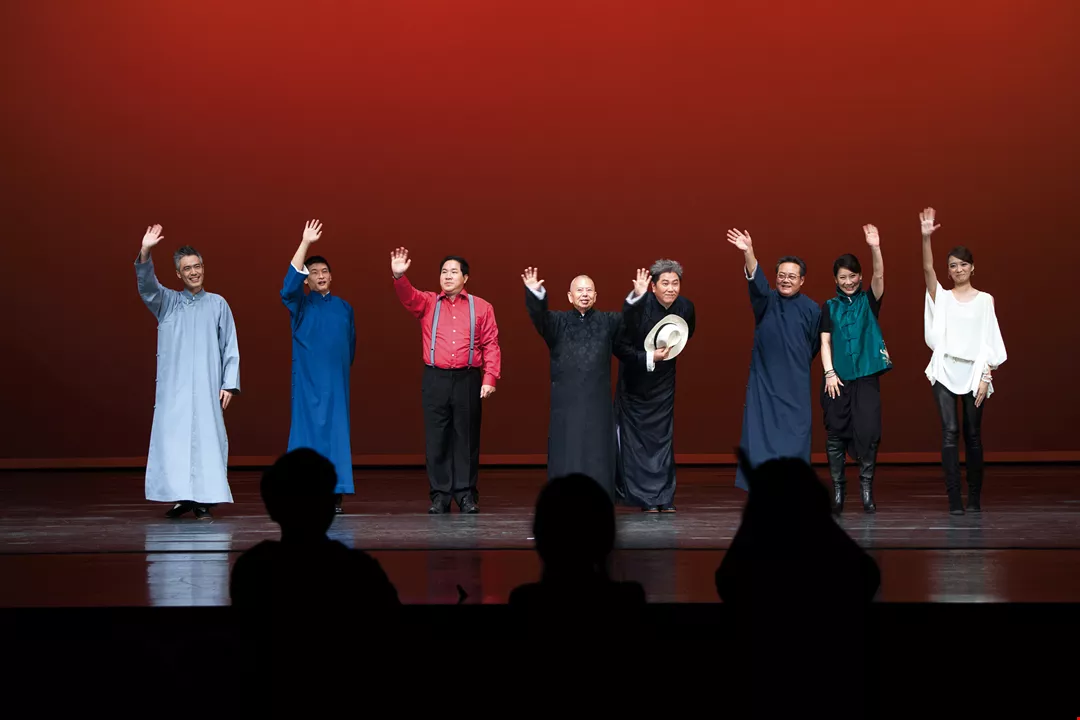
In 2013, Wu Zhaonan and his apprentices did a tour entitled Crosstalk: Love for a Lifetime. The love and support of diehard fans was their greatest reward. (courtesy of Liu Zengkai)


