Children’s Theater—Giving Kids Space to Dream
Lee Hsiang-ting / photos courtesy of the Eden Social Welfare Foundation / tr. by Jonathan Barnard
April 2015


In the Analects, Confucius says, “Let relaxation and enjoyment be found in the arts.” His comment captures the spirit behind children’s theater classes—the belief that play can stimulate children’s physical, imaginative and creative potentials.
Aimed particularly at the children of “new immigrants” (mostly Southeast Asian women who marry Taiwanese), these classes can help children of multicultural backgrounds to a better understanding of themselves and their emotions as they gain the courage to express themselves, building confidence and fostering joy.
If appreciation is the gateway to the arts, then children’s theater is that gateway’s key.
“Now imagine you’re a bunny—twitching your nose, hopping forward, chomping on something with your big front teeth.” On a Saturday morning in late March, 30 children crowd into a rehearsal space where they begin three hours of basic theater training under the direction of their teacher, Miss Hua Hua.
Graduates of the class can move on the following year to an advanced class, and once they are in junior high, to an additional class with a diverse content that includes such topics as gender education, interpersonal relations and various technical and vocational skills. The wide range of educational approaches attracts ever larger enrollments.
Chu Li-ying, director of the Eden Social Welfare Foundation’s Family Growth Center for New Immigrants, says: “Multiculturalism has left a special mark on this group of children. When first considering these theater classes, we decided to use a lively approach to get these children to know more about their own cultures.” The classes can help them build self-esteem. “All of the courses are much discussed and carefully planned.”

By developing children’s imagination and creativity, theater classes help to cultivate powers of self-expression.
“We don’t teach these classes to train child actors or the stars of the future,” Miss Hua Hua says. “Rather we hope to train in children powers of observation and self-confident expression, because many children of recent immigrants tend to be quite shy.”
The children of immigrant mothers that Miss Hua Hua has encountered are usually on the quiet side. “Our curriculum includes classes in physical development, voice development, imagination, creativity and finally group creativity.” Physical development begins with relatively simple actions to express things like size and shape, and imitating animals. The voice classes get children reacquainted with their own voices, as they learn different modes of linguistic expression.
The imagination and creativity classes are very much applicable to daily life. For instance, different kinds of flowers have different shapes and connotations. Furthermore, if children can improve their powers of observation in daily life and foster a sense of vision and appreciation, it will have a positive impact on their ability to study and focus. These classes are a way to cultivate a flair for living.
The last item on the list is the most important: It’s about learning how to communicate with others. Group creativity exercises help to build interpersonal skills. The teacher arranges for several children to play different components of a car. They move forward together but each in their own way. The exercise never fails to fill the room with laughter. At other times the children come together to bring to theatrical life the culinary ingredients of their mothers’ homelands. Each child is given free expression to act out a food of his or her choosing. When the food is put into the theatrical pan, some children explode as they hit the oil while others bounce and wiggle. These group activities always produce multicultural sparks, and as the students interact they become good friends.

Lin Jiahua—or Miss Hua Hua (Flower Flower), as she is known to her students—teaches theater both to the children of immigrants and to children in remote communities. These classes teach kids to get more in tune with their feelings and increase their self-confidence. (photo by Chang Su-Ching)
“When you return home today, all of you become little reporters. Ask your mother 20 questions about her homeland that you can share with your classmates next time.” The assignment creates an opportunity for children to gain a better understanding of their mothers’ cultures. And when classmates share what they’ve learned, the students learn about the cultures of other nations too.
Some immigrant mothers whose children took advanced classes were greatly impressed by how their children became more confident and lively, with many of them asking to attend a three-day summer camp. On their return the children were able to share with their parents the knowledge they had acquired of Vietnamese cuisine, Thai culture, Indonesian customs.... They also gained a deeper understanding of the hardships their mothers face living in Taiwan.
One mother, originally from Vietnam, says, “My son used to be very shy and quiet and wasn’t skilled socially. When he took the theater class last year, he began to share with us what he was learning in class, and when he went to school he began to take the initiative to help his classmates. He’s really opened up and gained confidence.” So long as he’s willing, she’s going to encourage him to take more classes.
Eden director Chu Li-ying says, “In fact, the class is also aimed at getting children to broaden their horizons. In particular, many immigrant mothers hope their children will gain an understanding of their own homelands. We build bridges. Many children begin to look forward to accompanying their mothers when they go back home to visit. We’re very pleased to see this kind of interaction.”

Children’s theater classes are focused on play-acting and having fun. They provide children with an introduction to the arts amid a happy atmosphere.
“When experiencing art, feeling is extremely important,” says Miss Hua Hua. “When there’s no feeling or passion, learning becomes boring, and one becomes less motivated to learn.” She is concerned about children growing up in an era of information explosion. Many parents want their children to cultivate an interest in the arts but don’t know how to begin. “After teaching for so many years, my biggest wish is to see children feel and then express themselves, even if it’s just to convey a simple sense of happiness,” she says. She explains that in the classroom she focuses on listening to children’s responses and doing her best to praise them, so that each and every one gains the courage to express themselves. Today the pace of life is so fast that it’s easy to overlook one’s feelings. Consequently, she teaches them to first stop and feel before advancing to understanding and appreciating.
Miss Hua Hua speaks from personal experience about how important it is for children to find where their own interests lie. In high school she studied baking. After she graduated, because she liked children, she found a job teaching in a kindergarten. She was surprised to find that her childlike vibe made it hard to gain the parents’ trust. The school ended up firing her. Thinking back on it today, she says, “That was an excellent setback.... I would later discover that my true interest lay in early childhood education, so I went on to enroll in a program in it.” After graduating, she got an internship at the Hsin-Yi Foundation, where she had her first contact with children’s theater and found she really enjoyed that way of teaching.
She was very fortunate to meet a few directors who worked for Ifkids Theatre, who introduced her to Teach for Taiwan, an organization that was founded to stem the tide of teachers leaving rural communities. Her religious faith taught her that she had a responsibility for children in rural communities, so she aligned her actions with her beliefs by finding employment as a substitute homeroom teacher at Xiayun Elementary School in Taoyuan’s Fuxing District. In addition to her classroom teaching duties, she has also founded a drama club at the school.
Now 33, she still has a childlike presence. She took a roundabout path to finding out what she likes to do. She hopes that children will be able to find what interests them as they study. She explains, “I am very fortunate to be a teacher of these third-grade children. Atayal children in the mountains also have their own mother language. I’ve had them create a play adapted from Cinderella that explains the importance of road safety. We made the costumes and props ourselves, and entered the play in a competition.” She says that some of the children lack confidence. But like the immigrant children she teaches, they all end up finding these theater classes engaging.
Recently, after enrolling in theater classes for immigrant children, a child discovered she had a passionate interest in performance and at the end of fifth grade was admitted to a Chinese Opera school. Every day at school she performs her stretching and vocal exercises without complaint. Miss Hua Hua finds her story deeply moving. “In fact, many immigrant mothers fully support whatever their children want to do. They have experienced adapting to a new environment themselves, so they can relate to the difficulties their children face.”
Children’s theater is like a magical charm that allows children to momentarily forget their concerns, cultivate appreciation and broaden their horizons. These classes also allow children to better understand themselves, to know their own likes, and to turn on their emotional radar, thus opening the gateway to the world of the arts.
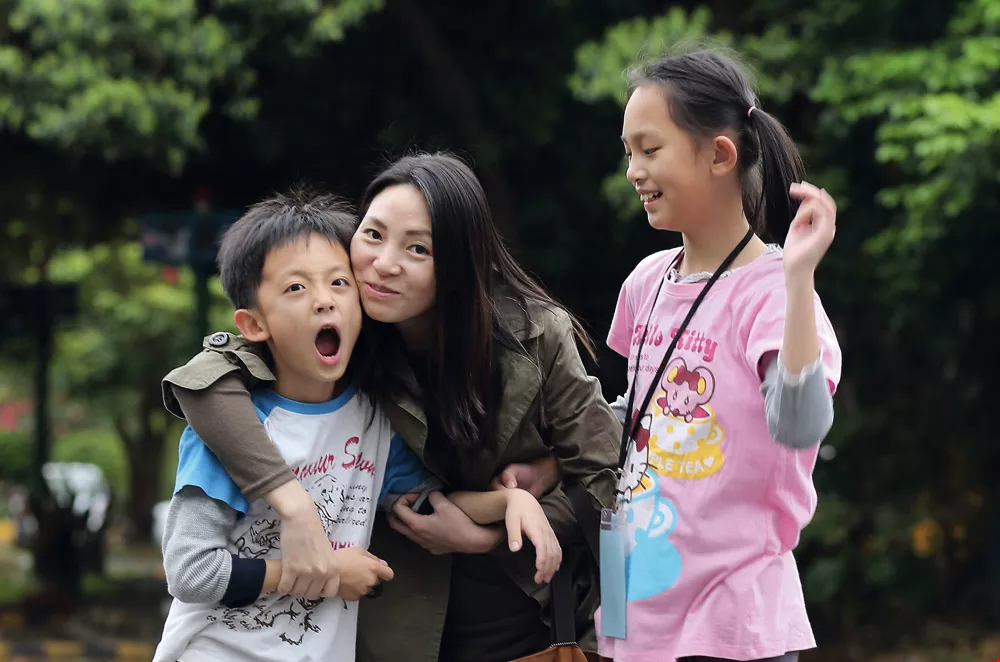
Multiculturalism is a cultural asset that belongs to all second-generation immigrants, and the diverse methods of learning taught in these children’s theater classes are avenues by which parents and children can grow closer. (photo by Chang Su-Ching)


