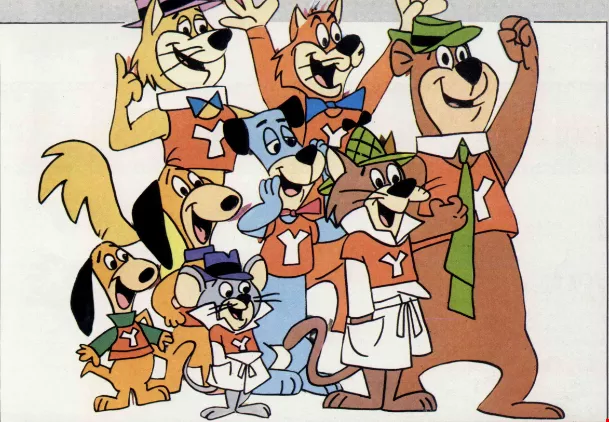
Cartoon making in the Republic of China started in 1930 when Wan Laimin and his two brothers produced the nation's first animated cartoon in Shanghai. In 1941, the brothers produced China's first color cartoon, "The Princess with the Iron Fan." After the government moved to Taiwan in 1949, many young people began to take an interest in making cartoons, under the influence of Chao Tse-hsui, a skilled practitioner in the art. Among famous cartoons already made in Taiwan are "Tien Hai Hai," "The Monkey," and "Traffic Safety." A leading figure among today's generation of young cartoon makers is Wang Chung-yuan, who returned from the U.S. to Taiwan last March to invest US$330,000 in the Cuckoos Nest Production Co. Soon after this enterprise, the first cartoon-maker in Taiwan, was established, Wang signed a contract with the Hanna-Baberra Cartoon Studio in the U.S. to produce 16 films in the Laff-A-Lympics series. This was the first time a cartoon had been made in Taiwan for showing by a foreign company. From primary school, Wang showed an interest in comic strips, and first became proficient under the instruction of Wang Shiao-chi, an acknowledged master in the art. In high school Wang won first prize in a comic strip competition for his age group. Wang's next big breakthrough came when he was studying economics at Soochow University in Taipei, and noticed how long it took his lecturers to draw charts and other illustrations on the blackboard. He thought how much time and energy could be saved, and at the same time how much extra interest could be stimulated, if the materials were presented in slide form. On his graduation, therefore, Wang started to make slides for the Tamkang college after finishing work each day at the Small and Medium Enterprises Bank in Taipei. But the lack of formal training began to show itself, and Wang studied hard to qualify for a course in instructional communications technology in the University of Indiana in 1971. After obtaining his M.A. degree, he worked for a spell with Richard Williams in helping to create the "Raggedy Ann and Andy" cartoon series. Williams became Wang's idol, and as a result, the Cuckoos Nest Productions follows Williams' style rather than that of Walt Disney. Wang moved on to Hanna-Baberra while at the same time studying cartoon creation at the University of Southern California. By now, Wang was longing to return to his own country to improve the standard of cartoons there. He wrote a letter to Pan Chen-chew, chairman of the National Youth Commission, outlining a plan to develop cartoon making in the Republic of China. After Pan gave his support, Wang presented a report to Hanna-Baberra on the prospects for cartoon-making in Taiwan, including an introduction to Taiwan's labor force, technical standards and investment climate. With Hanna-Baberra's blessing, Wang returned to carry out his plan. Shortly afterwards, Bud Getzler, vice president of Hanna-Baberra visited the Cuckoos Nest in Taiwan and found operations so satisfactory that he immediately signed a contract for production of the Laff-A-Lympics series, to be aired on U.S. TV stations this fall. Today, Cuckoos Nest employs a total of 108 people, including several arts graduates and professional cartoon makers. Male employees are responsible for animation, background, photography and editing, while females do the painting and inking. Now Wang has two long-range plans: to make cartoons based on Chinese legends and folk tales, accompanied by modern Chinese music, and to make slides promoting audio-visual and social education in Taiwan.
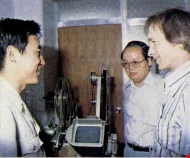
Don Patterson, Cuckoos Nest American advisor, delivering a lecture on making cartoons.
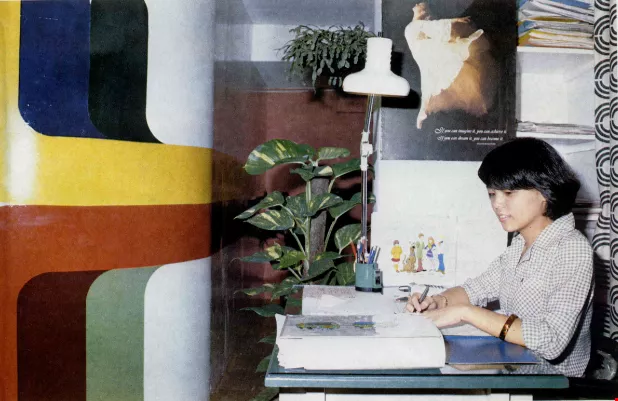
A view of management department.
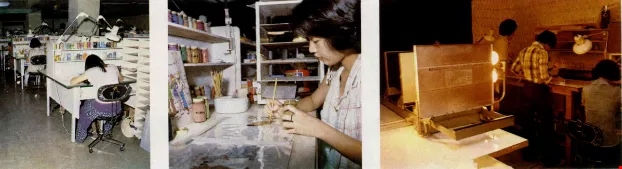
Views of the painting and the video-camera department.