Staying critical when war goes digital
Meanwhile, French artist Kévin Bray, who has long focused on the issue of media literacy, presents ProtoVise: Shaping IDs, Swapping Worlds. Combining large-scale 3D-printed sculptures with projection mapping, the work aims to guide audiences to reflect on the daily media content they consume and the hidden mechanisms driving it.
Curator Chen Hsiang-wen points out that today’s global conflicts and political events are constantly amplified and reconstructed through imagery, social media, and algorithms. Like isolated “instance dungeons” in a multiplayer video game, these crises unfold simultaneously across the globe. Using this metaphor as a starting point, the exhibition re-examines the intricate dynamics between image generation, the mechanics of viewing, and the power of information. Ultimately, it asks how we understand the real world through the lens of such imagery and information.
In an era where the cognitive boundary between reality and the virtual has completely collapsed, Chen emphasizes, “We do not need to reject technology. but I deeply wish to convey through this exhibition the necessity of awareness and critical reflection. That is the profound significance of hosting this exhibition here in Taiwan.”
Situated squarely on the First Island Chain, Taiwan serves as a crucial node where information, geopolitical power, and diverse perspectives intersect. Every day, the island receives a massive influx of varied imagery, which continually shapes public perceptions and judgments.
Speaking at the exhibition’s opening, Deputy Minister of Culture Lee Ching-hwi noted that it focuses not on technology or warfare in themselves, but rather on how people should view and comprehend a world dominated by images and data. Through the medium of art, the exhibition poses a critical question: When war enters our screens and algorithms, how do we maintain our judgment?
As Deputy Minister Lee aptly pointed out, the true value of art does not lie in providing easy answers, but in compelling us to constantly recalibrate the distance between ourselves and the world around us.
Exhibition Info: Instance Dungeons and Sights
· Dates: Now through June 28, 2026
· Hours: Tue–Fri 09:00–17:00 | Sat–Sun 09:00–18:00 (Closed Mon)
· Venue: NTMoFA (Galleries 103–107 & Gallery Street)
· Address: No. 2, Section 1, Wuquan West Rd., West District, Taichung City
、國美館長陳貺怡(前排右5)、策展人陳湘汶(前排右6)、參展藝術家等人。.jpg?w=1080&mode=crop&format=webp&quality=80)
Distinguished guests at the opening ceremony of NTMoFA’s Instance Dungeons and Sights. Attendees included Deputy Minister of Culture Lee Ching-hwi (front row, fourth from right), NTMoFA Director Chen Kuang-yi (front row, fifth from right), curator Chen Hsiang-wen (front row, sixth from right), and participating artists.
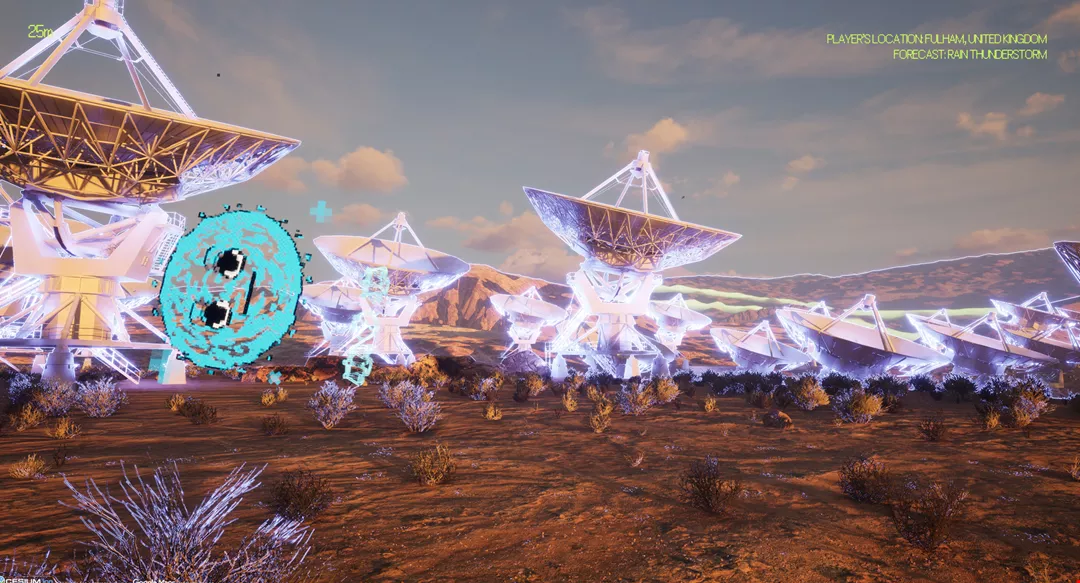
American artist Alice Bucknell’s video game installation Earth Engine proposes the concept of “Earth-as-Player,” subverting the human-centric control logic found in conventional gaming.
〈地球引擎〉展場一隅.jpg?w=1080&mode=crop&format=webp&quality=80)
Visitors interact with Alice Bucknell’s immersive video game work, Earth Engine.


〈如何消失〉展場一隅.jpg?w=1080&mode=crop&format=webp&quality=80)

〈原型夾制:塑造身分,置換世界〉展場一隅.jpg?w=1080&mode=crop&format=webp&quality=80)

@List.jpg?w=522&h=410&mode=crop&format=webp&quality=80)


