Looking Back Through Song: Ketzai Booklets
Ventine Tsai / photos cheng Yuan-ching / tr. by Jonathan Barnard
August 1993


Memories: Ignorant of what the island held for them, our ancestors were still determined to come to Taiwan.
Memories: How many times will we pass through the dark waters? The heart firms. As the great waves of a typhoon rock the boat, some raise their heads to the sky and others pray in their hearts to the gods.
Memories: Living in Taiwan, they dread the large stone and the big tree. Where they clear the land, they pull the small stones out by hand, and the blood flows. . .
Memories: Both hands are in the soil with no ox to help till the fields. Ah, time wait for me. Children and grandchildren, I raised you all eating dirt.
"Coming to Taiwan from the Mainland" by Chen Ta.
After the folk singer Chen Ta was long gone, when the Cloud Gate Dance Company performed a dance to a recording of his song "Coming to Taiwan from the Mainland," which describes the journey of our ancestors from mainland China to Taiwan, his husky voice and the history it told moved the young audience to tears.
Most people have little knowledge of ketzai, ketzai singers or ketzai booklets, but in fact "Coming to Taiwan from the Mainland" is a kind of ketzai song, and Chen Ta was a ketzai singer. Ketzai booklets are simply ketzai lyrics written down.
Ketzai booklets, which are also known as Fukienese or Taiwanese song booklets, contain lyrics set to the tunes of popular songs from ketzai theater (Fukienese or Taiwanese opera). Following the form of seven characters to a line and four rhymed lines to a stanza, the ketzai singers would improvise on the theme of an old folk tale or a major social event. Kuo Li-cheng, an expert on folklore, says that ketzai booklets are in the tradition of the pienwen style of writing found in the Tunhuang Caves, Sung and Yuan dynasty chiang-chang, taitzu (stories put into rhyme and sung with musical accompaniment) and muyushu. All are forms of popular literature.
Long before they were written down in booklets, these ketzai songs were being sung and revised by whoever sang them - adding a line here, pulling a stanza there. Constantly being refined, ketzai came to more and more reflect how people of that age lived and felt.
"These ketzai are like lyrics to popular songs today," says Tsang Tang-sheng, an associate professor of Chinese at Changhua Normal University, "except they're not written by one writer but are created by the public, generation after generation."
At first, Taiwan's ketzai booklets were all imported from the Hsiamen area of southern Fukien. But after a while, when the island's first printers took to pirating them, angry mainland publishers began to berate the offenders on the booklets' covers: "Pirating printers are shameless hooligans" or "Among pirating printers, the men are thieves and the women whores."
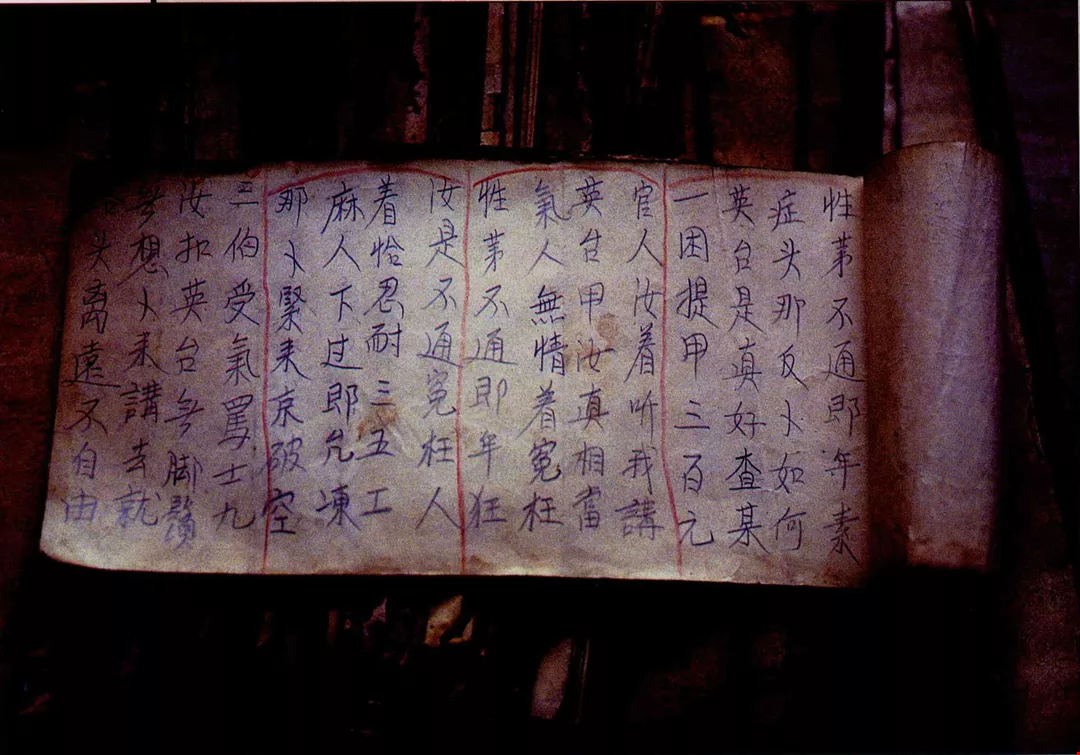
In the 55 hand-copied Taiwan adaptations of the story of Liang Shan-po and Chu Ying-tai, Liang is a hero of northern wars against the Huns, and he and Chu Ying-tai come to life again and marry.
Changing the story:
When traditional mainland stories were extended into song, there was even greater room for "local adaptation. " Take, for instance, the famous story of "Liang Shan-po and Chu Ying-tai," which was prolifically turned into about 55 different ketzai booklets. In the story a girl named Ying-tai, oppressed by traditional society, disguises herself as a boy so she can go to school, where she falls in love with her classmate Shan-po. Left with no recourse when Ying-tai's father has her engaged to someone else, Shan-po dies from grief. Ying-tai comes crying to his tomb, which opens for her. She jumps in, and they fly off as butterflies. With the Taiwan revisions of this tragedy, Shan-po not only comes to life again, but he goes north to fight the Huns and comes home in triumph. Then he and Ying-tai are finally married.
Tzeng Tze-liang, who wrote a master's thesis on Fukienese and Taiwanese song booklets, states, "the frontiersmen Taiwanese couldn't really be satisfied with those beautifully tragic love stories, "and so the ketzai booklets give the story a happy ending. The effeminate Shan-po becomes a double hero - with the sword as well as the pen. And to satisfy the fantasies of unmarried men, Ying-tai took the bold step of exposing her breasts to prove she was a woman.
During the era of the Japanese occupation, numerous booklets describing native Taiwanese life began to appear, such as those describing the luckless prostitute "Chin Kwai" who tied her pants' strings to her lover's and together jumped into a freight canal in Tainan, dying for love. This even made its way back to the mainland where it was turned into a drama. What's more, "because Taiwan was occupied by a foreign power, many ketzai booklets probe history," says collector Chen Chien-ming. After the retrocession of Taiwan, most ketzai booklets turned to tales of true love or the odd and unusual.
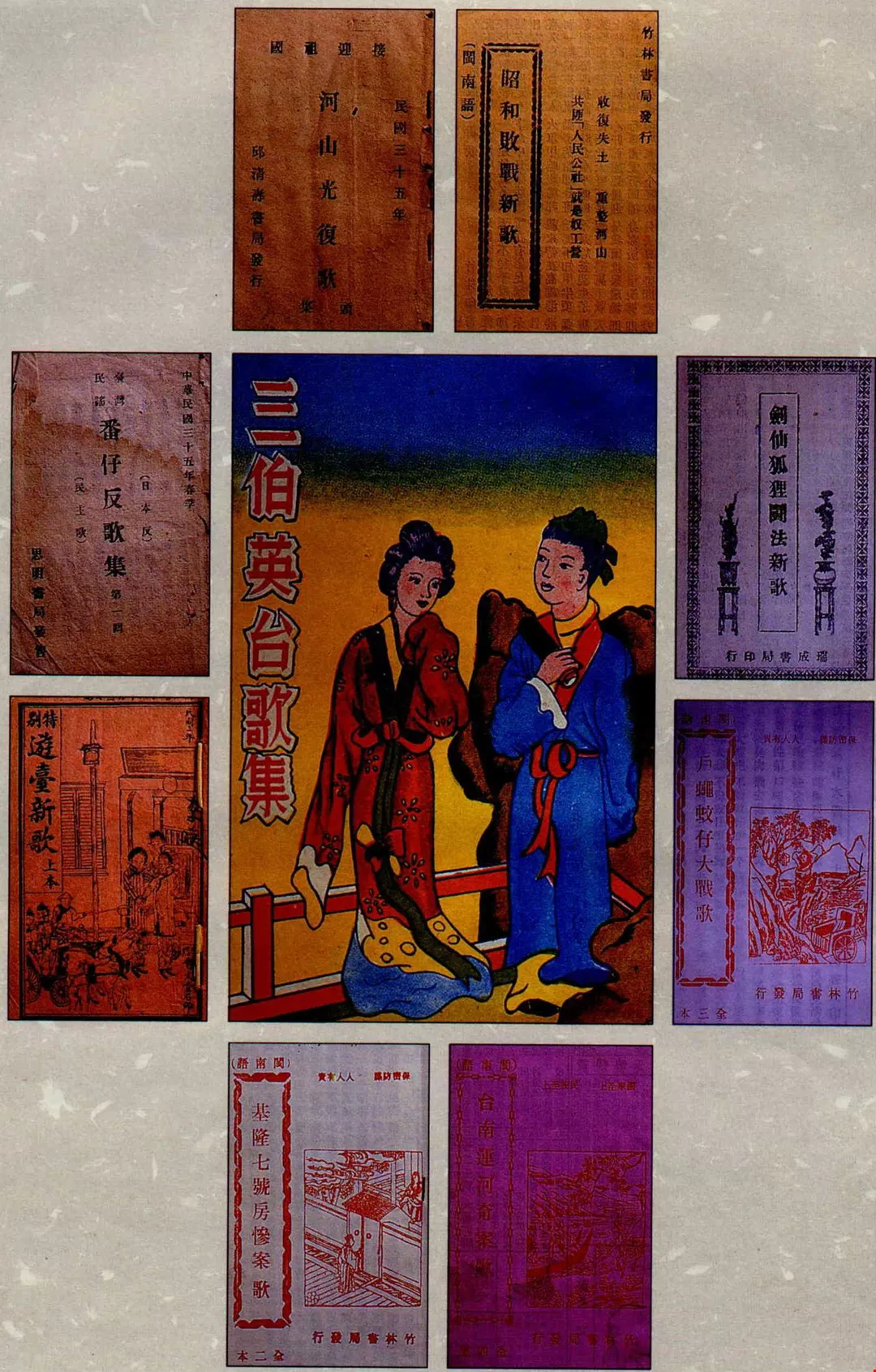
From the epic "Song of Hirohito's Defeat" to the "Tainan Freight Canal Incident," which describes a tragic incident on the margins of society, to the amusing "War of the Fly and Mosquito,"ketzai booklets serve as a record of their age. (from the collection of Chen chien-ming)
Tragic songs of the journey to Taiwan:
When Lien Ya-tang, the author of A History of Taiwan, said "Taiwan is without history," he meant that Taiwan lacked formal history written by government officials. But the common people did write their own history through ketzai. There are ten kinds of ketzai just describing how the pioneers opened the land. There is "coming home clad in finery" as described in "Kan Kuo-pao's Going to Taiwan Song" and there's "The Urging People Not to Go to Taiwan Song" : "From melancholy to illness, with no one to care... he is buried with no coffin, his bones exposed. The pigs and the dogs fight over the carcass. There is no tomb, and his family knows not of his fate."
With just a yuechin and a yehu (chinese stringed instruments), people could sing about everything from Panku's creating the world to Cheng Cheng-kung's leading the settlers to Taiwan. There is "The Taiwanese Democracy Song " in opposition to the Japanese occupation, the "Emperor Hirohito's Defeat in War Song" and "Welcoming the Nation Of Our Ancestors." In 300 years of Taiwanese history, there is little that's not in song.
There are serious historical songs and also light winsome pieces or religious sermons that reflect everyday life. "The Quitting Opium song," for instance, makes a vivid description of the haggard condition of a user: "The chest feels like a water jug and the two arms like iron hammers." And there is the "August Seventh Flood Song" that details the hardship caused by natural disaster. "The Bound Foster Daughter" and "The Farm Hand's Song" describe the feelings of hopelessness of people of low social status. Like the recent pop songs "Everyone Has the Chance to Become President" and "My Cash is All in the Stock Market," these songs help to paint a portrait of society.
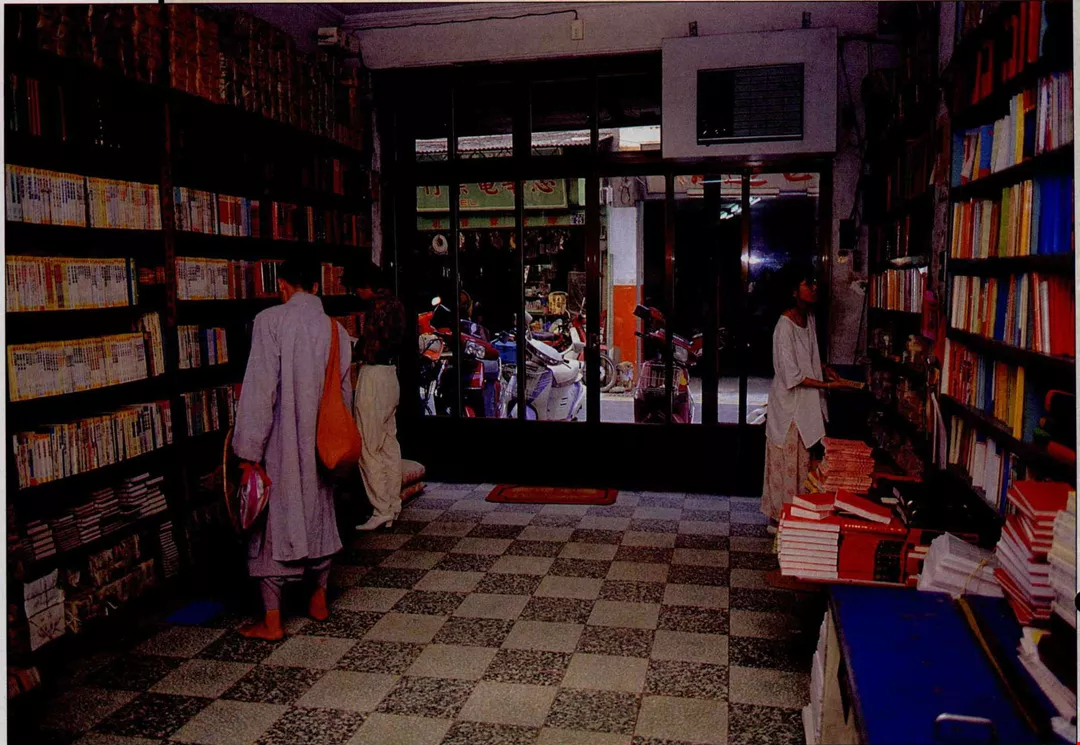
The publishing house Chulin, located across from Hsinchu's City God Temple, is Taiwan's last publisher of ketzai booklets.
Not after a handout:
Besides amateur singers among the public, professionals too helped spread the popularity of these songs. You could find their stages in every nook and corner of the city as well at temple fairs. They were largely people on the margins of society - beggars who had music written on long strips of cloth tied to their arms that people would pull to have sung, peddlers who would go all over selling their medicinal herbs, or the sellers of ketzai booklets.
This last group of singers would find some space, use ketzai to catch people's attention, pull the scattered crowds closer, and pass out ketzai booklets on loan for the performance.
Taking a melody suitable for lines of seven characters, they would start by softly singing of the love of Chen San and Wu Niang and then turn to what they had gleaned from their life on the road, of going from south to north: "In Tainan, they make bags of hemp; in Suao they're famous for white plaster; in Chushan of Miaoli, they grow persimmons and Nanshih is famous for Oolung tea. " So goes the "Products of Taiwan Song."
When the crowd grew, the singer would seek to grab their interest with "The War Song of the Fly and the Mosquito" or the "The Mutual Admiration Society of Fruits," which describes the loquat as the emperor, the tangerine as the empress, the banana as the commander-in-chief, and the star fruit as the meditation master.
Tired from singing, the singer would call the performance to a close with the lines " If you like these songs, buy a few at only NT$.30 a piece." And the satisfied old men and women would pull out their change to buy a song or two. Improvising on these lyrics to make your own tunes, you could say, "The ketzai are other people's, but the feeling is my own."
After radios and televisions became commonplace, the songs moved to the airwaves, and the business of creating them entered a stage of specialization. The age of ketzai was over. There were no longer just a limited number of tunes that anyone with a little practice could master to become singer and songwriter. Nowadays, every song has its own time, and often the lyrics take a back seat to the music. As a result, everyone is busy learning new songs, and there is no space for creative display in rewriting lyrics. "It's truly a disaster," Tsang Ting-sheng says of this movement away from creative participation.
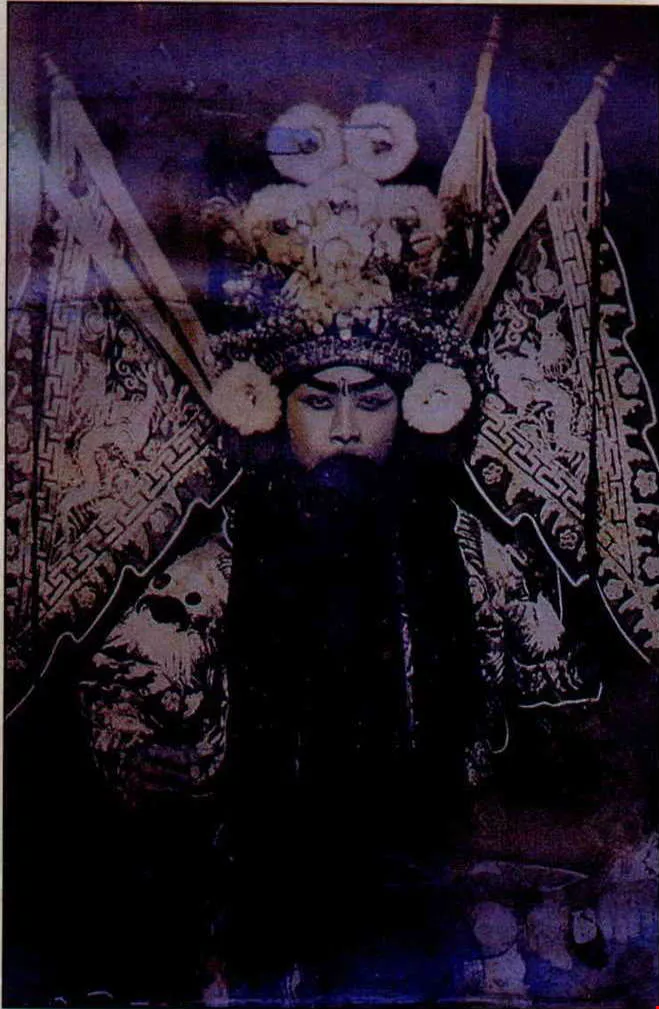
Lin Yu-lai, the deceased former owner of Chulin, was a Taiwanese opera performer in his youth. Besides performing, he would often speak in stanzas of four lines and lines of seven characters. He put together numerous ketzai booklets. (rephotographed by Cheng Yuan-ching)
Famous for its Ketzai booklets:
As ketzai has declined, its publishers have had to close up shop. Currently Chulin, across from the City God Temple in Hsinchu, is the only publisher of ketzai booklets on the whole island.
"I can't tell you a lot about ketzai," says the current publisher Wu Chao-mei. "But when my father-in-law was around, he would even conduct business in stanzas of four lines and lines of seven characters." Ten years ago, when her father-in-law Lin Yu-lai, the publisher of some 300 ketzai booklets, was on his death bed, Wu promised she wouldn't let the publishing house die out. And so after several ketzai publishing houses in southern and central Taiwan went belly up, Chulin became the last of a breed.
As for the future, she pulls a yellowed ketzai booklet from the shelf and points to its back: "Ketzai booklets are now in their last days. Look at this 1960 booklet- it still hasn't sold out! It's good that fortune telling books and kungfu novels are hot sellers. If I was just relying on ketzai booklets, I wouldn't be able to put food on the table."
Besides a few general entertainment programs, such as "Happy Every Day" and "Spring Every Day," which still use or make reference to ketzai booklets, some candidates emphasizing their roots have created new ketzai. For Yu Ching, the Taipei County magistrate, a think tank wrote a description of his political views during the elections three years ago in four line stanzas of seven characters per line. His subsequent victory proved that singing does indeed beat speaking.
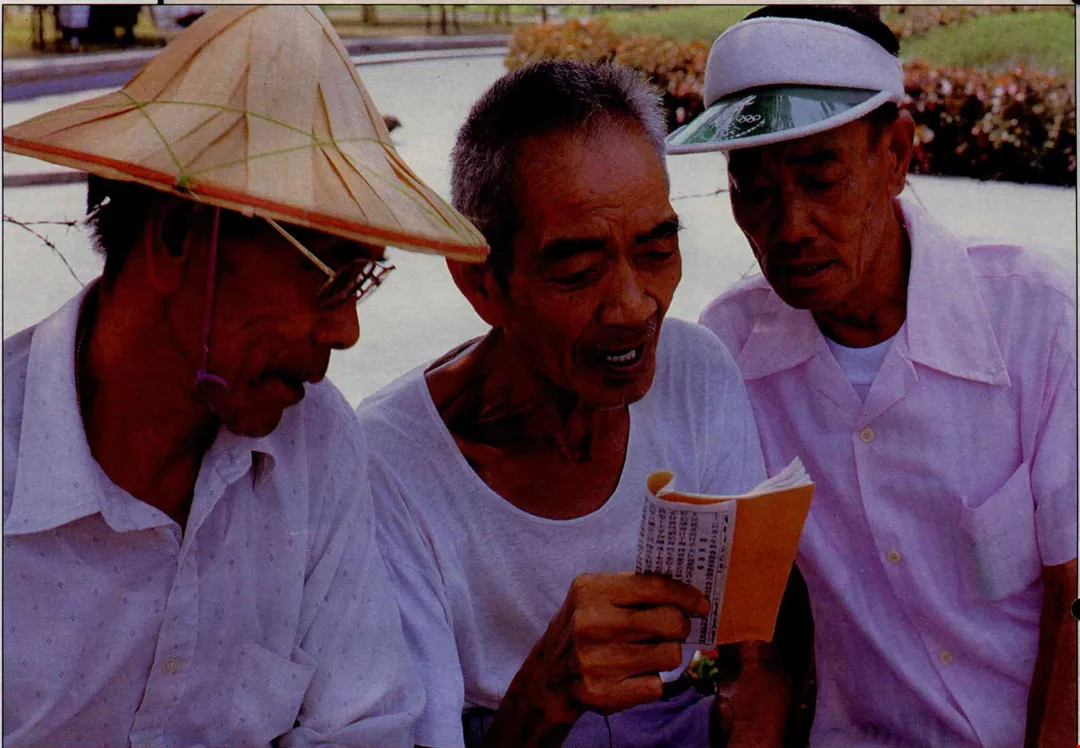
With ketzai booklets in their hands, a few friends sing the songs they so love. This is how songs became popular in the old days.(photo by Vincent Chang)
Grandpa's ketzai theater:
But such examples are few and far in between. There's simply no way for these songs to gain much of a following in the modern life of today. Now, you've got to go to Ilan, the center of ketzai theater (Taiwanese opera) or to the parks of such towns as Luotung or Taoyuan, where the genre once thrived. There you can still see old folk, hair thinning and eyesight bad, singing ketzai.
Some bring their suo-nas to blow on, and others their fans, flicking them demurely. And still others have brought nothing more than their voices. A 92-year-old gentleman named Hsiao can neither play an instrument nor sing many ketzai tunes, but alone, to the rhythm of a poem he learned in his village school, he chants out ketzai lyrics that have been enlarged on a copier, loudly singing of the stories, romance and youth of his generation.
[Picture Caption]
p.86
Leaning on each other for support, the blind diva Yang Hsiou-ching would sing ketzai as her husband, Yang Tzai-hsing, provided accompaniment on strings. They used the ketzai to attract customers for the medicine they were selling. Now, at evening folk concerts, it's pure performance. (photo by Pu Hua-chih)
p.88
In the 55 hand-copied Taiwan adaptations of the story of Liang Shan-po and Chu Ying-tai, Liang is a hero of northern wars against the Huns, and he and Chu Ying-tai come to life again and marry.
p.89
From the epic "Song of Hirohito's Defeat" to the "Tainan Freight Canal Incident," which describes a tragic incident on the margins of society, to the amusing "War of the Fly and Mosquito,"ketzai booklets serve as a record of their age. (from the collection of Chen Chien-ming)
p.90
The publishing house Chulin, located across from Hsinchu's City God Temple, is Taiwan's last publisher of ketzai booklets.
p.91
Lin Yu-lai, the deceased former owner of Chulin, was a Taiwanese opera performer in his youth. Besides performing, he would often speak in stanzas of four lines and lines of seven characters. He put together numerous ketzai booklets. (rephotographed by Cheng Yuan-ching)
p.92
With ketzai booklets in their hands, a few friends sing the songs they so love. This is how songs became popular in the old days.(photo by Vincent Chang)
p.93
People would pick one of the songs whose names were tied to his arms, and he would use the song to tell their fortunes and put food in his stomach. (from Taiwan Folk Customs)

@List.jpg?w=522&h=410&mode=crop&format=webp&quality=80)


