Taiwanese Activists' Role in Taiwan's Retrocession
Laura Li / photos courtesy of KMT Party Archives / tr. by Scott Williams
November 2010


The once important October 25 Retrocession Day holiday has slowly faded from memory since its removal from the rolls of national holidays during Lee Teng-hui's presidency. Nowadays, we no longer speak forcefully of our "victory in the war of resistance," but instead talk almost ruefully of "Japan's surrender."
In an effort to reestablish the retrocession's standing in the public's eye, the Taiwan Provincial Government and the Taipei City Government have staged an exhibition commemorating the 65th anniversary of the victory over Japan and retrocession to Chinese rule. Taipei's Zhongshan Hall, where Rikichi Ando, the last Japanese governor-general of Taiwan, signed surrender papers in 1945, will exhibit nearly 200 photographs depicting not just the activities of the Nationalist Army, but also the lesser known efforts of Taiwanese resistance groups such as the Taiwan Revolutionary Alliance and the Taiwan Volunteers, offering the public a different perspective on the relationship between Japanese-ruled Taiwan and the Republic of China.
"The building of the nation through revolution, the war of resistance to the Japanese, and Taiwan's retrocession are so closely linked as to be indivisible," avers Shao Ming-huang, director of the KMT Party Archives and the organizer of this exhibition.
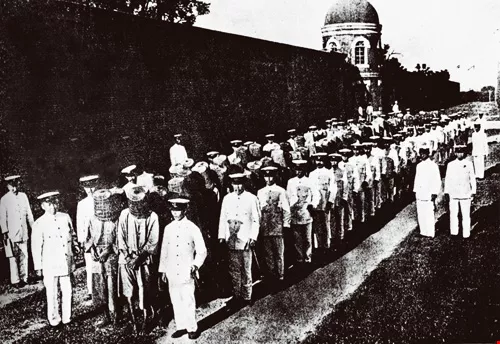
The 1915 Tapani Incident, which took place in the Tainan area, was the last and most virulent armed Han uprising against the Japanese on Taiwan. The photo shows the incident's instigators being led to trial.
When Sun Yat-sen and Lu Haodong traveled to Tianjin in 1894, they also sent a letter to Li Hongzhang, then the viceroy of Zhili and minister of Beiyang, laying out a plan to save the nation. But then the First Sino-Japanese War broke out, the Beiyang Fleet was annihilated, and the Qing court signed the Treaty of Shimonoseki ceding the Liaodong peninsula, Taiwan, and the Pescadores to Japan. Sun's indignation at the loss of life and of national honor sparked his revolutionary activities.
In 1897, three years after Sun formed the Revive China Society, Chen Shaobai established the group's Taipei branch. In 1900, Sun established a command center near present-day Taipei's Changsha Street with the goal of fomenting revolution in Huizhou, Guangdong Province. In spite of the Japanese governor-general's behind-the-scenes involvement, more and more Taiwanese joined the movement, including individuals such as Luo Fuxing, who went on to participate in the Huanghuagang Uprising. By 1910, many of Taiwan's elites, including Weng Junming, Jiang Weishui, Du Congming, Sun Qiaoshan, Liao Jinping, Lian Heng, and Lai Ho, had joined the society.
The Zhongshan Hall exhibition includes a group photo of students from Taiwan Governor-General's Medical College (now the National Taiwan University College of Medicine) taken during their 1913 summer break. More than a simple representation of friendship, the photo has an air of parting about it. Weng Junming and Du Congming, then just 20 years old, are among those pictured. Outraged by Yuan Shikai's plot to make himself emperor, his assassination of Song Jiaoren, and his attempts to harm Sun Yat-sen, the two wrote their wills and traveled to Beijing with vials of Vibrio cholerae bacteria that they intended to use to kill Yuan. Though they ultimately abandoned their plan, that they contemplated it at all suggests just how greatly Taiwan's volunteers admired Sun.
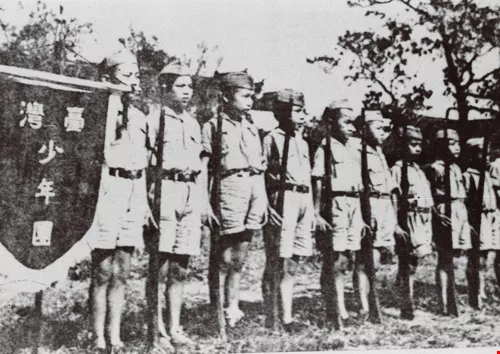
Many people know about the Taiwanese who fought for Japan in the Pacific War, but General Li Youbang's Taiwanese Youth Brigade, part of the Taiwan Volunteers, actually fought against the Japanese. These 117 boys aged eight to 16 were primarily responsible for propaganda and communications.
Jiang Weishui, a democracy fighter who had a profound impact on Taiwan, was one of Sun's Taiwanese adherents and came to be much beloved by Taiwanese.
Recognizing that Taiwan's armed resistance to Japanese rule had resulted in terrible casualties and that "the motherland" was too busy with its own internal strife to do anything for Taiwan, Jiang, Lin Xiantang, and others took Liang Qichao's advice: they began working within the system. On the one hand, their non-military resistance took the form of establishing the Taiwan Culture Association to spur public spirit. On the other, it involved actively lobbying the colonial government to establish a popular assembly. Jiang established the Taiwan People's Party in 1927 (and gave it a flag that resembled the ROC's), but the Japanese ordered the party disbanded just three years later.
Another Sun follower, Weng Congming, moved to the Chinese mainland after 1915's Tapani Incident. There, he covertly supported Sun Yat-sen's revolution and Northern Expedition while practicing medicine in Xiamen and Shanghai. Weng surrendered his Japanese citizenship in the wake of 1937's Marco Polo Bridge Incident, and was ultimately killed by poison in Japanese-occupied Changzhou. Prior to his death, he had been working to establish a Taiwan branch of the KMT.
Sun Yat-sen's death in Nanjing in 1925 triggered mourning in both mainland China and Japanese-controlled Taiwan. Zhang Wojun, a Taiwanese writer much influenced by the May Fourth Movement, wrote:
"Four hundred million citizens are weeping today over your death. When the news came, the people of my island felt their insides collapse as if their souls had fled. Looking westward to the heartland, the tears come pouring out...."
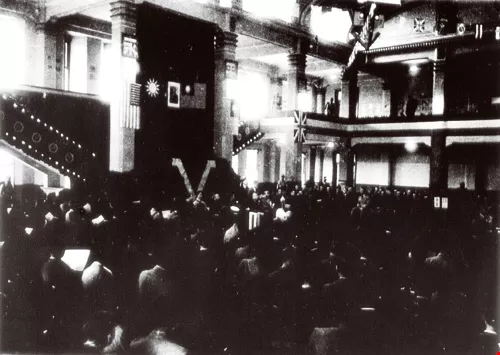
On October 25, 1945, Zhongshan Hall hosted a ceremony witnessed by representatives from the US and the UK marking Japan's surrender of Taiwan. There, Chen Yi, head of the Taiwan Provisional Garrison Command, accepted surrender instruments from Rikichi Ando, the last Japanese Governor-General of Taiwan.
Taiwanese volunteers didn't just yearn for the Republic of China, they were also intimately involved in Sun's revolution. When war broke out between China and Japan in 1937, numerous Taiwanese stepped into the breach, returning to the motherland to fight the Japanese.
"They did so because they knew that defeating Japan was the only way to return Taiwan to China," says Shao Ming-huang, adding that Taiwanese volunteers streamed back to China by every means possible. At first, their activities were largely unorganized. Then, in 1941, the Taiwan Revolutionary Alliance formed in Chongqing and vowed "to gather all of Taiwan's revolutionary forces under the leadership of the Chinese Nationalist Party in order to overthrow Japanese imperialism, return Taiwan to Chinese rule, and build a new China based on the Three Principles of the People." General Li Youbang, who had joined the Taiwan Culture Association at 14 and gone on to study at the Whampoa Military Academy, recruited more than 300 young Taiwanese to form the Taiwan Volunteers, a guerrilla group active along the coasts of Fujian and Zhejiang Provinces.
The Taiwanese volunteers' efforts to resist the Japanese and restore Taiwan to China gave rise to many profoundly moving events, some of the most tragic of which involved the Lin family of Wufeng.
Originally from Changzhou, Fujian Province, the Wufeng Lins were widely recognized as one of Taiwan's most important families. During the Qing Dynasty, Lin Shuangwen was involved in anti-Qing activities and Lin Chaodong helped then-governor Liu Mingchuan repulse a French landing force. During the Japanese occupation, Lin Chaodong's son Lin Zumi sold off the family property to support the activities of Luo Fuxing, Yu Qingfang, and others engaged in military resistance to the Japanese. During the same period, Lin Xiantang employed non-military methods to resist the Japanese and promote democracy. Generations of the Lin family believed that Taiwan's existence was dependent on China's and that loving Taiwan meant loving China.
Lin Zumi not only spent his family's fortune supporting anti-Japanese activities, but also kept close to Sun Yat-sen. Made a commander of the Southern Min troops, he ultimately died for the cause, killed by the warlords during Sun's Northern Expedition.
Lin Zumi's son Lin Zhengheng followed in his father's footsteps, attending the ROC Military Academy in Nanjing and devoting himself to the Japanese resistance. He fought the Japanese in the Yunnan-Burma theater, where, in spite of suffering severe injuries to his left arm, he wrote to his wife: "I have done my duty in this divine war. Taiwan's return to Chinese control-my father's life's ambition-has been accomplished. If he knew, he would be smiling in the afterlife."
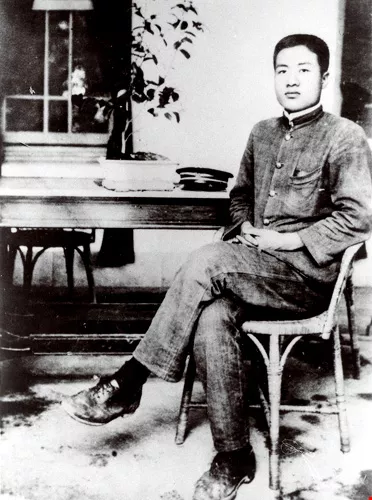
Though monitored and repressed by the Japanese colonial government, Taiwanese volunteers were determined to play a role in their motherland's history. Jiang Weishui (left) and Liao Jinping (center) were disciples of Sun Yat-sen. Lin Zhengheng (right), one of the Wufeng Lins, actually fought the Japanese. But the political upheavals and policy errors of the early years after retrocession brought suffering to an entire generation of Taiwanese elites, a situation that has yet to be redressed.
But history is often tinged with sadness. After the victory over Japan, Lin Zhengheng and many other ordinary citizens became disgruntled with the corruption of KMT rule and turned hopeful eyes to the Communists. The civil war between the Communists and the Nationalists ended up ensnaring not just mainland Chinese, but many of the Taiwanese volunteers.
In 1946, Lin Zhengheng led 20-some young Taiwanese people back to Taiwan to start a rebellion. Following 1947's February 28th Incident, they joined Taichung's 27 Brigade and began an armed insurrection against the KMT government. Though they escaped arrest at the time, they were jailed during the White Terror of 1949. Taiwanese officials and gentry appealed to Chiang Kai-shek to free Lin, but Lin refused to repent and was executed by firing squad at the age of just 34.
Though unfortunate, Lin Zhengheng's fate was hardly unique. Taiwan's joyous celebrations of retrocession had hardly died down when Taiwanese discovered that they'd welcomed in a corrupt government that had been rejected by the populace of the motherland.
The February 28th Incident, which occurred just two years after retrocession, resulted in the deaths of many politically active Taiwanese elites. Even Lin Maosheng, the acting dean of NTU's College of Liberal Arts who had commemorated Taiwan's retrocession with a speech at Zhongshan Hall entitled "Returning to the Embrace of the Motherland," was forcibly detained then "disappeared." Jiang Weishui's daughter Jiang Biyu and her husband, Zhong Haodong (the younger brother of writer Zhong Lihe), also suffered terribly during the White Terror. That the Taiwanese volunteers who had fought for Sun Yat-sen's revolution and resisted the Japanese to bring about retrocession suffered so much at the hands of the KMT was a source of bitter irony and pain. Their vicissitudes turned them against the KMT, which they came to regard as a foreign regime.
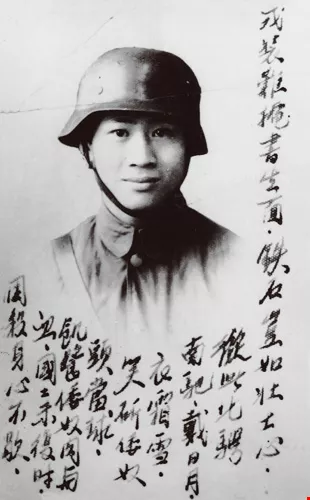
Though monitored and repressed by the Japanese colonial government, Taiwanese volunteers were determined to play a role in their motherland's history. Jiang Weishui (left) and Liao Jinping (center) were disciples of Sun Yat-sen. Lin Zhengheng (right), one of the Wufeng Lins, actually fought the Japanese. But the political upheavals and policy errors of the early years after retrocession brought suffering to an entire generation of Taiwanese elites, a situation that has yet to be redressed.
In 2005, 58 years after the February 28th Incident, Liao Dexiong, the son of Liao Jinping, a victim of the incident, presented a bottle of whiskey to Ma Ying-jeou, who was then the mayor of Taipei, in recognition of Ma's annual visits to the family to pay his respects. The whiskey had been given to Liao Jinping by Sun Yat-sen during a 1913 visit to Taiwan for secret meetings with the Taiwan Revolutionary Alliance. Prior to his execution, Liao had managed to have the key to his safe delivered to his family along with instructions that they were to treasure the whiskey inside it.
Some 58 years later, Liao's son presented the bottle to Ma, who would become KMT party chairman just six months later. The younger Liao's gift showed his forgiveness and symbolized the willingness of some of the families who suffered to again accept the KMT. Now, as we celebrate the 65th anniversary of victory in the war with Japan and of Taiwan's retrocession, and the first major anniversary since the KMT reassumed the reins of power, these black-and-white photos offer us the chance to reexperience the significance of that historical moment.
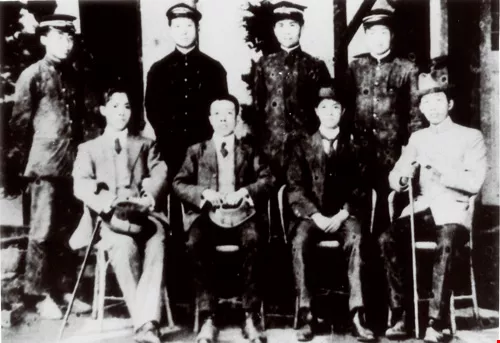
Upset about Yuan Shikai's efforts to harm Sun Yat-sen, Weng Junming (front row, second from left) and Du Congming (third from left) traveled to Beijing intending to infect Yuan with cholera bacteria. They are pictured here with their classmates from Taiwan Governor-General's Medical College. Jiang Weishui is in the back row at the far right.

@List.jpg?w=522&h=410&mode=crop&format=webp&quality=80)


