Yu Wanzeng--Finding Pastures New
Ventine Tsai / photos Hsueh Chi-kuang / tr. by Robert Taylor
July 1993


Playing opposite mainland's "National Treasure" Grade artist Du Jinfang (right) not only enriched Yu Wanzeng's operatic experience, it also raised his whole "stature" as a performer. (photo by Teng Hui-en, courtesy of China Times Weekly)
For lack of opportunities to perform on stage in Mainland China, many Peking Opera artists who play supporting roles such as soldiers, servants and palace maids put on their stage costumes and rove about the tourist hotels, becoming a "side dish" to amuse the guests as they enjoy their drinks. Even a Grade 1 performer like Yu Wanzeng has gone as long as six months without a stage appearance.
"In Taiwan you've got the chance to perform and earn some money too, why not just stay there!" Yu Wanzeng's own wife suggested to him.
At the end of May, after 16 stage performances and nine lectures, all before appreciative audiences in packed houses, most of the 96 visitors from Mainland China's "China Peking Opera Company" set off on their journey home, to return to a languid life of working "two days on, three days off." But Grade 1 performer Yu Wanzeng stayed behind in Taiwan, still working busily.
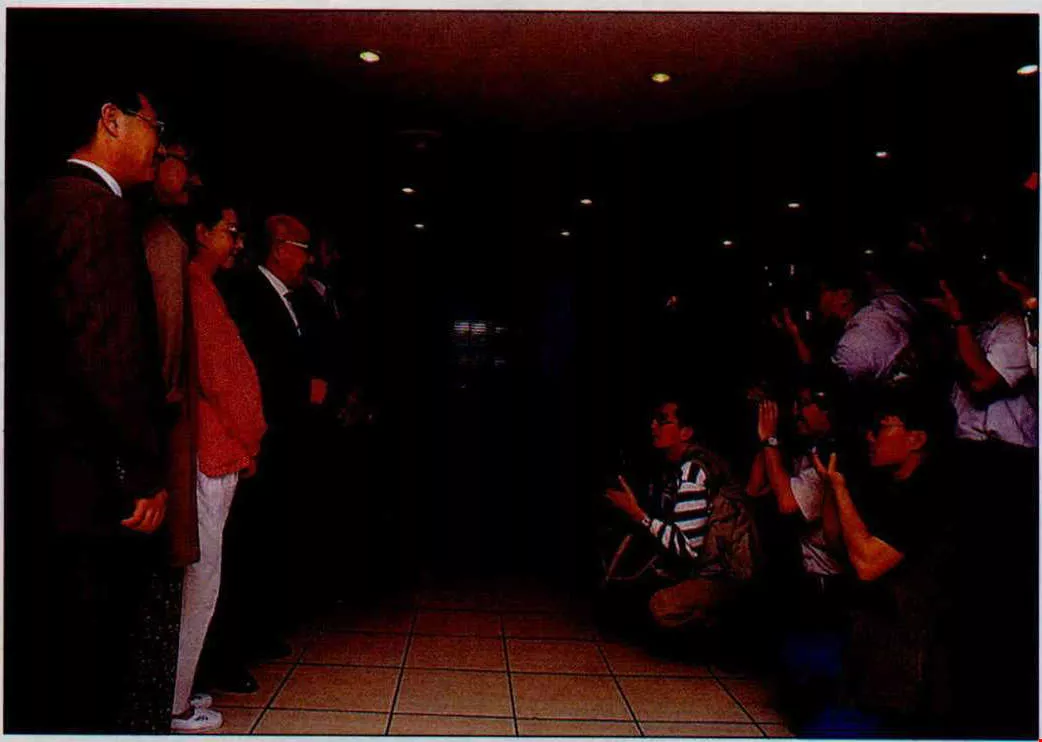
A news conference held when the "China Peking Opera Company" came to perform in Taiwan brought together many Grade 1 performers including Yu Wanzeng (far left). Their arrival delighted the media and audiences alike. (photo by Pu Hua-chih)
Well worth the journey to Taiwan:
In early June, in the little time remaining before the public graduation performance by the students of Kwo Khang Art School, Yu Wanzeng hurried to give them master classes, analyzing the characters' psychological conflicts, while at the same time correcting the students' posture and movements. Since then he has appeared on four or five TV and radio programs to explain Peking Opera. The grand finale will be at the end of July when he appears with Wei Hai-min, Chen Yuen-cheng and other artists from Taiwan to perform works such as Liao Yin Chi and Chin Hsiang-lian.
The reason for Yu Wanzeng's "good fortune" lies in his "Taiwan connections." In fact, back in late 1991, taking advantage of a trip to visit his uncle Hsiao Yun-sheng in Taiwan, Yu Wanzeng played with the ROC air force's Ta Peng Chinese Opera Troupe in Su Tang Chun, thus becoming the first mainland hsiaosheng to perform in Taiwan. Early this year he once again took leave from the China Peking Opera Company to play in three performances in Taiwan, all of them to full houses.
Yu Wanzeng does not object to being asked about his income: what with stage performances, teaching and media appearances, it adds up to some NT$300,000 over six months, or about 12 years' salary on the mainland. "People here are very warmhearted. When they find out I am from the mainland, they give me all kinds of extra money, and friends and family have given me many 'red envelopes,'" says Yu Wanzeng.
When back on the mainland he is constantly telling his comrades at the China Peking Opera Company that coming to perform in Taiwan is very much "worthwhile." "By 'worthwhile' I don't just mean the money, the psychological boost is the important thing. If you give lectures like this about opera on the mainland, you're happy if just two or three people turn up; there's no way you'd have people even standing in the aisles like you do here!" says Yu Wanzeng with emotion.
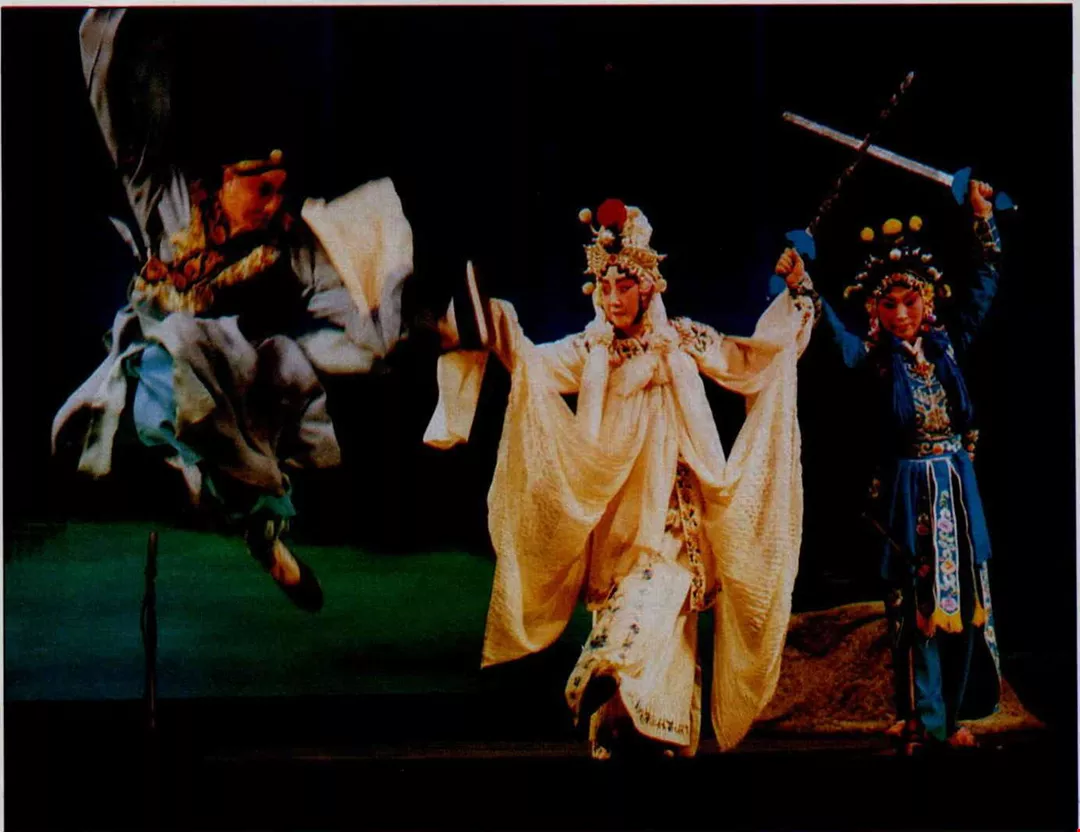
When traditional opera started playing again, Yu Wanzeng at last had a chance to display his talents. (photo by Teng Hui-en, courtesy of China Times Weekly)
Opera stars were the darlings of the nation:
In 1949, with the civil war between the Kuomintang and the Communists barely over, when Mei Lanfang arrived at Beijing Railway Station from Shanghai where he had taken shelter from the fighting, all the famous opera stars were there to meet him. Among them was Xiao Cuihua (Yu Lian-quan), a female impersonator whose fame rivalled that of the "four great female impersonators" of the 1920's (Mei Lanfang, Cheng Yanqiu, Xun Huisheng and Shang Xiaoyun). Xiao Cuihua was Yu Wanzeng's grandfather; at the time Yu Wanzeng was a baby less than a year old.
His father Yu Shiwen was also a well-known artist. When Yu Wanzeng was at primary school his grandfather was still on the stage, and at home his father would start exercising his voice and rehearsing roles as soon as he got up in the morning. "This business was in my blood from the start," Yu Wanzeng recalls.
As a boy he took the entrance exam for the China Operatic School, which was directly administered by the Ministry of Culture. The School's principal was his maternal great-grandfather Xiao Changhua, and its chief examiner was his maternal grandfather. With their help, Yu Wanzeng entered the circle of Chinese opera performers.
"In the days when I was studying opera, being a Chinese opera performer was a very glamorous profession, just like a pop singer nowadays," says Yu Wanzeng. For Peking Opera stars to be invited to meet Zhou Enlai was commonplace, and it was no rare thing for the audience to stand up part way through a performance, indicating that Mao Zedong himself had come to watch. Students from the School were often called to Zhongnanhai (the residence of top mainland leaders) to sing excerpts from operas. Of mainland China's Grade 1 per forming artists, 95% were Peking Opera artists. Their status was high and so was their pay: stars like Ma Lianliang and Zhou Xinfang drew salaries approaching RMB2000 a month, at a time when ordinary manual workers only took home about RMB60.
Though the School's teachers included 10 great masters such as Xiao Changhua and Hou Xirui, the ones who trained Yu Wanzeng to play hsiaosheng roles were Jiang Miaoxiang, who played alongside Mei Lanfang for many years, and Chen Shengtai, a master of the Mei, Shang, Chang and Hsun schools' hsiaosheng styles. "Life at the School was full of optimism," recalls Yu Wanzeng, recounting how after class everyone would rush to grab props and bag a training booth. Each of them hoped that when they graduated they would be among the select few to be accepted into the China Peking Opera Company.
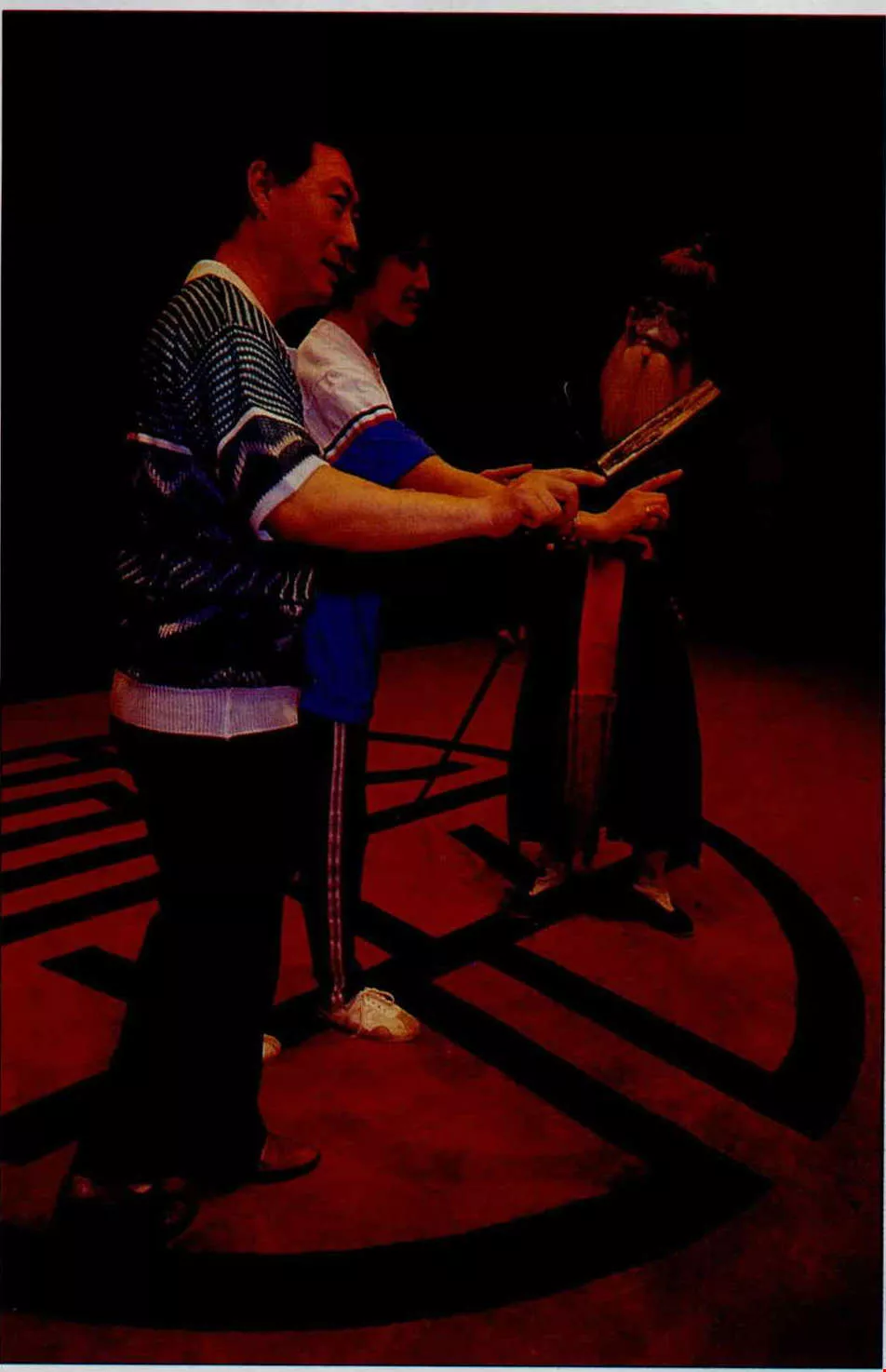
"The students may not be as accomplished as on the mainland, but they are devoted and hardworking." Apart from performing in Taiwan, Yu Wanzeng has been giving Chinese opera classes at the Kwo Khang Art School's Chinese Opera Department.
No one dreamed of fame any more:
But before they could graduate, the chaos of the Cultural Revolution burst upon China. "That was the end for us," says Yu Wanzeng. Singing practice and stretching exercises gave way to making revolution and taking part in political campaigns. Then he was sent down to the countryside, to Zhangjiakou in Hebei Province, where every day was spent working in the fields, catching frogs or fishing for prawns. "No one dreamt of becoming famous any more; we didn't even know if we'd ever be able to go back to Beijing," Yu Wanzeng says without a trace of bitterness, as if speaking of events which had happened to someone else.
Things were even worse for his family. Peking Opera actors were categorized among the "three famous and three highs" (famous authors, directors and performers; high wages, author's fees and other remuneration), and as such none could escape having their houses ransacked and their property confiscated. Before the Red Guards arrived, Yu Wanzeng and his elder brother hurriedly searched the family house themselves to dispose of everything "incriminating." "Everything with memories attached, everything of any value, all went up in smoke." He and his brother even chiselled the inlaid mother-of-pearl decorations one by one from the family's tables and chairs. Their grandfather stood by as if in a daze, personally tearing up the beloved photographs of his great opera performances. "If those had been found it would have meant death; all we could hold onto was our lives."
Two years later, Yu Wanzeng joined the Beijing Military Region's "Armed Forces Peking Opera Troupe" (similar to the Performing Arts Brigade in Taiwan), but all they could perform were the eight "model operas," repeated ad infinitum. It was a long period of time, but he has little to say about it. "Every day we had to pull up grass and study politics," says Yu Wanzeng, glossing over 10 years of turmoil in just one sentence.
Talent waiting for an opportunity:
The year the "Gang of Four" fell from power and the Cultural Revolution came to an end, Yu Wanzeng was 27. One day his father said to him earnestly: "In three years you'll be 30; you're a man with a family now, but what are you going to do about your artistic career?" His father warned him that talent has to find the right opportunity, opportunities do not wait for talent. If he was prepared to work hard there was still time. His father's words awoke Yu Wanzeng as if from a dream, and from then on he put all his energy into relearning his craft, seeking out masters to coach him line by line through operas containing hsiaosheng roles. Some pieces he studied with as many as four or five teachers. After three years, traditional operas were finally allowed to be staged again, and an elated Yu Wanzeng began training even more assiduously.
Once a rare opportunity to perform turned up: the army troupe was to play the "Tuanchiao" scene from the Legend of the White Snake, and had not found anyone to sing the role of Hsu Hsien. But finally another member of the troupe who had studied wusheng (male acrobatic roles) was chosen for the part. Although already 30 years old, Yu Wanzeng was so disappointed that he wept.
At last his chance did arrive. After five years of hard training, he was noticed for his performance in Pai Yi Tu Chiang in Beijing. This newly written piece was the first in which a hsiaosheng played the leading role. The whole work contained 130 hsiaosheng singing lines, which is three times the usual amount. They included sections in singing styles such as "slow ehrhuang" which had not been used for nearly thirty years, and in the newly created "baby ehrhuang" style. The piece was a highly challenging, first-rate work, and provided a perfect opportunity for Yu Wanzeng to demonstrate the mastery he had gained in five years of hard study.
At that time Du Jinfang, Mei Lanfang's favorite female student, had been searching desperately for a hsiaosheng to play opposite her. Yu Wanzeng was seconded to the China Peking Opera Company, where he performed with Du Jinfang at many venues inside and outside China. "To play on the same stage with a 'National Treasure' Grade artist like Du Jinfang raised my whole stature as a performer, says Yu Wanzeng, who looks upon that time as a turning point in his life.
Good luck or bad? It's hard to say:
Yu Wanzeng's fame grew by the day, but he found himself obstructed at every turn by the army, which refused to lend him to other troupes. In 1988 he resolved to leave the Armed Forces Peking Opera Troupe and formally join the China Peking Opera Company, although they could pay only half his previous salary. When he was a youngster it had seemed so close, but it had taken him twenty years to get there!
In the Company, some older artists would often say to him with regret: "What a pity you didn't come to us in better times; with your good stage looks and fine voice, you'd surely have been a great success!" But Yu Wanzeng was not convinced. It was true that he was too late to see the glamour of the old masters' days, but privately he surmised that "if I'd really been there in those days, with so many good performers around, then I would never have stood out like that." Before the Cultural Revolution Du Jinfang played opposite such great artists as Li Shaochun and Ye Shenglan. If the Cultural Revolution had not destroyed their careers, he might never have got the part of Hsu Hsien. "The environment had changed, but was it good luck or bad?" It's hard to say!"
Big money for simple art:
Since the mainland began pursuing its policies of reform and opening, the younger generation has been attracted by the novelty of imported culture, and the Peking Opera companies, faced with shrinking audiences, have had to reduce their number of performances, abandoning the previous minimum of 180 shows per year. "What can we do? The more shows we put on, the more money we lose!" says Lu Ruiming, director of the China Peking Opera Company. Tickets for Peking Opera cost RMB5 to RMB10 each, but only three seats in ten are filled, while a pop music concert can pack a sports stadium with ten or twenty thousand people with tickets priced at around RMB100 to RMB140.
"It's what you might call an inverted payscale," explains Yu Wanzeng. Simple art earns the big money, while complex art earns none. That's what people mean when they say "you can make more selling baked potatoes than being a professor." Many performers have changed jobs. One former supporting-role singer who made a fortune selling mutton shishkebabs spent RMB5000 to indulge his love of the opera by having Liu Changyu, a famous player of huatan (lively young female roles) from the China Peking Opera Company, come and perform with him.
Yu Wanzeng's wife was originally a musician at the Armed Forces Peking Opera Troupe, but in recent years she has also been training middle-aged women as fashion models and teaching ballroom dancing, which keep her both busy and happy. Recently she has even started a "third job" with a trading company!
Creating one's own opportunities:
"The number of shows the operatic troupes are putting on nowadays really couldn't be any smaller," says Yu Wanzeng. He himself has had to "rest" for as long as six months at a time. If artists wish to in crease their number of performances, they have to create their own opportunities--in other words, to go "moonlighting."
For them, moonlighting means taking part in performances put on by other opera troupes, for instance going to Shandong or Tianjin to play with the local companies there. Some organize their own work opportunities by putting together a small group of performers. What the artists themselves like most are "oratorio" performances. "The reason is very simple; it's not much effort, audiences like it, and you can make good money!" Slipped into an evening's variety show, oratorio performances are done without costume or makeup, and just by singing a short section from a piece one can earn more than an ordinary month's salary. But with over 800 performers in the China Peking opera Company alone, and 13 Peking Opera troupes in Beijing Municipality, only a minority of well-known players actually have the chance to perform at evening functions in this way, so the frustration felt by the other artists can be imagined. "Some of the performers who play supporting roles such as soldiers, servants and palace maids put on their stage costumes and rove about the tourist hotels, becoming nothing but a 'side dish' to amuse the guests as they enjoy their drinks! It's a sad thing to see Peking Opera come to this!" says Yu Wanzeng sorrowfully.
Fleeting youth:
As for himself, the scholarly- looking Yu Wanzeng says slowly: "I'm already 45; I can't do anything but sing and raise tropical fish, but the fish eat money, they don't earn it." He knows that his voice, looks and experience make now his golden years for singing opera. The career of any hsiaosheng performer is limited, for once he grows older and loses his looks, he will no longer get any parts. "The time is very short, so I won't take a second job, I'll just keep on singing--I only have three to five more years."
So will he stay in Taiwan to pursue his career, as his wife suggested?
For artists from the mainland, "Taiwan is the last place left where Peking Opera is viable. The audiences are of high quality, there is not much illiteracy, and people have a good understanding of the actors." Yu Wanzeng likes playing in Taiwan very much. But he does not plan to stay and pursue his career here in the long term, for "If you perform too much, you'll just spoil the audiences' appetite. If I became a Taiwanese performer, then I'm afraid I'd lose my novelty value for the audiences here. Don't you think so?"
[Picture Caption]
p.8
Playing opposite the mainland's "National Treasure" Grade artist Du Jinfang (right) not only enriched Yu Wanzeng's operatic experience, it also raised his whole "stature" as a performer. (photo by Teng Hui-en, courtesy of China Times Weekly)
p.9
A news conference held when the "China Peking Opera Company" came to perform in Taiwan brought together many Grade 1 performers including Yu Wanzeng (far left). Their arrival delighted the media and audiences alike. (photo by Pu Hua-chih)
p.10
When traditional opera started playing again, Yu Wanzeng at last had a chance to display his talents. (photo by Teng Hui-en, courtesy of China Times Weekly)
p.11
"The students may not be as accomplished as on the mainland, but they are devoted and hardworking." Apart from performing in Taiwan, Yu Wanzeng has been giving Chinese opera classes at the Kwo Khang Art School's Chinese Opera Department.
p.12
Yu Wanzeng has performed many times in Taiwan while visiting his uncle here. His mother's and father's families have both been performing Chinese opera for generations.


@List.jpg?w=522&h=410&mode=crop&format=webp&quality=80)


