Vincent Fang: His Path from Pop to Film
Vito Lee / photos courtesy of Vincent Fang / tr. by Geoff Hegarty and Sophia Chen
July 2011


Songs like "Qing Hua Ci" ("Blue and White Porcelain"), "Fa Ru Xue" ("With Hair Like Snow") and "Lan-ting Xu" ("Orchid Pavilion Preface") are hot material in the contemporary Chinese-speaking pop music world.
The words of these songs are the work of Vincent Fang, a Taiwanese pop-song lyricist who borrows ideas from Tang and Song Dynasty poetry to create a Chinese classical influence. He has written a number of songs for Taiwan's top pop singers including Jay Chou, S.H.E., Jody Jiang and Jolin Tsai. Electric guitars are today replacing traditional Chinese instruments, and sensuous music videos are contrasted against tranquil scenes from ancient times. Vincent's lyrics have brought to light a cultural imagination spanning more than 2000 years' history: from Shi Jing (The Book of Songs) to Chu Ci (Songs of the South).
Vincent's story from blue-collar worker to musical mastermind and filmmaker may seem inspirational, but the reality has been far from simple.
In his office, vehicle license plates and house numbers are piled in a corner. A white cabinet next to a pile of scrap metal is filled with cigarette packs of the now-defunct "New Paradise" brand. A faded plate stands next to a bookcase where Golden Melody Awards are randomly displayed, carrying a shocking announcement: "The theft or sale of firearms is punishable by death."
It is often said that an author's writing style mirrors their own character-the style is the man-but this does not apply to Vincent. Dark skinned with a rugged physique, he usually dresses comfortably with black headscarf, T-shirt, loose jeans and sneakers.
Vincent's mother passed away earlier this year. On a table, amongst obituaries and a pile of documents lies a platinum ring, the work of the daughter of Tung Yang-tzu, a Chinese brush-writing calligrapher. The daughter has used two Chinese characters from her mother's work-Se (form) and Kong (emptiness)-to create a hollowed-out ring as a gift for the sunken-faced Vincent. He strokes the ring gently. When he meets friends, he pauses and tells them: "Don't ask me about my mother-I can't talk about it."
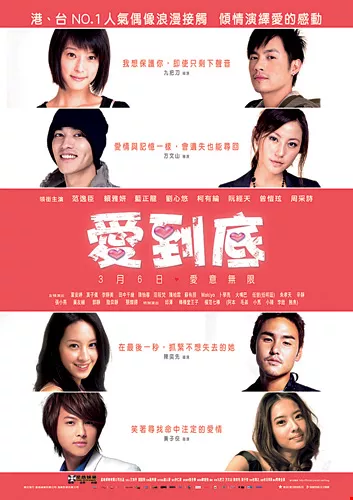
Filmmaking is Vincent's ultimate dream. He first displayed his cinematic talent by making a segment of the four-part film Love.
But life goes on. As well as traveling to China to market his books, he is still using his office in Taipei, spending a lot of time preparing material for his film. Working takes him away from the pain of his loss.
Vincent's friends know that his dream is to make films. In 2008 he produced his debut work Huashan 24 as part of the film Love, a series of four love stories directed by four different directors. The film was shot at Huashan Creative Park, providing a great sense of Taipei City history.
Vincent is currently getting ready for a new film on a much larger scale, Ethnic Chinese, which examines how US-raised Chinese deal with issues of identity.
In 2010, after organizing finance, his filmmaking visions began to be realized. Preparations for shooting started earlier this year, and will hopefully begin in August, so he's expecting to have the film ready for Chinese New Year in 2012.
Comparing the work of writing with that of creating film images, the former is a much simpler process-it can be handled by one person without having to rely on others. There's no need for communication or coordination, and the writer is completely free to let his imagination run riot. Movie making, on the other hand, is a much more complex process. A director has to communicate and negotiate with professionals in many areas including photography, lighting, art, props, costumes, style and modeling, and even actors and set builders.
"So anyone who can work with just words is very fortunate. A computer, a room and some uninterrupted time are all you need to create something out of thin air. But the process of writing is also very lonely--you can't discuss things with others, otherwise it's not purely your own."
For Vincent, creative writing was his ticket into the film industry. When he was young, he had no idea how to begin making a film.
"When I came out of my compulsory military service, I applied for a job with a movie company in Ximending, Taipei. I remember standing outside the building before the interview memorizing my lines to tell them that I didn't care about the money, as long as I could get work in the film field," Vincent recalls. Over the past few years he has been inspired by watching close friend Jay Chou, who has had parts in a number of Taiwanese films including Initial D and Secret, and in the Hollywood movie The Green Hornet.
"Jay's success makes me all the more determined to make my dream come true. I've been looking for possible themes and sponsors for the last two years, but while I have some experience with music video, my dream of making movies is still just that-a dream," says Vincent.
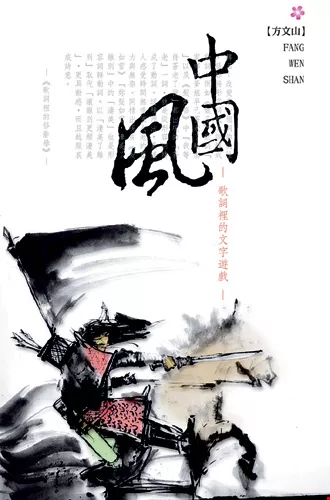
Of Vincent's two books, Blue and White Porcelain shares his creative inspirations, while Chinese Style discusses his song lyrics in terms of allusions to Chinese literature.
Taiwanese pop star Jay Chou's second album Fantasy was released at the end of 2001. The work in fact realizes one of his own personal fantasies with some very interesting song titles. Of the 10 songs on the album, six are from the hand of Vincent Fang. It swept the Chinese-speaking pop-music market-again. In Taiwan alone sales reached 400,000 copies.
Three of Vincent's contributions to the album-"Love Before the Century," "Shanghai 1943" and "William's Castle"-were nominated at the 13th Golden Melody Awards in Taiwan for Best Lyrics, creating an interesting situation: various of his works competing with each other. And Fantasy won awards for Best Mandarin Album, Best Album Producer, Best Composer, Best Lyricist ("William's Castle") and Best Musical Arrangement. In fact, Vincent has been nominated for Best Lyricist for eight consecutive years. And he has gained a position as Jay's personal lyric writer. His career has apparently reached its peak.
But he doesn't like to talk much about his past.
"I was born in Hualien, but we moved away before I started elementary school, so I have only a vague recollection of my early childhood," says Vincent.
This rather quiet child, who enjoyed learning language, literature, history and geography, experienced several episodes of moving house, and eventually graduated from Chenggong Industrial and Commercial Vocational Senior High School in Taoyuan County. After military service, he worked in several different casual jobs, including selling automotive parts and security equipment, as well as delivering advertising material, and spent a period as a golf caddie. Vincent reflects on his early life: "When I was young, my family was not very well off, so I had to turn my hand to all kinds of odd jobs."
During junior high school, Vincent often spent time in a bookstore near his home where he enjoyed reading, and gradually entered the worlds of ancient Chinese poets Li Qingzhao and Li Yu, and modern poets Hsia Yu and Hsi Mu-jung. "The lyrics of Li Qingzhao remain my favorites."
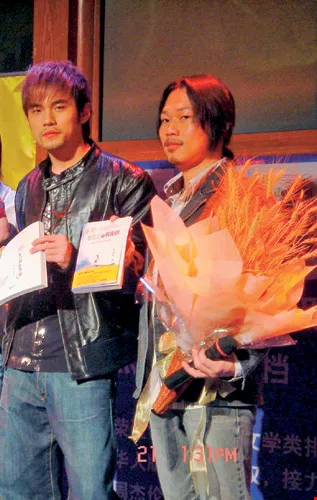
Jay Chou and Vincent Fang are good mates, achieving great success in their individual careers largely as a result of feeding off each other's ideas.
At age 22, he quit his job of the time and registered for a film-writing class run by the Government Information Office. He was doing casual work during the day and studying in the evenings.
The 1990s were the era of emerging Taiwanese directors Ang Lee, Tsai Ming-liang and Chen Kuo-fu. While they were gaining fame in the international arena, the local film industry was going through hard times. But with naive confidence in his ability to write, Vincent believed he might have an opportunity to break into the movie world as a scriptwriter.
And while the movie business was going through bad times, the music recording industry was booming-this was before the days of illegal Internet music downloads. Realizing that there was little chance of breaking into the depressed film industry, he thought about writing song lyrics and trying out for the music business.
Within a year, he'd written more than a hundred songs. He arranged the lyrics and sent them to major recording company producers whose addresses he found from music stores. He'd had no responses at all, until one night the phone rang at 1:30.
Amazingly, it was a call from popular entertainment host Jacky Wu. Vincent froze solid once he realized who was calling-but that call changed his life completely, from a complete nonentity to pop star Jay Chou's exclusive lyricist. Jacky Wu, who heads a major recording company, Jay and Vincent have together formed a creative "iron triangle" to create bestselling albums.
"Jacky recognized my ability and promoted me. He was one of the most influential figures in the entertainment world, and I was utterly afraid of him. But getting to know and trust each other didn't take long-a few months later we were able to chat at ease. Jacky's a pretty easygoing guy."
Jay Chou has also provided him a great deal of help in his career.
Jay once described how his music and Vincent's lyrics mix: "Without Vincent's lyrics, my music wouldn't have achieved the popularity it has, and the opposite is true: there's no doubt that without my music, Vincent's lyrics wouldn't be so well known."
With this mutual respect for each other's work, they have become the best of partners, with nine albums so far in the bag, and their collaboration on a series of Chinese classical-style works has dramatically enhanced their popularity.

In this narrow cramped office with its messy desk, as long as Vincent has a pen, he is able to convey remarkable images in lyric form.
There are plenty of examples of highly wrought artistic pop music from the past, and some that have exploited the classical tradition-"Yi Jian Mei" and "Prelude to Water Melody," for instance. But it has been said that Vincent's lyrics possess a "something" that makes them unique.
Why? What is the "something"? Vincent's answer is simple: "I just enjoy the classical tradition!"
From his recording debut to his first win at the Golden Melody Awards, he hadn't yet established a strong style that was seen as his own. Yet he noticed that no matter what he wrote, there was always a connection to the Chinese classics, and even his love letters are written in this style.
"Several years on, I can now state quite clearly that my lyrics contain strong nationalistic elements-a strong degree of cultural identification. Phrases like qing hua ci (blue and white porcelain) and shu fa (calligraphy) identify strongly and unambiguously with Chinese culture."
In addition to his use of a classical style, Vincent's lyrics are also very visual, with a strong sense of image. He is also able to successfully integrate different cultures and customs into his writing, so the audience for his music often feel as if they are entering a richly graphic world-almost like a movie.
A typical example is "Love Before the Century": "Priest / Temple / Campaign / Bow / Passing by the Goddess of Sumer / I made a wish in the name of the goddess / Missing you is as the Tigris' flow."
There are a number of techniques that he uses to cultivate the rich imagery achieved by his lyrics.
"Rhyme is very important," explains Vincent. Most pop-music lyrics use rhymes. "Lyrics such as like blue and waiting for you, rhyme the sound 'oo.' Rhyme is an important element in pop music because it gives music a sense of dynamism, and provides a key for memory. It's always been this way, beginning with the Book of Songs down to the whole range of ancient Chinese poetry, such as Tang Dynasty poet Li Bai's "Tranquil Night Thoughts": "Over my bed is the bright moonlight. Is the frost painting the ground in white? I raise my head to see the moon bright. Lower it to picture my home in my mind's sight."
"But in this visually oriented era, imagery may be even more important." The words in "With Hair Like Snow," for example: "Your hair is like snow / Making our parting beautifully sorrowful / Who is moved by the incense I burnt? / Inviting the bright moon / Making memory clear / Love becomes pure beneath the moonlight / Your hair is like snow / Your tears are scattering / Who has waned while I am waiting?"
"Words like snow, bright moon, clear, moonlight and wane evoke similar imagery."
"I use a lot of metaphor in my writing. For example, a head of gray hair represents the passage of time, conveying the feeling of growing old and declining. That's how I use this sort of imagery to create my lyrics."
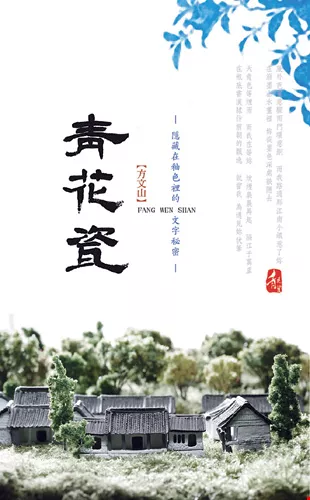
Of Vincent's two books, Blue and White Porcelain shares his creative inspirations, while Chinese Style discusses his song lyrics in terms of allusions to Chinese literature.
Following Jay Chou's triumph in the Chinese-speaking pop-music market, Vincent's work has become popular in China.
"China experienced cultural destruction during the Cultural Revolution, so people there have a stronger need for tradition than in Taiwan. Whenever I visit China, I get the feeling that people are hungry for traditional culture. They are looking for cultural memory." He observes that his lyrics have the advantage of satisfying this need, and this is doubtless one of the reasons for his popularity across the strait.
Vincent often quotes classical texts in his lyrics. In "With Hair Like Snow," for example: "Grandeur is like great volumes of water flowing east / Yet I need only one spoonful to bear in my mind" is a reference to the classical novel Dream of the Red Chamber: "Despite the great volumes of water, I need only a spoonful to drink." (You are the only one for me in this multifarious world.)
Another example is "Chrysanthemum Terrace": "North wind flutters, dawn is yet to come / In my mind you linger on / Alone by the lake / Its surface mirroring me and my shadow." This is a reference to Li Bai's poem titled "Drinking Alone Under the Moon": "So I raised my cup to invite the shining moon. Along with my shadow we became a party of three." Li Bai uses the imagery of moon, people and shadows. Vincent utilizes a similar metaphor but creates his own setting: a shadow which is hard to remove from his consciousness adds to his lonely shadow reflected on the lake's surface.
Because of the popularity of Vincent's lyrics and his use of Chinese classical literature, many schools in China and Taiwan have started to use his lyrics as a source for examinations in Chinese language and literature. Suddenly, his lyrics have transcended the pop-music scene to promote a sort of renaissance in classical literature, posing the question as to whether Vincent's lyrics have themselves become a form of modern poetry.
"Assuming tens of thousands of exams in Taiwan schools during a decade, and seeing that my lyrics might be used as a source only a couple of times, it -hardly seems worthy of any sort of fuss. But if we believe the media reports, it looks like pop music has been promoted to a new level of importance."
"Pop-music lyrics are not of the standard of, for example, the poems of Yu Kuang-chung or Cheng Chou-yu. They are the figures who will have the lasting influence on Chinese modern poetry." Vincent clearly appreciates the reality of the situation.
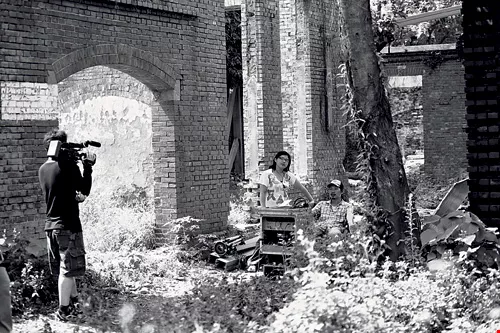
Vincent's Huashan 24 was shot in weed-ridden old buildings at Huashan Creative Park.
As a writer, Vincent has quite a sophisticated and comprehensive view of human affairs, but he believes firmly that people need to retain some degree of simplicity despite apparent sophistication.
"My collections are something that I appreciate but often don't make sense to others."
Vincent has collected over 1000 license plates of various types, along with advertising signs ranging from the period of Japanese occupation and the early postwar period, to the 1980s and 1990s. He has spent over NT$1 million on his collections of stuff-often mere trash in the eyes of others.
"Heads of the public service are employed by the tenure system. They only need to worry about matters that occur during their tenure. When they are transferred to another post, they are no longer responsible for matters from the previous post. Therefore, the authorities in charge of culture and historic monuments are always less efficient than civil organizations because they are never forced to sincerely acknowledge the value of these old things."
Vincent carefully takes off his Se-Kong ring and puts it on the table. He proudly picks up various number plates, and his face lightens, becomes noticeably brighter than when he was talking about his writing.
"I have more than a thousand license plates. To some extent, they can be regarded as texts, but an individual item will tend to lose its value if separated from the collection. I like things that I believe are valuable without any external confirmation. I don't need other opinions to consolidate my confidence in their value."
In the extremely materialistic worlds of music and film, Vincent is lucky to have people who treasure him. And this multimedia environment provides opportunities for him to chant his lyrics, or record the story of a generation in images.
He has often been drawn to talk about his music and lyrics by the media, but now he is more than happy to chat about his film: the great dream that is yet to be realized.
"I don't think people ever get bored telling or listening to stories," says Argentinian writer Jorge Luis Borges.
This is especially true of a storyteller who understands the true meaning of "value." This is true of Vincent Fang and his dream of making a film. His unexciting childhood, the friendship with Jay Chou and Jacky Wu, and his spectacular success in writing pop music, are now giving way to the pursuit of yet another dream.
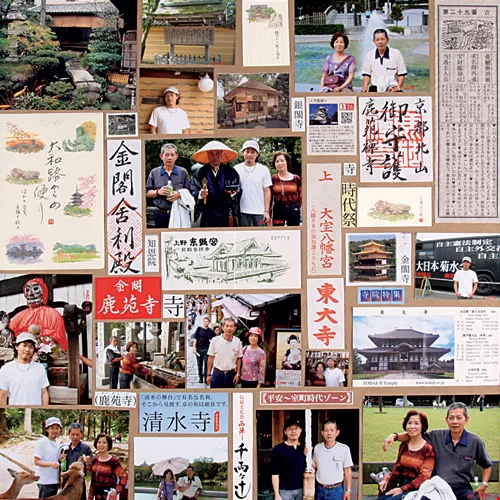
Vincent frequently takes his parents traveling abroad. He has made some of their holiday snaps into collage posters as a way of remembering and thanking his parents.

Vincent likes old stuff and old customs. His hobby is collecting folk antiquities.

@List.jpg?w=522&h=410&mode=crop&format=webp&quality=80)


