

"Statues that can move, haunted apartment buildings.... In this story of the world through the eyes of children, there is a sense both of community and of the supernatural, combined with a combination of growth and nostalgia. The direction of this up-and-comer is beyond words!" So goes one review of Yang Yazhe's film Orz Boyz, which won Best Director at the 2008 Taipei Film Festival.
If the success of Cape No. 7 was a miracle, then the performance of 2008's second-highest selling Taiwanese film, Orz Boyz, was the result of pure effort. Having caught the eyes of cinema audiences with his debut feature after 10 years in the television industry, what makes Yang's story special?
While many new directors get into the movie business motivated by dreams, the slim, crew-cut, 38-year-old Yang Yazhe is more practical: "My livelihood is more important than some dream, and if one day I can't make a living in film, then I'll find something else."
Since graduating from Tamkang University's Department of Mass Communication, Yang has been an advertising assistant and an animation planner, but it was while helping an old schoolmate at a production company with scriptwriting that he discovered that freelancing could pay just as well as full-time work. After this, he left his job and began focusing on freelance work.
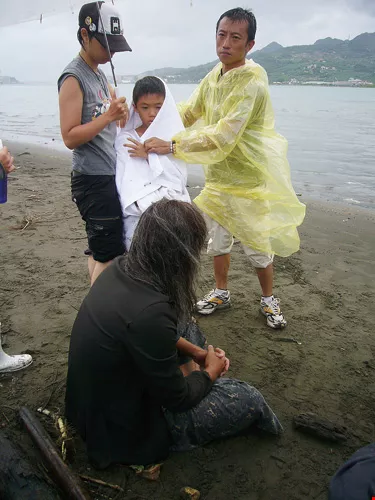
Yang Yazhe has a long list of credits to his name, including the gay love and prostitution story Game of Loneliness, the comic-book adaptation A..S..T.., and his first film, Orz Boyz. The top two photos above show Yang at work on filming a television series, while the lower two show him giving advice for a scene to the young star of Orz Boyz.
Emulating Taiwanese classics
Yang's first foray into cinema was the script for 40-minute short film Too Young, on which he worked with new director Huang Mingzheng. The film showcased Yang's potential, and went on to win Best Short Film at the 1998 Golden Horse Awards. So how did a mass communication major end up a scriptwriter?
Yang tells of taking a scriptwriting course at college, but he felt that the course's emphasis on "structure," "characters," "events," "conflict," and "climax" was too far divorced from reality. Later he joined the school's experimental theater troupe where, inspired by troupe director Ding Hongzhe, he began writing.
Ding's motto was "Seeing human life through tears," and this became Yang's credo. "This idea doesn't mean a script has to be a tragedy, but rather that one should see the world for what it is and empathize with humanity's plight. Only that way can you give your scripts real humanity."
To better understand the craft of scriptwriting, in 1990 Yang obtained a copy of the handwritten script of director Wu Nien-jen's Song of the Exile, which won the Golden Horse award for Best Original Script. Yang then proceeded to copy the script in his own hand page by page. "It was like learning Buddhist scripture by copying it out; by the end, I had an epiphany, and came to really appreciate how this one old man had been able to write in such detail about the feelings and thoughts of a mother and daughter."
Yang likens writing a script to building a house-the structure is the foundation, and the characters and plot are the framing. Copying out that script was to Yang like interning with a master, enabling him to understand the core points of the scriptwriting process.
When, in 1993, mainland Chinese director Chen Kaige released his film Farewell My Concubine, Yang was enraptured, watching the film 10 times in succession and diligently studying Chen's script.
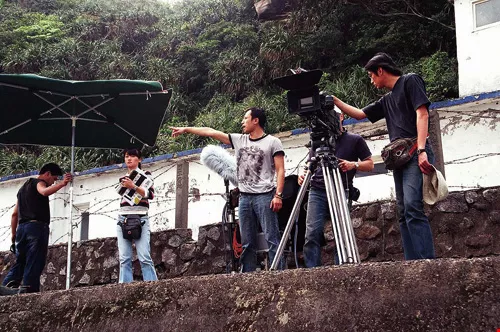
Yang Yazhe has a long list of credits to his name, including the gay love and prostitution story Game of Loneliness, the comic-book adaptation A..S..T.., and his first film, Orz Boyz. The top two photos above show Yang at work on filming a television series, while the lower two show him giving advice for a scene to the young star of Orz Boyz.
Hitting the silver screen
Unlike the previous generation of filmmakers, who moved into television as box-office sales slumped and left them with no means to make movies, Yang Yazhe went from success on the small screen to seeking the chance to hit it big in theaters.
In 2002, Yang made a TV movie for the Public Television Service called A Lease to Paradise, telling the story of an old woman whose son and daughter-in-law had died young and whose husband had suffered a stroke. Every weekday she would sell rice dumplings in front of the local temple to help raise her grandson. Worried about having no resting place once she passed on, the woman spent her savings on a place to have her ashes stored in a charnel house, never realizing the charnel house was an illegal building. This movie won Best Editing at the Golden Bell Awards, along with Best Director and Best TV Movie. Yang's achievements earned the attention of Yee Chin-yen, director of Blue Crossing, who asked Yang to write the novelization of his film. Later they collaborated on the PTS television series Dangerous Mind, with Yang serving as assistant director.
Yang continued to work with PTS, and originally he had planned to film Orz Boyz for the channel as well, but production had to wait until after in 2005 he began working on the Wu Nien-jen-directed PTS series A..S..T.. It wasn't until 2006 that Yang was free to finish the script of Orz Boyz. Things took another unexpected turn when actor-turned-producer Li Lie looked over the script and couldn't put it down, not only setting up an office to work on it, but also helping secure a filmmaker's grant of NT$5 million. Given the lack of regard in which local audiences held Taiwanese films, Li even went so far as to persuade her mother to take out a NT$7 million mortgage on their home, taking a huge gamble to realize her and Yang's cinematic dream.
Many have asked Yang how things differ between working for television and for the cinema.
"Well, television's not as refined as cinema, and a lot of other changes come with the change in scale, such as cheesy dialogue, having to make sure the lighting is very bright, and having to deal with smaller budgets. All this means it can be hard to be really satisfied with the end product," says Yang. While production costs for his movie were about 10 times that of television, Yang believes one should be just as committed to one as to the other-the impact of a film or TV show on audiences is not dependent on its budget, but on how profound and thought provoking the script is.
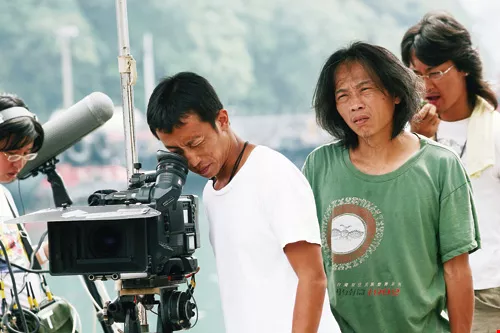
Yang Yazhe has a long list of credits to his name, including the gay love and prostitution story Game of Loneliness, the comic-book adaptation A..S..T.., and his first film, Orz Boyz. The top two photos above show Yang at work on filming a television series, while the lower two show him giving advice for a scene to the young star of Orz Boyz.
The least of these
Yang, who had grown up near Banqiao City's Nanya Night Market and whose father provided fortune telling, feng shui, and Taoist rituals to the public, has seen for himself the vibrancy of Taiwan's lower class. He finds pleasure in writing with warm strokes the stories of those in our society who are ignored by most.
"I got into the business of directing more by luck than skill, and whether others might be able to copy my path I can't really say," says Yang who, like Ang Lee, has relied on good stories and good scripts to make his name.
Whereas the older generation of directors-the likes of Edward Yang, Hou Hsiao-hsien, and Tsai Ming-liang-were able to handle casting, music, cinematography, costuming, and so forth single-handedly with the director's authority unquestionable, Yang Yazhe notes that his generation has been educated to communicate, cooperate, and negotiate with others, so while the new generation lack that kind of professional expertise and may write their scripts single-handedly, they must take on board the ideas of producers, assistant directors, and cinematographers. This means that one doesn't get as much of a sense of satisfaction with directing as the public might think.
From the outside, many people consider Yang's films to show a sense of confidence and ease, but being part of the last generation to grow up with schools' placing strict restrictions on students' hair styles and length, Yang says he still feels the pressure to convey deeper moral messages. "If my works had no deeper meaning to them, I don't think I would be comfortable with that."
Take for example Orz Boyz. The two young classmates of the story, who cheat their classmates of their allowances and are a source of constant headaches for their teacher, rebel against their world by yelling, screaming, chasing others, and fighting. But when as a grown-up Liar No. 2 is reunited with a cartoon character key ring he valued in his youth, audiences can't help but be flooded with feelings of warmth. Orz Boyz, with its laughs and tears, comforts the soul while giving us faith in a brighter, more hopeful future.
Perhaps it is an uncontrived sense of humanity that lends Yang Yazhe's works their distinctive style and have given Yang the chance to reach the top of his field.

Yang Yazhe has a long list of credits to his name, including the gay love and prostitution story Game of Loneliness, the comic-book adaptation A..S..T.., and his first film, Orz Boyz. The top two photos above show Yang at work on filming a television series, while the lower two show him giving advice for a scene to the young star of Orz Boyz.
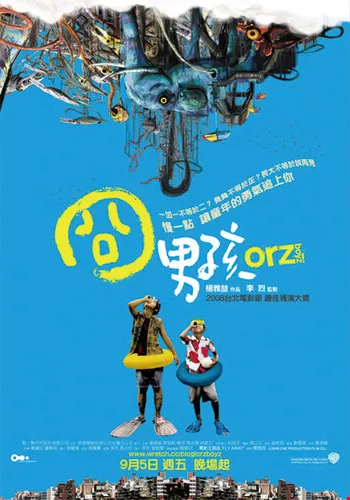
(courtesy of One Production)

@List.jpg?w=522&h=410&mode=crop&format=webp&quality=80)


