

Internet enterprises, which faced col- lapse in an exploding bubble in 2000, have bounced back over the past two years, following breakthroughs in e-commerce technology and the popularity of online auctions. By the end of 2002, the online penetration rate for households in Taiwan stood at 53%, according to the Institute for Information Industry's Market Intelligence Center. Of that number, one-third buy goods and services online. The most common purchases are books and magazines (8%), followed by computer software and computer accessories (4%).
Whether it's that people don't have time to go out shopping or that they are compulsive bargain hunters (online prices are generally lower), does the growth in online book shopping herald the age of the online bookstore?
In a survey of major bookstores in Taiwan, Hong Kong, and China, Eslite took first place in Taiwan, followed closely by Page One, an international chain from Singapore that has been in the Taiwanese market for less than two years. It's significant that number three on the list is the virtual bookseller Books.com.tw. Possessing the capacity to challenge the high-traffic, spacious bookstore chains, Books.com represents a promising future for Taiwan's online booksellers and a change in the habits of book buyers.
Books.com is just a mouse click away, and shoppers browsing the website's pages will discover that most books are marked down 21%. Some previous bestsellers even drop to 40% of the original sales price. Aside from good prices, the online bookstores offer office workers who don't have time to browse bookstores and night owls the convenience of shopping anytime they want. Convenience and low prices have really won over office workers and students.
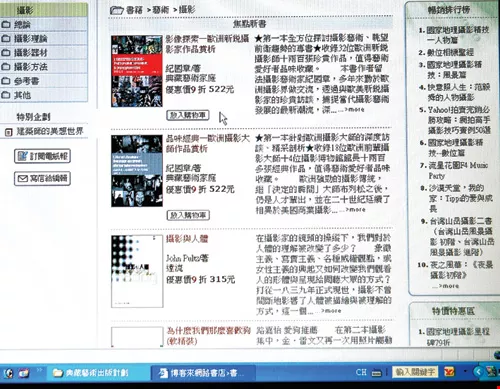
On the Books.com.tw site, readers can find excerpts, reviews, and readers' comments for all titles, and purchases can be picked up and paid for at any 7-Eleven. This method gives online bookshops their prime selling point, for books can be picked up at 24-hour stores in any town or village in Taiwan.
Selling books online
Although it is common knowledge that online books are cheaper, one cannot help wondering why publishers are willing to hold down prices and supply online bookstores at the expense of their own profits.
Of the over 43,000 new books published per year in Taiwan, over 40% are returned to the publishers. Stella Yu, manager of the books department at Books.com, admits that the company's bargaining power over publishers lies on its lower rate of book returns.
Books.com allows readers to first pick out the book they want online and only then does the company place the order with the publisher, says Yu. As a result, books returned to the publisher drop to less than 10%. The strategy saves on storage space and frees up capital for the publishers. It also allows Books.com to lower prices without losing profits. Yet the greatest beneficiary of all is the reader.
At the mention of Books.com, one can't help but think of Terry Chang, the president who often featured in the company's advertisements. Ten years ago Chang, relying on his natural pluck and determination, and his intuition and management ability, invested NT$5 million to found Books.com, which was the first online bookstore in the greater China region and followed Amazon.com, the world's first online bookstore, by only a year.
In 2000, Books.com forged a deal with 7-Eleven that allowed for book buyers to order books online and pick them up and pay for them at convenience stores near their homes. This innovation allowed for online bookstores to pair their attractive qualities with the 24-hour service of convenience stores and reach into towns and villages all across Taiwan. The following year, President Chain Store Corporation, the owner of the 7-Eleven franchise in Taiwan, invested NT$140 million in Books.com, allowing the company to avoid the financial perils of a start-up and shelter under the flag of the Uni-President Group, the parent of President Chain Store.

Terry Chang (front, center), president of Books.com.tw, invested NT$5 million ten years ago to found the first online bookstore in Taiwan, Hong Kong or China. At the end of 2004, annual sales figures indicated sales growth of 150%.
Cyber strategy
The most important job of a bookstore is to package and promote the products of the publisher, attracting the attention of a target audience to particular titles.
Nearly the entire staff of Books.com jumped ship from Eslite, Kingstone, Hess, and other large brick-and-mortar bookshops. Some felt optimistic about the possibilities of the online market and decided to make the leap. They wanted to experience selling hardcopy books in a virtual world.
Stella Yu herself was once the manager of the Tunhua South Road branch of Eslite, and Cheng Chien-min, the books department's team manager, was an employee of a traditional bookshop for seven years. Only a year ago, he took the plunge into the online book world. Comparing the two types of booksellers, Cheng says that traditional shops rely principally on sales floors, displays, and point-of-purchase advertising to promote books. Customer service and live promotional events are factored into their operations. In the virtual world, however, booksellers lose that sense of intimacy, and figuring out how to recapture that connection with the reader is crucial.

On the Books.com.tw site, readers can find excerpts, reviews, and readers' comments for all titles, and purchases can be picked up and paid for at any 7-Eleven. This method gives online bookshops their prime selling point, for books can be picked up at 24-hour stores in any town or village in Taiwan.
How to sell in cyberspace
The in-house book buyers at Books.com scan publishers' monthly lists of new books and display their titles under headings such as literature, arts, travel, popular science, and finance, highlighting the appeal of each type. Most books need only a single web page of description, but promoting the major titles of the year requires company meetings to decide on a comprehensive marketing plan.
The exceedingly popular The Da Vinci Code, for example, which is said to have sold one copy every four seconds, was also a big hit for Books.com. This single title landed Books.com on a list of e-commerce sales champs in TechVantage magazine. The online bookseller placed fifth, beating out more than 300 competitors.
Bookstores are able to pile up titles such as The Da Vinci Code in easily visible places, giving readers the feeling that it's a worthwhile read and prompting them to pick up a copy, says Yu. But walk-in bookshops have no way of telling consumers what's special about the book or just how good it is. They have to rely entirely on the feel that readers get from skimming through the pages in on the spot. The sales department at online bookstores, on the other hand, can make use of web page design, related activities, and book reviews. After readers become more familiar with a book's content, they can decide whether or not to buy it.
If a book falls under the category of detective stories, mysteries, travel, or arts, Books.com will tailor the web page to the subject, giving readers with different interests more information, says Cheng Chien-min. When finalizing their orders, customers are presented with rewarding activities, such as trivia contests. If readers answer five questions correctly, they win a NT$100 discount coupon.
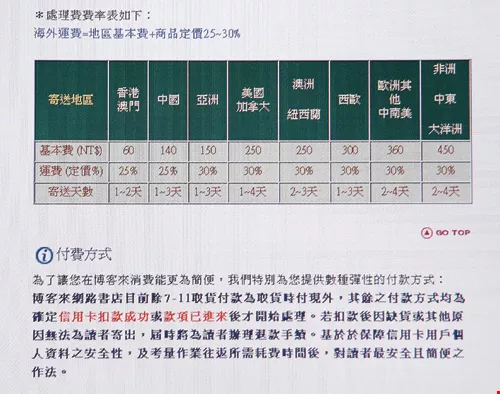
On the Books.com.tw site, readers can find excerpts, reviews, and readers' comments for all titles, and purchases can be picked up and paid for at any 7-Eleven. This method gives online bookshops their prime selling point, for books can be picked up at 24-hour stores in any town or village in Taiwan.
Personalized shopping
Cheng believes that traditional bookstores can perhaps use the comfort and elegant atmosphere of their sales spaces to keep customers coming back, by creating a personalized shopping experience. Although virtual booksellers have no actual physical sales space and rely generally on lower prices to satisfy readers, their greatest strength is in fact interpreting products for customers. This too creates a kind of hands-on experience.
Online bookselling is not simply buying and selling, Cheng adds, it is also an intellectual and emotional sharing process. When readers choose to enter the site, they get a lot out of just reading through the various introductory information. Even if they don't buy this time, they'll come back again. Books.com hopes to use this kind of specialty service to build readers' loyalty to the site.
For the past three years, Ms. Chu, formerly an assistant manager at a design house, has been a devoted customer of Books.com. Aside from the good prices, she finds that she prefers browsing through the website's introductions on her computer screen, eventually buying the books that she really wants. As for the many titles on display at walk-in bookstores, well, she finds it too distracting-her eyes begin to blur and her legs get tired as she searches in vain for a book she wants to buy. Online bookstores, furthermore, include not only excerpts from books and recommendations from well-known people, but also readers' personal thoughts on a title. All these factors help Ms. Chu in making a selection. Most importantly, paying for books right there at a convenience store when picking them up removes lingering doubts about the security of e-commerce, so why not jump aboard?
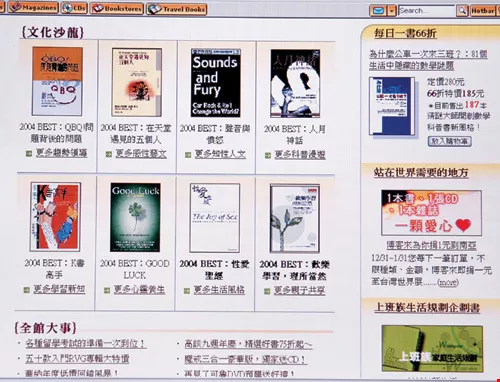
On the Books.com.tw site, readers can find excerpts, reviews, and readers' comments for all titles, and purchases can be picked up and paid for at any 7-Eleven. This method gives online bookshops their prime selling point, for books can be picked up at 24-hour stores in any town or village in Taiwan.
Virtually boundless
In the past few years, the average number of books published in Taiwan has exceeded 100 per day. The books are like snowflakes falling in a blizzard, according to Books.com, which presently does business with over 1,200 publishing houses.
Aside from pure market considerations, such as selling the major works from various publishers and the works of best-selling authors, Books.com also pays a good deal of attention to the content of the books. Even if a title is not terribly popular, as long as it is a readable, well-crafted work, Books.com will do its best to promote the book. Less popular topics might simply need to be interpreted and explained in order to pique the interest of readers and boost saleability. This is one of the unique strengths of online booksellers.
The virtual world, moreover, is unrestricted by boundaries. It's unnecessary to worry about replacing slow-moving titles with new stock, and online booksellers and publishers have an unwritten agreement to allow all participating publishers to list their entire stock in the databank of the website which also clearly states the number of copies of a title in stock, how many days delivery will take, and whether the title is still in print. By searching these data, readers indirectly get a good grasp of what's out there. In the virtual world, there really is no pressure to make floor space pay for itself, and an online bookstore offers limitless possibilities.

On the Books.com.tw site, readers can find excerpts, reviews, and readers' comments for all titles, and purchases can be picked up and paid for at any 7-Eleven. This method gives online bookshops their prime selling point, for books can be picked up at 24-hour stores in any town or village in Taiwan.
200,000 hits a day
Presently, Books.com has 850,000 members, the majority of whom are between the ages of 25 and 35, with women outnumbering men. The number of visits to the website's homepage reaches 200,000 per day. For Cheng Chien-min, these figures are the clearest indication of the site's allure.
Brick-and-mortar bookstores are limited by location, says Cheng. Even if a bookshop is located in a busy subway station with hordes of people passing through, at most 5,000 people might enter the shop. An online bookshop, however, reaches every corner of Taiwan. If there is a promotional activity for a new book today, 200,000 readers can access it. This kind of large-scale promotion has an almost addictive appeal.
In recent years, Books.com has been expanding beyond books, notes Stella Yu. In 2000, the site began to sell CDs and began to coordinate activities with Mook, a local travel magazine. In 2003, the site added DVDs; in 2004, publications in simplified Chinese characters. This year it has added cosmetics and baby products. The site is becoming a comprehensive, one-stop shopping site, and even offers nine different online newspapers.
Aside from diversifying its products, Books.com, like many traditional booksellers, has begun to develop business-to-business services for corporate customers. For now, Books.com is focusing on libraries and private companies. Present customers include National Taiwan University, National Chengchi University, National Yunlin University of Science and Technology, and National Cheng Kung University.

In recent years, buying products online has become an accepted practice as online security and convenience have both increased, drastically changing the book-buying habits of readers. Online booksellers are also free from the need for storage space and need not expend their efforts designing a walk-in shopping area. This allows the virtual booksellers to plunge right into the torrents of competition.
150% growth
After ten years in the business, Books.com plans to keep expanding. Terry Chang, the president, recalls that when he founded the company, whether it was publishers, friends, or family, everyone was pessimistic. "Taiwan has too many bookstores as it is, who needs an online bookshop?" they said.
Yet after many years of trial and error and hard effort, Books.com today not only offers complete book listings and has built up a database of customer information but also prepares book abstracts and collects all kinds of publishing data for its customers. Since teaming up with President Chain Store four years ago to allow customers to collect and pay for books at convenience stores, Books.com has grown at an even faster pace. It broke even in 2002, and from 2003 to 2004, sales grew by 150%. The company has turned a profit since last year, according to Hoko Chen. All things considered, not a bad record at all.
Weathering competition
After the difficult period that followed the bursting of the dot-com bubble, the number of web surfers has increased dramatically in recent years. The convenience of online shopping and general acceptance that purchasing online is secure has dramatically changed the way readers buy books. The online bookseller need not be responsible for storage facilities or designing an elegant sales floor. It takes only modest capital to offer book sales online 24 hours a day and to enter the stormy seas of competition.
Aside from Books.com, Taiwan's full-service online booksellers include Eslitebooks.com, Kingstone.com.tw, Book4u.com.tw, and Silkbook.com.
Since 2002, most comprehensive online bookstores' sales volumes have ranged from around NT$100 to 200 million. Kingstone.com.tw, for one, turned a profit in the first quarter of last year, even though the website had been operating for less than five years. In the analysis of Neil Peng, head of marketing, a virtual bookstore and its walk-in counterpart can serve each other in positive ways. With "Kingstone" on the website, it's not hard to attract customers.
When Kingstone first founded an online bookshop, some in the company wondered if it wasn't just creating competition for itself. After witnessing the proliferation of other online bookstores, Kingstone felt there was an urgent need to diversify its services to suit different customer groups.
Peng concedes that online bookstores have been giving traditional shops a run for their money as they have proliferated in recent years. He believes that the future of the walk-in bookstore is as a place of leisure-a place people will visit for the atmosphere, to sip coffee, browse clearly marked shelves, and be waited on by a warm and efficient sales staff. In this way, readers can really experience the pleasure of book browsing.
Traditional bookstores are not only under attack from online booksellers. A few large-scale publishing houses are also staking a claim in the virtual book realm. Websites set up by publishers, including Readingtimes.com.tw, Bookzone.com.tw, Ylib.com, and Sanmin.com.tw, are able to offer the best prices of all for their own publications. The publishers have opened a new front in the online battle for book sales. These publishers' websites are said to rake in NT$1-7 million per month.
Amid this fierce competition, could it be that the efforts of the trailblazing Books.com over the past ten years will lead only to the success of its younger competitors?
Hoko Chen, director of marketing of Books.com, says that of course risks abound in the fiercely competitive online bookselling environment, but one of Books.com's strong points is its comprehensive book list, which the online bookshops of publishing houses cannot match. Compared with bookshops that combine online and walk-in sales and sometimes have unfocused management strategies, Books.com has a more focused strategy and can adjust to the market more accurately.
Yet online promotions, good discounts, fast and convenient delivery are all strong points for Books.com, says Chang Hsiu-ming, a special assistant in the president's office. "We're not afraid of competition," she says. "Where there's a will, there's a way. We're only trying to surpass ourselves" Books.com is ready for the next phase of the virtual battle.

@List.jpg?w=522&h=410&mode=crop&format=webp&quality=80)


