Answering Questions in Contemporary Sculpture: Kuo Chin-chih’s Life in Art
Kathy Teng / photos Kuo Chin-chih / tr. by Scott Williams
August 2017


Kuo Chin-chih, an early postwar Taiwanese sculptor, has been recognized around the world for his remarkable work. Japan’s Asahi Shimbun newspaper lavishly praised his Gate of Saha, and the 1999 exhibition Forjar el Espacio: La Escultura Forjada en el Siglo XX, a retrospective of 20th-century metal sculpture, included his Entrance of the Sun alongside the work of the renowned sculptor Eduardo Chillida. Kuo has spent his life addressing the questions facing contemporary sculpture, while pursuing innovations in his art and international recognition for his work.
Kuo Chin-chih’s wife recalls a conversation she had with Kuo when they were young:
“Which matters more to you, money or ideals?” she asked.
“Ideals, of course. Money doesn’t interest me,” he replied.
“You don’t love money any more than I do, so let’s pursue our ideals!”
At the time, Kuo’s dream was to create innovative work and earn international recognition. Decades of hard work have enabled him to achieve both of those ambitions.
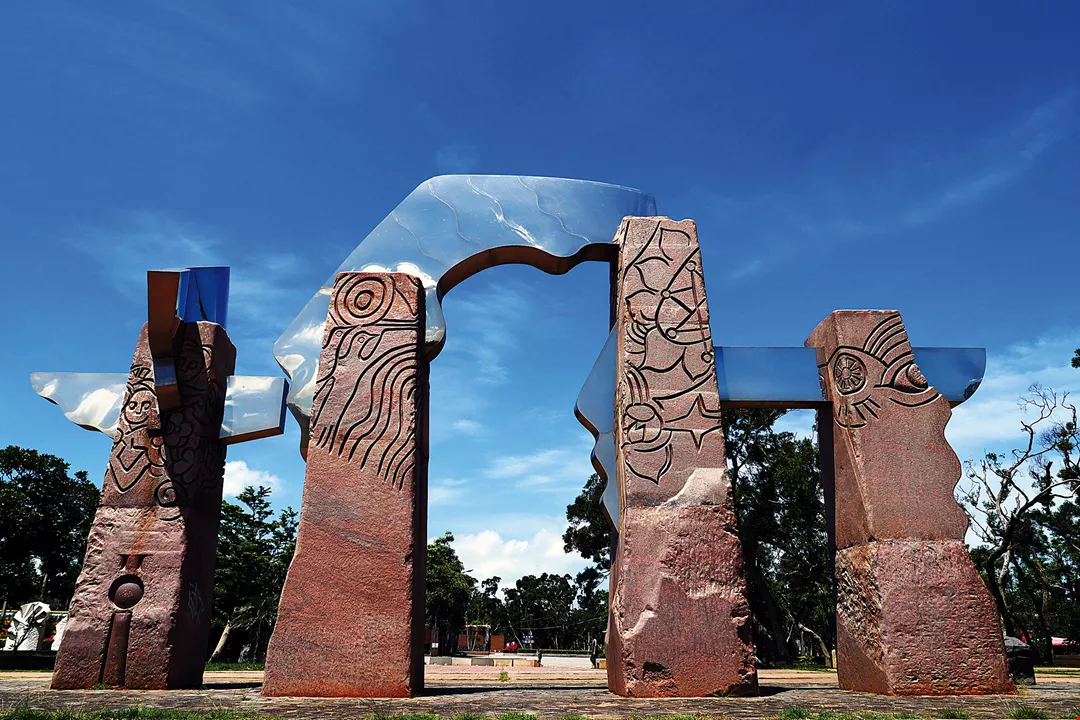
Kuo Chin-Chih’s Entrance of the Sun was included in the 1999 metal sculpture exhibition Forjar el Espacio.
A pioneer
Born in Dajia, Taichung, in 1939, Kuo graduated from the arts department of Taiwan Provincial Taipei Normal School (today’s National Taipei University of Education) and became an elementary-school arts teacher. On a trip back to Taipei to visit friends, he chanced to observe a technique for sculpting using plaster molds. Thinking that it looked pretty straightforward, he began studying and experimenting with the technique. When a friend subsequently invited him to take part in a central Taiwan arts exhibition, Kuo chose to show one of his new sculptures. To Kuo’s surprise, the piece won second prize, prompting him to quit his job and join the sculpture program at the National Academy of Arts (now the National Taiwan University of Arts). He went on to win first prize at the Taiwan Provincial Fine Arts Exhibition, a gold medal at the National Art Exhibition, ROC, and the top prize at the Taiyang Fine Arts Exhibition while a student at the NAA.
In those days, one part of Taiwan’s sculpture community was dedicated to a traditional realism, while another was pursuing an experimental revolution influenced by Western modernism. While the second group was also rooted in realism, it was using it as a jumping off point to explore the question: “What is modern sculpture?”
A member of the second group, Kuo was a meticulous and tireless experimenter who was seeking to create his own stylistic vocabulary. His experiments took him first to steel and clay, and then later into abstract forms. He formed the Xingxiang Sculpture Club with friends in the 1960s, and became one of the founding members of the ZODIAC Sculpture Group, a pioneer in modern Taiwanese sculpture, in the 1970s.
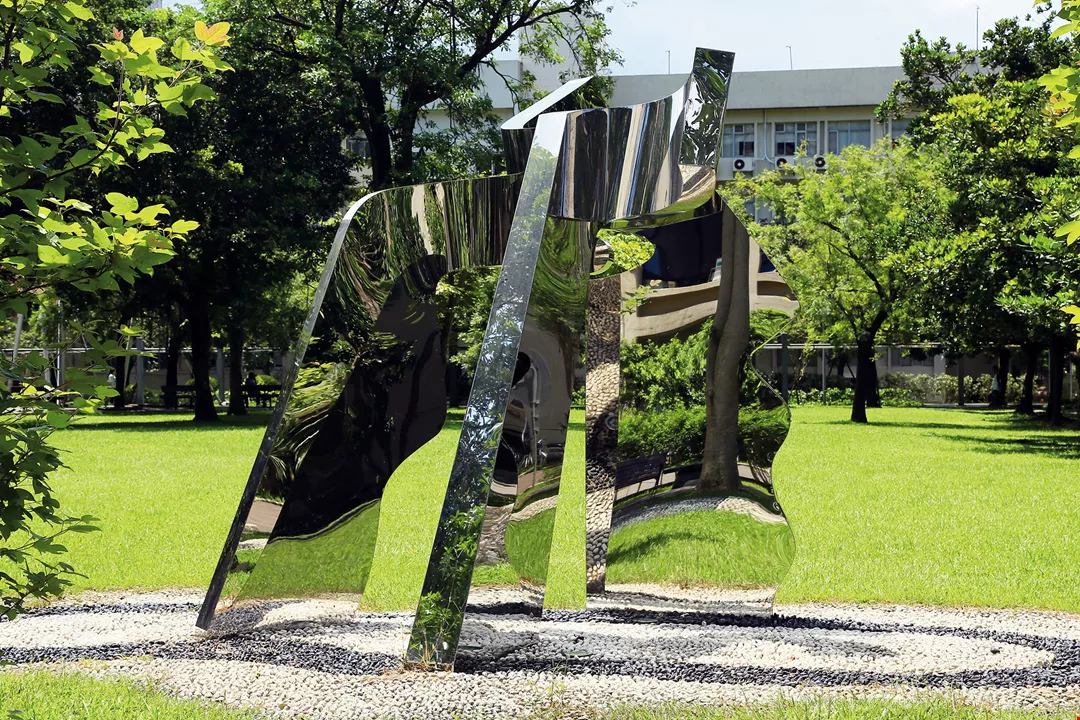
By reflecting the surrounding environment, the mirror-like surfaces of the stainless-steel sculpture Advancing Generation (2011) offer different views when seen from different angles.
Whither modern sculpture?
“In world sculptural history, the period up to the 19th century is regarded as the era of stone sculpture. The use of molds didn’t become mainstream until the time of Rodin, more or less the 50 years from 1880 to 1930. Modern sculptors were pursuing numerous lines of development by the 20th century, leading to the emergence of composite media, combining materials such as bronze, brass, and stainless steel.
When Kuo started sculpting, most stone sculptures in Taiwan were produced for traditional temples. “No one was doing modern sculpture.” Kuo began working in stone because he wanted modern stone sculpture to exist in Taiwan. To that end, he used to ride his motorcycle to Mt. Guanyin, which was a prime source for andesite and home to many stonemasons, to observe how traditional masons produced stone sculptures. He then bought tools and began to practice shaping small pieces from andesite.
When Citibank established a branch in Taiwan in 1969, the company asked Kuo to design a stone sculpture for it. Drawing inspiration from the use of cowries as one of the earliest forms of currency, he created Song of Currency, a 1.6-meter-tall piece that was his first large work in stone.
Kuo created new work continuously for the next 20 years, diving deep into his study of stone sculpture. He also traveled widely during this period, following the artistic traces of ancient civilizations, finding inspiration in their work, and wondering what defined his own vocabulary and work.
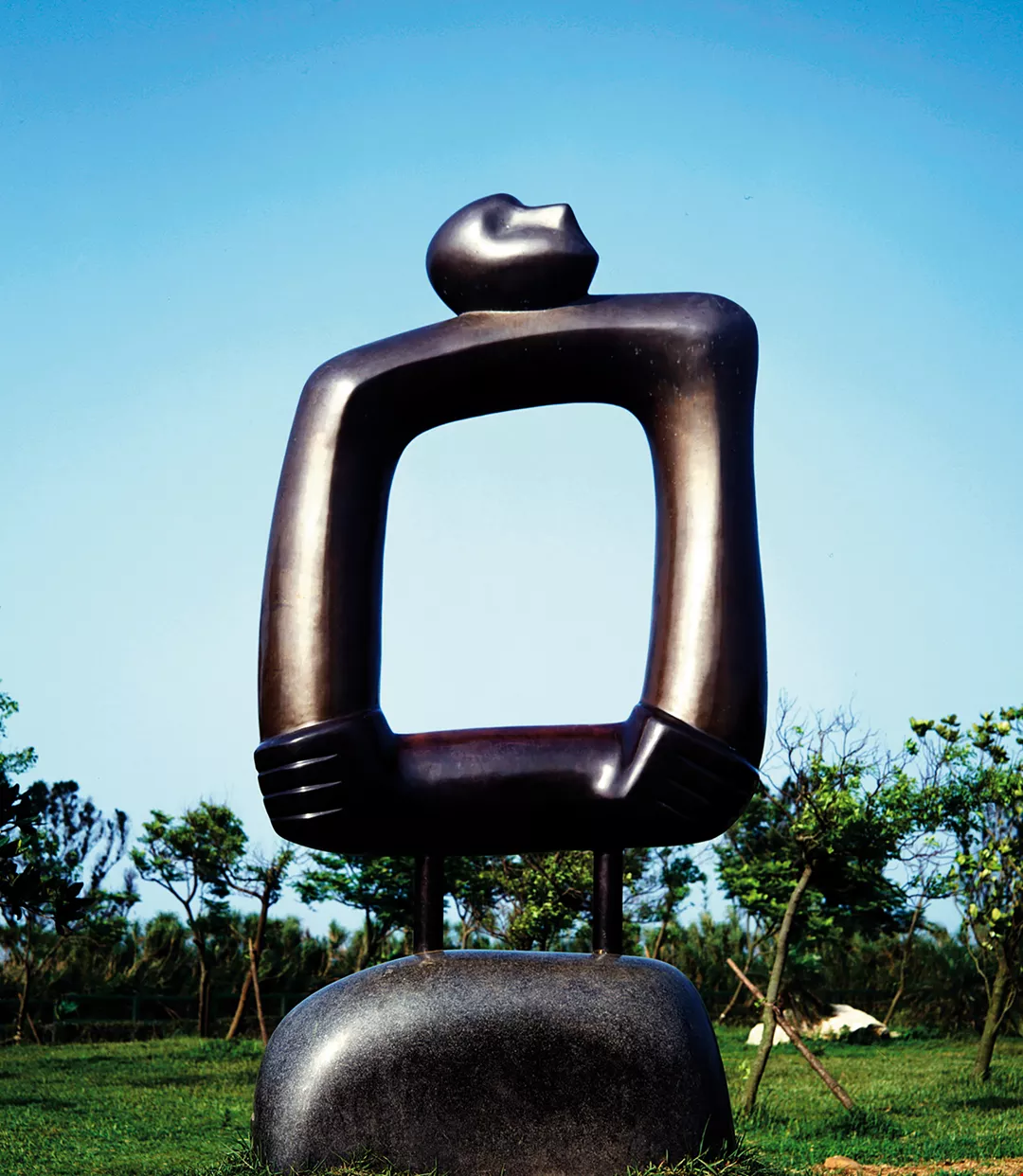
New Moon (1982) contrasts the physical sculpture and the surrounding space. (courtesy of Kuo Chin-chih)
Composite media
“I spent too long working on form, and was already more than 50 years old when I switched my focus to working in composite media,” says Kuo.
Kuo found nothing to call his own while feeling his way through basic forms, so he decided to try experimenting with composite materials instead. He tried combining stone with brass, bronze and stainless steel, but none of his experiments succeeded. “I considered a piece a failure if I was unable to make the materials appear distinctively different, to make them contrast and set off one another,” explains Kuo.
He achieved success with his combination of granite and stainless steel in 1993’s New Vision, a piece that combines concrete and abstract elements to create contrasts between brightness and shadow. It consists of a base comprising two rough granite columns of different heights, with an eye carved into the taller column, and twisting lines of stainless steel mounted atop the shorter. While some people interpret these lines as hair, Kuo says they represent a brain in the act of thinking. He explains further that the eye, carved with a few simple lines, represents the idea of “looking ahead.” Kuo is relatively satisfied with how it turned out.
In 1994, Kuo showed Gate of Saha at Japan’s third Association of Asian Contemporary Sculptors domestic exhibition. As the newspaper Asahi Shimbun described the piece: “Its two ‘eyes’ are carved into red granite. Gold wings on the left and right reflect these eyes from a variety of angles, causing the sculpture’s look to change with the movement of the sun, as if in different dimensions.” It was a truly pioneering work, with mirror-like stainless-steel surfaces taking on surprising new aspects when seen from different angles.
Kuo’s career underwent a turning point at the age of 50, and he says that it is his work since then that finally made his international reputation.
By this time, Kuo had already developed a unique vocabulary, and at 50 he began to free himself from the limitations of his materials. He moved freely between the concrete and the abstract; contrasted fantasy and reality, light and shade; produced harmonious blends from combinations of clashing materials; and successfully expressed his ideas in works created in a variety of materials.
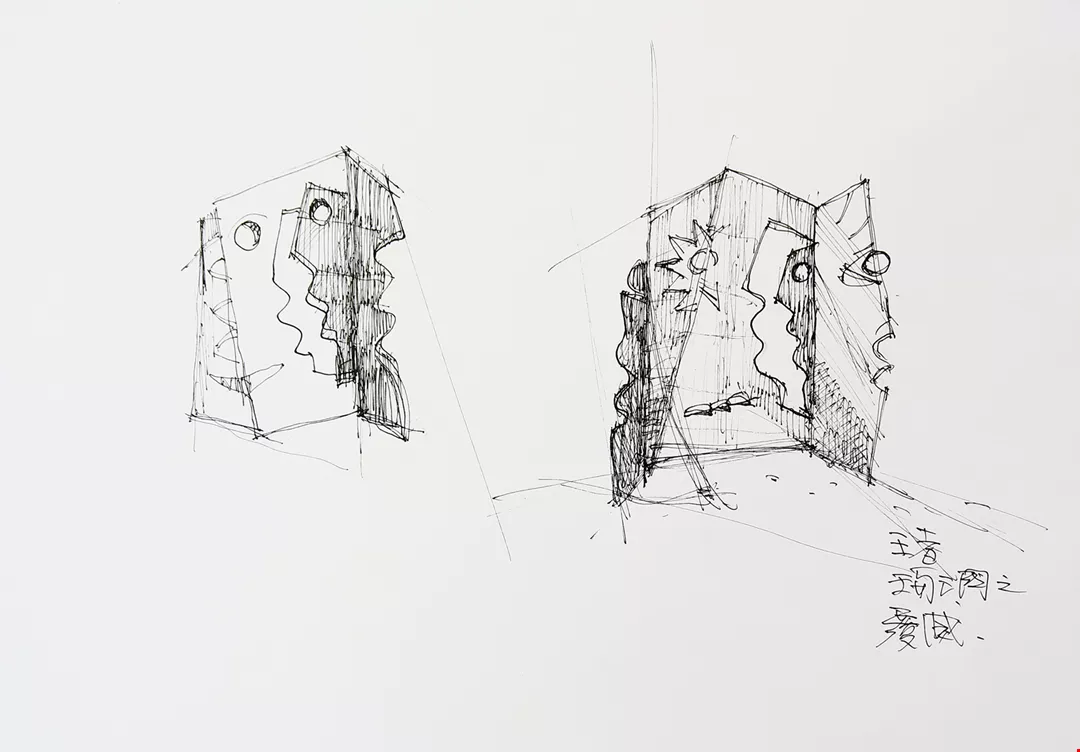
Kuo Chin-chih still sketches out his ideas by hand.
Pouring feeling into sculpture
In 2016, Kuo joined the Tung Ho Steel Foundation’s Tung Ho Steel International Artist Residency Program.
Kuo’s creative process during the residency emphasized working by hand and focusing on feelings, just as it had for many years. He still sketches out his plans by hand, and then makes a small model from cardboard that he can study from a variety of angles. Once he has a good sense of the design, he tweaks it until it is perfect.
Kuo’s design for The King, a piece he produced during the residency, includes many triangular holes punched through a steel plate. Kuo, who is now nearly 80, had laborers build him a near-5-meter-tall scaffolding to facilitate his work on the sculpture, and insisted on climbing onto it himself to check the placement, size and orientation of the holes. He was adamant that all the details be just right.
Kuo Chin-chih remains as artistically experimental as ever. In the past, most of his sculptures were physical objects that were, in a sense, sealed. For this project, he metaphorically sliced his work open. He made it permeable, exploring spaces that were originally closed up tight. He also designed a round turntable that would move with the wind to transform the sculpture’s normally static forms into something dynamic. He says he has given the question of dynamism much thought in recent years.
But sculpting is weary work and the white-haired Kuo is no longer able to devote all his time to it. Nonetheless, he continues to think about his art form. Having sought innovation and international recognition ever since his early years pioneering modern stone sculpture, he remains as committed as ever to spending his days making art.
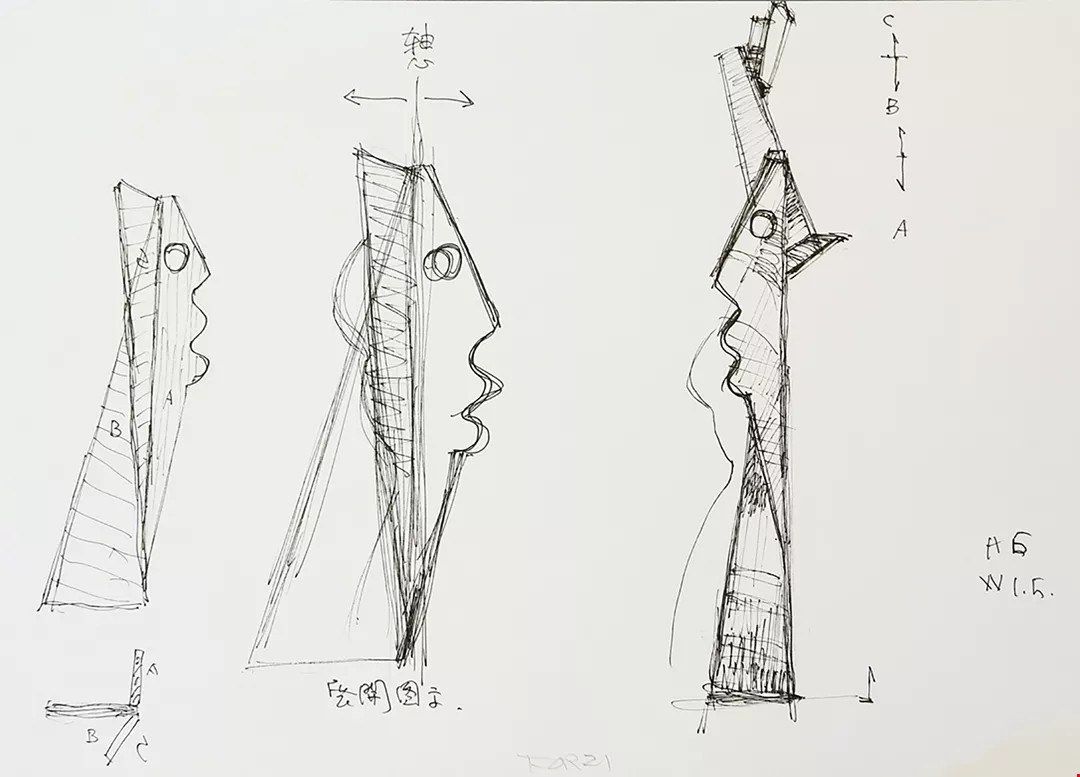
Kuo Chin-chih still sketches out his ideas by hand.
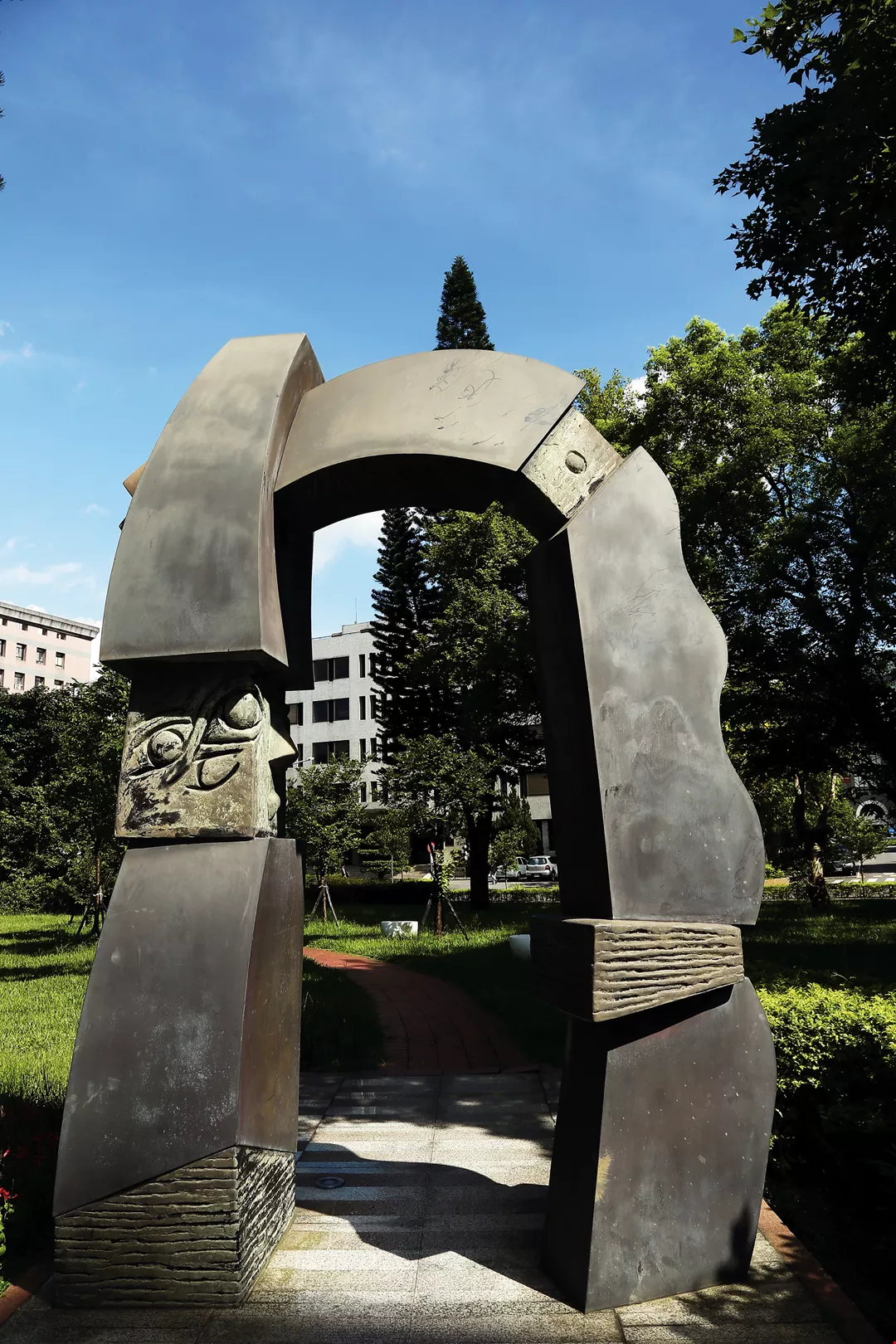
Symphony of Life, located outside the Academia Sinica’s Genomics Research Center, makes use of white marble, bronze, and brass, as well as a variety of inlaying techniques. (photo by Jimmy Lin)
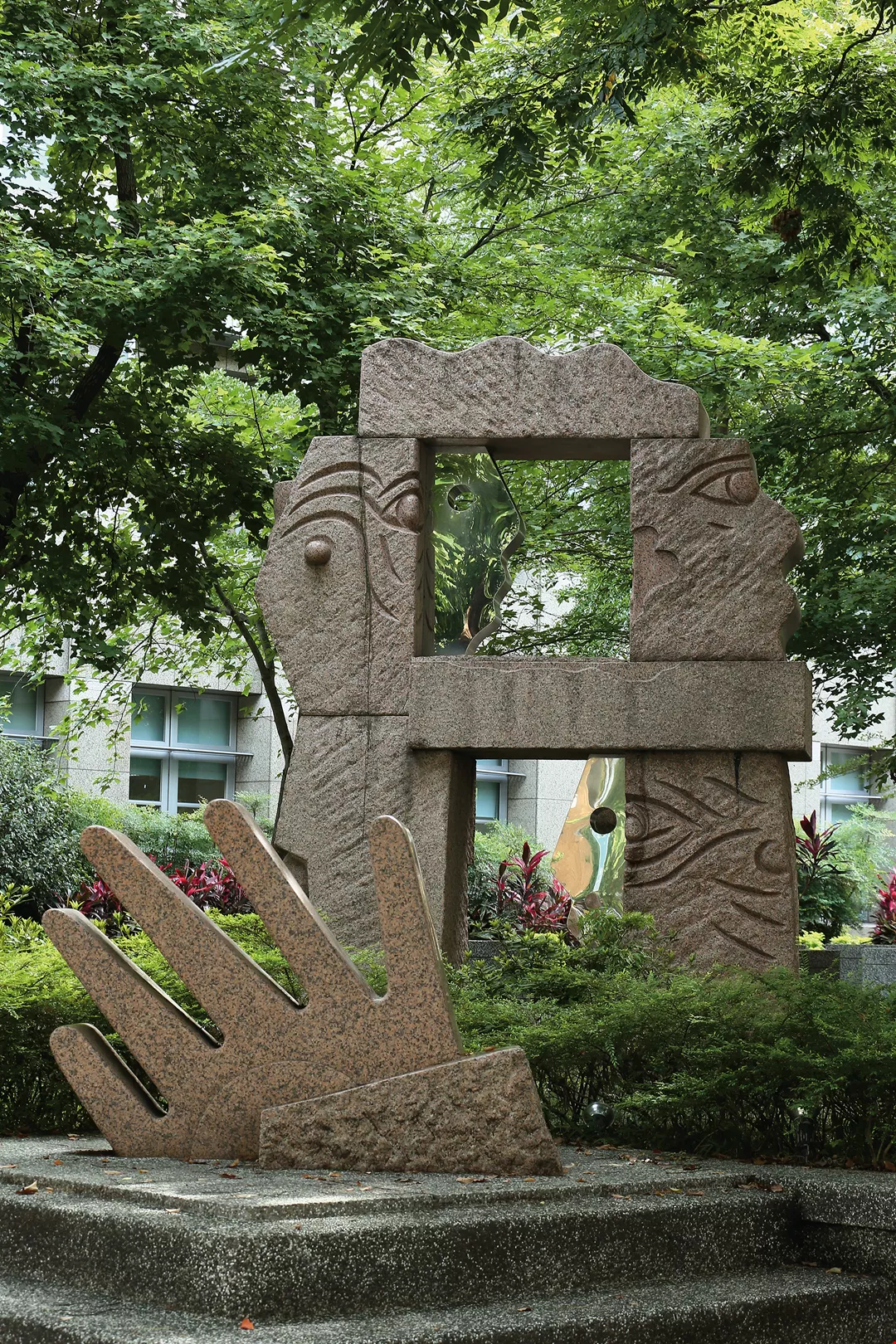
The Healthy Way (2005), located at the National Taiwan University College of Public Health.
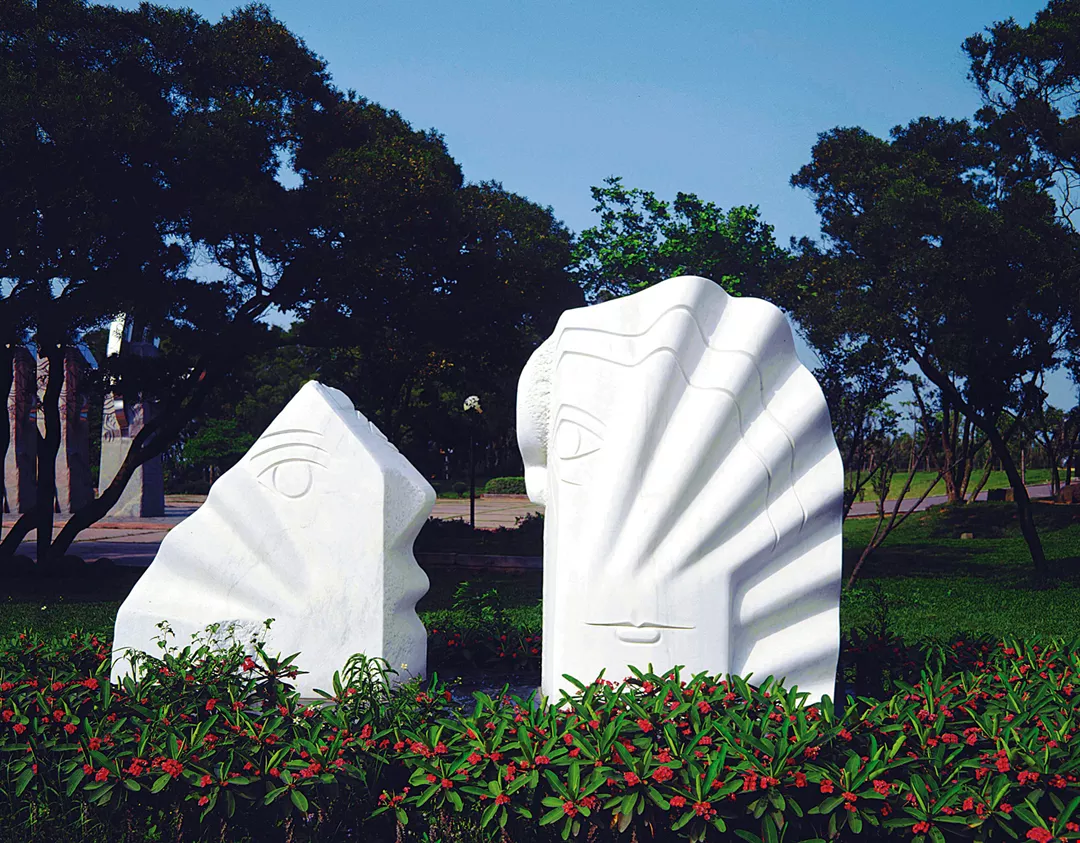
Lovers, located in Taichung’s Mt. Tiezhen Sculpture Plaza, mixes concrete and abstract elements. (courtesy of Kuo Chin-chih)
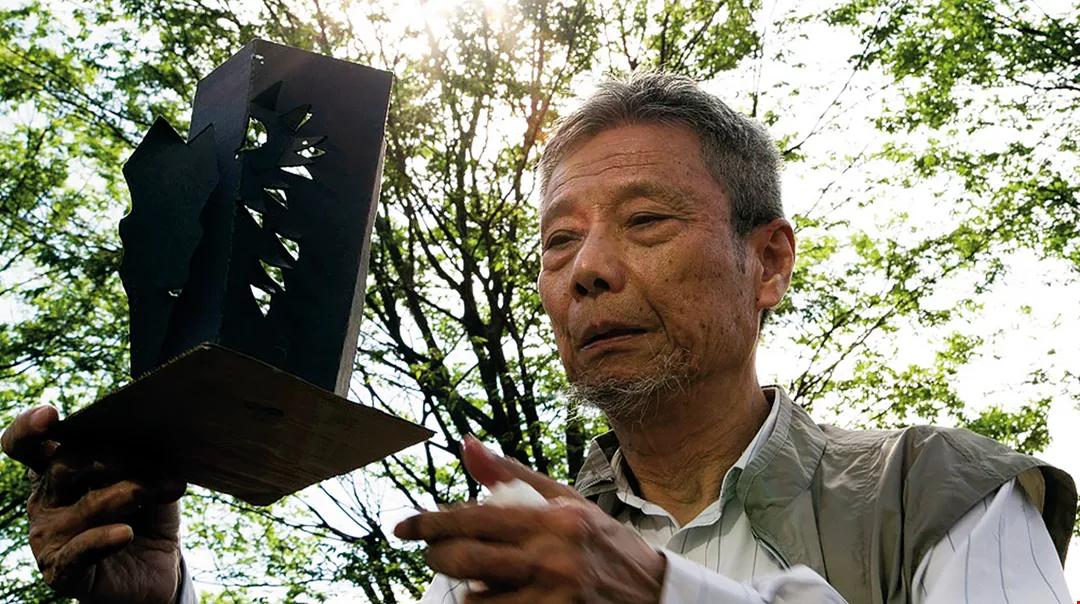
Kuo Chin-chih studies a cardboard mock-up, a technique that has been part of his creative process for many years. He also still emphasizes working by hand and focusing on his feelings. (courtesy of Kuo Chin-chih)
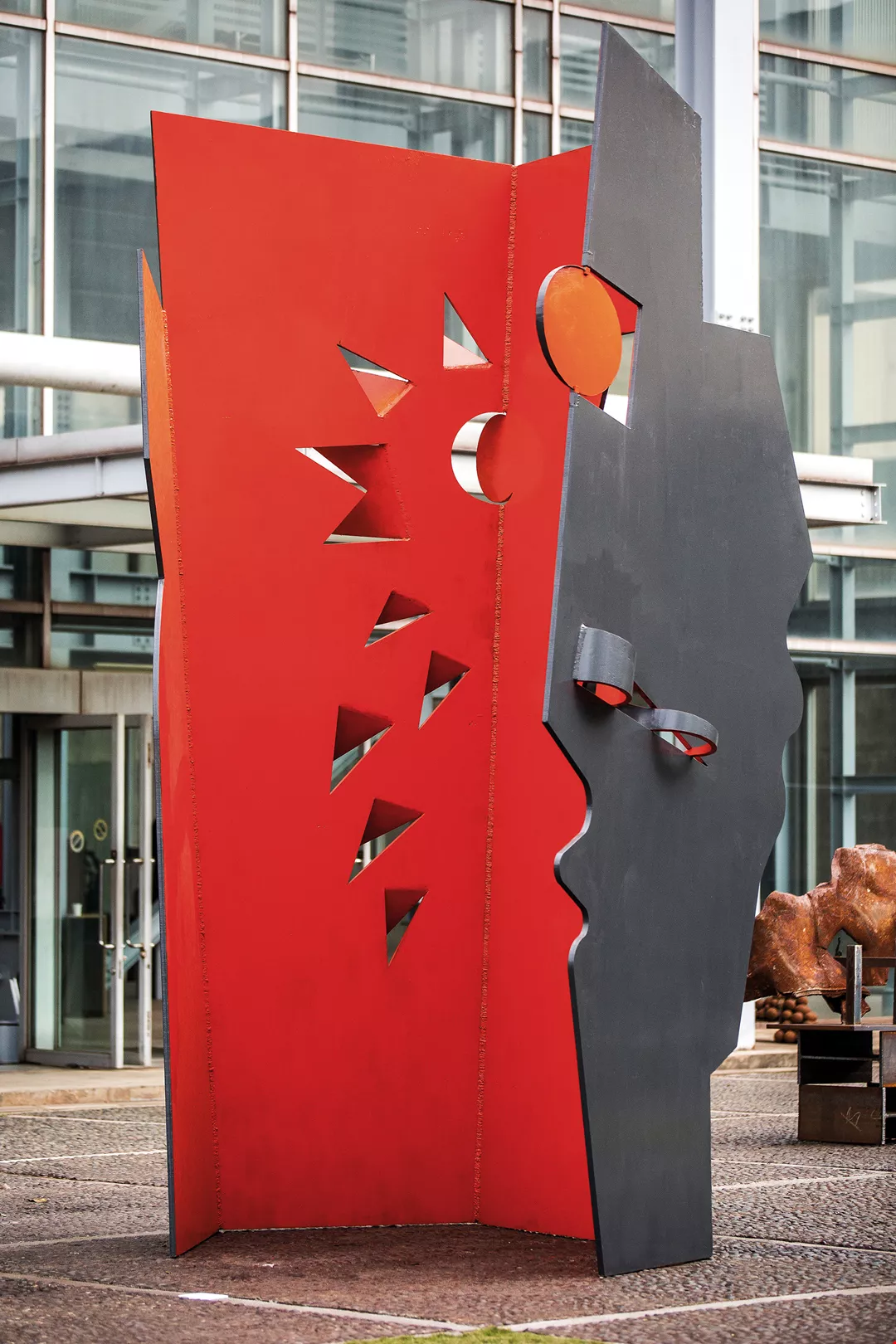
Now nearly 80 years old, Kuo Chin-Chih thinks constantly about the feasibility of certain forms. His The King cuts open a sculpted form, making it into a permeable space. (courtesy of the Tung Ho Steel Foundation)


