Master of the New Orientalism--Tim Yip
Wang Wan-chia / photos Jimmy Lin / tr. by Phil Newell
August 2010


Most people know Tim Yip through films. In particular, in 2001 he became the first ever person from the Chinese world to win the US Academy Award for Best Art Direction, received for the elegant Oriental imagery he brought to Crouching Tiger, Hidden Dragon. Since then, demand for his services has gone into hyperdrive, accelerating the spread of his fame and appeal worldwide.
Today, 10 years later, if you ask him to look back and assess what the impact of winning the Oscar was, he replies with a big laugh: "What do you mean 'look back'? I'm still living in the moment of being an Academy Award winner!" In an even more frank remark, he says, "Fame is great! It's the fastest way to get international respect." He adds with pride that if you consider art direction in the Chinese-language film world, the only names that people have permanently stored in their memories are William Chang (who collaborated very successfully with Tsui Hark and now works with Wong Kar-Wai) and Tim Yip.
But Yip is by no means limited to film. He moves without difficulty through the genres of live theater, costume design, visual arts, and contemporary art. The late Kao Hsin-chiang, former editor-in-chief of the culture pages at the China Times, once lauded Yip as "a name that is impossible to pigeonhole. Like the giants of the European Renaissance, he crosses boundaries of materials and wanders freely among different media, comfortable dealing with any challenge." But this ability to change gears effortlessly in fact is rooted in a tremendous amount of hard work, thinking, and discernment, and is by no means just luck.
It's an early-summer afternoon, and a heavy rain has just let up. Tim Yip, simply dressed in a linen shirt, appears at Taipei's Museum of Contemporary Art. He's not very tall (less than 160 centimeters), and on his head is a black cap that he never takes off. The purpose of this trip to Taipei is not to lend his skills to someone else's creation, but to hold his first ever solo show in Taiwan, "Summer Holiday." This being the day before the opening, he is checking over every detail of the exhibition, which occupies a huge space. Covering everything from the angle and intensity of the lighting to the pathway that winds through the images, objects, and staged sets on display, he gives suggestions and instructions to the work team. For one item alone-the hair of the main character, a mannequin named Lili-he makes more than 10 adjustments. In his thick Cantonese accent, he says with humor, "I guess I'm just very demanding!"
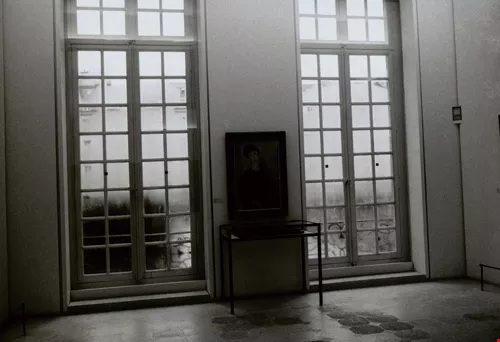
Photography and drawing were Tim Yip's first two eyes on the world. He feels that photography is not so much a matter of creativity as it is an exploration of the relationship between the external and internal realms. The photos here are all his.
Tim Yip was born in 1967 into a very poor Hong Kong household with seven mouths to feed, squeezed into a small old one-story house. He devoted all his free time to drawing, but in that era when aesthetics were neither rewarded nor encouraged by society, he comments, "To say that your ambition in life was to go into the arts was about as honorable as saying you wanted to be a drug addict."
Yip spent many of his adolescent days roaming the streets in a cheap suit, dressing beyond his age in his impatience to declare that he was not far from joining the "adult world." At the same time he longed with all his heart for a career in some field related to the arts. He was very much influenced in this by his older brother, Alain Yip, who had already made a name for himself as a photographer, and Tim decided to study photography at Hong Kong Polytechnic University. He has compared drawing and photography to "two powerful door gods" who pointed the way forward for him.
Alain, seven years older than Tim, not only became famous earlier and married Annie Liu (an actress for TVB television), in 1986 he also founded his own wedding-photo company which attracted an endless stream of customers, and made Alain much talked about for a time. Astonishingly, Alain-who was coincidentally visiting Tim on the day that this reporter was there-formally (and without any publicity) became a Buddhist monk in Taipei in May of this year. Taking the name-in-religion Chang Lin, Alain had in fact been studying Buddhism for several years. In late June, he went public with his decision in a Buddhist publication, which was followed by a media storm in Hong Kong. What does Tim have to say? He is supportive, passing the whole thing off with a lighthearted, "I suppose it is just that the time for his Buddhist destiny has come!"

The Contemporary Legend Theater's production of Medea was the first time Tim Yip did theater costumes, and created a connection that kept Yip living in Taiwan for many years. The photo left shows the costume from Medea worn by Wei Hai-ming, while the photo at right shows Yip (left) with Wu Hsing-kuo.
In 1986, Tim Yip, who at that time was working as a photographer for a Hong Kong film magazine, after being recommended by Tsui Hark, got a job as art designer for John Woo's film A Better Tomorrow, thus launching a relationship with film that has been solid and rewarding ever since. The following year, for Stanley Kwan's film Rouge, he recreated the extravagant, self-indulgent nonstop-party ambience of 1930s Hong Kong, and began to develop a deep interest in the culture and arts of the past.
That was a golden age for Hong Kong moviemaking, with over 300 productions screened each year. Faced with an uninterrupted flow of offers, Yip decided he would turn down purely commercially oriented films, saying they were "not refined enough" and "no fun."
In 1992, through the film Temptation of a Monk, he met Wu Hsing-kuo, a Peking Opera actor from Taiwan and founder of the Contemporary Legend Theater. The two hit it off right away, and Yip promptly packed his bags and, with two assistants in tow, moved into the small apartment (maybe 70 square meters) owned by Wu and his wife (the dancer and choreographer Lin Hsiu-wei), rubbing elbows with their family of four night and day for three months.
Asked to do costumes for Contemporary Legend's adaptation of the classical Greek tragedy Medea, Yip, who had never before done operatic costume design, was completely uninhibited and let his muse soar free. He decided to dress up Peking Opera diva Wei Hai-ming with a European Renaissance style hoop skirt, Chinese-style sleeves so wide that when swept open they covered the whole stage, extravagantly embellished aristocratic Chinese headgear, and an elaborately painted face for her leading role as a vicious yet tragic woman who is so set on revenge against her husband that she kills her own son.
"Taiwan was really fun back then! A bunch of lunatics like Wu Hsing-kuo could go without sleep, go without eating, completely immersed in Peking Opera." Thinking back to those days, Yip uses the term "collective madness" to describe the idealistic and richly creative decade of the 1990s.
In his mind's eye, Taiwan in those days-fresh out of martial law and enjoying real freedom for the first time in four decades-had an atmosphere deeply imbued with culture, with huge talents as common as clouds in the sky. In film there were directors Hou Hsiao-hsien and Edward Yang, in the performance arts the Cloud Gate Theater under Lin Hwai-min was just hitting its stride, and all you had to do was open a newspaper to find literary pages invigorated by writers and critics like Pai Hsien-yung, Li Ao, and Po Yang. Simply standing in the Eslite Bookstore flipping through the latest issues of newspapers and magazines from around the world gave him a sense of satisfaction that he had never had in the cultural wasteland of Hong Kong.
Meanwhile, "lunatic" Wu Hsing-kuo was similarly amazed at the passion for creativity of this man from Hong Kong. Virtually every piece of cloth, every decorative object, was collected by Yip personally, suitcase in hand, from the Yongle fabric market. Wu says of him, "He spent every last penny of his own on books, not even having enough in his pockets for a cup of coffee." What Wu most admired was that "he never stopped trying to improve himself and striving for perfection. No matter what the medium or stage, he pulled out all the stops, and, dragging a cartload of books behind him, never ceased to elaborate and defend his own viewpoint."
The first performance of Medea in 1993 created a sensation with its stunning visuals. From there Yip went on to seven years of involvement in live performances in Taiwan, doing stage design and/or costumes for an honor roll of Taiwan's leading theater and dance companies.
Sharing his views on designing costumes in an Oriental style, Yip has written: "In ancient times, China was a center of high style, with its fashions reflecting its imperial power," but because of cultural transmission and absurd mistakes in historical discourse, the aesthetics of the Tang Dynasty are often taken to be the same as those of traditional Japan. Yip explains that the Tang focused on visual sensuality; the human body was liberated and half-exposed. They enjoyed a kind of self-confidence and luxuriousness with respect to beauty. In contrast, Japan's traditional culture was centered on a more reserved definition of beauty. Women were tightly bound inside clothing, with an etiquette of restraint that was informed by a male-dominated social structure. "The two peoples in fact were just manifesting their different spiritual cultures," argues the richly informed Yip, who has developed a whole "fabric archeology."
Among his many credits, for the production of Miroirs de Vie by the Legend Lin Dance Theater he contrived a multi-layered costume for the role of Mazu that ended up weighing 40 kilograms. He was also invited to the opera house in Graz, Austria, for a production of Rashomon directed by Lin Hwai-min, for which Yip blended the forms and styles of Peking Opera and Japanese Kabuki. After all those years of mutual interaction and shared experiences of doing the artistically revolutionary, Yip says with obvious satisfaction: "You could say that there's nobody in Taiwan's cultural community that I didn't get to know personally!"
However, by the time he finished Lear Was Here in cooperation with Wu Hsing-kuo in 2000, Yip was bemoaning the poor quality of the "stage environment" in Taiwan: the market was too small, there weren't enough specialists being trained, and there weren't enough high-quality pieces to perform. "How can people be expected to produce dream theater with such a shortage of resources? It does nothing but suck all the energy out of you!" Therefore he said goodbye to live theater, which had enthralled him for so many years, and returned to film after his long hiatus, making Crouching Tiger, Hidden Dragon with Ang Lee.
This marked the start of a fad for "the aura of the Orient," combining the retro with the avant-garde, that swept the world. More particularly, after Crouching Tiger, Hidden Dragon there was great enthusiasm in the Chinese-language movie industry for large-scale period dramas, resulting in epic films with huge budgets, grandiose sets, and art teams of as many as 300 people. (Examples of this genre include The Promise, The Banquet, and Red Cliff). For all of these, filmmakers demanded Tim Yip by name, and would not settle for anyone else. This is how he was in position to construct his powerfully beautiful and elaborate "Oriental imagery."
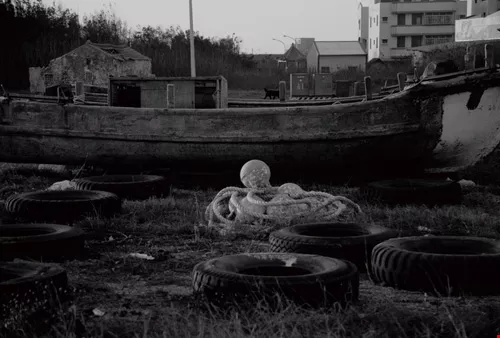
Photography and drawing were Tim Yip's first two eyes on the world. He feels that photography is not so much a matter of creativity as it is an exploration of the relationship between the external and internal realms. The photos here are all his.
Yip remarks that the West has been the strongest cultural entity in the world since the 19th century, not only influencing thought and culture around the world, but even arbitrarily taking the lead across a broad spectrum of fields to interpret other people's cultures. China, much weaker, has followed the logic of Western concepts, becoming an object of interpretation, which has caused Chinese people's understanding of themselves to waver. Yip, who grew up in a colony of the British Empire, has only been able, through trying to understand himself and seek out his roots, to move step by step toward his mother culture, which is so familiar and yet so distant.
In his search for the true Orient and true China, Yip-who describes himself as an "archeology nut"-has applied himself to an extent that few observers could imagine. He has over 10,000 volumes in his home, from literature and history to biology and mechanical engineering. It has only been by combing through this mountain of material and researching the pathways of history that he has been able to build a foundation for innovating through the classical.
Yip mentions that he sometimes sees stage works that have clearly been churned out by flipping through some foreign magazines and then adding a few Oriental elements as interpreted from a Western viewpoint. Western colonial powers understood the Orient through a combination of ridicule and a search for exoticism, and launched wars and conquest through occupation and seizure. This, he says sadly, has led to hundreds of years of fractures, distortions, and malformations in Asian culture. When the term "Orient" is mentioned in an international context, the cultures of the region are still framed in the discourse of "Orientalism" from a Western perspective, pushed to the periphery of world culture, passively being understood, analyzed, and reproduced.
Through the process of collecting information, Yip has come to regret that archeology got rather a late start in China, and cultural artifacts and historical materials are incomplete. Perhaps it is because there is an element of "wishful thinking" in the character of the mass of Chinese people that even historical documents themselves embellish the facts and exaggerate the statistics in order to glorify the powers-that-were, making it difficult to rely on such materials.
For example, for the John Woo film Red Cliff (2008), the prop team exhausted themselves making a reproduction of a 37-meter-long boat for the character of Sun Quan, who was a real historical figure (founder of the state of Wu in the Three Kingdoms Period). But it could only hold 200 people, not the 20,000 claimed in historical records. When you also consider that the route along the Yangtze River narrows in places, then how big a boat could it have really been?

Photography and drawing were Tim Yip's first two eyes on the world. He feels that photography is not so much a matter of creativity as it is an exploration of the relationship between the external and internal realms. The photos here are all his.
An American film critic once described the unique aesthetic that Yip has created in films as a "fabulous new world." In fact, the "New Orientalism" that combines "being" and "unbeing" is a concept that he has often proposed and reiterated in recent years.
Yip, who tells us "I have many observations and thoughts about human existence," explains that "being" is the separations and connections of extant matter. Whether tangible or otherwise, objects-each occupying different levels-form a "known" world, and we can sense and follow the rules in that world. Therefore humans sense a boundary that, in actual fact, does not embrace everything. What we know is only a small part of a vast reality, because we are not wise enough to understand the whole of reality. Therefore all we can do is feel it.
"Unbeing" is "the embodiment of the unknown," traversed by imagination in a post-humanist spirit. Humans use their own intelligence to construct the world, and through science constantly test their knowledge, but still they are only tailoring reality to human knowledge. Human understanding is constantly being challenged by reality, leaving people besieged by profound doubts and confusion. Post-humanism, on the other hand, aspires to find a new path and escape from the ever-increasing complexification of humanism, what Yip calls its "confusing soliloquy."
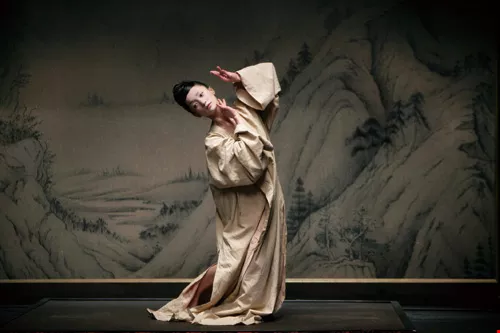
An "Oriental aura" combining the retro and the avant-garde became another of Tim Yip's signature styles. In films, he pays homage to Chinese classicism, while also constructing refined textures characteristic of art films. The photos at left show scenes from two films for which Yip was both art director and costume designer: The Banquet (left) and Crouching Tiger, Hidden Dragon (right). Above are hand-drawn sketches prepared for the same films.
Tim Yip lived in Taiwan for nearly 10 years, and many times has declared having much deeper emotional ties to Taiwan than to his birthplace, Hong Kong. Moreover, he has developed a unique perspective on the arts and culture of Taiwan.
"Hysterical optimists" is the term he uses to describe the Taiwanese character. Take for example the imagery of rain, which appears quite often in his solo show at the Museum of Contemporary Art. Rain on English streets has produced the melancholy, subdued English nature. But in Taiwan, people just say, "Oh, well, it's raining again!" then put on their sandals and head right out onto the streets, living happily in the same old way.
Yip also observes that in Taiwanese culture it is most important to take people's feelings into account (rather than, say, rules or strict logic), and Taiwanese have a high degree of tolerance for just about anything. But he also eventually discovered that "people don't think much about the results, they put up with things that are less than adequate just for the sake of not making a fuss that could hurt someone else's feelings." In the arts, for example, though it is possible to make a quick emotional connection with Taiwanese, their skills are unfortunately not as strong as their feelings, and "aesthetic sense is not given the importance it deserves." Thus most people remain mired in the humdrum or even the vulgar, and it has not been possible to produce more cultural elites like Ang Lee or Hou Hsiao-hsien.
Having said that, Yip also reveals (and here perhaps his lasting affection for Taiwan makes him slightly biased!) that after having worked with virtually every contemporary director in Hong Kong, mainland China, and Taiwan, Tsai Ming-liang and Ang Lee-both Taiwanese with foreign backgrounds-are the two directors with whom he feels himself to be on the same wavelength, and with whom there is an innate mutual comprehension when conversing.
Of the former, who comes from Malaysia and has a highly refined sensibility, Yip says that Tsai "taught me what a film is" and is "the person whose nature is most fitted to a world of film." Of Ang Lee, meanwhile, who has lived for a long time in New York, Yip avers that he not only has a mature and professional grasp of the language of motion pictures, but also every role-from Li Mubai in Crouching Tiger, Hidden Dragon to Mr. Yi in Lust, Caution-is a variation on Lee himself, and everywhere you can see signs of how he has invested his own emotions in his films.
Saying "their works are immediately identifiable" to describe filmmakers like Tsai and Lee who "instill themselves completely" in their movies, Yip says that when directors use their films to liberate themselves, the emotion revealed is sincere, powerful, and moving. To him, this is more than just a matter of this personality type being more common in Taiwan than in Hong Kong or mainland China-this unique character could only have been nurtured by Taiwan.
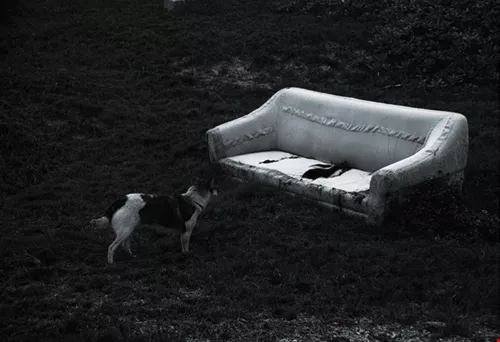
Photography and drawing were Tim Yip's first two eyes on the world. He feels that photography is not so much a matter of creativity as it is an exploration of the relationship between the external and internal realms. The photos here are all his.
Once at a lecture, Yip was asked, "What do you most fear?" He shot back frankly: "I fear the commonplace!"
Yip relates that he will always reserve 20% of life exclusively for pure artistic creation in "a dialogue with myself," since he finds his ever-brewing inner world to be even bigger than the external one. He forces himself to explore and uncover secrets in that world, where there is even greater mysterious internal creativity waiting to be unleashed.
The current "Summer Holiday" show at the Museum of Contemporary Art is not only rooted in his profound observations of Taiwan, it also fully manifests his principles and his reflections on his personal creative aesthetic. All of the stories in the show, whose exhibition-space design is based on stage concepts and which threads through the historic building that houses the MOCA, revolve around a virtual lead actress, "Lili."
In one of the rooms, visitors enter a completely red space, where their eyes are struck by an enormous Lili mannequin, six meters tall, dressed in an elaborate red gown, lying paralyzed on the floor in a state of exhaustion. A green light diffuses through glass embedded in the floor, bringing into even sharper relief the bizarre desolation in the red-hot, party-till-you-drop atmosphere of the space.
Yip says that when the collective craziness of a party is over, we must return to our individual worlds, quietly rethinking the past, observing the present, and anticipating the future. By going wild we super-size ourselves, and then completely shatter; only in this way can we see ourselves clearly from exterior to interior.
Since 2002, Tim Yip has held exhibitions in the Netherlands, France, the US, Spain, Beijing, Hong Kong, and Shanghai. Two days after opening the show in Taipei, he flew to Milan. We asked him how he can remain so productively creative when every block of time in his working schedule is filled. He says that as long as you drink deeply of life and keep observing what is going on around, you can go through to places that others can't get to. Says Yip in his perpetually Cantonese-accented Chinese: "It's like boxing with a different opponent each day!"

Photography and drawing were Tim Yip's first two eyes on the world. He feels that photography is not so much a matter of creativity as it is an exploration of the relationship between the external and internal realms. The photos here are all his.
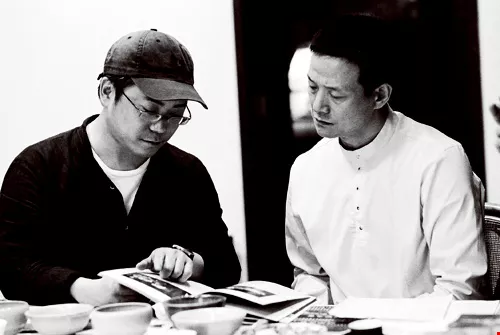
The Contemporary Legend Theater's production of Medea was the first time Tim Yip did theater costumes, and created a connection that kept Yip living in Taiwan for many years. The photo left shows the costume from Medea worn by Wei Hai-ming, while the photo at right shows Yip (left) with Wu Hsing-kuo.
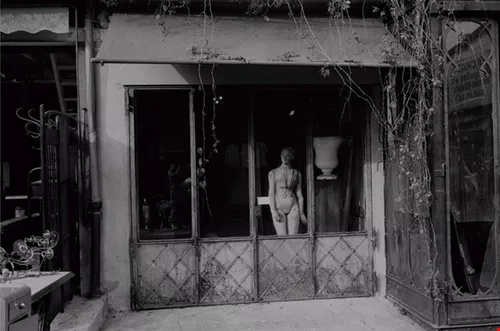
Photography and drawing were Tim Yip's first two eyes on the world. He feels that photography is not so much a matter of creativity as it is an exploration of the relationship between the external and internal realms. The photos here are all his.
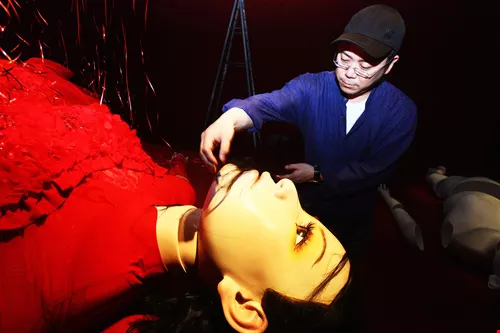
In Yip's Taipei solo exhibition, entitled "Summer Holiday," through the real existence of the lifeless mannequin Lili, we enter "unbeing" and explore the reality and possibilities that exist in an alternative space. Second from right is a sculpture of a woman entitled "Desire." She stands in the center of a darkened room, and crystal tears slowly flow from her hollow eye sockets. This was the original conception for the role of Lili, and the starting point of Yip's development of the Lili series.

An "Oriental aura" combining the retro and the avant-garde became another of Tim Yip's signature styles. In films, he pays homage to Chinese classicism, while also constructing refined textures characteristic of art films. The photos at left show scenes from two films for which Yip was both art director and costume designer: The Banquet (left) and Crouching Tiger, Hidden Dragon (right). Above are hand-drawn sketches prepared for the same films.
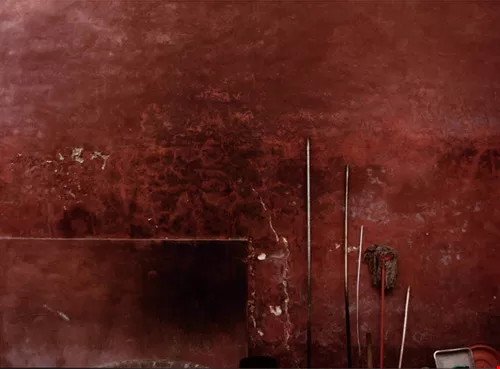
Photography and drawing were Tim Yip's first two eyes on the world. He feels that photography is not so much a matter of creativity as it is an exploration of the relationship between the external and internal realms. The photos here are all his.
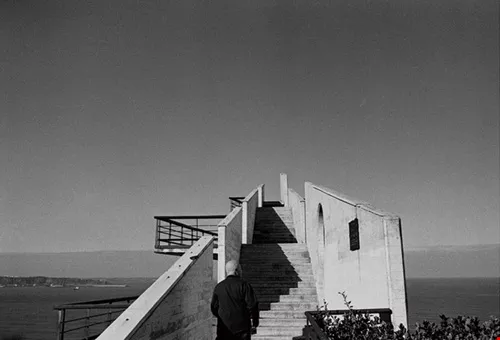
Photography and drawing were Tim Yip's first two eyes on the world. He feels that photography is not so much a matter of creativity as it is an exploration of the relationship between the external and internal realms. The photos here are all his.

In Yip's Taipei solo exhibition, entitled "Summer Holiday," through the real existence of the lifeless mannequin Lili, we enter "unbeing" and explore the reality and possibilities that exist in an alternative space. Second from right is a sculpture of a woman entitled "Desire." She stands in the center of a darkened room, and crystal tears slowly flow from her hollow eye sockets. This was the original conception for the role of Lili, and the starting point of Yip's development of the Lili series.

Photography and drawing were Tim Yip's first two eyes on the world. He feels that photography is not so much a matter of creativity as it is an exploration of the relationship between the external and internal realms. The photos here are all his.
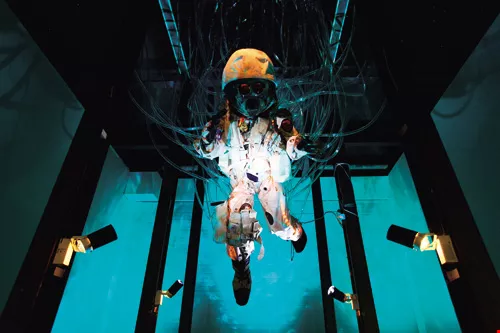
In Yip's Taipei solo exhibition, entitled "Summer Holiday," through the real existence of the lifeless mannequin Lili, we enter "unbeing" and explore the reality and possibilities that exist in an alternative space. Second from right is a sculpture of a woman entitled "Desire." She stands in the center of a darkened room, and crystal tears slowly flow from her hollow eye sockets. This was the original conception for the role of Lili, and the starting point of Yip's development of the Lili series.
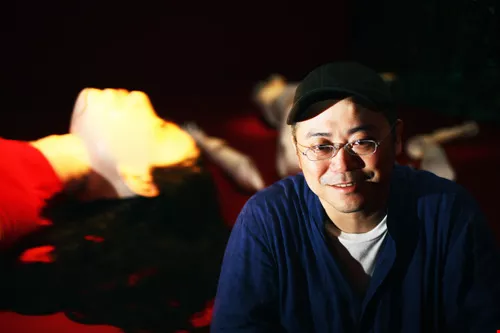
Tim Yip is not only a versatile artist and designer, but is also the creator of the "New Orientalism" style.
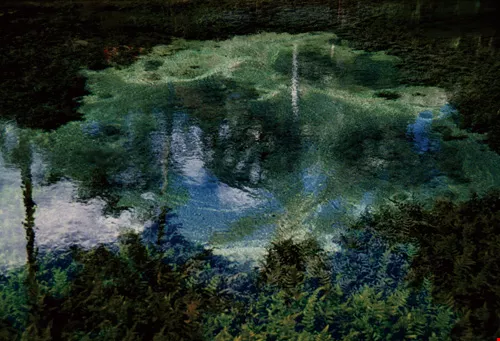
Photography and drawing were Tim Yip's first two eyes on the world. He feels that photography is not so much a matter of creativity as it is an exploration of the relationship between the external and internal realms. The photos here are all his.

@List.jpg?w=522&h=410&mode=crop&format=webp&quality=80)


