From the Mainstream to the Margins Lucy Tuann on Overseas Chinese-Language Literature
Interview by Elaine Chen / tr. by Brent Heinrich
February 1995


Judging from the reserved appearance of Lucy Tuann, now over 50 years old, it's certainly hard to imagine that she has consistently remained in the "avant garde" of modern Chinese history.
In order to help construct a greater China, she and her husband returned to China on the eve of the Cultural Revolution. After going through intense turmoil, she evacuated the mainland, and thereafter wrote the novel Mayor Yin. Later on, because of her overseas support of Taiwan's non-partisan democracy movement, she was blacklisted by the ROC. Currently, because she has helped mainland writer Aibei publish Too Heavy to Say Father, she has been barred from entering mainland China.
Lucy Tuann, who currently lives in Hong Kong, came to Taiwan recently to participate in some women's movement activities, which gave us a chance to have a face-to-face interview with this writer whom we have not seen for a long time. Our conversation with her follows:
Q: In this book of short stories, are there any topics about which you are specially concerned, or any special messages which you want to communicate?
A: There are mainland girls who agree to compromising marriages in order to get a green card. The question of 1997 is hanging over everyone's heads in Hong Kong. The Tiananmen Incident has had a big impact upon overseas Chinese. These are the relatively new happenings that have occurred to this generation of Chinese. And there are others, like the tensions between the generations and cross-cultural marriages. What I want to write about is the problems that Chinese people face as they are spread out striving everywhere.
Especially women. This emphasis happened unconsciously, because for many years I've been concerned about the women's movement. This time I have come to Taiwan to raise funds in coordination with Li Yuan-chen's Awakening Foundation and the Warm Life association.
Q: Why did you choose the short story "Wang the Leftist" as the title of the whole book?
A: After writing novels based on overseas Chinese in America for over ten years, I quit writing completely for four years. And why could I suddenly be able to write fiction again? Because something real happened at the time.
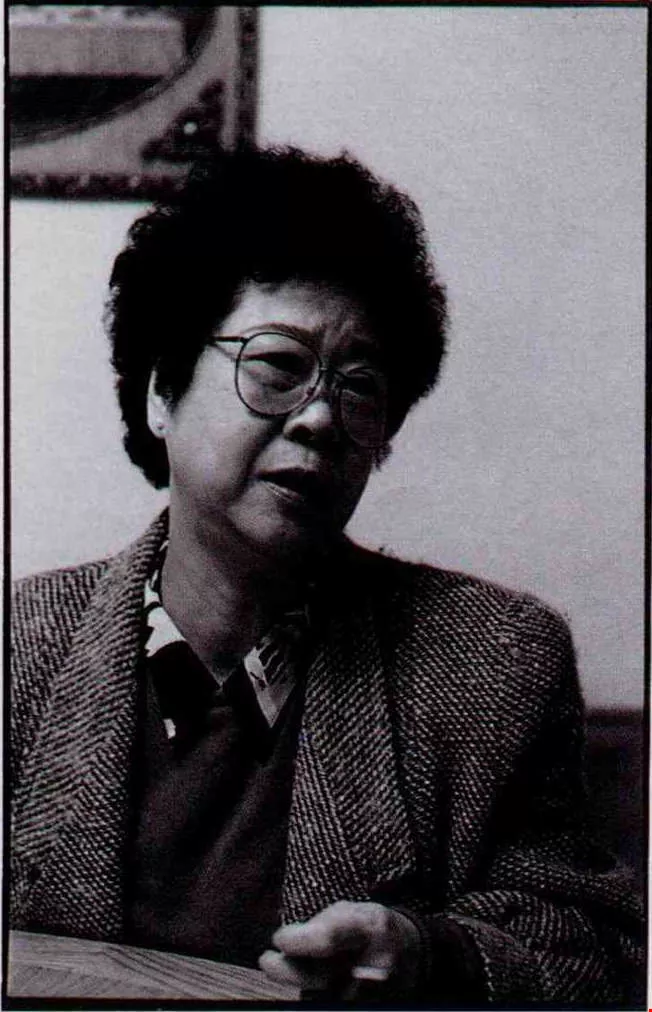
In the future, if I'm in Hong Kong, I'll continue to write about Hong Kong. If I return to Taiwan, then I'll write about Taiwan.
Green card gone, passport present
I have a friend who really loves mainland China. He worked for the United Nations, but for many years past he still wouldn't take an American passport. He just had a green card. After retiring, he decided to return to his hometown on the mainland to set up a library. We all supported him, donating books and money. Then unexpectedly, he broke the news to us last year that he had shut the library down.
Oh! I was so angry and surprised! I said, "How could you close down? There's still so many books in my home. Many of them have been specially autographed by their authors. I've already told you, all you have to do is think of a way of getting them, and you can take them all. You don't have to wait till I'm dead."
He said, "I can't carry on. It's incredible how many books have been stolen." In 1993, 4000 books were stolen. Many social problems are reflected in the stealing of books. The most important is the demise of morals. He said that so many books were stolen, and his house was robbed as well. They took his money, a camera. Even his green card was stolen. Only his Chinese passport, which he had left sitting on his desk, had been left behind.
This stimulated me immensely. In three days I wrote "Wang the Leftist." From that time on, I was able to write short stories again. Because this event had such a great impact on me, and also because I had from the beginning been paying a lot of attention to the changes in mainland China in the last few years, I decided to go to Hong Kong to write a series of stories concerning mainland China. But as it turned out I got involved in how the people of Hong Kong felt about the approaching changes of 1997.
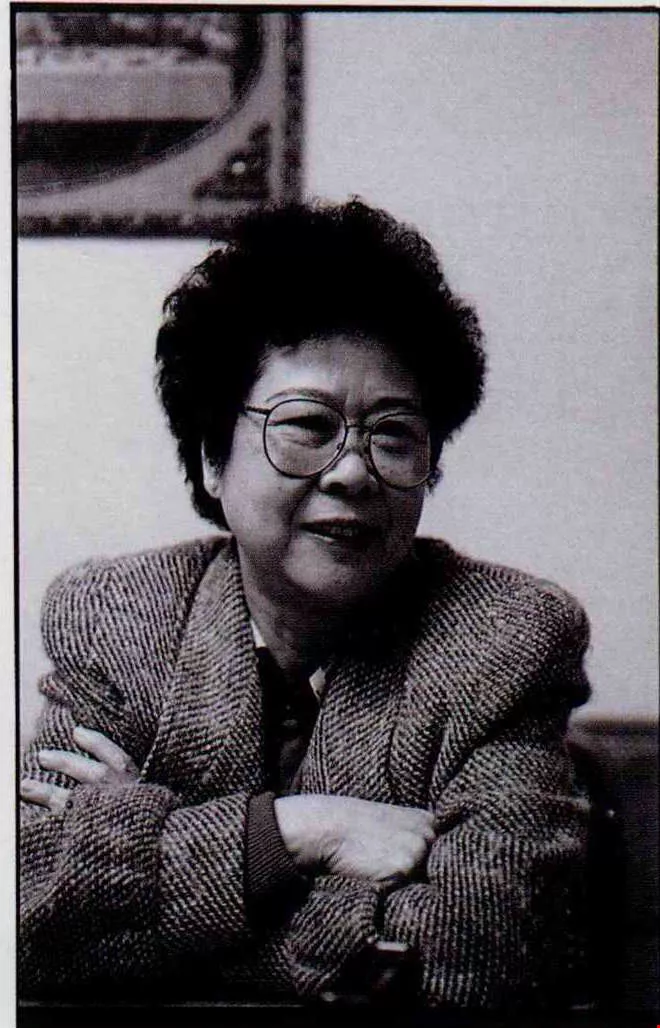
In the future, if I'm in Hong Kong, I'll continue to write about Hong Kong. If I return to Taiwan, then I'll write about Taiwan.
Useless stories
Q: Why did you stop writing for four years? What was your emotional state for those four years? Had you planned never to write fiction again?
A: Right. When I wrote I really didn't feel interested. I felt that stories were simply useless. Once the great wave of commercialism had swept through Taiwan and the mainland, fiction simply had no more power. In the past I believed that novels, just as Liang Chi-chao said, had the power to motivate society, they had a kind of potency that could improve things. But after living in America for ten years, I completely rejected my beliefs of the past. I doubted there was anyone still reading any novels. With fewer and fewer readers, I became discouraged. And I also had a job, so for four years I didn't write any stories. I only wrote some articles from time to time.
"Wang Tsuo" is the first story I wrote in the past four years; it was a turning point, so I'm more than willing to use it as the title of this book.
Q: Are all the other stories based on true events too?
A: Yes, my stories are based on what I've seen, what I know or what I've heard. It seems I don't often really need to make things up. Except for the mysterious stories that I wrote during my freshman and sophomore years in college, I didn't really think it was necessary for the others, because there was so much material available in society. Of course, I fictionalize my stories. I change the names of characters; I change their professions or their age.
In this book of stories, several times I discussed the problems that Chinese people have buying and selling land, because in the last two or three years I worked in a real estate agency in the United States, and I saw a lot of real-life examples. For instance, a lot of people from Taiwan and Hong Kong, in order to immigrate, sell off their original homes. When they want to go back, the price of real estate back home has already skyrocketed, and they can't buy it back. This is particularly true in Taiwan, especially because of the additional factor of the appreciation of the New Taiwan Dollar. It's just like the old lady in the story "Refusing to Lose 20,000 Dollars"; I really did see her in a miserable state, truly stricken with sorrow.
Q: Can you please chat a bit for our readers about what's been happening lately in your life? A lot of people in Taiwan feel that ever since they read your Mayor Yin, it's like you have just disappeared.
A: After I came out of the mainland, I taught for a year in Hong Kong and then emigrated to Canada. Then, because of my husband's work, I transferred to the United States.
As long as their culture does not die
I went to Berkeley, California, and lived there for 15 years. For the first ten years, everything I wrote about had to do with overseas Chinese in America. I thought that the Chinese there in the 1980s were very different from all the American Chinese for the previous 100 years. They were already a whole new batch of Chinese, mainly the ones coming from Taiwan. Their educational levels are very high, they have professions, and furthermore they all want to set down roots in America.
Beyond this I wanted to advocate a literature of Chinese culture. The important thing is writing in the Chinese language. As long as it is about Chinese people, it's still a branch of Chinese literature. For this reason, whether it is in Taiwan, the mainland, Hong Kong, Southeast Asia, or the US, if it's written in Chinese, I believe it all can be called literature of Chinese culture.
The whole world has become a global village, and geographical boundaries are getting vaguer and vaguer. In terms of literature, it's hard to say what is American literature or what is British literature; we classify literature according to the English language, the Chinese language, the Japanese language.
I hope that all Chinese people can be very broad minded and not be limited to nationalistic conventions. It doesn't matter what territory a people occupies; as long as their culture does not die, this people will live with a great deal of self-respect.
Q: But the subjects which they are concerned about are quite different. For instance, the fiction written by Taiwan's local writers reflects local things.
A: This is very natural, and it ought to be this way, because literature in the first place is a reflection and an exploratory dialogue between the writer and life. Writers write about what they have an intimate knowledge of. Taiwan writers write about their Taiwanese environment; mainland writers do the same.
Q: Are you worried that the book you have just written, whose stories focus on overseas Chinese, will be unable to find a broad response in Taiwan?
Taiwan's army of writers
A: There is no such pressure, because I am certainly aware that it is not within the mainstream of Taiwan's literature, at least from the point of view of subject matter.
In the past, literature from overseas students was mainstream for a time. During the sixties if you opened up the two major newspapers, all the major writers of the time were living in the US. Yu Li-hua and S.K.Chang for instance--they were all like that. In the sixties the literary sections of the two major newspapers were scorned by some as being the overseas student press.
That kind of criticism is correct. But in those days everyone who could write took a degree in foreign languages and later went abroad to study. However, when they went abroad they didn't forget about writing, and they didn't forget their homeland, so it developed into what was called overseas student literature.
But nowadays it is different. Society has opened up, and the media has become multifaceted. There is a lot of space, and also the level of education in Taiwan has risen. An army of writers has formed by itself here.
Q: As a Chinese writer living abroad, how do you keep your creativity flowing? Is it very difficult? How do you avoid a feeling of separation between yourself and your readers?
A: This is definitely a problem. When writing about one's motherland, of course one can't always live in a world of nostalgia. That can become very confining. But literary subjects are often universal. It's not entirely impossible to pass beyond this bottleneck.
For example, S.K. Chang first wrote in advocacy of Taiwan's sovereignty over the Tiaoyutai islands. Then he began to write science fiction, which was free of temporal or spatial limitations. I write about Chinese society. A certain distance between myself and my readers must inevitably come into existence, so I must maintain a long-term, intimate interaction and understanding with my ancestral land, just like Lung Ying-tai, who comes and goes to and from Taiwan every year, keeping in close contact with the place she cares about.
Q: In the last several years, Western countries seem to have been starting to pay attention to overseas Chinese writers, especially a few writers like Amy Tan and Maxine Hong Kingston. What differences do you think there are between the literature of overseas Chinese and the kind of Chinese-language literature which you advocate?
A: The literature of overseas Chinese is written in English, and its sights are locked in on foreign readers. The topics they write about are not modern Chinese people, and furthermore, there is a vagueness about their setting in time. But if you estimated it, it would probably be in the thirties and forties, and also in the seventies and eighties. The main emphasis is on the relations between two generations of immigrants.
But what we should pay attention to is that overseas Chinese literature is not typical or representative. It more or less caters to Western tastes. It draws attention to and selects issues that are relatively backward, eccentric or arcane. I've been observing it for more than 20 years, and overseas Chinese writing generally doesn't go beyond the scope of these topics.
Don't belittle Taiwan culture
Q: Along similar lines to what you just said, the Taiwan of today is very different from the Taiwan of the 1960s. In that era the literary sections of the two major newspapers were monopolized by overseas students. The current trend is precisely the opposite, with an emphasis placed on the native soil. In your opinion, what kind of attitude should Taiwan's readers employ when reading the Chinese literature of these overseas authors?
A: I believe that the trends of today are going in the right direction, and they are natural. When the people in a certain place have been repressed for 30 or 40 years, with the first chance of freedom they get, inevitably they will want to identify themselves, to focus on their own past and present.
But I hope that this attitude will not be frozen in this state long term. That would lead to self-belittlement. Ultimately we should return to Chinese culture, we should feed the outstanding cultural achievements of Taiwan back into Chinese culture.
Taiwan's readers cannot go on forever feeling that they only live in Taiwan. Understanding the strivings of Taiwanese living abroad is also very important. Some day in the future you too may go to a foreign land, so don't discriminate against expatriates. In the past everyone cried, "Love your country, no matter first or last." I think that we should also love Taiwan, no matter first or last.
We have been away from Taiwan for a long time. Today I see the progress Taiwan has made, and my heart is filled with both admiration and pride. And I feel that whatever struggles, whatever labors we undertake overseas, we do it to be part of Taiwan. And when someday there are those among us who want to return to Taiwan, it won't be merely returning to enjoy its benefits, but returning to make contributions. It's only a questioning of contributing first or contributing later.
Q: Would you mind discussing your future writing plans?
A: I still live by an old principle, to write about what I am very familiar with. The stories that I write, if only I can say that they make the readers feel they've gained something, or that they have evoked some resonance, or that they have taught a lesson, or that they have achieved communication, then I will be satisfied.
In the future, if I'm in Hong Kong, I'll continue to write about Hong Kong. If I return to Taiwan, then I'll write about Taiwan. And this is actually very possible. Lee Yuan-chen and Shih Chi-ching and some others all want me to go back and work in Taiwan. We would work together to help promote the women's movement. That would be very interesting.
[Picture Caption]
p.89
In the future, if I'm in Hong Kong, I'll continue to write about Hong Kong.
If I return to Taiwan, then I'll write about Taiwan.

@List.jpg?w=522&h=410&mode=crop&format=webp&quality=80)

@List.jpg?w=522&h=410&mode=crop&format=webp&quality=80)


