The Best Know No Boundaries--Multi-Award-Winning Designer Chen Yanting
Lin Hsin-ching / photos Jimmy Lin / tr. by Geof Aberhart
July 2010


Winners of prestigious international prizes are not uncommon amongst the students at National Taiwan University of Science and Technology's College of Design, but most of them find success in one of three areas: industrial design, graphic design, or computer animation. Very few can lay claim to the trifecta.
However, second-year graduate student Chen Yanting is the one in that one-in-a-million shot. Since his senior year at college, Chen has been seeking out international and domestic design competitions of all sorts to test his skills, and thus far he has earned over 70 different design awards, 55 of which are amongst the leading international awards.
These include the German iF and red dot awards, the IDEA awards from the US, the UK's D&AD, the Italian I Castelli Animati, and many others given to those at the top of their fields internationally. Taiwan's own Chen Yanting quickly became a familiar and much anticipated face to judges, but what is his secret to having swept so many awards in so many fields?
Situated near Keelung's night market and established during the Japanese occupation of Taiwan, Baoshan Contacts and Eyewear is known locally as the place to get glasses. In recent years, the store has made no small number of appearances in the media, but not for its booming business or products. Instead, the focus has been on Chen Yanting, the 26-year-old son of the proprietor.
Chen has already become his own brand, standing out from the rising design stars of his generation, and "astonishing" is the only way to describe his history of awards. In 2008 alone, he won 17 international design awards for his short film Cutting and poster "Letter Cutting," both done in traditional Chinese paper-cutting style. These and Chen's dozens of other awards have not only earned him a grant from the Ministry of Education of almost NT$1 million, but also gained him sponsorship in the "Overseas Training for Young Artists and Designers" program, as part of which he has been invited to spend a year at the world's leading design school, New York's Pratt Institute.
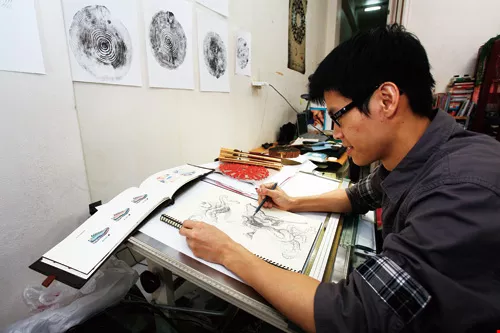
Unlike many other creative types, Chen Yanting is no night owl, but rather prefers to come up with ideas and draft blueprints in the morning, when his mind is at its clearest.
Wearing a pair of black-framed glasses and cutting a refined figure, Chen Yanting is a true representative of the talent often overlooked in Taiwan's vocational schools.
"Yanting was always such a good boy, and he could really draw, even as a child. He was never a particular standout student, almost always just ending up above average no matter how hard he worked. I even got a call from his teacher complaining that he spent too much time off in his own world in class." So says Chen's mother, an outgoing and vibrant woman, of her son's time at school. After taking the Senior High School Entrance Exams, she says, Chen scored highly enough to get into Songshan Senior High in Taipei, the fifth most popular choice of high school in Taiwan, but instead she and her husband encouraged Chen to enroll in the advertising design program at Erh Shing Senior High School's vocational section, given his talent for design.
This parental practicality ultimately gave Chen a head start on his peers in terms of finding his direction, and over his three years at vocational school he was able to develop his skills in art, printing, and computer-assisted design. In the end, he graduated first in his class, testing into National Taiwan University of Science and Technology's Department of Industrial and Commercial Design.
Over his first three years at NTUST, Chen says he focused primarily on building his basic skills. Driven by a tremendous passion for learning, he enrolled in more courses than necessary, taking on all the knowledge he could find and adapting it to further his own abilities.
His graduation project in 2007 was a turning point for Chen; "I felt like the time had come, and I figured I needed to do something with some real power, so I decided to go with something most people are unfamiliar with-traditional paper cutting. I hoped that this way, as well as creating a strong piece, I could also do something to promote awareness of this nearly lost art both in and out of Taiwan," says Chen.
In order to learn paper cutting, Chen paid several visits to renowned paper cutting artist and award winner Lee Huan-chang. Not only did Chen learn this complex art under Lee, he also had the chance to discuss with Lee his decades of work and experience.
Upon hearing Lee's frustration that traditional paper cutting seemingly has no place in modern cities, Chen was struck with inspiration and determined to try and combine the two. For his short film Cutting he used computer animation and real-world sets, using the role of "paper-cutting magician" to merge modern cityscapes with traditional paper cutting patterns, transforming modern streets into winding cuts in paper, the gaps between buildings into detail work. With the magician's every cut, new street scenes are opened up, metaphorically showing how with the efforts of commited people, paper cutting can add a new kind of beauty to city life.
Chen's paper cutting animation and poster, creative and thought-provoking, also earned him recognition from the international design community, boosting his confidence and inspiring him to turn his eyes abroad.
During his year at the Pratt Institute, Chen was constantly challenged and inspired by the wealth of resources and tremendously skilled students, and his creativity continued to flow. He created a series of environmentally conscious posters that earned international awards in Mexico and Poland, as well as an Adobe Design Achievement Award.
Taking as his inspiration the iconic logos of car companies like Saab, Ferrari, and Dodge, Chen created satirical versions with the lion, horse, and ram poisoned, taking a jab at the companies' heavy responsibility in creating greenhouse gas emissions; this earned him a gold award in ACM SIGGRAPH's Space-Time Student Competition and Exhibition, with judges commending it for its effective use of simplicity to make a strong statement.
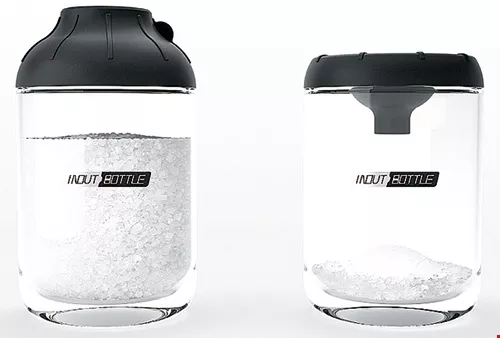
This piece, an IDEA winner, is a jar with a silicon lid that can be depressed with a simple touch to create a funnel to pour sugar, salt, or similar without fear of spills.
A specialist in graphic design and computer animation, it is Chen's involvement in fields outside his specialties, like industrial design, and his ability to take international awards even as a complete newcomer that have really got people talking.
"To me, the language of creativity is one that can be translated to different areas and methods; as designers and creative people, we shouldn't limit ourselves. Not to mention, my teachers and classmates at NTUST can lend a hand with specialist advice, which means that taking on that field wasn't especially difficult."
Whether in graphic design or industrial design, Chen has been able to create direct, effective methods through detailed observation of everyday life. In 2009, after deciding to try his hand at industrial design, he carried a notepad with him constantly, recording any problems or questions he encountered, interesting media reports, or any other flashes of inspiration that hit him.
"That year I was doing my military service on Mazu, and with just an empty notebook and a lot of thought, I was able to draft up about 70 design ideas, which I ultimately shrunk down to five pieces." Unfamiliar with manufacturing methods, Chen sought out fellow graduate student Ye Xin to help him take those five pieces and make them reality.
This year has been a banner year for Chen's industrial design work. Working with Ye, he has earned three different international awards with three different pieces. With his "catch-free drain cover"-designed to look like Venetian blinds and to fit drains running at 30-degree angles, it will neither catch on shoe heels nor let small items like keyrings fall through into the water-he won the German iF award; with the "Inout Bottle"-a jar with a silicon lid that can be gently pressed down with one finger to reveal a funnel-shaped opening through which condiments such as sugar or salt can be poured quickly, easily and without spilling-he took the American IDEA award; and thanks to his " e-Ink Ruler"-a tape measure that, using the principles of electronic paper, can be switched between centimeters and inches-he walked away with an Output Award from the Netherlands.
"I've got another two projects being assessed by judges right now, and I'm expecting at least one international award from them," says Chen confidently.
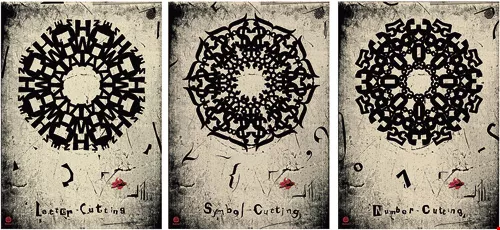
In this series, Chen combines familiar letters, numbers, and mathematical symbols with traditional Chinese paper-cutting to create a piece that transcends language. This depth of meaning helped the series, titled "Letter Cutting," become a winner at the iF and red dot awards.
Despite his heavy workload of classes and design work, Chen has continued to maintain a healthy, ordered lifestyle. He gets up every day at 7 a.m. at the latest, goes to bed at 11 p.m., and never sleeps in nor burns the midnight oil. This is quite different from the usual perception of artists as free-spirited night owls.
"My family runs a business, and so ever since I was little I've been used to that kind of schedule," says Chen. "As soon as the clock strikes 10 p.m., my mind just starts getting all foggy, but when I've just got up at 6 a.m. I'm at my clearest and my creativity is at its peak," he continues, showing a similar approach to that of famous Japanese author Haruki Murakami.
Chen has also stayed clear of the usual aggressive competitiveness of designers, working with fellow students to help encourage them, and even writing up a detailed timetable for anyone interested in entering any of the international competitions. Thanks to such efforts, he has become the go-to guy for NTUST design students.
If asked to explain what the judges see in his work, Chen gets straight to the point: "European judges prefer ideas over practicality-for instance, the Output judges look more kindly on things the more imaginative and out-there they are. IDEA, a US competition, is completely the opposite; they prefer things that could genuinely go into mass production in the future...."
This is Chen Yanting. A thinker and a dreamer, but with an entrepreneur's realism and practicality. Still studying toward master's degrees from both Pratt and NTUST, Chen will surely continue carving a broad trail through the world of design.
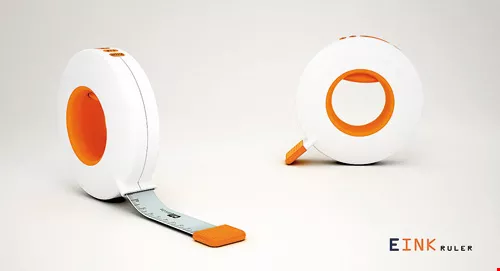
Using a concept similar to that of electronic paper, the "e-Ink Ruler" can be converted to read in inches or centimeters, making it a convenient tool and earning Chen a gong at the Output Awards in the Netherlands earlier this year.
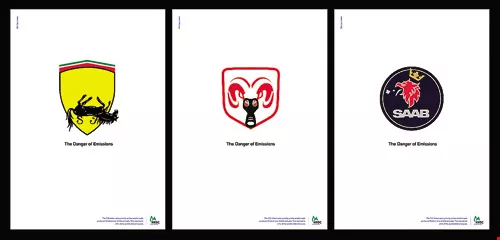
This poster, taking aim at car companies for their massive contributions to global warming, takes recognizable animal iconography from these companies, transforming them into a passed-out horse, a gasmask-clad ram, and a coughing lion. This thought-provoking piece of satire is a worthy winner of the US's ACM Siggraph Space-Time Student Competition.

@List.jpg?w=522&h=410&mode=crop&format=webp&quality=80)

@List.jpg?w=522&h=410&mode=crop&format=webp&quality=80)


