My Son! Author Huang Chun-ming Remembers Huang Kuo-chun
Tsai Wen-ting / photos Pu Hua-chih / tr. by Scott Williams
January 2007


The death of a child can be almost too much for parents to bear.
Huang Kuo-chun, the 32-year-old son of author Huang Chun-ming, hanged himself some three years ago.
In the years since, Huang Chun-ming has continued to write, give lectures, and create plays for children. If anything, he works even harder now than he used to. But there is another Huang Chun-ming, one that was devoted to his children. That Huang lost more than ten kilograms and aged visibly following his son's death.
The day Kuo-chun died, Huang was giving a seminar in Hualien. His cell phone turned off, he had no idea his family was trying desperately to contact him.
After the seminar, Huang chose for no particular reason to take a little-used trail back to where he was staying. When he badly turned his ankle on the way, he began to worry that something was wrong.
Later, hearing the news that his son had killed himself, a disbelieving Huang jumped into his car and sped off in the pouring rain. Taking the provincial highway from Hualien to Taipei, he raced along the Chingshui Cliffs on the Hualien coast and through the twists and turns of the mountain road between Ilan and Taipei. In Taipei, family members' sorrow over Kuo-chun's death was matched by their fear for Huang, who had been known to drive at terrifying speeds and had been in several accidents.
"Nothing was going to get in my way," recalls Huang. "I wasn't going to wait for anything!" As he drove, he kept repeating his son's name, over and over again. "I said his name more times that day than I had in the previous 30-some years combined," he says.
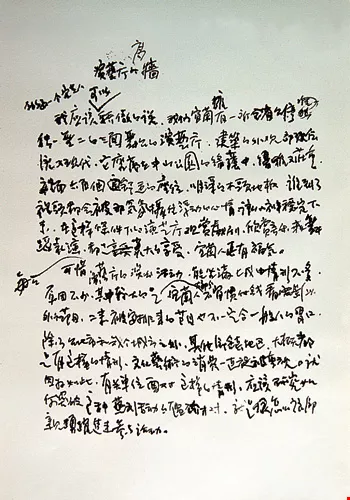
Throughout his long career, Huang has always done his writing by hand with pen and ink.
"He was a truly gentle child," recalls Huang, his voice tender. "We loved him very much." Those simple sentences summing up their 32-year father-son relationship are packed with a world of feeling.
Huang's youngest son was a source of pride, as well as a frequent object of protective concern. Though Kuo-chun was an exceptionally sensitive person who had difficulty dealing with the outside world and had grown up differently than most, he had developed his own ideas and ways of thinking about things.
As a child, Kuo-chun would hide in his room and cry when he heard accounts of sad or unjust events. Author Chen Ying-chen recalls that once, when he was relating the story of how the Aboriginal youth Tang Ying-shen had been sentenced to death for killing his cruel boss in a moment of rage, Kuo-chun became so upset that he retreated into a corner to cry.
As a student at Tamkang High School, he was befriended by an older girl who had noticed that he was often alone. Learning that he loved classical music, she often invited him to concerts with her. Many years later, Kuo-chun learned that she was having trouble adapting to life in Hong Kong, where she had moved with her husband. Concerned about her, he decided to cheer her up with a "care package" that included fictitious accounts of national events, gossip, comics and ads. He also recast Taiwanese current events as amusing illustrated stories. He then sent this package he had created entirely on his own to her as a kind of long-distance hug, hoping that she would take strength from it.
Kuo-chun never actively sought to make friends and didn't like to go out. Knowing that his default answer to everything was "no," Huang and his wife would push Kuo-chun to go out by suggesting, "Why don't we 'not' go to the movies?"
As a child, he was melancholic and a little bit angry at the world for its imperfections. Once when the family was having dinner out, they found themselves waiting and waiting for a fish dish. Eventually, everyone was full and the fish still hadn't arrived; they told the restaurant to forget about it if they hadn't already cooked it. They were surprised when the restaurant owner told them it had been made, then kept them waiting for ages longer. It was a pricey dish, too, costing NT$1,200. When they got home that evening, Kuo-chen was still so angry that he wanted to go back and spray paint "Rip-off shop" on the restaurant's door. Huang naturally prevented him from doing so.
Kuo-chun was a bit of a neat-freak and an extremely frugal shopper--he would trek across several neighborhoods to bring back boxes of sale-priced rice or water and would become angry if he came across a new book in the house that no one had gotten around to reading.
"He also did all kinds of work around the house," says Huang, continuing to enumerate Kuo-chun's virtues. "He scrubbed our floors himself." Though the books and CDs he left behind still sit neatly on their shelves in the Huang's home, and his paintings still hang quietly on the walls, a veneer of dust has begun to gather on the case of his cello.
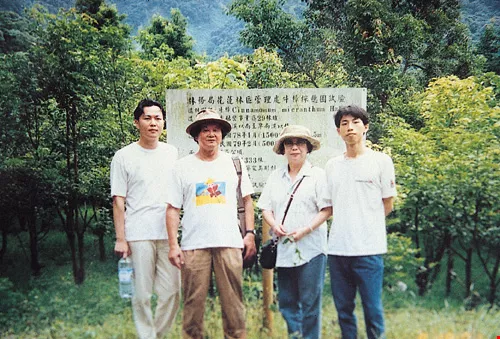
A family photo from happier times. Standing beside Huang and his wife are their two sons: the sunny elder, Kuo-chen (left), and the slender, elegant Kuo-chun.
Kuo-chun, who was born in 1971, used to say of himself that he had a hard time dealing with people. After graduating from Tamkang, he elected not to go on to university. Instead, he taught himself to play piano, cello and violin. When he later became interested in portraiture, he filled the Huangs' home with sketches and oil paintings that showed off his confident brushwork.
After completing his military service, Kuo-chun began to delve into literature. In 1997, at the age of 26, he won the Unitas Award for new writers for his story "Liu Bai." At the time, no one knew that this young unknown was Huang Chun-ming's son.
"We often called him our 'monkey boy.' The term evokes a complex set of feelings; it suggests that the child is adorable, infuriating and a source of concern," explains Huang, who idolized his son. "He was such a special person." One time, facing dubious looks from the family after he had passed gas during a meal, a very young Kuo-chun told them, "I didn't fart; it was my poop singing."
"Those 30-odd years were just like that, like a flower that had bloomed. The way he used language, drew, played music.... All of it moved us," says Huang.
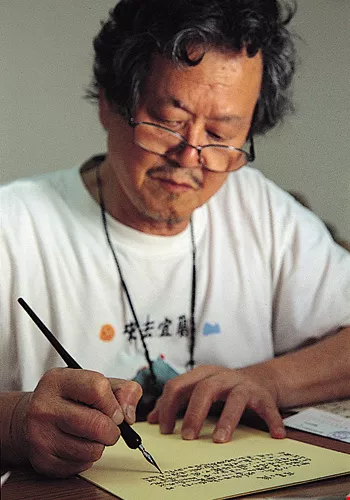
Throughout his long career, Huang has always done his writing by hand with pen and ink.
Huang was a very confident parent. "I knew that I could teach my kids better than a school could," he says.
Kuo-chun spent his early years living near the mountains in Peitou, a place filled with the wonder of the natural world. Once, a playmate who lived nearby filled a frog's belly with water, then threw the swollen creature into the air to watch it fall to its death.
When Huang heard of the matter, he wrote the young Kuo-chun a letter: "In one year, a single frog, just one lazy toad, eats enough insects to save a farmer US$50 worth of pesticides. Toads are people's friends. People's friends are your father's friends. And your father's friends are your good friends, Kuo-chun."
One evening sometime later, Huang spotted a toad basking in the glow of a streetlight after feasting on the clouds of termites brought out by an earlier rain. The toad's belly bulged with the bugs he had eaten and even the ones that landed on his head no longer interested him.
Huang decided to bring it home to dissect for his children. "Father," said Kuo-chun, "didn't you tell us that toads are our friends? Why are you going to dissect it?"
"I want you to understand their contribution," explained Huang, "so you'll take better care of them in the future."
Huang then cut the toad open, explaining the structure of its internal organs to his two sons and carefully counting the bugs in its belly. The more than 70 termites they found in its stomach taught Kuo-chun and his older brother Kuo-chen a valuable lesson--toads play an important role in the ecosystem.
When they had finished, Huang arranged the toad's corpse in a box and took his children into the mountains to bury it. He still remembers the then young and scrawny Kuo-chun telling him: "Father, I understand. The toad's death has taught me a lesson."
When he was in the third grade, Kuo-chun had an extremely strict teacher who punished misbehavior by having the class write lines--20 lines for each item on their vocabulary list. Since each lesson in their Chinese text contained 17 new words, that meant 340 lines.
Kuo-chun wrote slowly, and was often still working on his lines so late into the night that the tears began to flow. Huang went to see the teacher to talk over the problem. He explained that Kuo-chun took the writing of lines very seriously, but asked the teacher to consider the importance of sleep and requested that the boy be allowed call it a night at 10 p.m. "I guess I just don't know how to teach the kids of you authors," responded the teacher coldly.
Thereafter, the teacher gave Kuo-chun the cold shoulder and his classmates ignored him. The teacher also never acknowledged the painstaking work Kuo-chun put into his lines, the late nights spent writing in tear-stained workbooks. Instead, he just handed them off to the head of Kuo-chun's row to check. Huang is still angered by the memory.
Seeing that Kuo-chun was becoming more and more frightened of school, Huang decided to take him on a motorcycle trip. When Kuo-chun objected that they would have to wait until summer vacation, Huang told him there was no need, he would tell the school he was sick.
"How can you lie to the teacher like that?" asked the innocent Kuo-chun.
"We're going to do a good thing," replied Huang. "You can lie to people when you're doing something good. It's when you're doing something bad that you can't lie."
Setting out from Taipei, Huang and Kuo-chun took in the mountains and the sea. They watched farmers harvest their crops, and once even saw new lives enter the world when a farmer allowed them to watch a sow give birth. They visited the banana plantations on Mt. Chi, and Huang later showed Kuo-chun how Taiwanese bananas that went unsold in Japan were dumped in Kaohsiung's rivers.
Whenever they made a stop, they would pull out their map, trace where they had been and work out where they were now. Then Kuo-chun would call his mother to say hello, standing on the back of the motorcycle to reach the public phone.
As they drove, they sang into the wind, running through every song they knew. "We even sang the national anthem twice," says Huang. Reminiscing about the little details of that happy time, he recalls the warmth of Kuo-chun's hands wrapped tightly around his waist as they rode. He had so hoped to guide the boy out of his shell without scarring him.
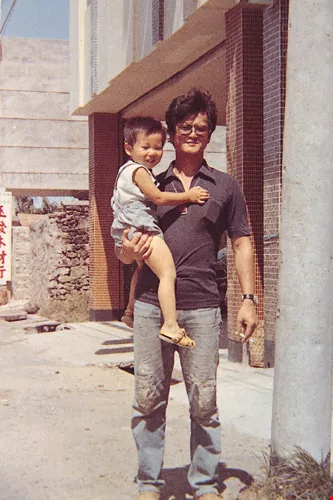
Huang carried Kuo-chun around, wrote him letters, took him on a motorcycle trip.... He was an interesting and amusing friend to his two sons.
Influenced by his father's feeling that diplomas were useless, Kuo-chun only graduated from high school. Huang didn't push him, though his mother worried that he would have difficulty finding a job without a university degree. Huang disagreed. "If that's the case," he told Kuo-chun, "I'll make you a diploma from 'Huang Chun-ming University.'"
Kuo-chun thought this was hilarious. "Who'd want your diploma," he laughed.
"When people cut themselves off from the outer world," says Huang, "they tend to develop a rich inner life." He explains that Kuo-chun had little interest in developing relationships with other people and didn't like to travel. Instead, influenced by his family's tastes, he came to know classical music and jazz inside and out.
Once, when Huang had a group of university students over to their home to talk about the fiction of Anton Chekhov, Kuo-chun, then in the 11th grade, brought tears to the eyes of one of the female students with an analysis of Imperial Russia's class system and the pathetic plight of its poorer classes.
He lived in a world quite different from that of most people, largely in solitude and possessed of interests beyond the scope of most people his age. One day he returned home in a terrible temper. "Dad," he said, "you've misled me. I've read the books on your shelves, listened to your music, and now I have not one friend."
Huang thought Kuo-chun's attack was unfair, and became angry himself: "Then just forget it all!" As close as they were, father and son both dug in their heels and didn't speak to each other for six months.
On the afternoon the impasse ended, Huang was napping in his study when his wife shook him awake. "How can you sleep when your child is crying like that," she asked.
"I'm sorry," said Kuo-chun, who had been sitting next to him sobbing quietly for some time. With the ending of their six-month-long cold war, the two became closer than ever.
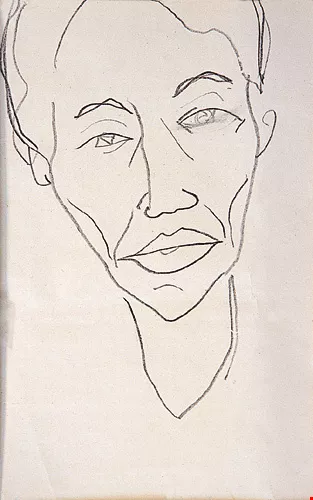
A self-taught artist, Kuo-chun drew with bold, fluid lines and created a sense of depth in his oil paintings. Huang and his wife, Lin Mei-yin, were always proud of and concerned for their son, a talented, sensitive and obstinate soul who ultimately caused them great pain.
Huang and his wife worried more than once that the sensitive Kuo-chun might kill himself. Huang visited Kuo-chun every week during his military service. Even a broken arm didn't interrupt the visits--Huang just drove to the base one-handed until it healed.
Kuo-chun made it through his time in the military largely without incident, spending only one vacation holed up in his room crying. When Kuo-chun had spent the entire afternoon with the door locked, Huang became terrified he had done something rash and broke it down.
While Kuo-chun was serving as a squad leader among the guards at a Taoyuan airbase, he knew a soldier who often seemed a little out of it. For several nights running, this soldier hid in a corner by himself after he finished his watch. On one of these nights, he was beaten and kicked by other soldiers. Soon after, he requested leave to return home and killed himself in a hotel room. An investigation revealed that the soldier's father had died, his mother had terminal cancer, his older brother was in jail, and his younger sister had run away with a man. Kuo-chun was grieved at the suicide of someone his own age and angered that he had no power to rewrite the tragedy.
"He wept because he was in great pain," says Huang, who later named the protagonist of his children's play Little Hunchback Chin-tou after the soldier.
Huang is infuriated by people who try to judge suicide from a rational standpoint, people who say things like, "You really don't need to kill yourself."
"That's because you have no conception of the suicide's sense of desperation," he says.
In spite of the pain Kuo-chun's suicide has caused them, neither Huang nor his wife blame him for his decision. "The pain he felt at that time was far greater than what we feel," he explains.
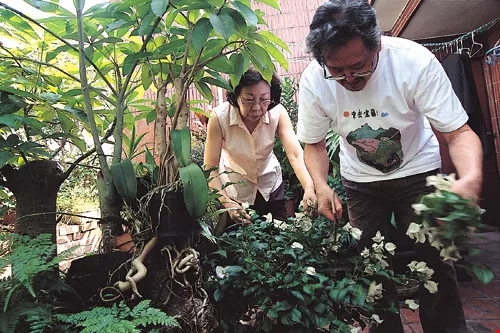
Huang and his wife work together among the flowers and plants that grow on the roof of their home. Even when they nag each other a little, you can still sense their concern and love for one another.
Six months before he killed himself, the reclusive Kuo-chun suddenly announced he wanted to take a trip to Hualien alone. "OK. Be careful," his parents replied blandly, keeping their joy to themselves.
"That was the first time in his life that he'd taken the initiative about a trip," recalls his mother, Lin Mei-yin. "It was also the only time." Their joy didn't last long.
It turned out that Kuo-chun was traveling to Hualien to visit an author, the first woman to stir romantic feelings in him. He even dyed his hair for the trip. It seemed that the always introverted Kuo-chun had finally become interested in something outside himself. Who could have known that he would be unable to get over a romantic disappointment?
"He made a decision to sacrifice his life to this love," says Huang, speaking at Kuo-chun's memorial service. "That's outside the scope of our ordinary values. How could you ask him to follow our rules?"
For a year after Kuo-chun's death, Huang felt like his son was still in the house. If Huang was downstairs, he had the sense that Kuo-chun was upstairs in the study; when he went upstairs himself, it seemed as if Kuo-chun had heard his familiar tread and had slipped off just ahead of him.
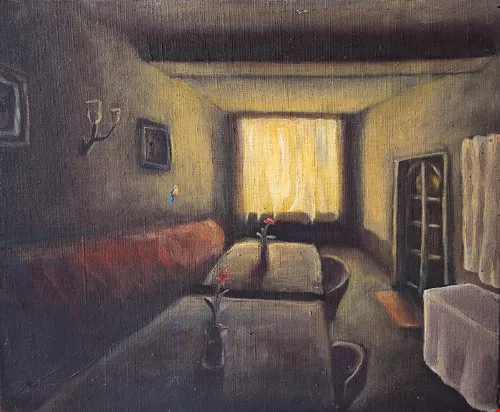
A self-taught artist, Kuo-chun drew with bold, fluid lines and created a sense of depth in his oil paintings. Huang and his wife, Lin Mei-yin, were always proud of and concerned for their son, a talented, sensitive and obstinate soul who ultimately caused them great pain.
Kuo-chun's mother, meanwhile, completely fell apart. This child she had carried inside her for nine months had hanged himself, and she had had to cut him down with her own hands. She was unable to work, couldn't eat or drink, and cried all day. For more than three years, she has been unable to bear being alone in the house where her youngest son killed himself. Now, when Huang is away, she stays at her oldest son's home.
After the suicide, the members of Huang's Big Fish Children's Theater Troupe worried that their leader would give up the theater. They knew how sensitive he was--he cried with his actors at nearly every performance.
"But," says the group's director, Tu Shu-chen, "Huang kept writing fiction and plays, and threw himself into life with even more vigor."
Huang even kept an appointment at the Presidential Palace the week of Kuo-chun's death, speaking there on mother-tongue education in Taiwan while his family was still grieving.
Since Kuo-chun's death, the Huang family has given up hosting happy gatherings. Instead, most of Huang's old friends have been choosing to get together with him at places other than his home. When they speak to him, their voices are soft, slow and a little stiff. As author Yu Tien-tsung put it: "When the meal was finally over, all I felt was the tedium. Everyone was scrupulously avoiding something, as if they were afraid to touch on certain things."
Over the past three years, Huang has been very active with the people with whom he is promoting children's theater, none of whom has ever seen him break down or lose control. Only subtle clues reveal how much this father misses his son.
According to Huang's "grandma" of the last dozen or so years, Lee Hsing-chuen, when the theater group went down to Hualien to perform the year after Kuo-chun's death, Huang distracted himself by taking a few members of the troupe with him to Carp Lake. There they noticed a difference in his mood, and had the sense that he was searching for something. Later, they learned that he had with him a picture Kuo-chun had taken during his trip to Hualien before his suicide. Huang had been using the indistinct background of the photo as a reference as he paced the lake's shore, trying to discern what his son had been thinking at the time he shot the picture.
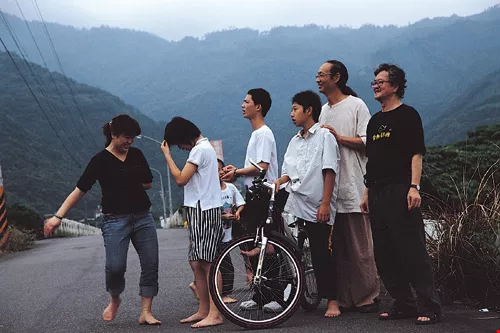
In recent years, Huang has thrown himself into writing and directing children's theater. The members of his Big Fish Theater Troupe are like a big family and Huang their much-loved grandpa.
But keeping busy with work hasn't stopped him from missing Kuo-chun. Six months ago, the Big Fish troupe revived Little Hunchback. When Chin-tou, the much-abused little hunchback who is the play's protagonist, dies near the story's end, his friend exclaims, "Chin-tou has returned to Hunchback Village. He won't ever be back!" But during this performance Huang misheard the line as, "Kuo-chun has passed away. He won't ever be back!" He nearly broke down.
The citizens of Ilan have long admired Huang's work. Seeking to do something for him following his son's death, they decided to help him realize a long-held dream--the founding of a literary journal. Pooling many small donations, they established the Big Fish Foundation for just this purpose.
The journal, called Jiu Wan Shiba Guai, published its first issue around the time that the Taipei-Ilan Expressway opened and now has about 2,000 subscribers. Huang's dedication to the journal and the theater troupe bring him back to Ilan every week, by train if he's too ill to drive. And he's often been known to stay late into the night touching up articles and working on the journal's cover.
"Modern people are always stimulated, but never moved," he argues, explaining why he is pouring his time into children's plays and a literary journal. "I want to stir the most basic emotions in everyone's heart."
For our last interview session, we met at Huang's Taipei home, where Kuo-chun's mother showed us photos from his childhood and some of the things he had made. Each time emotion welled visibly in Huang, he made an excuse to step out for a moment, escaping into another room before his grief grew any worse: "Let me cut up a persimmon for you. They're very sweet." "See, this is one of Kuo-chun's sketches. Isn't it good?"
When Huang was out of the room, Lin told us, "That's how he is; he just can't face it." In the three years since his son's death, Huang has broken down and cried at home only twice. He couldn't even bring himself to visit Kuo-chun's grave on the first two anniversaries of his death. He didn't make his first visit to the tomb until his old friend Yu Tien-tsung's wife died this year and was laid to rest near Kuo-chun.
One of the biggest changes Kuo-chun's death has wrought in Huang's life has been in his willingness to take care of his health, that is, he's taking better care of himself in order to better care for his wife. For her part, Lin has been slowly getting back on her feet with the help of religion and now worries most about all the feelings Huang has repressed.
The sorrow of parents who lose a child knows no bounds. Three years after his son's death, Huang hasn't surrendered to his grief, turned to religion or sought counseling. He says he doesn't want to forget any of the pain and doesn't like family and friends' constant offers of consolation, which he feels have caused his wife to wallow in self-pity. Instead, he's taken a different approach to facing his pain: "If you are a parent," he argues, "you have no right to kill yourself. You have to be brave and live on!"
The Huang Chun-ming FilesLife
Born in Luotung, Ilan County, in 1935. His mother died when he was eight, leaving five children. Graduated from Pingtung Normal College in 1958.
Has worked as an elementary school teacher, an electrician's apprentice, a radio operator in the military, an editor for a radio station, a documentary film maker, an ad man, and a manager with Adidas. His wife is Lin Mei-yin, and they have had two sons, Kuo-chen and Kuo-chun.
Literature
Published his first story, "Ching Tao-fu's Son," in 1956. Published his first collection of stories, The Son's Big Doll, in 1969. It was followed by The Gong, Sayonara, Goodbye, The Young Widow and I Love Mary. He won the Wu San-lien Award for Literature and the Arts in 1980. Since 1990, he has published Waiting for the Name of a Flower and the literary comic Wang Shanshou and Niu Jin.
In 1998, he published his long-awaited "senior citizens series" of short stories, which included "Dead and Alive," "Spring on Gray Whiskers" and "Here Comes the Ghost-Eater," in a collected edition entitled Setting Them Free for which he won the National Cultural and Arts Foundation's second annual literary award. He was also recognized as the most representative of Taiwan's contemporary Nativist authors.
In 2006, he began publishing the literary journal Jiu Wan Shiba Guai.
Television and film
In 1973, he filmed the documentary Fragrant Island about Taiwan, ushering in a new era in Taiwanese documentary filmmaking and literary reportage in the literary supplements to Taiwan's newspapers.
In the 1980s, a number of his short stories were turned into films, including "The Son's Big Doll," "Xiaoqi's Cap," "The Taste of Apples," "Sayonara, Goodbye," "A Flower in the Rainy Night" and "I Love Mary."
Theater
In recent years, Huang has focused on children's literature and children's theater. In 1993, he published "Huang Chun-ming's Fairy Tales" in five volumes--Little Sparrow, Scarecrow, The Emperor Who Loved Sugar, The Short-Nosed Elephant, Little Hunchback, and I'm a Cat.
In 1994, he founded the Big Fish Theater Group, which has produced The Earth Dragon Loves Cake, The Scarecrow and the Sparrow, Hanging a Bell, Little Hunchback and Little Lee's No Big Liar.
In 2003, he wrote and directed children's plays and Taiwanese operas. His writing and direction of Taiwanese Opera versions of Du Zichun and The Emperor Who Loved Sugar demonstrated his commitment to updating the art form.

@List.jpg?w=522&h=410&mode=crop&format=webp&quality=80)


