Keeper of the Treasury--NPM Conservator Yang Yuan-chyuan
Kuo Li-chuan / photos Chuang Kung-ju / tr. by David Mayer
January 2009


What kind of job would make you as lonely as the man in the moon, yet allow you to spend your days in the company of national treasures? What job would afford the opportunity to spend your time contemplating the beauty of Shang-Dynasty bronze bells and tripods or the original calligraphy of Yan Zhenqing or Liu Gongquan, and then to delicately touch up the blemishes that have accumulated over the centuries, so that these treasures look once again just like they did the day they were first crafted so long ago?
This job does exist, and is held by conservator Yang Yuan-chyuan, who has toiled away, heroically if little noticed, at the National Palace Museum in Taipei for many years now. But his story is well worth our notice.
The news media in early 2007 reported that about a half-centimeter had broken off the left antenna of the katydid (symbol of a big family and many descendants) on the National Palace Museum's famed Jadeite Cabbage, a premier attraction at the museum. The "old injury" had long been an open secret, but many in the general public were shocked at the news. All of a sudden, everyone wanted to know if the broken antenna would be repaired.

Conserving ancient artifacts is a lonely task, but it does afford the opportunity to spend one's days with great national treasures and commune across the years with the great artists of past centuries. For Yang Yuan-chyuan, director of the Conservation Section at the National Palace Museum, 40 happy years of conservation work have gone by in a flash.
Conservation over restoration
According to Yang Yuan-chyuan, head of the museum's Conservation Section, it wouldn't be a problem for the National Palace Museum (NPM) to restore the Jadeite Cabbage to its original condition, and he notes that the museum in years past was often quite aggressive in attempts to do just that. More recently, however, the NPM has adopted newer concepts originating in the West, opting whenever possible for simple cleaning and conservation of damaged objects, so long as the damage does not affect the piece's structure or its overall aesthetic appearance. Some museums these days even undo restorations of the past for the sake of a clean appearance.
"The conservation approach to art objects is based on the idea that 'prevention is better than restoration.'" It is about keeping things in their current condition and not letting them get any worse, says Yang, who explains that damage and breakage are actually regarded as part of the art object. They are an important element of the art and the historic reality of each piece.
Asks Yang, "Don't a lot of the stone sculptures on display in Western museums have missing parts?" He feels that replacing missing parts and reapplying colors keeps museum visitors from seeing the actual work of art and often inflicts permanent damage, so it's often better to do nothing at all. For example, the NPM has a famous ceremonial bronze that dates back well over 2,000 years to the Western Zhou Dynasty. It has serious damage from corrosion, but the museum will not take any special steps unless the damage starts getting worse. This is an example of the "less is better" approach. Tinker with things a bit less, but love them the more for their weathered antiquity.

An artifact sent in for conservation work is first given a visual inspection with the naked eye and then with a loupe before X-ray photos are taken. Moreover, objects needing to be moved are placed in a transport truck specially fitted out with thick protective padding to prevent damage.
The exodus
As the fourth largest museum in the world, the NPM itself is no stranger to historical adversity. The museum was established in Beijing after the last Qing emperor Puyi left the Forbidden City in 1925, but a few years later the Japanese invaded China, prompting the Nationalist government to pack up the museum's collection and ship it south, first to Shanghai, then on to Nanjing, Changsha, Guiyang, and Sichuan. When the Nationalist government retreated to Taiwan in 1949, the palace treasures were once again whisked in a perilous journey aboard a naval ship and stored in Wufeng Township, Taichung County, where the provincial government was located. There they stayed until 1965, when they were transferred to their current home in the Waishuanghsi area of Taipei City.
The journey traversed thousands of kilometers, during which the items in the collection could only be conserved using the old methods. Museum curators in those days seldom had a background in the modern sciences, and were thus little on guard for damage not visible to the naked eye. This proved disastrous in hot and humid Taiwan, where insects thrive. To study methods used in the West, the NPM formally established a preservation office in 1969. Yang was the first specialist that the museum ever dispatched overseas.
Yang will retire in 2009 after a distinguished 40-year career that began upon graduation from Chung Yuan Christian College of Science and Engineering. His whole working life has been spent caring for the treasures of the National Palace Museum. Yang explains that all items in the collection fall into three main categories: vessels, calligraphy and paintings, and paper artifacts. In the museum's early years, there was a different department to care for the items in each of the three categories. Paintings and paper artifacts, in particular, were never moved around because they were often in very fragile condition. Today, however, the three departments have been merged together, and Yang's department has expanded to 12 people, bringing it nearly up to par with staff sizes at similar departments overseas.

This X-ray photo shows clearly that the horse's back leg was once broken, then repaired and reinforced with a copper rod.
Teamwork turns the trick
Art objects age at different rates, depending on what they are made of.
Decay is usually quickest with paper artifacts (the paper can easily become desiccated and brittle, or suffer insect damage), bronzes (easily corroded), cloisonne (contains thin bronze bands), and objects made of bamboo, wood, ivory, bone, fabric, or other organic materials. Generally speaking, objects made of inorganic materials (such as hard jade or stone) are less susceptible to degradation, as are ceramics fired at temperatures of around 1,250oC.
The causes of degradation fall into three categories: chemical, physical, and biological. When an object is sent in for conservation, a conservation team is put together that has expertise in these three areas plus art. The chemistry and physical science experts test samples to determine the exact makeup of the material, and analyze the structural and chemical causes of the degradation to determine the best way to treat the object. Corroded bronze, for example, is not treated in the same way as rusted iron. The expert in biological sciences inspects to see what sort of insects or fungi may be eating away at the piece, while the artist may look at the history of the piece and provide his or her findings to the person doing the actual conservation work.

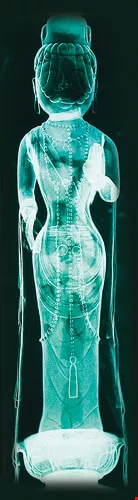
X-ray analysis shows differences in the techniques used during different dynasties. For example, there is an internal vessel within this vase, which is quite a rarity.
Science in service of art
"We're like a hospital where the 'patients' are art objects rather than people," says Yang, who leads me into the preservation office. Displayed on the walls there are reminders of how to conserve different objects, depending on the material they are made of. Ordinary objects must be kept at a temperature of 20-22oC and relative humidity of 55-60%, with lighting at 50 lux (5 candlepower). Bronzes require relative humidity of 40-45%, while lacquerware requires 60-65%. Objects can also be affected by the quality of indoor air, which has gotten worse in recent years, or by volatile fluids used for conservation (such as alcohol or toluene), so conservation experts are beginning to pay much closer attention to controlling indoor air quality.
Objects needing conservation are placed in carefully constructed boxes or crates for protection and taken to the Conservation Section. The section has its own transport truck with a carrying rack akin to the gurney found on ambulances. And just like the ambulance gurney, anything that enters or leaves the premises does so on the rack. Under no circumstances does anyone carry an object around in their bare hands.
After an object is taken into the "hospital," the procedures are much like those of a hospital. First they examine a history chart that identifies the object and indicates what work has been done on it in the past. And the history chart is so important that it, too, is stored at constant temperature and humidity. And it is strictly forbidden to staple or glue the chart or do anything else that would damage the paper.

You may be surprised to learn that a spray of warm water is used to clean the surface of ancient paintings. It does no damage at all, and special chemicals can even be used to eliminate fungus spots.
Prepping the "patient"
In the "clinical examination," while the object is still on the work table, the conservation team talks with the curator in charge about the need for conservation and the location of the damage. It then makes a visual inspection, logs the object in, measures "height and weight," and sends it to the photo room. There it is carefully photographed from the side at 90o rotations, then from the top and bottom, with additional photos taken of the damaged part.
A more rigorous inspection follows, first with the naked eye, then using a loupe. Where the object is damaged, a 20x microscope is used to project an image of the damaged location onto a screen. "At this point all you can see is the surface. To better understand the situation beneath the surface, you have to use X-ray photography." Yang is a licensed X-ray technician.
X-ray photography lays bare the inner secrets of thousand-year-old artifacts, including how they were produced, and different work processes. Without damaging the object, it reveals whether a bronze has any air pockets, and if the makers went back and re-poured the mold to fill in places where the molten bronze may not have reached on the first pour. It also shows if the internal structure has been damaged, and if there have ever been any "uninvited guests" (such as burrowing insects). Signs of any previous repair work are also apparent in an X-ray image. It even yields relatively clear images of engraved inscriptions that have gone fuzzy from corrosion.
Yang mentions a piece of porcelain that appeared flawless on the surface, while an X-ray photo revealed a dark patch (the brightness of X-ray images varies depending on the material) in the upper half, a sign that the piece had undergone a major repair in the past. Whoever repaired it managed to cover his tracks quite skillfully. An ultraviolet light can also be used to uncover such secrets.
Many outside the profession ask whether these imaging techniques do not themselves damage the objects being examined. Yang responds that the top priority is to be non-destructive and non-invasive, and X-ray photography and ultraviolet light provide an indispensable "third eye," much like the CAT scans that surgeons would find it hard to do without.
Conservation techniques are actually in a continual state of evolution. When the NPM and National Tsing Hua University in 1976 jointly formulated a Chinese Cultural Artifact Research Project, they chose to use the highly flexible neutron activation system to do a systematic analysis and study of bronzes and porcelains. In more recent years, as technology has continued to advance, they have switched to the "X-ray fluorescence" (XRF) technique to carry out qualitative analysis of the physical composition of cultural artifacts.
X-ray machines and other modern scientific equipment play a big role in the conservation of ancient artifacts.
Conservation processes
Artifact conservation is demanding work. A conservator must have aesthetic sensibility and artistic skills to match those of the original artist. He must be intimately familiar with all kinds of repair materials and how to prepare them. And more importantly, ancient artifacts are just like people: each one is unique, so the conservator has to approach each one accordingly. How should this piece be conserved? How far should I go with repair? These judgments require experience and intuition, and lie at the very heart of conservation work.
To ensure quality, all NPM conservation work is done in-house. The conservators must go through extended on-the-job training, and are sent to Japan and Britain to take courses. They practice their craft on everyday items, and before embarking on a conservation job they always test the object first and do little "dry runs" to make sure no problems will crop up. Only then does the actual conservation work begin.
One of the simplest jobs a conservator handles is cleaning the surface of wood, for example, but even here, he can choose to clean it with any of eight different kinds of cleaner, including water, alcohol, olive soap, and even spit. Which is the most appropriate? How long do you leave the cleaning agent on the surface of the wood to clean it without damaging it? It takes a lot of experience to answer such questions.
Conservation work is guided by a number of basic principles. Apart from the "less is better" approach mentioned above, the most important principle is that the materials and methods used in conservation must be reversible. It should be possible to remove or undo, with damaging the object, anything that was previously applied or done. For example, you don't weld bronzes or stick tape to paper.
As Yang walks me through his world, one built on hard work and diligent study, I begin to better appreciate just how much there is to know in his complex specialty.
(1) Conservation of bronzes
Bronze vessels require care on a regular basis. Most ancient bronzes still surviving from the Shang and Zhou dynasties spent two to three thousand years buried underground before their discovery. Some will have spent the millennia in direct contact with the earth and underground moisture, while others were enclosed in dark, dank tombs. It would be unusual for such bronzes to emerge unblemished.
Most such blemishes are harmless, and collectors prize certain kinds of discoloration. Moreover, verdigris formed by corrosion seals the metal below away from the air, thus acting as a protective layer that prevents corrosion from creeping deeper into the metal. The only destructive type of corrosion occurs when chlorides react with the metal to form cuprous chloride.
Yang stresses: "Cuprous chloride absorbs oxygen and moisture from the air and produces cupric chloride, a powdery substance that will just keep on eating away at the bronze unless you put a stop to it. We call it bronze disease." When the bronze is placed in a sealed case at a relative humidity of 45% or lower, the problem will not get any worse.
Yang points out that there are different ways to treat bronze disease. Some are very time consuming, some are expensive, some eliminate the discoloration but leave the bronze pitted, and some leave the bronze discolored, so each bronze piece must be considered on its own merits.
Yang most often employs the "BTA" method. He first uses a small probe, scraper, and brush to clear away the loose cupric chloride powder, then uses an organic solvent mixed with acetone and toluene to wash away any oils adhering to the surface of the bronze, and next soaks the bronze piece in a mixture of benzotriazole (BTA) and alcohol for about 14 hours. The resulting chemical reactions produce a stable protective film. After that, he dries the piece in a vacuum chamber. This method turns the bronze a bit darker and causes it to lose a bit of its luster, but does an outstanding job of conserving the metal.
(2) Conservation of porcelains
Fragile porcelain is the type of artifact most often in need of repair. Before repair, it must be cleaned. If the piece has previously been repaired using superglue, the surface of the break must first be treated with a cotton swab soaked in hydrogen peroxide to soften the old glue. Dirt and grime are removed by brushing lightly with acetone or alcohol, then the piece is soaked in water. After the old glue has been removed, the piece must be dried in a ventilated or heated chamber.
Next, it's time to put the "jigsaw puzzle" back together based on the decorative pattern, thickness of the pieces, and other clues. The larger shards are pieced together first, then the small slivers are painstakingly fitted in. To check whether a shard has been properly fitted, a light is shone on the piece from behind; if no light gets through, a proper fit is confirmed. After the whole thing is fitted together, it is time to apply glue.
When a porcelain piece is reinforced, glued, and restored to its original color, the choice of chemicals, filler, and pigment will all have a huge impact on the quality of the conservation work. In the old days they used plaster, or perhaps lime and egg whites. More recently, however, isinglass and B72 have generally been the adhesives of choice. No matter what kind of adhesive method is used, the most important thing is to avoid damaging the artifact; quality of conservation is secondary.
Recreating the coloring of the glaze is the most important aspect of the conservation process, and the most difficult. The piece must be restored to its original color, and the color has got to be convincing. It's not a job well done unless it is impossible to tell the difference with the naked eye. If the glaze layer is relatively thin, it is enough just to apply some color to the surface, but if the glaze layer is thick then a bit of re-glazing is in order. Glazes from different dynasties are different in color, moreover, so you will show yourself up as an amateur if you use a Ming color on a piece from the Song Dynasty.
According to Yang, the NPM often uses non-water-soluble pigments, mixing in an appropriate amount of binding agent (similar to paint baking colors), then using a small spray gun to spray an even coat onto the porcelain. Afterwards, the piece is baked for two hours in a heated chamber. After that, the technician dips a calligraphy brush into binding agent and pigment and carefully paints on the appropriate pattern. It may not sound too difficult, but the conservator must have a fine aesthetic sense and well honed technique, otherwise the decorative elements will retain none of the charm of the original.
(3) Conservation of lacquerware
Lacquerware is one of the most unique classes of items in the NPM collection. Lacquer itself is a liquid that must be brushed onto a solid material before its beauty becomes evident. The solid material to which it is applied is called a "base" and may be made of wood, bamboo, cloth, copper, or paper.
Lacquer does an outstanding job of protecting the base beneath. It is extremely adhesive, and thus does not fall away easily. It is resistant to acids, alkalis, and bacteria, and thus highly impervious to degradation. There is an old saying that you can "bury a single drop of lacquer in the soil, and it will not break down in a thousand years." As long as lacquerware is not exposed to big changes in sunlight or temperature and humidity, which would cause the underlying wood or bamboo base to expand and contract, it will usually remain in good condition for a very long time.
Ancient lacquerware generally gets dirty over the years, and needs to be cleaned, but water is absolutely the last thing to do the cleaning with. Lacquer is waterproof, to be sure, but a very old piece usually has cracks in it.
"If water gets through the cracks and underneath the lacquer, it will break down the undercoat, which would damage the base through expansion and warping, no matter what it is made of."
Yang takes out a feather duster and a wool brush, the best tools for cleaning lacquerware.
(4) Conservation of paper
Chinese painting and calligraphy from the Han and subsequent dynasties were most often executed on silk paper, but by the Song Dynasty cotton paper had become the medium of choice. The biggest shortcoming of cotton paper is that it grows brittle with age, and is thin and prone to wrinkling. Silk paper, too, is very apt to wrinkle if there is uneven tension on the warp and weft threads. Everything in the NPM collection is on cotton paper, which ages with time. The protective silk borders and backs are also easily damaged, and a scroll that is frequently rolled and unrolled, or hung on a wall, is susceptible to cracking and creasing.
Lai Qingzhong, who has worked in paper artifact conservation at the NPM for almost 30 years, points out that paper and silk are quite delicate. They are easily damaged by changes in temperature and humidity, and therefore require painstaking care and regular attention. If there is a crease mark, for example, it must be supported from the reverse side. If the head on the end of the scroll spindle has fallen off or broken, it has to be fixed. If there is insect damage, the holes must be filled.
Because cotton paper is light and thin, it is supported on the reverse by lining paper to afford greater toughness and make the painting lay more evenly. Then silk backing and borders are added. Even with all these protective measures, however, the backing and borders must be removed once every 100 years and remounted. But if the lining paper is dyed a special color, then care must be taken not to touch it, because removing it would change the look of the painting. The backing must be removed with extreme caution, one small piece at a time, beginning in the center and working toward the borders. Traditional methods are then used to dry the painting in a dark place, after which a new backing is applied with a specially prepared paste.

The porcelain dish on the right looks flawless to the naked eye, but an ultraviolet light (left) reveals that the upper part of the dish has actually been repaired in the past.
Looking for new torchbearers
Because conservation work is so time consuming, it is necessary to start working a year in advance to conserve and clean items scheduled to go on display the following year. With some 650,000 items in the NPM's vast collection, the conservators unavoidably find themselves racing against time. But they must keep detailed records showing when, where, and what they've done, what they've added or removed, what kind of materials they've used....
Apart from the conservation of national treasures, one of the most awkward situations that Yang and his co-workers face is frequent requests from people outside the museum (including friends, relatives, and even elected officials) to determine the authenticity or age of an artifact, or to repair it for them. The NPM has therefore adopted a rule that it will not date artifacts or repair anything outside the museum's own collection, but they can provide pointers to persons interested in conserving or cleaning artifacts themselves.
As he approaches retirement, Yang is especially concerned about the training of a new generation of conservators. Taiwan passed the Cultural Heritage Conservation Act in 1984, but so far only Tainan National College of the Arts has established a Graduate Institute of Conservation of Cultural Relics. The conservation of cultural artifacts attracts very little interest, so it is hard to find people to enter the field.
In addition to patience, perseverance, and a fine eye for detail, the conservation of ancient artifacts also requires the reasoning mind of a scientist, the sensitivity of an artist, and most importantly, the ability to endure loneliness.
In Yang's apt description, the work is like being in a long, deserted alley in the middle of the night with nothing for company but an old artifact that never speaks or smiles. That sort of loneliness is only familiar to cloistered monks deep in the mountains. But the joy of dealing daily with national treasures, communing across the years with the great artists of past centuries, and ensuring that what the ancients toiled to create will still live on in the world, is also something that they alone can know.

The porcelain dish on the right looks flawless to the naked eye, but an ultraviolet light (left) reveals that the upper part of the dish has actually been repaired in the past.
.jpg?w=1080&mode=crop&format=webp&quality=80)
This painting of Cai Zhi the Immortal is said to date from the Song Dynasty, but unfortunately the artist is not known. It is shown here before restoration (left) and after.

An artifact sent in for conservation work is first given a visual inspection with the naked eye and then with a loupe before X-ray photos are taken. Moreover, objects needing to be moved are placed in a transport truck specially fitted out with thick protective padding to prevent damage.

An artifact sent in for conservation work is first given a visual inspection with the naked eye and then with a loupe before X-ray photos are taken. Moreover, objects needing to be moved are placed in a transport truck specially fitted out with thick protective padding to prevent damage.

This painting of Cai Zhi the Immortal is said to date from the Song Dynasty, but unfortunately the artist is not known. It is shown here before restoration (left) and after.


