Showing off Pao-an Temple to the United Nations--Liao Wu-chih, Temple Keeper Extraordinaire
Tsai Wen-ting / photos Chuang Kung-ju / tr. by Julius Tsai
September 2004


In recent years, the Council for Cul- tural Affairs has been actively promoting Taiwanese sites for consideration as United Nations World Heritage Sites. However, as Taiwan is not currently a UN member, such efforts remain at the preparatory level.
Last year, after seven years and a NT$260 million restoration effort, Taipei's Pao-an Temple, under its status as a non-governmental organization, was awarded the United Nations Educational, Scientific and Cultural Organization's 2003 Asia-Pacific Heritage Award for Cultural Heritage Conservation. With this award, Pao-an Temple became the first historical site in Taiwan to be recognized by the UN, an event that caused a great stir in Taiwan's cultural world.
The moving force behind all of this activity has been the current president of Pao-an Temple, Liao Wu-chih. Indeed, Liao has tended to the restoration of the temple with the patient, attentive strokes of an artist.
On the morning of July 5, the 60-year-old Liao Wu-chih was elected to the presidency of Pao-an Temple by its board. With three sticks of fragrant incense in hand, Liao stood gazing silently at the icon of Emperor Pao-sheng. No words were needed, for over the past 20-some years, Liao had effected the reorganization and restoration of Pao-an Temple under the watchful gaze of this deity.
Traditional temple keepers have been content to sit idly by, napping next to the donation box. Alternately, the post has often been filled by gangsters in dark glasses, or by political figures. In contrast to these types of temple keeper, Liao came from the background of an artist with a passion for oil painting.
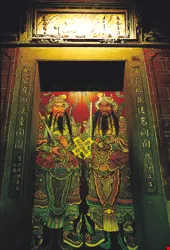
Liao Wu-chih not only provided local artisans a setting in which to fully display their artistic talents, he also preserved intact the temple's architectural style, which stems from southern Fujian. The photo shows the resplendent colors of the temple's paintings.
Artistic heyday
In fact, throughout the early part of his life, Liao had neither ties to Pao-an Temple, nor any to speak of with popular religion.
Liao Wu-chih was born in 1943, in the latter days of the Japanese occupation of Taiwan. After Taiwan was returned to ROC rule, he moved with his family to the Tataocheng area in Taipei. "Most of the artistic talent at the time congregated here," recalls Liao, counting off artists as if reviewing family treasures: there was Yang San-lang who lived next door, Chen Te-wang on Tihua Street, Hong Rui-lin on Kuisui Street, and Chang Wan-chuan on Anse Street. Chang, in particular, would exert a lifelong influence on Liao. All of these artists dwelt in the Tataocheng area.
After enrolling in Yenping High School, a private school, the art-loving Liao began to study painting with Chang Wan-chuan, going to his teacher's house every day after school. Liao still has lasting memories of the Japanese-educated Chang, including his European-style house and the pipe that he often held in his hand as he painted the hours away in his small attic. It was at this time that Liao began to aspire after the life of an artist.
Through his teacher, Liao came to know many idealistic artists of high personal character. From them, he learned to be upright and never stoop to flattery.
After graduating from high school, Liao was admitted to the Taipei National University of the Arts, but because of his youthful rebelliousness and his artist's romantic flair, he felt that what he was learning was too limited and withdrew from school.
In 1974, Liao's father died suddenly, and he returned home to continue the occupation that his father had pursued, serving as a notary public. But no matter how busy he was at work, he never gave up painting, even moving his studio into his office. While others viewed him as simply a notary, Liao saw himself as following his true calling in artistic creation; his job as a notary was merely something that he did on the side.
Liao, intoxicated as he was with art, saw temples simply as objects for sketches or paintings. It never occurred to him that in the days to come he would end up serving as a temple keeper.
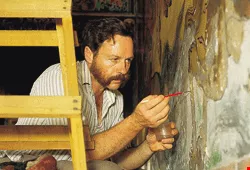
Pao-an Temple's winning the UNESCO Asia-Pacific Heritage Award for Cultural Heritage Conservation was no lucky accident, but the result of its efforts to uphold traditional craftsmanship while integrating modern technology, and the complex scope of its restoration. The photo shows an Australian mural preservation specialist painstakingly cleaning the artwork.
Where is Pao-an Temple?
In 1979, Pao-an Temple assumed the status of a corporate entity, and because one of the board members had been a good friend of his father's, Liao agreed to serve as a titular board member for two terms over eight years. "That was the first time I had ever stepped into Pao-an Temple. I even had to ask around to find out where it was," recalls Liao, smiling at the memory of life's serendipity.
In 1988, Liao assumed the role of director of general affairs for the temple. As a diligent person no matter what he put his hand to, he worked to turn an empty building on the temple's premises into a library. He started up art classes, pulling in his students and friends to serve as volunteer teachers. From an initial four classes, the temple now boasts 32 art classes, and has even become a community college for the Talungtung area.
When his four years as director of general affairs were up, Liao went on to assume the role of chief executive. Acting resolutely, he then began reforming many of the antiquated rules that the temple operated by.
First, Liao tackled the work ethic of temple employees. He set his sights on problem employees, such as those who would clock in but then disappear for the day, those who enriched themselves from supposed "fundraising" for the temple, and those who had access to the donation box but whose transactions could never be reconciled with the books. Liao relentlessly terminated the contracts of employees who created problems or engaged in illegal activity.
Liao's efforts in opening up the temple's finances to public scrutiny interfered with certain people's channels for financial gain, as well as destroying many a personal relationship. Naturally, his actions were very controversial, and caused discontent among some of the old-timers at the temple. Liao says with a grimace, "I think that I could fill two tour buses with all the people that I've offended."
Twice, Liao stormed off the job due to tempestuous opposition. On the second occasion, as he wrestled with whether to stay or to go, Master Sheng-yen of Dharma Drum Mountain-where Liao had taken Buddhist vows-said to him, "Whenever we encounter difficulties in our work, we must recognize that they result from accumulated karma, and we must bravely face up to them." Even though Liao, who was by nature quite obstinate when it came to religious matters, is unwilling to speak any further about this event, when he returned to Pao-an Temple he made up his mind that he would devote the rest of his life to Emperor Pao-sheng. "Everything had been mysteriously pre-ordained," he says.
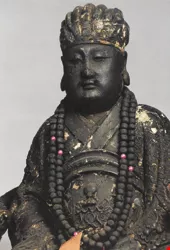
Liao Wu-chih, born on the sixth day of the sixth lunar month, the traditional day of the "Opening of the Gates of Hell," also bears a resmeblance to Emperor Pao-sheng himself. This has caused many to exclaim that all these things were long ago destined to be....
Learning the hard way
Pao-an Temple, an aging structure classified as a Grade Two Historic Site by the government, had been severely damaged by termite infestations in its roof and beams. The roof leaked, and the figures in jiannian-a traditional mosaic-like art form using shards of colored porcelain-along the ridge of the roof, had seriously deteriorated. Inside the temple, long-term exposure to incense smoke, poor ventilation, and moisture had caused the wall paintings along its corridors to peel away. Also, additions at various times since the end of Japanese rule, such as the spirit money furnace, water tower and artificial hills and pools, had disrupted the temple's original design and structure. As a result, Liao launched a massive restoration project in the second year after taking over as chief executive.
According to the Cultural Heritage Preservation Law, the restoration of historic sites requires a survey, the submission of a design, an initial cost estimate, and open bidding among contractors to qualify for government funds.
However, pre-restoration surveys of a site may differ dramatically from what is actually revealed when the structure is dismantled, and a proposed restoration may undergo numerous redesigns and be subject to continually increasing costs. In addition, public funds inevitably carry with them many restrictions in terms of time and budget. As a result, Pao-an Temple opted to raise its own funds to pay for the restoration.
At first, Pao-an Temple adopted the usual model for the restoration of historic structures in Taiwan: they contracted out the entire planning and supervision of the work to an architect. However, even at the preparatory stage, numerous difficulties were encountered.
In order to locate the China fir that the temple had originally been built with, Liao took six trips to China with the construction firm to mountainous areas of Fujian Province. After deplaning, they traveled by train and then by jeep over the bumpy roads into the old growth forests of China fir.
They obtained the necessary permits for cutting down and exporting the timber that they needed, only to discover when it arrived in Taiwan that over half of the shipment consisted of surreptitiously slipped-in, nursery-grown wood. Not only that, the timber had not been treated with sealant, and much of it had cracked by the time it arrived. In the end, plans to use this wood were abandoned and Taiwanese cypress was substituted in. The temple had wasted a year in these efforts, and the timber budget had soared from the original estimate of NT$20 million to NT$60-70 million.
In 1996, after that initial experience of failure, Liao, who at that time was the vice president of the temple, took up the weighty responsibility for the temple's restoration. He invited as a consultant a specialist in historic restoration and reconstituted the team. Liao went back to the traditional way that temples had been built, that is, where owner and artisans worked together. The owner would have complete control over the quality and progress of the work and would supply the materials, hiring artisans on a case-by-case basis depending on whether the project called for woodwork on a large scale, finely-scaled wood carving, work on the drainage for the tiled roofs and walls, work on the stone carvings, or color painting.
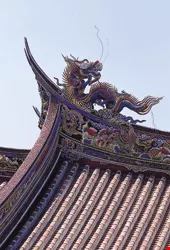
Liao Wu-chih not only provided local artisans a setting in which to fully display their artistic talents, he also preserved intact the temple's architectural style, which stems from southern Fujian. The photo shows the rooftop jiannian artwork
Smashing 60,000 bowls
The Pao-an Temple restoration proceeded in the spirit of the criteria for United Nations World Heritage Sites, with historical authenticity as its starting point. As far as possible, the site's original layout, style, materials, and construction methods were to be preserved.
The layer upon layer of jiannian art on the rooftops shows to what extent Liao insisted on original materials and workmanship, down to the last detail.
Jiannian, as mentioned, is a traditional craft in which shards from porcelain bowls are pieced together with adhesive to form the images of dragons and phoenixes, gods and immortals and all manner of flora and fauna. Most temples nowadays seek to lower their costs and reduce the amount of work involved in producing jiannian, using instead plastic or ready-made glass pieces, and cement as adhesive. However, jiannian artwork made by these methods falls apart quite easily.
In order to continue working by means of traditional crafts, Liao commissioned the construction of a lime trough, in which cotton batting and lime were mixed in water and left for more than 50 days to season the lime. This was meant to strengthen the adhesive properties of the mixture. However, they discovered too late that the lime trough had sprung a leak, ruining the seasoning process and allowing the lime to harden. All they could do was start all over again.
After the second attempt at lime seasoning succeeded, Liao sought out a master craftsman, who was by then in his nineties. The craftsman made a sticky rice porridge, and to that added in seasoned lime, fresh lime, brown sugar, hemp, and oyster shell powder, continually stirring the mixture to increase its stickiness; this is similar to the way that sticky rice balls are made. This method of creating "sticky rice lime," nowadays almost a lost art, produces a substance that is exceedingly flexible and resilient enough to withstand changes in humidity as well as temperature, and is unparalleled in its adhesiveness.
After the successful production of sticky rice lime, Liao commissioned a porcelain factory to fire up its kilns to produce 60,000 porcelain bowls in 29 hues for the jiannian artisans. From the second-floor library behind the main hall of Pao-an Temple, viewers can now see jiannian divine dragons and minute plum blossoms rich in color, delicate in form, and full of vibrancy. One almost needs a magnifying glass to appreciate how fine the handicraft is.
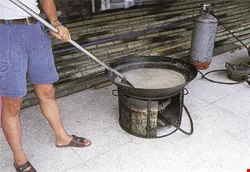
Pao-an Temple's winning the UNESCO Asia-Pacific Heritage Award for Cultural Heritage Conservation was no lucky accident, but the result of its efforts to uphold traditional craftsmanship while integrating modern technology, and the complex scope of its restoration. The photo shows the making of a thick glutenous-rice porridge as the first step in preparing "sticky rice lime".
Make-up remover for the temple
Aside from the reintroduction of traditional arts, pre-restoration Pao-an Temple had walls that had been painted over with matt emulsion paint and floors covered over with terrazzo and porcelain tiles. While these newer materials were easy to use and quick to apply, they constituted a heavy outer layer that caused the temple to lose its original, classical feel. Furthermore, these materials stifled the original wood so that the resulting build-up of humidity encouraged termite infestations.
At Liao's request, all of the cement-based render of the outer walls was removed, and after a thorough scrubbing and washing, pesticide was applied. Holes were patched with pieces of broken tile, a mixture of lime and sand was applied as a base, and then a layer made up of a mixture of brown sugar and lime was applied over it. The terrazo and tile floors of the interior and the halls were completely changed out and replaced with traditional unglazed tiles. This "make-up removal" session effectively solved the temple's humidity problems.
Among these efforts, the removal of the rain canopy over the moon terrace in front of the main temple hall was cause for great vexation on Liao's part. In the end, he found a marvelous solution to this problem.
In most temples, the open-air central courtyard is covered with a corrugated steel roof that serves as a rain covering for worshippers. However, "When you walked into Pao-an Temple, the entire roofline was blocked to view by this canopy. You couldn't see anything," says Liao.
Thereafter, when the board members traveled to "visit the divine ancestors" and burn incense at Baijiao in Fujian, China, Liao took the opportunity to subtly arrange an aesthetic appreciation tour to Hangzhou, home of China's most resplendent gardens. Fine rain was falling as they arrived at Lingyin Temple in Hangzhou, but as it fell, the faithful calmly opened up their umbrellas and continued worshipping. Liao stood to one side and asked rhetorically, "Doesn't it seem that even without a rain canopy, believers can still worship here?" Upon their return to Taiwan, the board unanimously approved the removal of the rain canopy at Pao-an Temple.
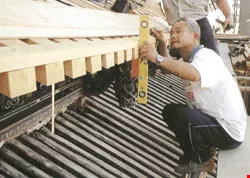
Pao-an Temple's winning the UNESCO Asia-Pacific Heritage Award for Cultural Heritage Conservation was no lucky accident, but the result of its efforts to uphold traditional craftsmanship while integrating modern technology, and the complex scope of its restoration. The photo shows a master carpenter carefully checking the roof construction with the help of a spirit level.
A complete health inspection
Aside from insisting on traditional methods, Liao also made use of modern technology to carry out the restoration. Pao-an Temple worked with the School of Forestry and Resource Conservation at National Taiwan University (NTU) to perform a detailed inspection of the state of decay of the wood in the temple, utilizing nondestructive ultrasound technology. When the flooring was redone, perforated water pipes were laid out in checkerboard fashion underneath it to serve as a preventive measure against termites. With this system in place, pesticide can now be applied every five years.
During the restoration, Liao assumed the roles of overseer, purchaser, site manager, and even architect. Each day he arrived with the workers in the morning, but even after they had gone home for the day, Liao put in additional hours making the necessary arrangements for the following day's work.
So how was it that Liao, an artist by training, was able to carry out each and every detail of this "mission impossible?" Liao laughs and replies, "Emperor Pao-sheng has worked in wondrous ways, granting me the wisdom and strength that I need." For example, while Liao was mulling over the termite problem, Tsai Ming-jer, assistant professor at the School of Forestry at NTU, happened to be at the temple with his wife, viewing the woodwork. Another time, when Liao was seeking out a surveying specialist, Wang Huey-jiun, associate professor of architecture at National Taiwan University of Science and Technology, also happened to be at the temple worshipping with his mother. "Our benefactors are many," says Liao, ascribing all of these happenings to the behind-the-scenes arrangement of Emperor Pao-sheng.
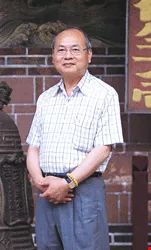
Liao Wu-chih, born on the sixth day of the sixth lunar month, the traditional day of the "Opening of the Gates of Hell," also bears a resmeblance to Emperor Pao-sheng himself. This has caused many to exclaim that all these things were long ago destined to be....
Lonely at the top
During the seven years of the restoration, Liao came to be considered a harsh overseer by the many employees, artisans, architects, and even scholars that he took off the job.
"I know that even within architectural circles there were many who did not wish the restoration of Pao-an Temple to succeed," says Wang Huey-jiun. Even though Liao's work served as a model for the restoration of historic sites, it also disrupted many previously-existing channels of improper financial gain. On more than one occasion, mobsters even brought their henchmen to Liao's office to threaten him.
When Liao traveled to Lotung in Ilan County to acquire cypress, he assured the sellers that he would not demand his own cut from the transaction. The timber merchants chuckled and replied, "Everyone always says that, but everyone still takes their cut." When they realized Liao was serious about refusing to skim off the top, this news not only spread throughout the trade but came to the ears of the temple faithful too.
"When the believers trust, you don't even need to ask, and the donations will flow in," says Liao. The fact that donations to the temple have increased from NT$30 million in 1992 to NT$90 million in 2003 illustrates their trust and support.
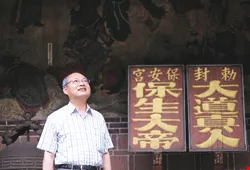
The art-loving Liao Wu-chih threw himself into the world of religious affairs, restoring Pao-an Temple like a work of art.
Built to last
"This project has struck a balance between using modern preservation techniques and traditional crafts. The utmost effort has been made to restore the original historical appearance of the site, and the careful attention to detail is highly significant in both religious and architectural terms." In 2003, UNESCO granted this high praise for Pao-an Temple's restoration.
Perhaps most worthy of joy is the fact that the care with which the restoration of Pao-an Temple was undertaken has already become a model for other such projects in Taipei. Fresh from this restoration project, Liao has taken on the overall planning of the restoration of the old temple at Chientan, and is also working with the great woodworker Hsieh Tung-hua to restore the Kuantu Temple.
"If artisans are given the proper forum for their work, their art will quite naturally be passed on to future generations," says Wang Huey-jiun. The fact that during the Pao-an Temple restoration there was an insistence on hiring native artisans rather than buying pre-fabricated materials from mainland China not only contributed to the classical feel of the temple, but also fully utilized these artisans' talents.
Aside from providing a setting for the work of traditional artisans and architects, Pao-an Temple has also become a place where popular drama and religious rites flourish.
Last year's qingcheng jiao ceremony saw Pao-an Temple's temple doors sealed for three days for these solemn communal rites of Daoism. But in order that ordinary believers could view the symbolic actions of the Daoist priests and hear their ritual singing, the temple took the unheard-of step of providing for a live broadcast of the rites on large television monitors outside of the temple doors. In addition, the third lunar month of each year brings the Pao-sheng Cultural Festival's "surname operas," in which fine drama is performed throughout the month, an event that has become a showcase for Taiwan's finest drama troupes. All of these activities are part of Liao's efforts to carry out the temple's "cultural mission."
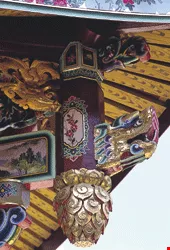
Liao Wu-chih not only provided local artisans a setting in which to fully display their artistic talents, he also preserved intact the temple's architectural style, which stems from southern Fujian. The photo shows the wooden decorative components below the eaves.
President without pay
In recent years, the cultural work of the temple has resulted in a series of awards. In 2002, the temple received the Premier's Prize for having been listed by the Ministry of the Interior as an outstanding temple for ten years in a row. In the same year, the temple received a cultural award from the City of Taipei, and in 2003 it received a major international award from UNESCO. "I never thought you could win awards for restoring temples," chuckles Liao.
Last year, photographer Ko Hsi-chieh was commissioned to capture the beauty of Pao-an Temple on film. In order to photograph an ancient icon of Emperor Pao-sheng, Ko asked permission to take off the ceremonial headgear and robes that Pao-sheng is traditionally attired in. When this was done, everyone discovered that Liao bears a striking resemblance to Emperor Pao-sheng!
Liao Wu-chih was born on the sixth day of the sixth lunar month, the day of the "Opening of the Gates of Hell" according to popular belief. Though trained from his youth as an artist, Liao serendipitously walked into Pao-an Temple and eventually became a temple keeper of a rare kind. In the end, he carried out the restoration of the temple as if he were creating a work of art. One could say that all of these things came about by coincidence, and yet, one also gets the strong feeling that these things were long ago destined to be....
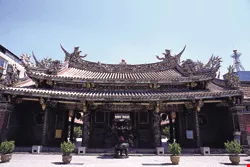
The resplendently restored Pao-an Temple has not only become a model of historic restoration, it also serves as a pioneering cultural center.
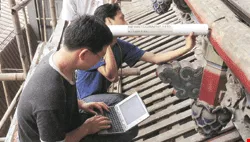
Pao-an Temple's winning the UNESCO Asia-Pacific Heritage Award for Cultural Heritage Conservation was no lucky accident, but the result of its efforts to uphold traditional craftsmanship while integrating modern technology, and the complex scope of its restoration. The photo shows students and professors from the School of Forestry and Resource Conservation at National Taiwan University performing a detailed ultrasound survey of the temple.
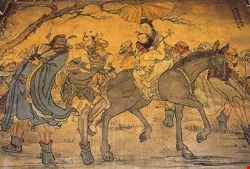
In Zhong Kui Taking His Younger Sister Home, the fresh and lovely countenance of the sister, and the lively innocence of her children, present a fascinating contrast to the repulsive ugliness of the demon-queller. This is a masterpiece by the famed painter Pan Li-shui.


