Adjusting Photography's Focus
Ventine Tsai / photos Hsueh Chi-kuang / tr. by Robert Taylor
September 1994


In a photograph, an enormous flower glows with a strange light. It was originally a real flower, but after being scanned into a computer and reshaped, recolored, illuminated and faded, in the picture it now blooms as unnaturally as in a dream or hallucination.
In a photograph, a concrete model animal, of a kind which can be seen anywhere in Taiwan, is pictured in the most natural, realistic style; it looks so false--and yet so real.
In a photograph, we see heavy clouds and a raging sea. But the photo is pasted at the foot of a wall: it is just a backdrop; in front of it, a tray of water with a glass house standing crooked in it makes up the rest of the piece.
These works may not seem much like photographs, but there's more: one of the new generation has got some classmates together to compose scenes expressing the loneliness of human existence; another experiments with a Barbie doll as the main character in her photographs; and a third deliberately lets mould attack his negatives...
This summer, such varied and unfettered works have really brought a freshness and interest to Taiwan's photographic world, which had long had nothing to offer but reportage and realism.
"Once I went to visit an old lady in a Hakka village. The wall in her living room was covered with photos of her relatives. When she pointed out one of an old gentleman and said, 'That's my husband!' tears began streaming from her eyes." Huang Hao-liang, winner of the novices' prize at this year's Taipei Photofest, uses this example to illustrate photographs' power to touch people's emotions.
Ever since the invention of photography a century and a half ago, people have wishfully believed that photographs are the embodiment of "reality." This is why we must have photographs on our identity papers, and in our newspapers. Photography's magical power to freeze movement and capture time causes it to be regarded as a kind of "proof" or "record," in a way paintings and writing are not.

With the computer locked on to his imagination, Chang Kuang-he transforms a real orchid into a flower out of a dream.
When reality is illusion, the illusory may be real
Living in a world full of photographic images, people learn about the world through photographs and even believe photographs while forgetting reality. For instance, everyone thinks they have seen the Eiffel Tower. But can a little picture postcard really convey the same feeling as climbing the Eiffel Tower oneself? What's more, by controlling exposure times and camera angles, and combining images in the darkroom, photography can turn day into night or plain into mountainside. No wonder then that "reality and illusion" has long been the greatest topic in people's explorations of the nature of photography.
Artists who use photography as the medium through which to "subjectively" express their ideas, all in their different ways question the reality of the photographic image. "Never believe that photographs are real," warns Wu Tien-chang. This painter had always worked with oil paints, but on this occasion he broke away completely from his previous style, combining photography with other media to produce a work which won one of the first prizes at this year's Taipei Biennial Exhibition of Contemporary Arts. Wu Tien-chang says that in this work, only the medium of photography could produce the effect he wanted of "passing off illusion as reality." "If I had painted it," says Wu, "it would have lost something essential."
His prizewinning work, entitled "Farewell to the Spring and Autumn Pavilion," looks like an old photograph from the 1970s. The youthful subject, wearing a navy uniform and carrying a guitar, appears to be posing before a scenic backcloth in a photographic studio. But in fact the subject, the role he portrays, the backcloth depicting the Spring and Autumn Pavilion, and the plastic imitation tile floor, are all designed and arranged by Wu Tien-chang himself; in other words, everything in the photo is "phony." The artist uses people's trust in the photographic image to lure them back into the past.
But what Wu Tien-chang wishes to express is not merely the romance and nostalgia of an old photograph. Firstly, the eyes of the young sailor in the picture are covered by a black mask, which harshly calls the viewers back from their journey into the past. And the imitation leather frame, over 10 centimeters broad, is studded with glass diamonds and white plastic flowers. This heavy frame exudes the air of a coffin, and its vulgar ornamentation reminds one strongly of today's funerals in Taiwan, where the grief and pain of death are mingled with the atmosphere of a coarse and gaudy celebration.
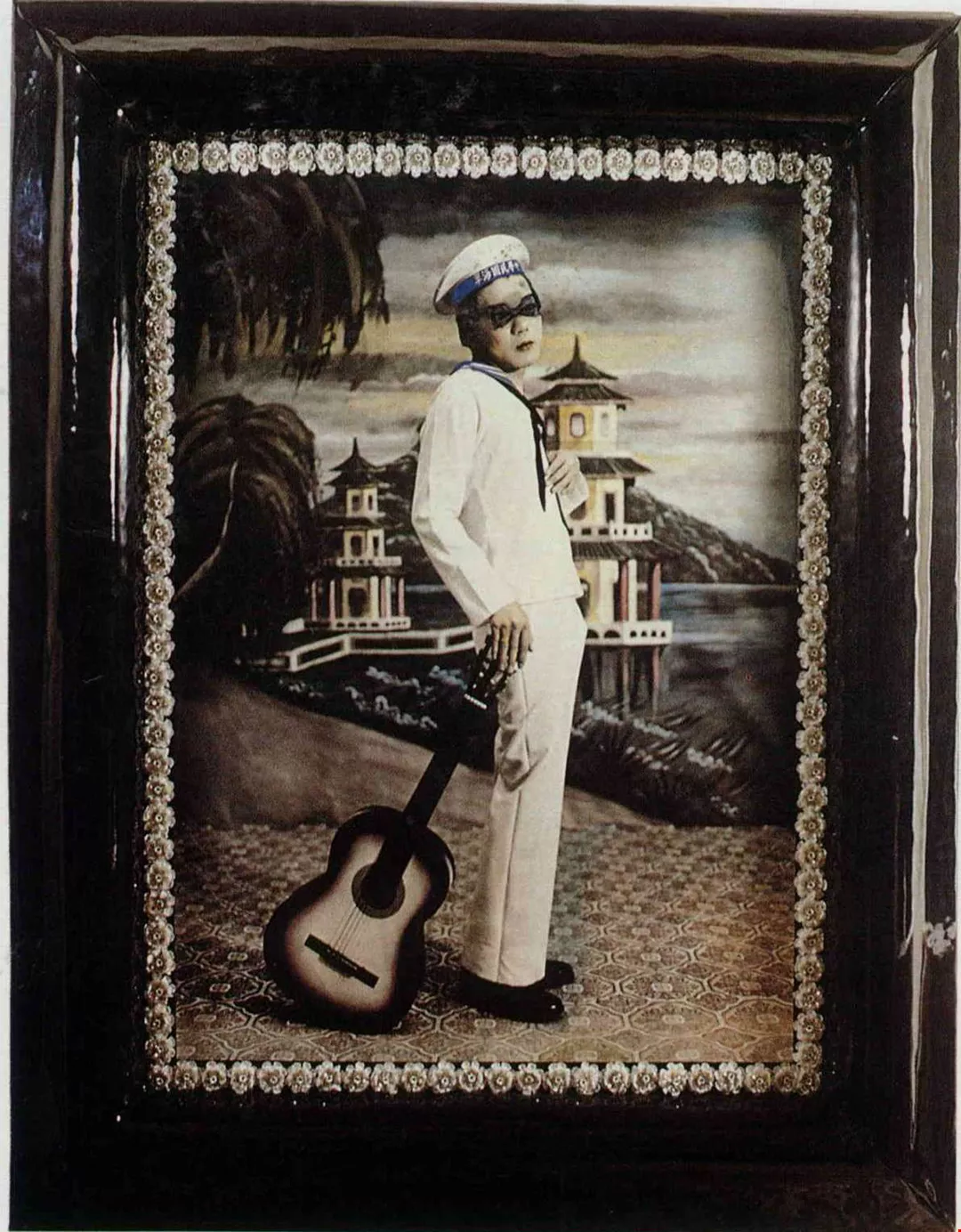
It looks like a romantic old photo, but the mask over the subject's eyes breaks the viewer's nostalgic reverie. The broad, thick imitation-leather frame has the look of a coffin, and with its white plastic flowers and imitation diamonds, Wu Tien-chang's "Farewell to the Spring and Autumn Pavilion" portrays the strange mixture of grief and festival to be found at contemporary funerals. (1993, 160×190cm) (courtesy of Wu Tien-chang)
An exhibition slow in coming
Wu Tien-chang's works have always had the quality of reflecting the age. He once used "Five Portraits of Chiang Ching-kuo" to express the change in style in Taiwan's politics as the island moved from military rule to the lifting of Martial Law restrictions. Today in the 1990s, Taiwan is richer, but its cities, which have not benefitted from long-term town planning, its hastily constructed show apartments, its higgledy-piggledy illegal buildings and its sheet-metal roofs, all betray a transitory, migrant state of mind. Thus Wu's choice of this bogus photograph and cheap imitation flowers, diamonds and leather mockingly reflects the Taiwan he "really" experiences.
When confronted with a work like this, in which Wu Tien-chang uses tricks not to be found in the photographic rule-books, audiences long used to appreciating reportage-style photographs, and even experienced photographers, are not sure what to make of this "new baby." They can hardly be blamed for this, for looking back on photography in Taiwan since World War II (apart from commercial photography), until the 1970s "salon photography" dominated the scene, while for almost two decades from the 1970s to the present, a "photojournalism" or "documentary" style has been the mainstream.
Over the past five years, the second generation of photographers who studied photography abroad have returned to Taiwan. They have brought back new forms of photographic creativity, and they give more thought to the nature and theoretical basis of photography. Through their art, their wrings and their teaching in universities and colleges, they have given many of the new generation the courage to experiment and break away from photography's traditional role of record, and begin using photography to express themselves rather than record society.
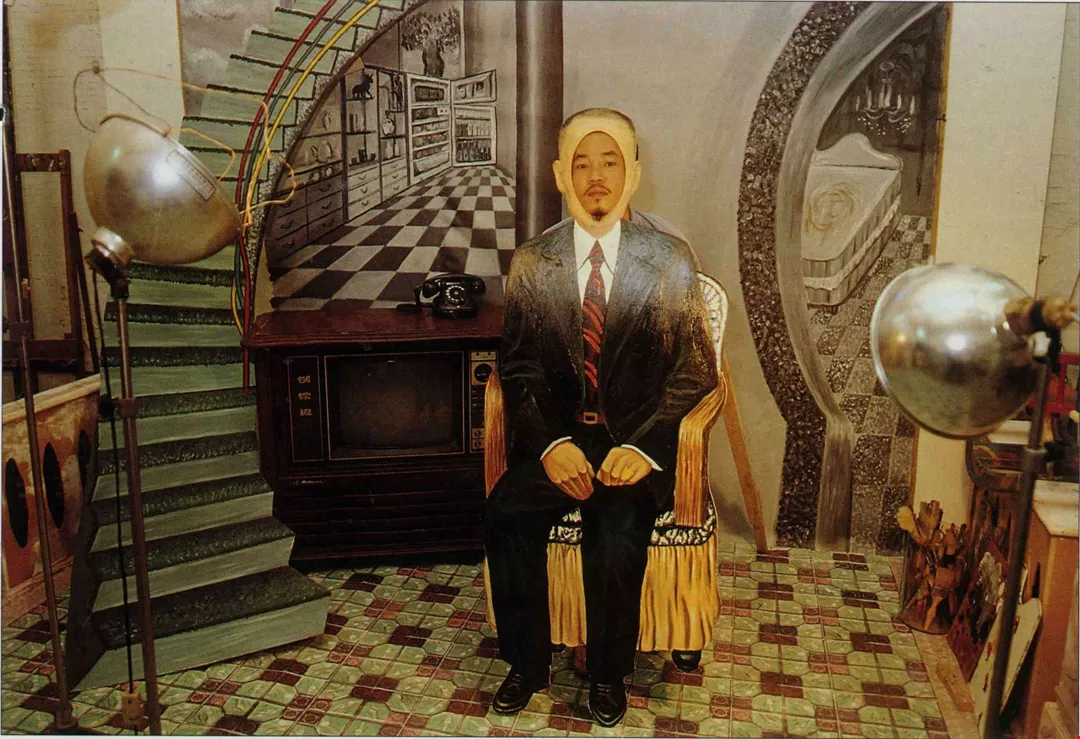
Since Wu Tien-chang's big conversion, his studio, once piled high with canvases and oil paints, has been turned into a photo studio which span s time and memories.
New generation, new photography
This summer, specialist art galleries put on two exhibitions which broke away from photography as reportage: "Between Reality and Illusion," and "Invention." And at the third annual Taipei Photofest, many new artists made their debuts. Wu Chia-pao, one of the first generation of photographers to study photography abroad, says with a sigh, "These exhibitions really have been a long time coming." But nonetheless they will inject more possibilities into Taiwan's photographic circles, and they herald a new era of unlimited variety.
When one speaks of taking photographs, most people's knowledge goes little further than picking up a camera, pointing it at the object seen in the viewfinder and pressing the shutter, and then getting the film developed. This kind of photography, in which no special techniques are used during shooting or developing, is known as "straight photography." By contrast, if the artist arranges the scene and orchestrates a storyline before taking the photograph, or uses darkroom techniques to alter the picture, or after the photograph is developed, adds color, makes a montage, photocopies the image or uses a computer to process it, or combines it with other materials to produce an installation piece, then it can be termed an "alternative" method of photography, explains Chang Kuang-he, who holds an MA in art from New York University and now teaches in the department of printing and photography at Taipei's World College of Journalism and Communications. Such works- -which have often been rejected as being outside the realm of photography-- are created subjectively and consciously by the artist.
Just as with all new art forms which are hard to categorize, categorization is only for the sake of convenient discussion. In fact most artists involved in alternative photography really don't care whether their works should or shouldn't be called photographs, nor do they call themselves photographers. But what they have in common is a deep love of the photographic image, which leads them to choose photography for their creative work. When their works appear, they almost always break with accepted ideas that a photograph creates a record, is decided in an instant, is immutable and is capable of unlimited reproduction.
The great French photographer Henri Cartier-Bresson once gave the classic definition of photography as the art of capturing movement at the "decisive moment." In other words, the quality of the finished photograph is decided in the split-second when the shutter is pressed. But for Chang Kuang-he, who returned to teach in Taiwan five years ago, the master's words do not apply. Chang Kuang-he spares no effort to propagate the idea of photography as creative art, and in his works he constantly calls into question traditional notions of photography's basic nature.
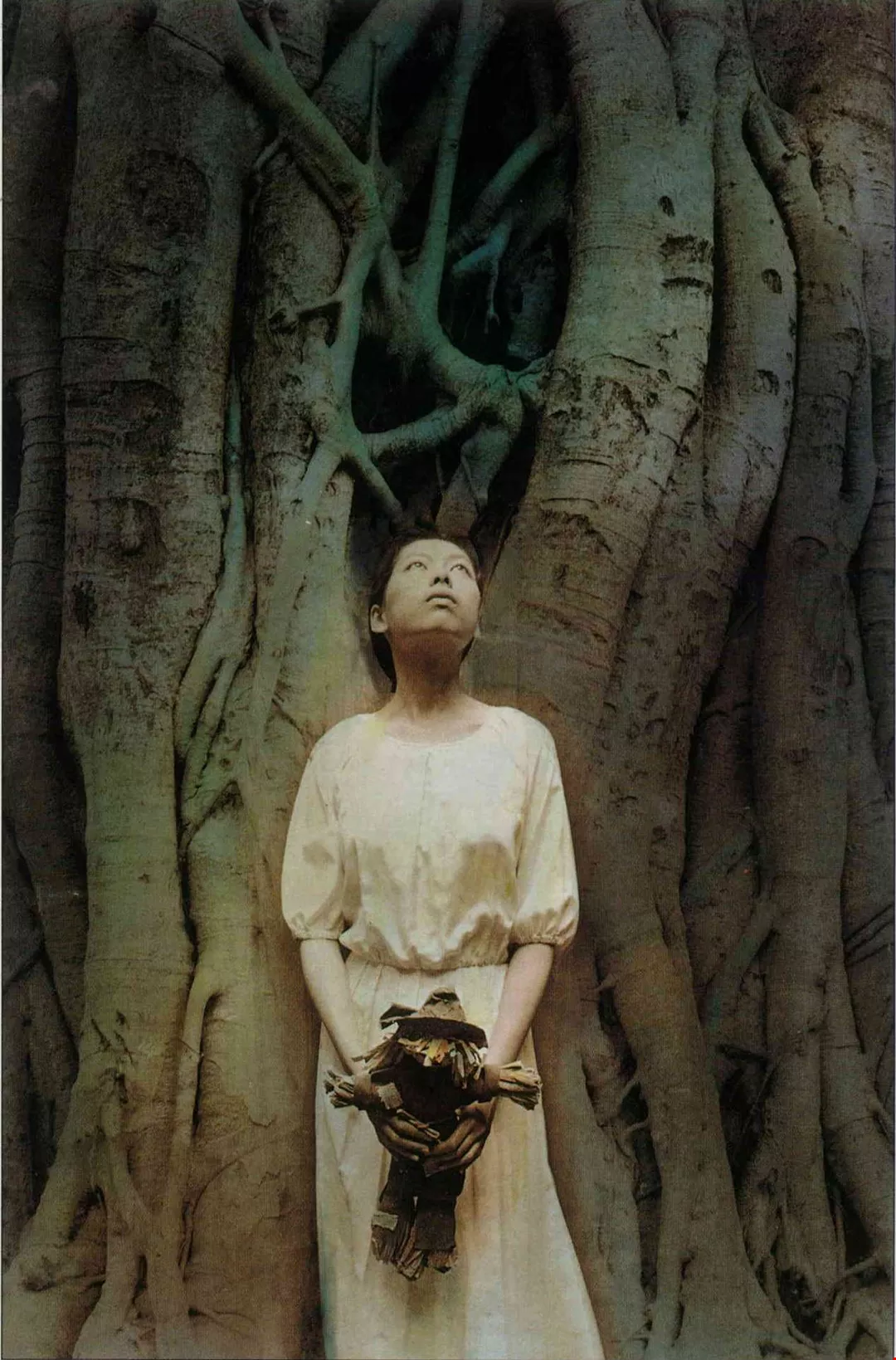
You say you'd like to fly away, but your feet are bound firmly to the earth... The young artist Huang Hao-liang created his series of posed photographs entitled "Windblown" to express his view of life. (1994, 54×79cm) (courtesy of Huang Hao-liang)
I start from where you left off
While he was studying in the USA, he used a simple pocket camera to photograph museum specimens of animal skeletons. He felt that in the dim light inside the museums, these skeletons looked like "Terminators" from a future world, each with an existence of its own. So he took pictures of them, wanting to bring them back to life. But when he had finished taking the pictures, for Chang Kuang-he the creative process had only just begun.
How could he bring these skeletons back to life? First, he had to deal with those unsightly museum captions and display stands. In the darkroom, Chang Kuang-he dispensed with the normal method of immersing the whole sheet of photographic paper in developer to develop a complete image. Instead he used a sponge soaked in developer, which he rubbed across the photo paper to produce a partial image. In this way he produced an effect in the developed picture like the brush strokes of a painting. By applying the sponge in different ways, he produced different works from the same negative. This also broke with the notion of photographs being reproducible in large numbers.
"Man does not have just one kind of relationship with the camera, and I don't like to be limited by machines," emphasizes Chang Kuang-he, who likes to turn the nature of photography upside down in all kinds of strange ways. But he specially explains that turning tradition on its head does not mean that he denies the value of photography as record or reportage. It's just that he hopes artists can broaden their perspectives and be open to different ideas, to expand and enrich the space available to photography in Taiwan.
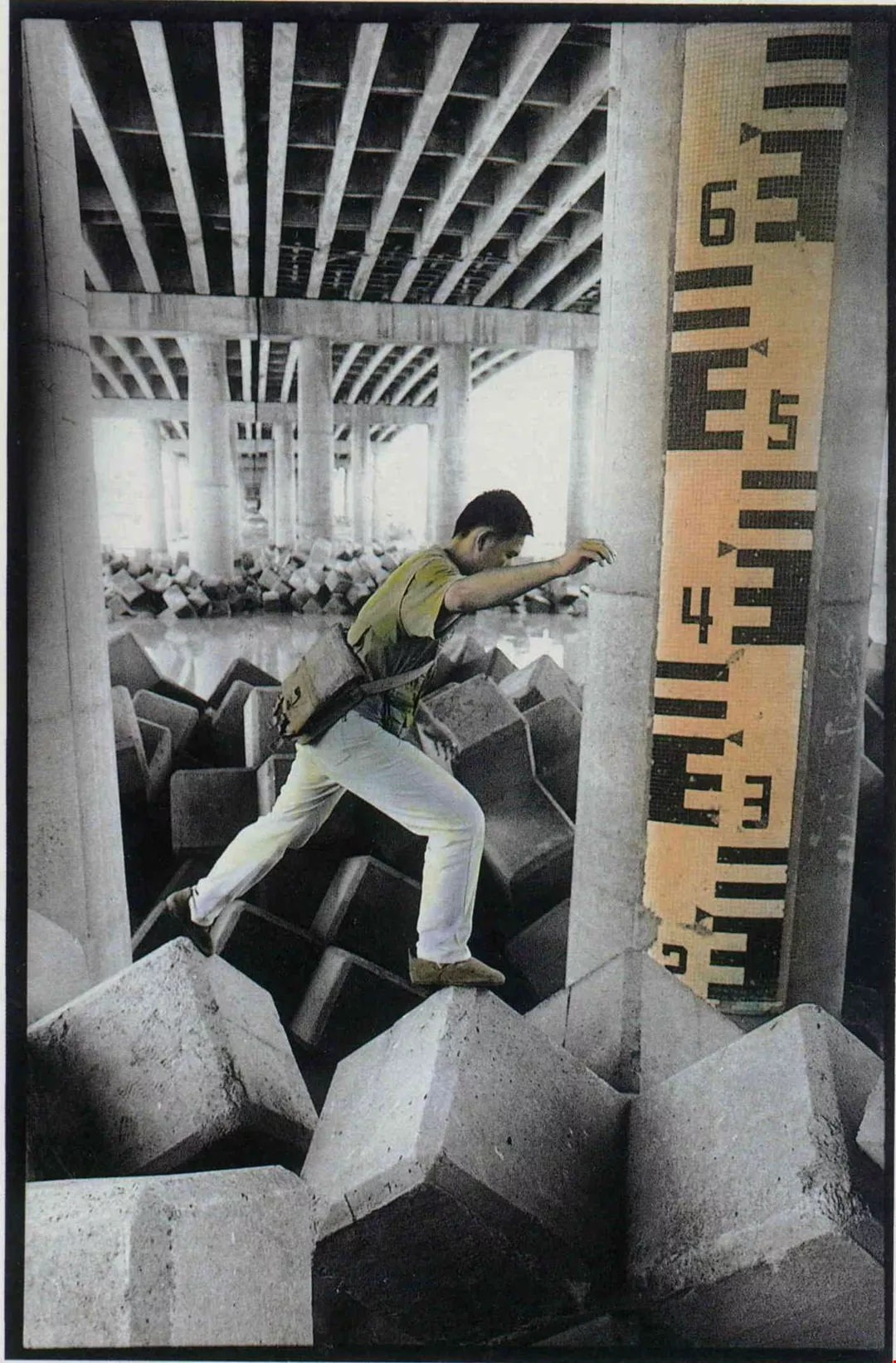
The young Huang Hao-liang does not wish to restrict himself to any particular photographic style. As more and more young artists with the courage to experiment enter the ranks of Taiwan's photographers, domination by a single style will become a thing of the past.
Writing a novel in pictures
Ben Yu, who teaches in the department of advertising at Chengchih University and who holds MAs from the United States and Britain, feels that photography is like literature: some like to write poems, while others like to write reportage. As for himself, he prefers the complex plot of a novel. After taking photographs for many years, he began to experiment with combining several pictures together to tell the stories he had in mind. The stories became more and more complex and the number of photographs he grouped together went from two or three to nine, to as many as 30. When we stand before a work comprising 30 photographs plastered across a whole wall, there is no way we can take it all in with just one sweep of the eye. We have to move our legs, following the path deliberately planned by Ben Yu, our vision advancing too as it jumps from one picture to the next. Different times and different characters deliberately appear together, intermingled with each other.
For instance, in Yu's "Friday's Forecast: Partly Sunny," as our eyes follow the images of trees, in one photograph we see a girl in red sitting with her back to the camera, while across from her picture is one of a stern-looking male stone statue. Around these two main characters are scattered scenes of pools of water and falling rain. In this work, Ben Yu portrays a man and a woman who are unable to get along and must finally part. There is nothing "accidental" about the 20 photographs which appear in this piece. The content of each of the pictures, and the relationship between them all, have a particular purpose which goes beyond simply the images of flowers and plants, man and woman.
When the camera was first invented, many painters were worried that drawing and painting would be replaced by photography. But one painter of that time, referring to photography's ability to record reality, said with assurance: "If cameras can't go up into heaven or down into hell, photographs will never replace paintings." In fact, neither painting nor photography have replaced each other, but each has influenced the other and both have progressed. But what today's alternative photographers wish to express in their work transcends the surface of the picture. They no longer bear the burden of heavy social responsibility, but emphasize that which belongs to the individual, and express the heaven and hell to be found in the depths of the soul.

Looking at the 20 photographs which make up Ben Yu's work "Friday's Forecast: Partly Sunny," where do you start from? And what story do they tell?(1988, 240×130cm) (courtesy of Ben Yu)
What the eye cannot capture
Huang Hao-liang, who won the novices' prize at the Taipei Photofest, is due to graduate from the National Institute of the Arts next year. Coming from a broken home, loneliness and unease have been part of his character since childhood. He feels that people have no more control over their lives than seeds blowing in the wind. If the wind doesn't blow, they can go nowhere, but when it does, they may be blown who-knows-where. Huang's father, for example, came to Taiwan alone as a demobilized soldier. After his wife--Huang's mother--walked out on them, he raised his children in Taitung, but as they grew up they left his side one after another. Huang is sure that a man like his father has his hopes and loves like anyone else. But he can only take each day as it comes. Huang Hao-liang believes that sometimes everyone feels some kind of "isolation," and this is something which even the closest friends and relatives cannot share.
In trying to communicate his own experience of life, Huang Hao-liang found that even when making himself the subject of his work, he was unable to produce something which came close to expressing his soul. So he sought out appropriate settings, and asked fellow students to pose for him to produce the images he had in his mind. Thus he produced two series of pictures, one entitled "Windblown" and the other "Grumbling." In one picture, a girl in white stands with her hands hanging down in front of her, holding a doll, her face turned up to look at the sky with an expression of hoping to fly away--wanting to leave but unable to. In another, Huang dresses his sister in an old suit inherited from his father's generation, and has her stand like a scarecrow amid lush wild grasses in the light of the setting sun.
Some say that what one knows in one's heart is more than what the eye can see, and cannot be captured just with a camera. For Huang Hao-liang, these arranged images capture something more true than any photograph of a "real" event, for they go deeper into his memories and his soul.

Between the real and the illusory, what is genuine? What is bogus? Recently Ben Yu has been photographing the "fake animals" which can be found all over Taiwan, in order to express Taiwan's real flavor.
My art--but not my photos
Some use innovative techniques, others explore the basic nature of photography. But at Chen Shun-chu's exhibitions, people often ask, "Is that photography at all?" Chen uses photographs in his works, but most are not ones he has taken himself. Chen, who has previously put on pure photographic exhibitions, feels that in the past he chose subjects to photograph in order to express his ideas, but today he chooses other people's photographs with which to express himself creatively. In both cases, the choices are his own active ones, but he feels the second of the two gives him greater freedom and greater scope. He especially likes black and white photos, for they impart a sense of a past which cannot be returned to. This quality is something very dear to Chen, who is often sunk in reverie, pursuing the memory of the lost happiness of his childhood.
Chen Shun-chu comes from a family which loves to be photographed. He remembers how every year on the third day of the Chinese New Year, his family would be sure to go to a studio to have their pictures taken. Their large collection of old photographs became the material for Chen Shun-chu's art. The photos he used in his 1993 work "The Family's Aquarium" were all full-face portraits of members of his family. Chen Shun-chu pasted blown-up copies of these portraits into wooden boxes which he stood on end and filled with water up to the photographs' noses, creating a feeling of suffocation. Twenty-five boxes in all are piled in a row of stacks to form a pyramid, in an order which has its own deeper meaning. In the tallest, central stack is the head of the family--Chen's father--but above him is the newest member of the family's youngest generation. In the stack in front of his father is Chen Shun-chu, and in front of Chen is the latest brother-in-law to have married into the family. Going down step by step behind the father are Chen's older sisters, and right at the back, her gaze encompassing the whole family, young and old, is Chen's mother. Through this highly novel arrangement, commonplace ID photographs express the process by which a family's existence is continued. Here, who actually took the photos is insignificant.
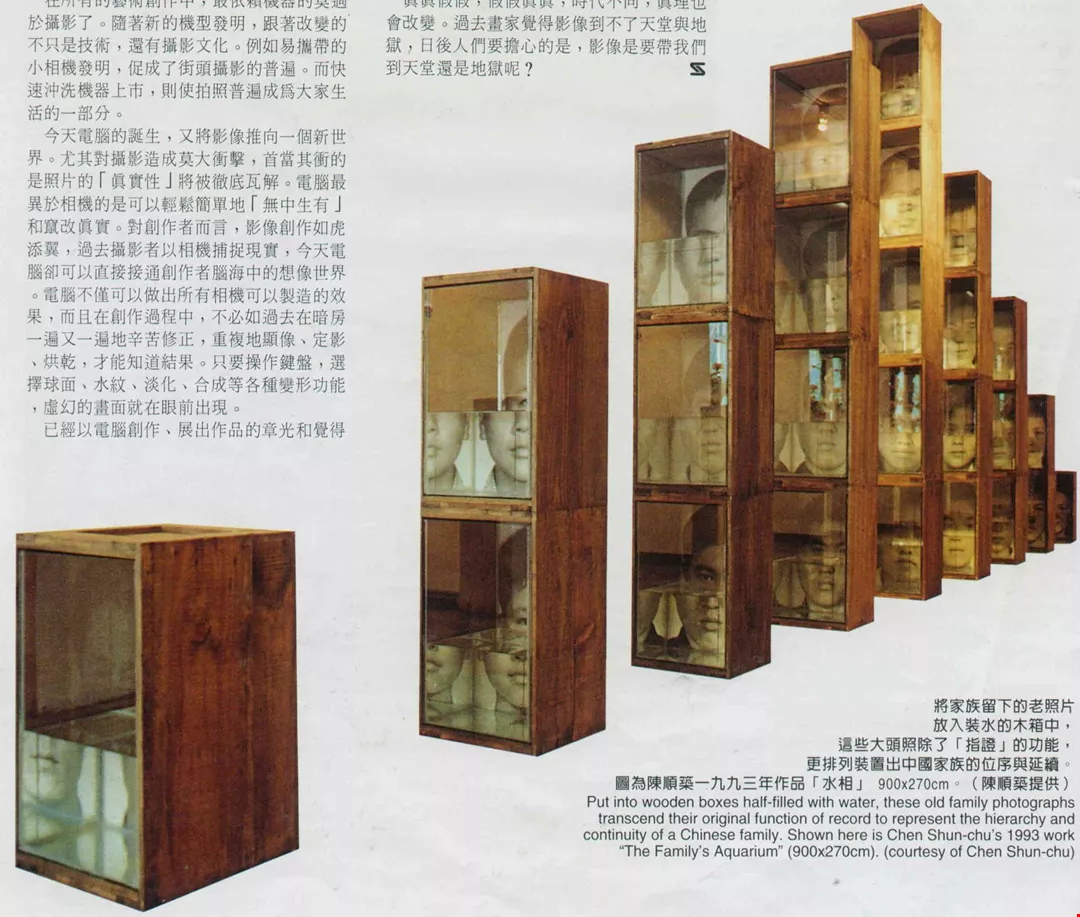
Put into wooden boxes half-filled with water, these old family photographs transcend their original function of record to represent the hierarchy and continuity of a Chinese family. Shown here is Chen Shun-chu's 1993 work "The Family's Aquarium" (900×270cm). (courtesy of Chen Shun-chu)
Photography or trickery?
Of all forms of art, the one which relies most heavily on technical apparatus is surely photography. When new equipment is invented, it changes not only technology but also photographic culture. For instance, the invention of the portable compact camera allowed photographers to get out on the streets, starting a new trend. And when high-speed developing machines came onto the market, they made photography a part of everyday life.
Today the advent of computers has again pushed the photographic image towards a new world. The first great change they will bring is the complete collapse of the concept of photographs as a "true record." The greatest difference between the computer and the camera is that the computer can easily "produce something from nothing" and change reality. Artists find their creativity unleashed, for where in the past the photographer had to use the camera to capture an image of something real, today the computer enables the artist to connect directly into the world of his own imagination. Not only can the computer create all the effects which are possible with the camera, but there is no need as in the past to make correction after tedious correction in the darkroom, repeatedly developing, fixing and drying before one can know the results. From the computer keyboard one can call up all kinds of manipulative functions such as spherizing, rippling, fading and merging, to make the picture one has imagined appear before one's eyes.
Chang Kuang-he, who has already exhibited works he has created on the computer, feels that working on the computer is like having an all-powerful magic charm. It really does make many things easier for the artist, and for Chang darkroom work has become a thing of the past. But faced with so many weird and wonderful functions, it is all too easy for the artist to be "sucked into" a technological game, and lose his own identity. And once the computer has replaced all the old manual skills, whether worthwhile results will be produced depends entirely on the artist's own intellect and imagination.
Let us leave behind art for a moment and talk about the photograph's role as "record." Using the computer, the photographer can "turn back the clock" and put right many defects and mistakes. That telegraph pole which there was just no way to avoid can be removed, an image in portrait format can be rescaled into landscape format, wars can be recreated, national leaders can be made to join hands in friendship. In the future, as computer-processed images become more and more common, people's immediate reaction on seeing a photograph may well be: "That can't be real."
Reality and illusion, illusion and reality--as times change, truth changes too. In bygone days, painters believed that photography could not reach into heaven or hell. In the future, the question people should worry about is: will these images take us to heaven, or to hell?
[Picture Caption]
p.28
Using a sponge soaked in developer to enable him to choose which parts of the image to develop, Chang Kuang-he creates photographs with "brush strokes" like those in a painting. Shown here is an untitled work from his 1988 "Museum" series. (courtesy of Chang Kuang-he)
p.29
With the computer locked on to his imagination, Chang Kuang-he transforms a real orchid into a flower out of a dream.
p.30
It looks like a romantic old photo, but the mask over the subject's eyes breaks the viewer's nostalgic reverie. The broad, thick imitation-leather frame has the look of a coffin, and with its white plastic flowers and imitation diamonds, Wu Tien-chang's "Farewell to the Spring and Autumn Pavilion" portrays the strange mixture of grief and festival to be found at contemporary funerals. (1993, 160x190cm) (courtesy of Wu Tien-chang)
p.31
Since Wu Tien-chang's big conversion, his studio, once piled high with canvases and oil paints, has been turned into a photo studio which spans time and memories.
p.32
You say you'd like to fly away, but your feet are bound firmly to the earth... The young artist Huang Hao-liang created his series of posed photographs entitled "Windblown" to express his view of life. (1994, 54x79cm) (courtesy of Huang Hao-liang)
p.33
The young Huang Hao-liang does not wish to restrict himself to any particular photographic style. As more and more young artists with the courage to experiment enter the ranks of Taiwan's photographers, domination by a single style will become a thing of the past.
p.34
Looking at the 20 photographs which make up Ben Yu's work "Friday's Forecast: Partly Sunny," where do you start from? And what story do they tell?(1988, 240x130cm) (courtesy of Ben Yu)
p.35
Between the real and the illusory, what is genuine? What is bogus? Recently Ben Yu has been photographing the "fake animals" which can be found all over Taiwan, in order to express Taiwan's real flavor.
p.36
Put into wooden boxes half-filled with water, these old family photographs transcend their original function of record to represent the hierarchy and continuity of a Chinese family. Shown here is Chen Shun-chu's 1993 work "The Family's Aquarium" (900x270cm). (courtesy of Chen Shun-chu)
p.37
In the frame, is it just Chen Shun-chu's image? Or Chen Shun-chu's spirit and thoughts? Today's artists no longer seek to record the outside world through the viewfinder, but instead use photographs to express their inner selves.
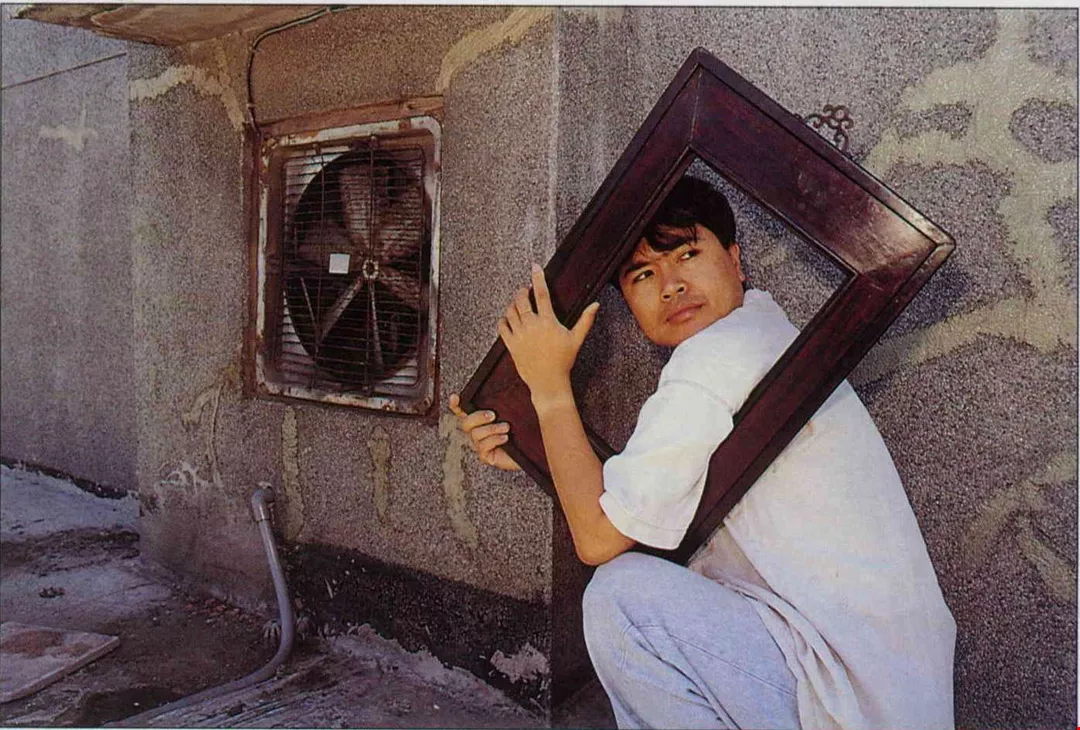
In the frame, is it just Chen Shun-chu's image? Or Chen Shun-chu's spirit and thoughts? Today's artists no longer seek to record the outside world through the viewfinder, but instead use photographs to express their inner selves.


