Asia on the Field, Taiwan in the Game
Records and Memories of Taiwanese Athletes at the Asian Games
Cathy Teng / photos Lin Min-hsuan
May 2026

.jpg?w=1080&mode=crop&format=webp&quality=80)
Asia on the Field: Taiwan and the Asian Games Special Exhibition, co-organized by the Ministry of Culture and the newly established Ministry of Sports, transforms fleeting moments of athletic glory into a shared cultural heritage through the systematic preservation of sports memories.
Asia on the Field: Taiwan and the Asian Games Special Exhibition recently opened at the National Museum of Taiwan History. As Taiwan’s first national-level exhibition dedicated to the Asian Games, it is curated by Hsieh Shih-yuan, an associate professor of history at National Cheng Kung University. Hsieh shifts the focus from the athletic arena to historical context, organized around four thematic “presences”—the presence of cultural subjectivity, Taiwan’s self-assured presence, the shared presence of participating athletes, and the presence of the audience. Through these lenses, the exhibition reflects on how “Asia” has been collectively imagined, while illustrating how Taiwan has been named and remembered throughout decades of international competition.
.jpg?w=1080&mode=crop&format=webp&quality=80)
Numerous sports brimming with unique Asian regional characteristics captivate visitors at the exhibition, underscoring the continent's distinct subjectivity and cultural diversity.
The Asian Games: Forging a Regional Identity
Unlike the ancient Olympic Games, the Asian Games did not hold its inaugural edition until 1951 in New Delhi, India. For many participating nations, this was never just another international sporting competition; rather, it served as a vital stage for Asian countries to envision one another and forge a shared regional identity.
The Asian Games has cultivated unique characteristics distinct from the Olympics. The exhibition highlights several regionally distinctive Asian sports, including Kurash from Uzbekistan, Kabaddi from India, Sepak Takraw from Malaysia, and Taekwondo from South Korea. Compared to the highly globalized Olympic system, these culturally steeped disciplines serve as the distinctive hallmarks of the Asian Games.
This Asian essence is equally woven into the visual symbols of each edition of the Games. The curator uses medals from past events to tell these stories, showcasing how local landmarks and cultural motifs are transformed into prominent highlights on each medal. For instance, the 1951 New Delhi medals featured the India Gate, the Bangkok Asian Games medals showcased stupas and elephants to symbolize Thai heritage, and the 2018 Jakarta-Palembang medals incorporated traditional Indonesian Batik patterns.
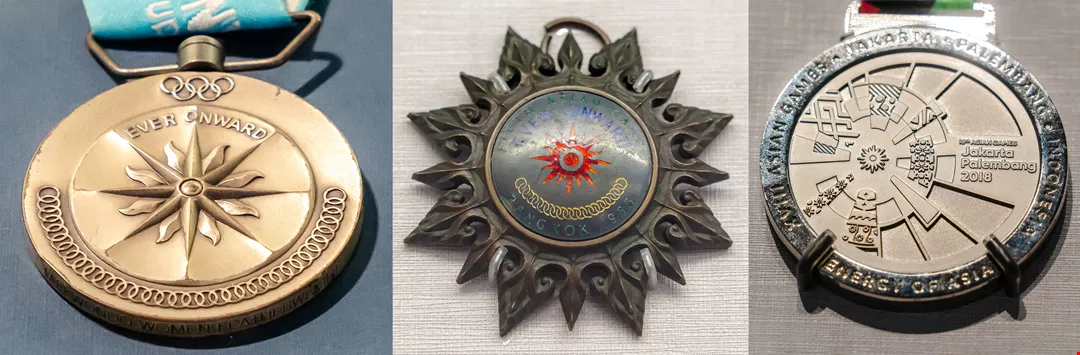
The sun is the paramount symbol of the Asian Games, embedded in the emblem of every edition.
(Left) The Taekwondo silver medal won by Tseng Li-cheng at the 2002 Busan Asian Games.
(Center) The women’s shot put bronze medal won by Wu Chin-yun at the 1966 Bangkok Asian Games.
(Right) The women’s softball silver medal won by Lai Meng-ting at the 2018 Jakarta-Palembang Asian Games.
These medals are more than mere tokens of victory; they serve as miniature imprints of their era, recording how Asian nations have perceived themselves and how they have chosen to present their identities to the world.
Taiwan’s Evolving Presence
Taiwan made its Asian Games debut in 1954 at the Manila event, where Yang Chuan-kwang, hailing from Taitung, captured his first gold medal in the decathlon. In 1958, he shattered the Asian Games record in Tokyo to successfully defend his title. Dubbed the “Iron Man of Asia,” C.K. Yang was arguably the first athlete to truly place Taiwan on the global sporting map.
Tucked in a corner of the exhibition is a bronze statue of Yang, on loan from the National Sports Training Center, accompanied by extensive archival footage. This display allows the public to feel the boundless talent and relentless dedication of the Iron Man of Asia. Yang’s legendary example naturally became the ultimate aspiration for the next generation of Taiwanese track stars, such as Wu Ah-min and Ku Chin-shui.
However, following the Republic of China’s withdrawal from the United Nations, Taiwan was officially excluded from the 1974 Tehran Asian Games. For nearly two decades, Taiwanese athletes were barred from the Asian Games arena. It was not until the 1981 Lausanne Agreement that Taiwan was finally permitted to return to the international sporting stage under the negotiated designation “Chinese Taipei.”
The journey back to the field was fraught with diplomatic hurdles. Numerous archived documents detail the myriad names under which Taiwan has participated. This constant shifting of titles vividly mirrors Taiwan’s shifting geopolitical circumstances and its evolving navigation of identity across different eras.
.jpg?w=1080&mode=crop&format=webp&quality=80)
Borrowed from the National Sports Training Center, the bronze statue of Yang Chuan-kwang allows visitors an up-close view of the physical contours of the man who authored some of Taiwan's most legendary athletic moments.
.
The exhibition also uncovers a rarely discussed chapter of history: early national delegations frequently recruited overseas Chinese athletes holding various foreign citizenships. Notable examples include Chinese-American shooter Wu Tao-yuan, who represented the ROC five times; Hong Kong football star Law Pak, a frequent national team selection; and Japanese-born Chinese cyclist Fan Yueh-tao, who secured a bronze medal at the Bangkok Asian Games. Transcending geographical borders to rally under a single flag, these diaspora athletes helped forge a collective “we,” vividly reflecting the sociopolitical climate of their time.
Ultimately, Taiwan’s “presence” has never been merely a static record of participation. Instead, it represents a relentless, ongoing quest to find a visible space in the world, constantly navigating a labyrinth of changing names and shifting identities.
.jpg?w=1080&mode=crop&format=webp&quality=80)
The evolving emblems and lettering on the national track jackets worn by “New Iron Man of Asia” Wu Ah-min across different competitions symbolize over 70 years of Taiwan’s diplomatic confrontations and compromises on the global stage.
Resurrecting Taiwan’s Asian Games Memories
On the athletic field, victory is often fiercely contested over a razor-thin margin of just 0.1 seconds or centimeters. Yet, when the exhibition’s spotlight pivots from the grand sweep of national history to the personal trajectories unfolding off the track, what emerges is the profound depth of the athletes’ lives.
.jpg?w=1080&mode=crop&format=webp&quality=80)
Driven by early political realities and a desire to win, Taiwan actively recruited overseas Chinese representatives to compete, achieving outstanding athletic results.
.
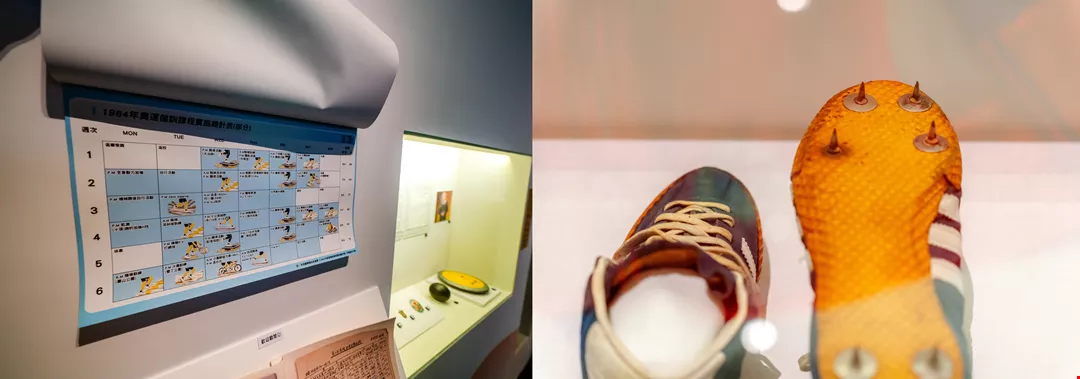
(Left) The meticulously designed training schedule of Wu Chin-yun.
(Right) The specialized footwear prepared by Wu Ah-min for various track and field events.
Asia on the Field has gathered obscure historical narratives rarely seen by the public. These range from table tennis player Huang Hsing, who missed making the national team by the margin of a single ping-pong ball, to the “Queen of the Throws” Wu Chin-yun, who dedicated her entire life to Taiwanese track and field, and Wu Ah-min, who carried the Iron Man torch. Through intimate interviews and meticulously gathered documents, the exhibition pieces together their authentic, unvarnished lives away from the glare of the media.
.
For the modern generation’s Asian Games memories, contemporary icons such as tennis star Lu Yen-hsun, Taekwondo gold medalist Chu Mu-yen, roller skater Huang Yu-lin, sprinter Yang Chun-han, boxer Chen Nien-chin, and Taekwondo medalist Tseng Li-cheng have generously loaned their personal training gear. These sweat-drenched artifacts actively perpetuate the unwavering belief and baton-passing spirit passed down through generations of Taiwanese competitors.
The exhibition culminates with an interactive installation, warmly inviting visitors to personally engage with these Asian Games memories. Attendees can not only experience the interactive displays but also leave messages of encouragement for the Taiwanese athletes preparing for the upcoming 2026 Aichi-Nagoya Asian Games. This interactive conclusion ensures that the hopes and blessings across different generations continue to converge and ripple outward.
.jpg?w=1080&mode=crop&format=webp&quality=80)
The Asian Games memories of the new generation of athletes similarly carry forward this spirit of unwavering belief throughout the exhibition.
Asia on the Field: Taiwan and the Asian Games Special Exhibition
Exhibition Dates | April 21 – October 18, 2026 (Annual closure: August 31 – September 7)
Opening Hours | Tuesday to Sunday, 09:00–17:00 (Closed on Mondays)
Location | Exhibition and Education Building, 4th Floor, Special Exhibition Room 2, National Museum of Taiwan History
@List.jpg?w=522&h=410&mode=crop&format=webp&quality=80)


