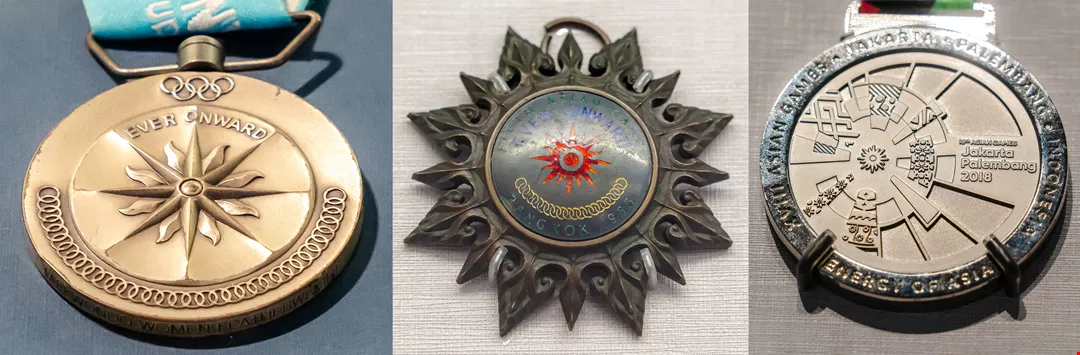
These medals are more than mere tokens of victory; they serve as miniature imprints of their era, recording how Asian nations have perceived themselves and how they have chosen to present their identities to the world.
Taiwan’s Evolving Presence
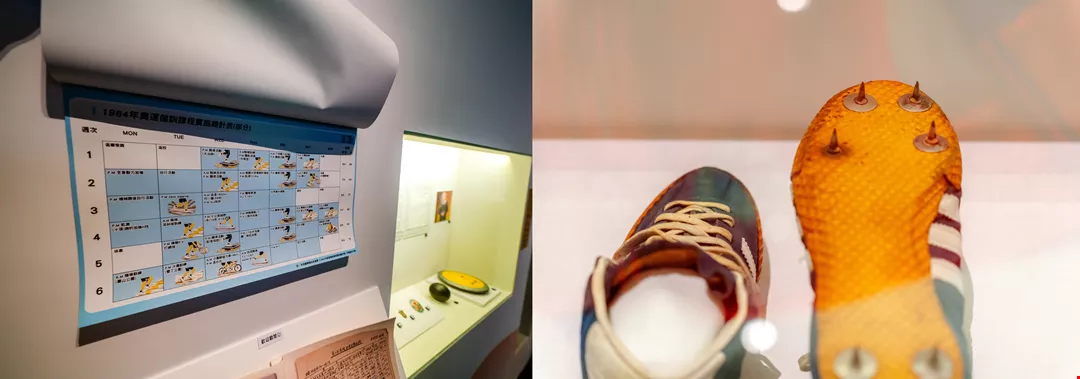
Taiwan made its Asian Games debut in 1954 at the Manila event, where Yang Chuan-kwang, hailing from Taitung, captured his first gold medal in the decathlon. In 1958, he shattered the Asian Games record in Tokyo to successfully defend his title. Dubbed the “Iron Man of Asia,” C.K. Yang was arguably the first athlete to truly place Taiwan on the global sporting map.
Tucked in a corner of the exhibition is a bronze statue of Yang, on loan from the National Sports Training Center, accompanied by extensive archival footage. This display allows the public to feel the boundless talent and relentless dedication of the Iron Man of Asia. Yang’s legendary example naturally became the ultimate aspiration for the next generation of Taiwanese track stars, such as Wu Ah-min and Ku Chin-shui.
However, following the Republic of China’s withdrawal from the United Nations, Taiwan was officially excluded from the 1974 Tehran Asian Games. For nearly two decades, Taiwanese athletes were barred from the Asian Games arena. It was not until the 1981 Lausanne Agreement that Taiwan was finally permitted to return to the international sporting stage under the negotiated designation “Chinese Taipei.”
The journey back to the field was fraught with diplomatic hurdles. Numerous archived documents detail the myriad names under which Taiwan has participated. This constant shifting of titles vividly mirrors Taiwan’s shifting geopolitical circumstances and its evolving navigation of identity across different eras.
.jpg?w=1080&mode=crop&format=webp&quality=80)
Borrowed from the National Sports Training Center, the bronze statue of Yang Chuan-kwang allows visitors an up-close view of the physical contours of the man who authored some of Taiwan's most legendary athletic moments.

.jpg?w=1080&mode=crop&format=webp&quality=80)
.jpg?w=1080&mode=crop&format=webp&quality=80)
.jpg?w=1080&mode=crop&format=webp&quality=80)
.jpg?w=1080&mode=crop&format=webp&quality=80)
.jpg?w=1080&mode=crop&format=webp&quality=80)


@List.jpg?w=522&h=410&mode=crop&format=webp&quality=80)


