Life after Death--Charlie Chu Writes a New Page in 3D Film
Lin Hsin-ching / photos Chuang Kung-ju / tr. by Geoff Hegarty and Sophia Chen
October 2010


In April this year, the first live-action 3D film to fully adopt digital photography was released in the Chinese-speaking film world. Clownfish is a love story between Wu Guoyu, a young man who has had an inferiority complex since his childhood, and a blind girl, Xuerou. It is a warm and inspirational story, a very touching work with the added color of clown performances brought to life through the magic of 3D. Yet despite its enchanting qualities, marketing problems sadly led to a lack of box-office support with takings of no more than NT$2 million.
While it wasn't a financial success, Clownfish displays the exquisite skills of its maker in the manipulation of cameras and masterful editing. Chu is also able to utilize accurate positive or negative parallax imaging in order to reinforce the ambience of the scene. For example, a love scene between Wu Guoyu and Xuerou shot in Yeliu uses positive parallax image methods to create a panorama in which the audience are immersed. The clown troupe performance, on the other hand, used negative parallax imaging to bring the audience into intimate contact with the action to amazing effect-a capability unique to 3D. The subtle use of the possibilities of 3D clearly displays director Charlie Chu's mastery of three-dimensional imaging.
Since Clownfish, Chu's name has become synonymous with 3D in the Chinese film world. He was invited by Hou Hsiao-hsien, visual director for the Taipei Pavilion at the Shanghai Expo, to assist in the construction of a 360-degree 3D cinema for the film Life in Taipei, and also served as 3D technical advisor for the shooting of the Mayday 3DNA concert. Capturing everything perfectly on the first try at this concert was especially critical, as there would be no second chance.
The Chinese-speaking film world, even beyond the shores of Taiwan, regards Chu as a master of the 3D genre, a rare bird indeed. Hong Kong director Tsui Hark, for example, who is planning to shoot a 3D version of New Dragon Inn, has been to Taiwan seven times recently, his main aim to get Chu to join his team. Unfortunately, because the work would have required an extended commitment in China, it had eventually to be abandoned because of Chu's professional and family responsibilities in Taiwan. Yet his achievements continue to be recognized by the most influential of the Chinese-speaking film field, and his reputation as the "guru" of 3D is rock solid.
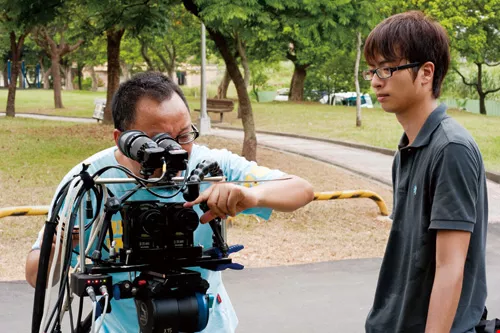
After successfully negotiating the gates of hell, Chu developed a new approach to life. He hopes to express his personality through his work-to make it his own through the study and mastery of 3D techniques. The picture at center shows him teaching his young staff how to shoot 3D, and right is an educational e-book that contains many of Chu's 3D images on an ecological theme.
Although many know only of Chu, who turns 43 this year, as figurehead of the 3D movie scene, he has in fact been working in Taiwan's film and television industry for more than 20 years. He graduated from the Electronics Department of National Keelung Commercial and Industrial Vocational Senior High School, but because he wasn't particularly interested in study and lacked any practical skills, his first job after military service was in real estate. "But I lacked the 'gift of the gab' and lasted only a short period in real estate before I quit," says Chu.
For quite a period, he was at a loose end. Then at age 23, in the early 90s, he noticed a newspaper advertisement for an assistant cinematographer at Feichien Media, a well-known film and television outfit of the period. Because the position required no specialized experience (and also because he had been jobless for three months), he went for an interview, disregarding entirely the meager monthly offering of NT$6,000.
His first job as assistant cinematographer was in the popular TV series The Postman Always Rings the Wrong Bells, though as a newbie Chu's main task was to hold the microphone. His first experience in a film studio triggered great interest and curiosity at everything that was happening. In several very funny scenes, Chu was supposed to hold the microphone in silence, yet he laughed out loud as he had become so involved with the plot-which did nothing to endear him to the rest of the film crew. The general response was shouts of anger: "Are you here to work or to watch the show?"
Despite his lack of success at holding microphones, he gained a fascination for everything to do with the film industry, and for eight months focused intently on his work, learning all the time. Eventually he was promoted to the position of full-time cinematographer, tasked with filming many TV shows that were popular at that time, including Full Swing, Golden Charts, and Quack Woo Lala.
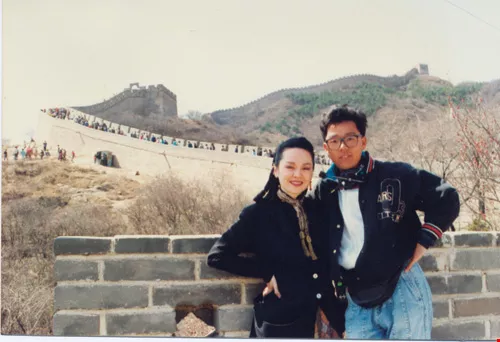
Chu's training as a cinematographer provided him with a solid foundation in movie-making. Pictures left to right show Chu with Hong Kong actor Alex Man in 1991 when they were shooting Golden Charts; with famous local singer Stella Chang about 15 years ago producing her music video in France; when shooting Tsui Tai-ching's MV at Beijing's Great Wall in 1989; with Shu Qi (second from left) while shooting her nude photo album at the start of her career more than 10 years ago; and while shooting Buddhist Master Hsing Yun's album of prayers in 2002.
Because of his developing skills and hard-working attitude, Chu's talent began to be recognized by a number of well-known directors in film and television. So gradually he progressed from being known as "Little Chu" to "Brother Chu", and then later to "Grandpa Chu." Always full of energy where film was concerned, he quit his job at the media company and established his own venture. By that stage, his skills were in great demand by a number of entertainers including veteran singer Wu Ching-hsien, whose series of karaoke videos (actually made by a Japanese company) were shot by Chu. He was also responsible for a range of music videos by well- known singers, such as Pai Ping-ping, Kerris Tsai, Chang Hsiu-ching, Tsai Hsiao-hu, Malas Kao, and Shen Wen-cheng.
After gaining both fame and fortune, Chu's work tended to diversify, from TV programs, advertisements, and music videos, to product launches. As long as he could squeeze it in, he would take all the work that was offered. This almost superhuman effort lasted until 2002, when there occurred a dramatic turning point in his life and career.
Chu was at the peak of his career, when one day flying from Shanghai to Taipei, he suddenly found himself suffering very severe tinnitus. Initially, he thought the problem was caused by air pressure in the cabin, so he wasn't terribly concerned. But a few days later, when he was putting on his shoes at home, he fell without warning and simultaneously lost hearing in his left ear. He went immediately to Keelung Chang Gung Memorial Hospital for treatment, but no apparent cause was found. Then later he attended Chang Gung Memorial in Taipei and Linkou. Eventually, it was discovered that a fist-sized tumor was growing in his cerebellum, and had surrounded six pairs of nerves that control the left-side functions of swallowing, vision, hearing and facial feeling.
"Medical staff at Linkou Chang Gung Memorial Hospital told me that if I did not have an operation immediately, I would probably have only six months to live, and if I was spared death, there was a 50% chance of going into a persistent vegetative state. I was only 35 at the time, and my wife was still young. In fact, the eldest of my three daughters was still in kindergarten. This terrible news was really a bolt from the blue for our family!"
Chu knew that he probably wouldn't live long, so he wrote a posthumous letter to his wife. He even invited a good photographer friend to take photos of himself and the whole family. At that most desperate moment, Buddhist Master Hsing Yun, who had once asked Chu to shoot a video promoting the spread of the dharma, fortunately introduced Chu to neurosurgeon Dr. Chen Min-Hsiung, director of the Neurosurgical Institute, Taipei Veterans General Hospital.
"Unexpectedly, Dr. Chen disagreed with the diagnosis I had received from Chang Gung Memorial Hospital. He thought the tumor was benign, which meant that the chance of surgical failure could be reduced to only about three percent. Although I was half in belief and half in doubt, I grasped at this new hope as I would have grabbed a piece of driftwood in the dark ocean at night. I decided to give myself a chance: to have the operation," recalls Chu.
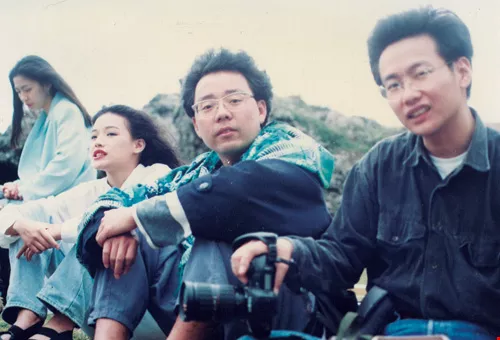
Chu's training as a cinematographer provided him with a solid foundation in movie-making. Pictures left to right show Chu with Hong Kong actor Alex Man in 1991 when they were shooting Golden Charts; with famous local singer Stella Chang about 15 years ago producing her music video in France; when shooting Tsui Tai-ching's MV at Beijing's Great Wall in 1989; with Shu Qi (second from left) while shooting her nude photo album at the start of her career more than 10 years ago; and while shooting Buddhist Master Hsing Yun's album of prayers in 2002.
The 18 hours of brain surgery were very successful, Chu eluding death by the closest of margins. But despite his new chance at life, he was left with a range of semi-permanent afflictions, as the tumor had affected the nerves controlling his left craniofacial functions.
The biggest impact was that he lost hearing in his left ear. His left eye often felt dry and tears flowed easily, so very often he suffered blurred vision. His ability to swallow was slightly affected, and sometimes he would begin to retch for no reason. He lost some degree of feeling on the left side of his face, as though he was touching his face through a piece of cloth. Even six months after the surgery, he had to sleep with an eye patch to help him close his left eye.
During the year-long process of learning to live harmoniously with his various disorders, Chu developed a new sort of understanding for life. He decided that his past work was in a sense blind and indiscriminate; he needed to get rid of this blindness in order to express his personality through his work: to make it his own.
Thus, in 2006, after the emergence of the high-definition digital video camera, Chu was directing soap operas such as A Beautiful Song, Herb of Lover, and Happy Choice from Hong Kong TVB television. But at the same time, he was travelling across Taiwan recording the beautiful scenery and local culture of the nation with his HD digital camera. These were later edited into films such as The Century of Taiwan and Postcards from Taiwan, which were shown on the Public Television Service channel.
Besides digital work, Chu also began to take an interest in 3D imaging, a field which had always held fascination for him, but for which he had not been able to spare the time. Initially, he intended to visit the experts in Europe or the US to learn the medium, but the fees were outrageous and they wanted him to buy their camera equipment if he wanted to learn about 3D. Chu found this unacceptable, so finally he bought two 3D cameras from Germany and worked it out for himself.
The basic principle of shooting 3D involves a "right and left" visual setup, which means two camera lenses to shoot images from different perspectives, simulating human vision. With special devices like glasses so the audience receives different signals for each eye, three-dimensional effects can be achieved. However, if the two camera lenses are not precisely adjusted, the angular difference between the two images that the audience will experience will be too great, and they can become disoriented and feel dizzy.
Chu, with his unbalanced binocular vision, found all this extremely difficult when he was getting started with 3D. Because his left eye was often teary and blurred, constant peering at 3D images often led to a great deal of discomfort.
"In addition, I had little understanding of the techniques of 3D imaging at the outset, so I just followed my old habits. I tended to overuse the mix of positive and negative parallax techniques, and as a result I became dizzy and vomited the first time I watched my work in the editing room. I finally finished the editing by taking car-sickness tablets for a whole month!" The ever-optimistic Chu happily regards his inflictions as the standard indicator of whether his 3D shots are acceptable. "If I can watch my own work without getting dizzy, then I feel confident that it will be acceptable for the audience. I often joke that I'm the lucky possessor of 3D eyes!"
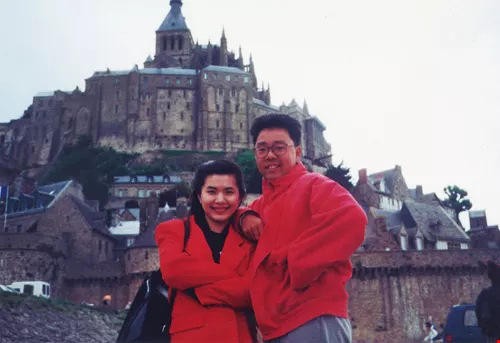
Chu's training as a cinematographer provided him with a solid foundation in movie-making. Pictures left to right show Chu with Hong Kong actor Alex Man in 1991 when they were shooting Golden Charts; with famous local singer Stella Chang about 15 years ago producing her music video in France; when shooting Tsui Tai-ching's MV at Beijing's Great Wall in 1989; with Shu Qi (second from left) while shooting her nude photo album at the start of her career more than 10 years ago; and while shooting Buddhist Master Hsing Yun's album of prayers in 2002.
Chu also enjoys dabbling in real estate, and since 2006 has sold four properties in very good areas of Taipei and Keelung, raising more than NT$45 million to put towards the purchase of 3D cameras, tripods and other essential gear. With four years of intense experience to hone his skills, Chu has become a master of the 3D genre. In last year's Golden Horse Film Festival, he showed his documentary Kuke Task, the first 3D film to focus on insects and environmental protection, winning enormous praise from his peers.
The drama Clownfish signaled another crucial point in Chu's life.
"On the one hand, I hoped that I could produce a film for my daughter to enjoy, with no bad language or violence; on the other, I wanted to show the world that Taiwan could produce live-action 3D movies," says Chu.
With Chu's mastery of 3D, the shooting of Clownfish was completed in only 15 days. Thus, costs-actors, shooting, venues and other miscellaneous expenditure-could be held at around NT$2 million. So although the film had a poor box-office, for Chu it was basically a break-even venture.
And then there are the offshoots from Clownfish to consider, which for Chu have been enormous. "Life in Taipei and Mayday 3DNA, for example, each cost more than NT$10 million. At the moment I am the only director in Taiwan skilled in 3D with a lot of my own unique techniques, so a lot of the big technology companies seek permission to use my content to test their new products like 3D screens."
Chu argues that although Clownfish basically lost money, it has in fact contributed to recognition of his position in the Chinese-speaking film market. "For me, the film has generated enormous gains." Chu is full of confidence, and is planning to produce two full-length dramas based on unusual subjects: "the soul of the unborn" and "fortune-telling." He enthuses: "The stories are fascinating and address a number of moral issues, but they shouldn't be too scary for audiences."
Chu has successfully negotiated the gates of hell, and with the advent of 3D has created new perspectives on a bright new world for himself!

After successfully negotiating the gates of hell, Chu developed a new approach to life. He hopes to express his personality through his work-to make it his own through the study and mastery of 3D techniques. The picture at center shows him teaching his young staff how to shoot 3D, and right is an educational e-book that contains many of Chu's 3D images on an ecological theme.
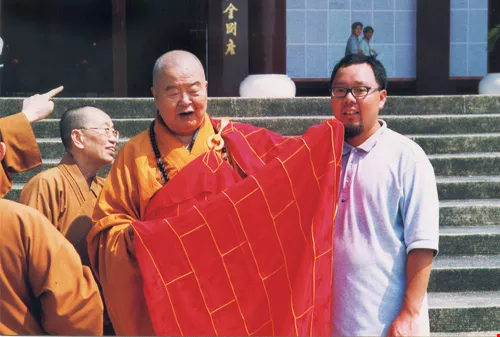
Chu's training as a cinematographer provided him with a solid foundation in movie-making. Pictures left to right show Chu with Hong Kong actor Alex Man in 1991 when they were shooting Golden Charts; with famous local singer Stella Chang about 15 years ago producing her music video in France; when shooting Tsui Tai-ching's MV at Beijing's Great Wall in 1989; with Shu Qi (second from left) while shooting her nude photo album at the start of her career more than 10 years ago; and while shooting Buddhist Master Hsing Yun's album of prayers in 2002.
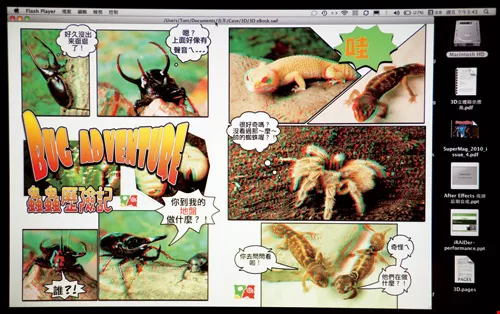
After successfully negotiating the gates of hell, Chu developed a new approach to life. He hopes to express his personality through his work-to make it his own through the study and mastery of 3D techniques. The picture at center shows him teaching his young staff how to shoot 3D, and right is an educational e-book that contains many of Chu's 3D images on an ecological theme.
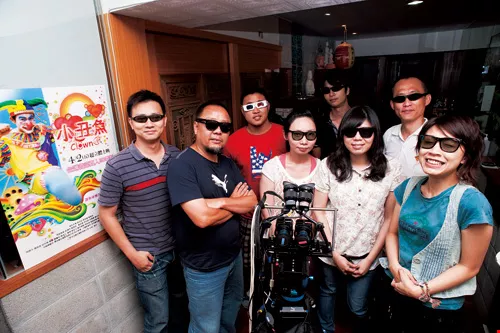
Gene Young 3D iMAGE, a company which Chu founded, is currently one of the few production houses active in the 3D field. The average age of staff is under 30. The picture shows Chu (second from left) and his team wearing 3D glasses.


