Flying Into Painting--Chinese Artists and Birds
Chang Ching-ju / photos art courtesy of the National Palace Museum and prints courtesy of Ho Hua-jen / tr. by Christopher Hughes
February 1993


Two months ago a Canadian artist, J. Fenwick Lansdowne, held an exhibition in Taiwan on the theme of Chinese rare birds. His lively and fine depictions of Chinese birds and their habitats has led many people, including some ecologists, to exclaim: "The Chinese have not been good at giving realistic renderings of birds and their habitats, which is something they should strive hard to do in the future." Words that were not perhaps entirely fair to Chinese painting.
Today the rise of environmental awareness and the rapidly increasing numbers of bird watchers has been accompanied by a flourishing of the art of bird painting. What distinguishes this painting above all from the classical Chinese genre of bird and flower painting is that artists today take the various species of Taiwan's wild birds as their subjects and venture deep into the high mountains to make firsthand observations and record birds and their surroundings to make the sketches for their paintings.
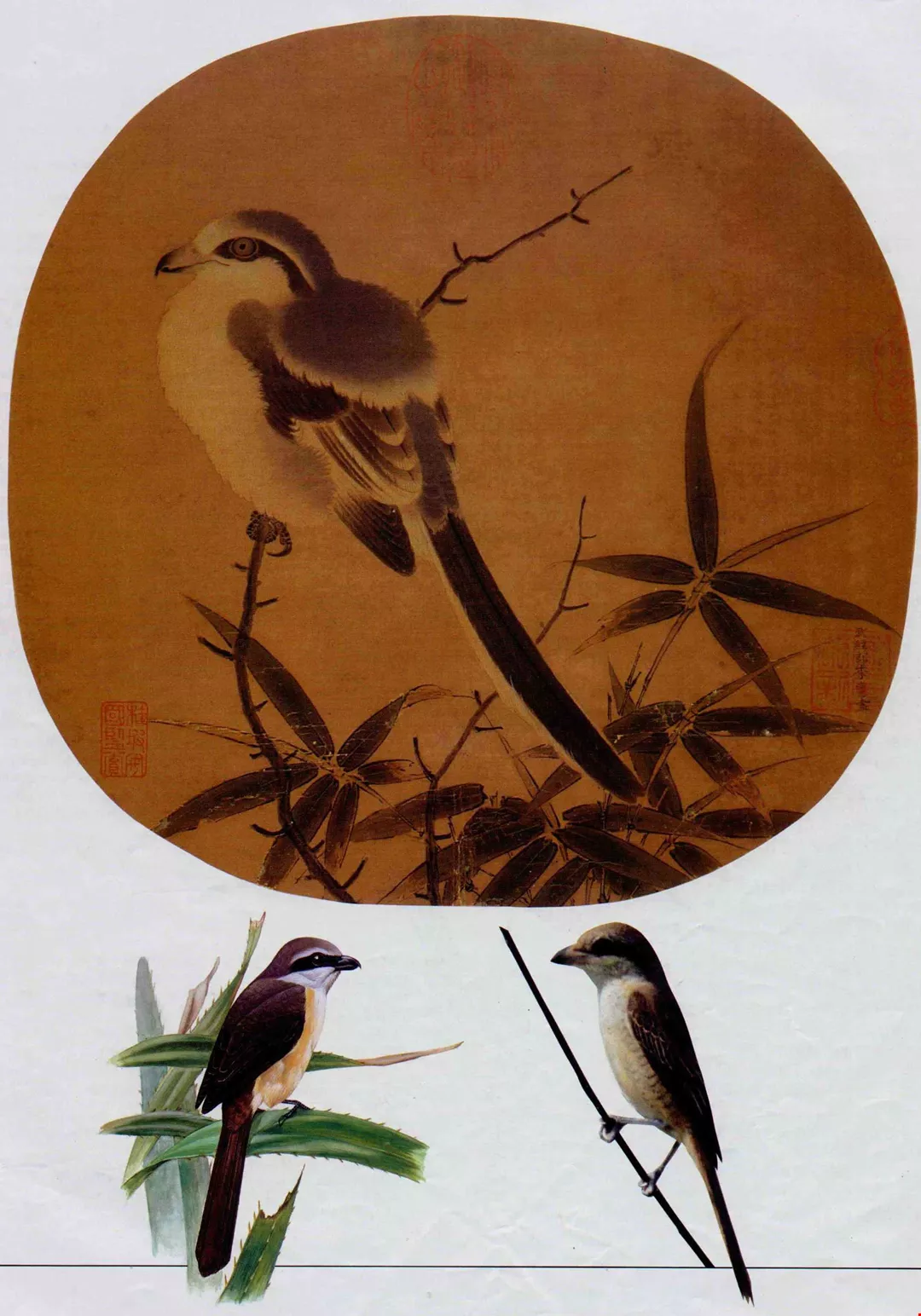
In this painting of a "bamboo pigeon" (shrike) by Li An-chung of the sung dynasty, the upper part of the bird's beak is slightly curved, covering the lower part, while there is white coloring over the eye and on the shoulders and layers of coloring on the body are disdtinct. It seems as vivid as either the one in the wild or the one painted by Ho Hua-jen, except that the Sung dynasty painter chose to emphasize the round body shape. (right photo by Kuo Chih-yung, left picture courtesy of Ho Hua-jen)
A new path for bird and flower painting?
By comparison, the lack of detailed observation in traditional bird and flower painting has always tended to leave people with the impression that it lacks "realistic feeling." It is as if the extreme refinement of brush work in such paintings leaves them like dead specimens. With the growing number of bird watchers gradually getting to know the names and ecology of Taiwan's wild species, people are less ready than ever to accept such traditional bird and flower painting. Now many people have come to the opinion that the ecological style has opened a new path for Chinese bird painting, which used to consist mainly of detailed brushwork imitations of the ancients.
Two years ago, the Chinese Postal Museum thus issued a set of stamps featuring the wild bird paintings of Yang En-sheng which have been very warmly received, and an exhibition was held last year of prints of Taiwanese bird species by Ho hua-jen, which received much critical acclaim. Cards, calendars and notebooks on the theme of wild birds are everywhere. The exhibition on Chinese rare birds by Lansdowne, which was four years in the planning, also created quite a stir.
In general, the recent observation of wild birds and painting styles began in the West, which is therefore where many ecological bird painters received their inspiration from. But is ecological observation and the realistic painting of birds and their environments really a Western tradition?
Lin Po-ting, acting curator of the department of painting and calligraphy of the National Palace Museum, with nearly 20 years of bird watching experience behind him, and a veteran bird lover and fellow of the Bird Watching Society, thinks this is not necessarily so. Whereas other people watch birds so as to indulge their interests in nature, Lin Po-ting sets out with the added purpose of using it to help him get a better understanding of the sentiments enjoyed by the painters of Chinese bird and flower paintings through the ages and make progress in his knowledge of how to tell authentic from fake works of art.
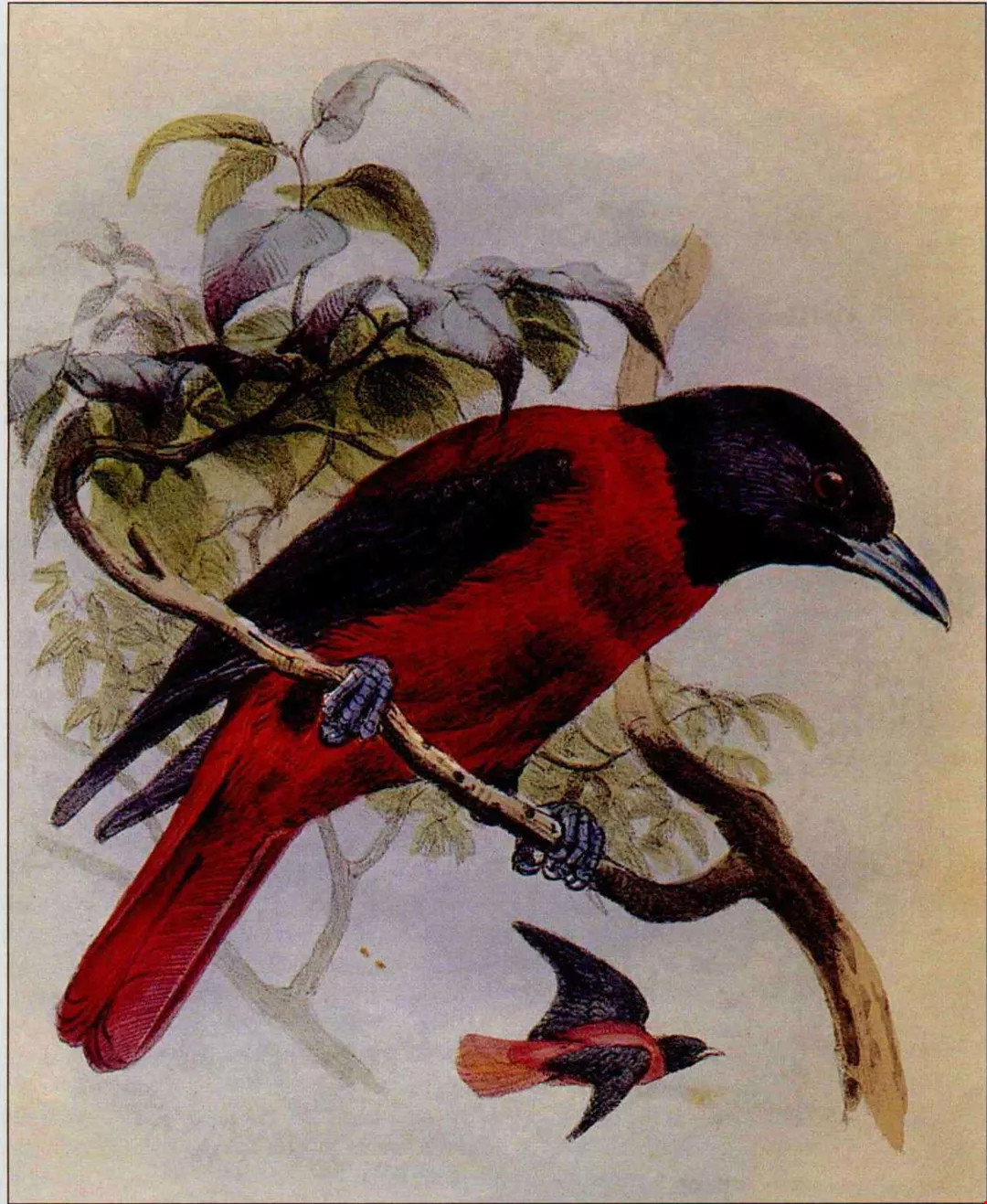
(Above)The maroon oriole painted by the nineteenth century German artist Wolf appeared in the English ornithological journal /bis. The modern style of painting wild birds began with depictions by Western painters of the flora and fauna collected by biologists from all over the world.
The ancients paint it; the moderns bake it:
An incident that happened to the previous deputy director of the museum, Li Lin-tsan, can clarify the reasoning behind this.
Thirty years ago, Li Lin-tsan sent some great masterpieces from the National Palace Museum to San Francisco for an exhibition. At the exhibition there was one spectator who stood revelling in front of the painting Bamboo Pigeons by the Sung dynasty artist Li An-chung for more than two hours. He eventually got up his courage and invited Li to his house because he wanted to discuss something with him. Although Li was a bit dubious, it was hard to turn down such a kind offer. On arrival he was confronted by a cage containing two birds which were the spitting image of those in the Li An-chung painting.
The American proudly pronounced: "My Chinese friends, you say your painting is based on my birds? Or are my birds based on your painting?" At which they fell about laughing.
For the bird watchers of today, what the ancients called "bamboo pigeons" are in fact the familiar shrike that passes through Taiwan every year. In fact roast shrike was once a delicacy served to guests in the Kenting area. Ten years ago, when environmental awareness was just picking up in Taiwan, environmentalists put much energy into appealing to the residents of Kenting to stop trapping this bird, making it the first animal for which demands for protection were made.
Today as soon as bird lovers catch sight of the bamboo pigeon painting they will exclaim, "the shrike!" The most obvious of the shrike's special characteristics are that it stands alone in the high branches of trees and its eyes roam widely in all directions. In Li Lin-tsan's view, as for the bamboo pigeons in the paintings, "How could their grand, imperious, imposing manner ever be captured by a camera?" Unfortunately, Li An-chung, who carried out detailed observations, could not have foreseen that today's trappers would catch the shrike, exploiting its particular habit of perching up high in its position of great preeminence.
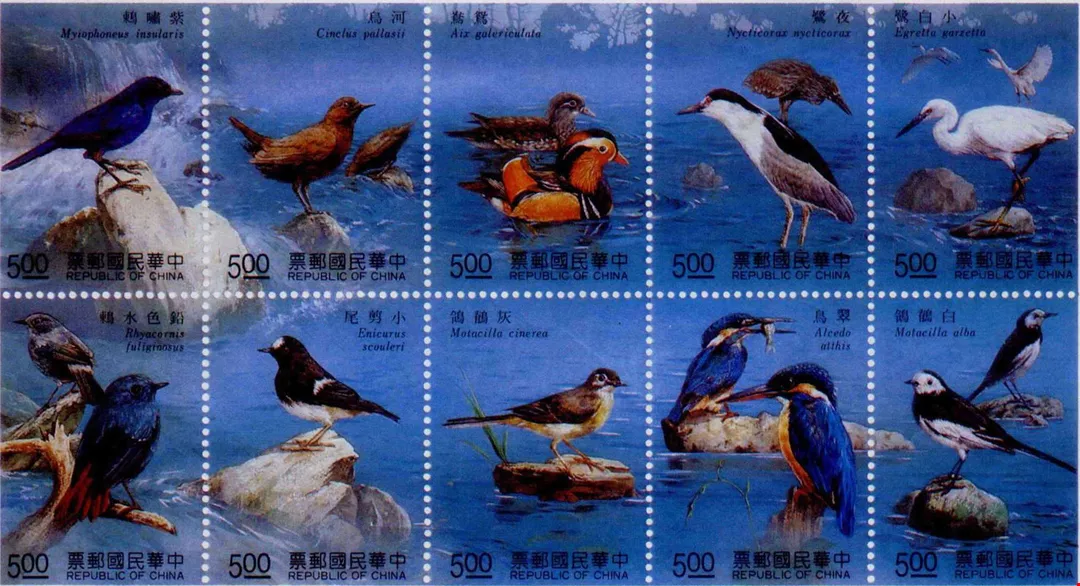
(Below)Two years ago, the issue of stamps by the Chinese Postal Museum showing the wild bird species of Taiwan's mountain streams by Yang En-sheng was widely welcomed. The challenge for artists wanting to unify art and science is a big one.(courtesy of the Chinese Postal Museum)
Humble ecological observation:
"The first generation of Chinese painters were like today's scientists and carried out very scientific research into nature," says Chiang Hsun, former director of the fine arts department at Tunghai University. In the past he always felt that Chinese artists just portrayed their inner sentiments through a kind of expressionism, but this was actually a big mistake. This was especially the case in the Sung dynasty, when artists were influenced by the empiricist zeitgeist of a flourishing rationalism, which led them not only to observation of the structures of things, but also to an analysis of their anatomy.
Chinese artists used their eyes to observe the myriad things of nature, such as the structures of rocks and mountain formations, and took their brushes to catch nature's most magnificent objects through a variety of intricate techniques of the brush. "No matter whether you are talking about East or West, there were very few later artists who were so like scientists and made such observations of the structure of rocks," says Chiang Hsun.
It is interesting that some thirty years ago Li An-chung's Bamboo Pigeons led to comparisons being made between the ancients and moderns. People have also been moved by the story of the Northern Sung painter Ma Yuan, who even more conspicuously reveals the humble attitude taken by Sung artists in their observations of nature.
Following the conquest of the Northern Sung, Ma Yuan fled from north to south China where he settled at Hangchow's West Lake. He was soon confronted by many obstacles as he tried to use the techniques he had garnered from observing and painting the arid northern mountainscapes to portray the warm scenery of the south. This led Ma to travel widely, observing the mountain scenery of the south and such phenomena as the shapes created by the action of the sea on stones and the patterns made when water passes over land. He went on to produce 12 albums on the relationship between water and coast.
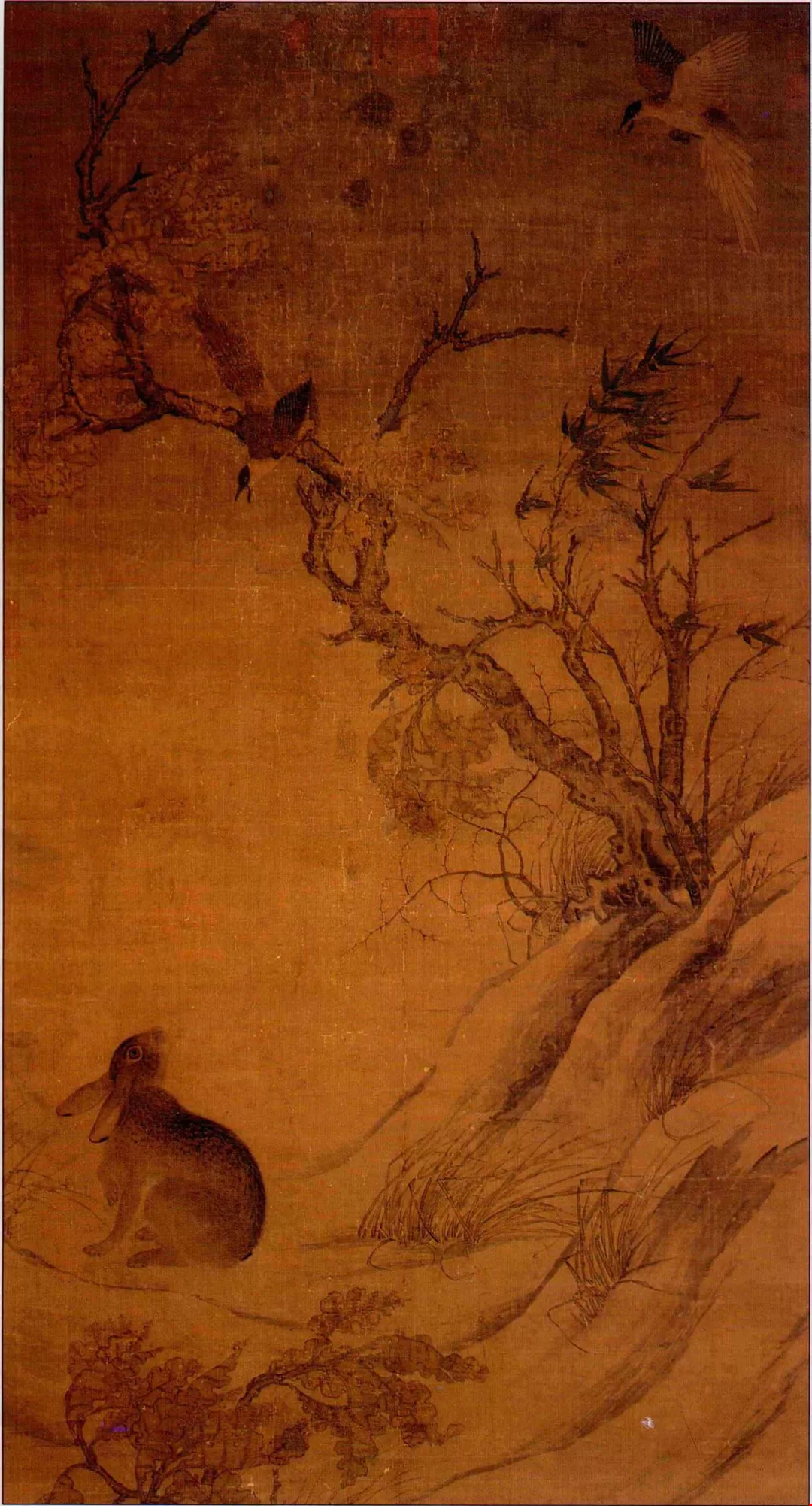
The unity of form and spirit evident in Tsui Pai's Double Happiness is representative of the Sung dynasty genre of flower and bird painting from.
A supporting role in Western art:
Because Chinese philosophy has never put people in a superior position, the myriad things of nature occupy an important position in the sentiments of the Chinese people. Thus birds, fish, apes and other animals in flower and bird painting have always gone to make up one of the three main themes of Chinese painting, along with mountain landscapes and people.
Looking on the other hand at the unsurpassable religious paintings of the same period in the West, "animals just play supporting roles," says bird artist Ho Hua-jen. It seems there are just not any representative works of purely animal art that can be discussed in Western art history.
By the sixteenth century the influence of Greco-Roman classical art in the West had reached saturation point. With the opening up of sea routes, Japanese flower and bird painting that originated from China came to be highly regarded by Western painters and entered into the mainstream of Western painting. However, due to the different philosophical outlooks of East and West, the ripples it made were still too small.
As for China, the long process of familiarization and observation gone through by the ancients enabled bird and flower painting to secure an important place in its later art.
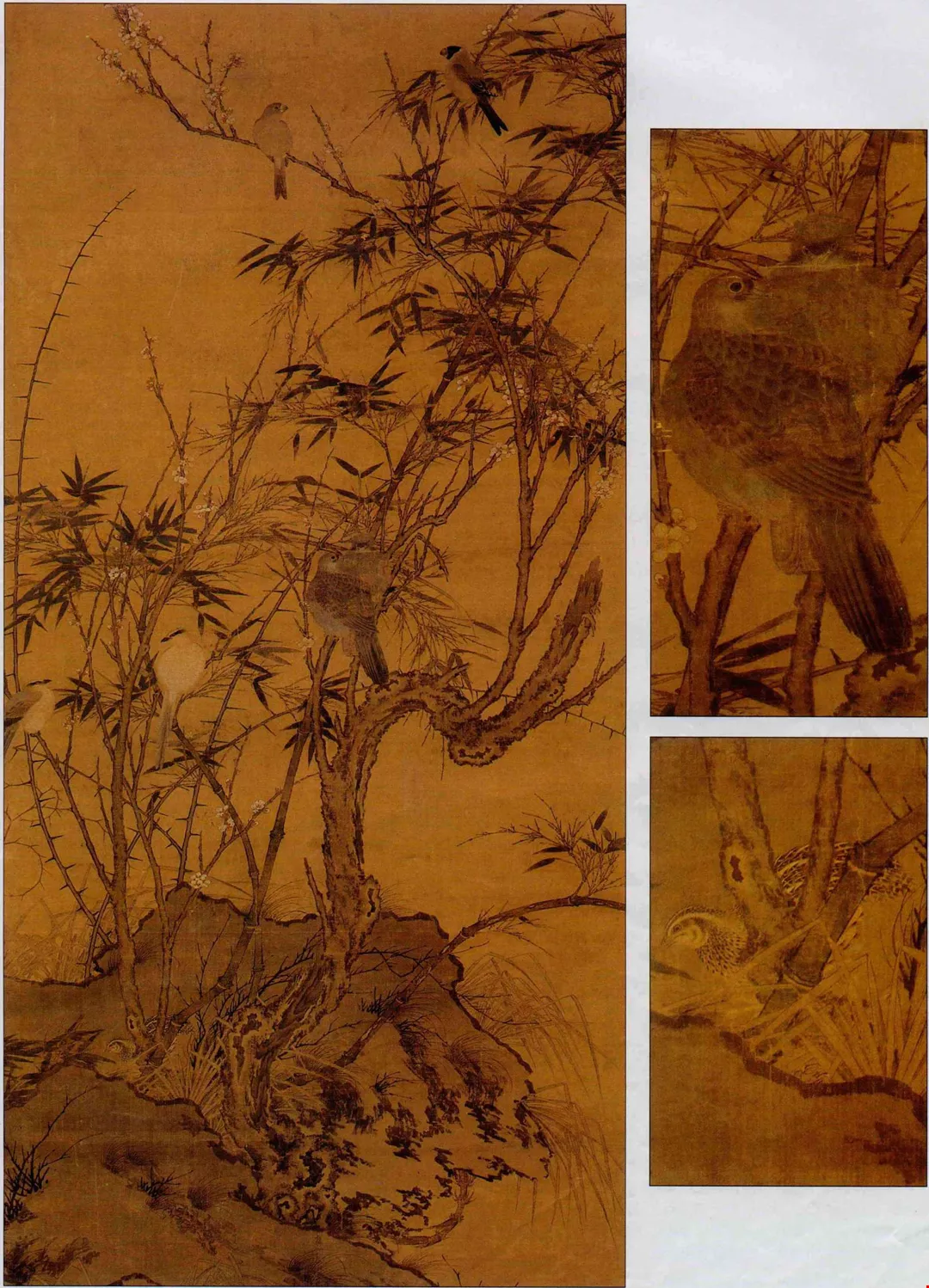
Art historians say that Plum, Bamboo and Animals from the painting academy of the Sung emperor Hui Tsung reveals that the artist not only knew how bamboo grows and sprouts leaves, but also that he understood the difference between the long fine feathers of the pigeon and the pointed plumage of the quail.
A bird in the bush worth two in the hand:
Hsu Cheng, director of the registration department at the National Palace Museum, says that flower and bird painting started growing from thinking about nature in the Tang dynasty, and after a rapid blossoming in the period of the Five Dynasties took to the path of realism, seeking to imitate nature in its mode of representation. With such realism requiring high artistic skills, perfect technique became the objective sought after by artists.
The earliest flower and bird paintings had excellent colors and beautifully delicate and detailed brush work, as can be seen in the work of the court painter Huang Chuan of the Western Hsu in the period of the Five Dynasties. The album he left for his son is just like today's illustrations with the subjects scattered on the paper with no apparent relationship, as though waiting to supply people with information. Although this work does not include a lot of birds, art historians believe such art is the best proof of the great spirit of natural observation possessed by the Sung artists, and it can be said to be the earliest example of bird illustration in China.
Bird lovers today can judge the species of birds from the special characteristics shown in paintings. The great tits that once flocked in Taiwan's mountains, and the white wagtails that pass the winter in Taiwan settling in the estuaries of the west coast, can all be seen in the bird illustrations of a thousand years ago. Although these are real illustrations,they were only meant as models for later people to imitate, unlike today's illustrations to which are added inscriptions introducing details of a bird's ecology, habits and appearance.
With much talent and artistic ability, the able poet and painter Emperor Tsung of the Southern Sung was also a realist when it came to painting birds. On one occasion the lychee trees in front of his palace were laden with fruit and the peacocks wandering to-and-fro beneath made a perfect scene which the emperor quickly summoned his artist to capture. However, in the resulting picture the birds were shown with their right feet raised. Emperor Hui told the artist that when a peacock rises up it should first lift its left leg, and when the artist went to see for himself this turned out to be the case.
In the eyes of art historian James Cahill, a painting from Hui Tsung's painting academy of plum, bamboo and animals kept in the National Palace Museum reveals how, "Under the feeling for realism there is concealed concentrated and patient observation. The artist knew how bamboo grows and sprouts leaves and understood the difference between the fine long feathers of a pigeon and the pointed plumage of the quail."
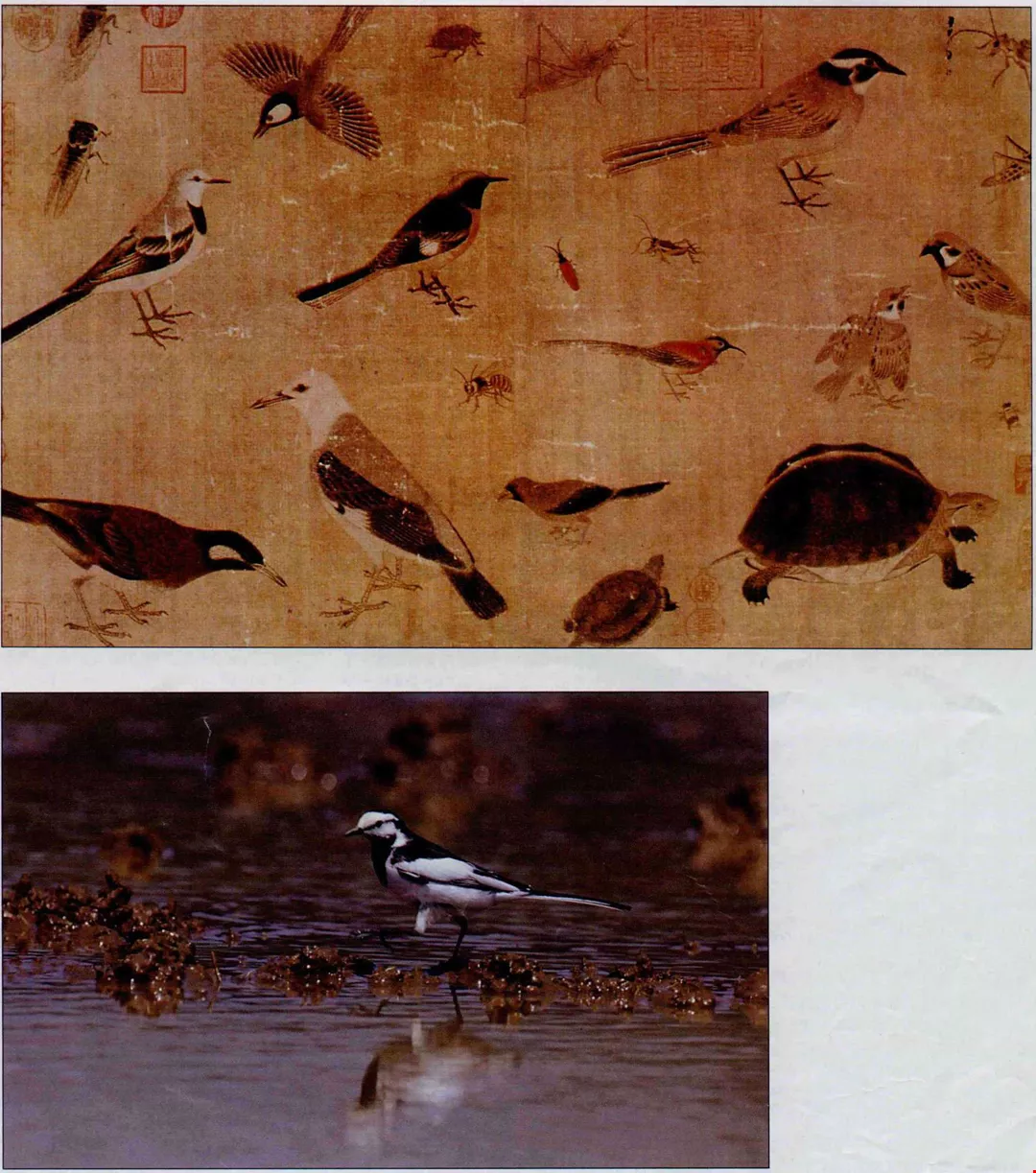
Huang Chuan's scroll of rare species painted from life features birds the names of which today's bird watchers can call out with ease. To the left and center of the picture can be seen the migratory white wagtail which passes through Taiwan every year. Below is a photograph of the white wagtail taken by photographer Kuo Chih-yung.
Surpassing realism, entering expressionism:
She Cheng explains that when the Northern Sung dynasty took over the artistic heritage of the Five Dynasties, realism was still of primary importance for painting technique. Techniques in the Sung had made progress over those of the Tang, and after they had gradually been able to catch reality, the level of connoiseurship advanced to touch the area above appearance. Apart from sheer indulgence in the pleasure of painting, art also came to be moulded by a love of searching out the inner essence of things. Flower and bird painting entered the main stream of Northern Sung painting, and apart from pursuing detailed and accurate outer description it came to place even more emphasis on expression of the inner being of the subject.
Lin Po-ting thinks that the portrayal of descriptive reality was just not enough for the Sung painters. Realism was no longer of paramount importance; it was rather the essential life of the subject that had to be brought out.
Lin Po-ting takes the Northern Sung artist Tsui Pai's Double Happiness as an example of art of both superseding appearances and catching the tone of the myriad things of nature. In this work, two magpies face off a hare that has crossed their territory; the birds stretch out their wings to scare the hare, their feathers ruffled by the wind; the hare turns in astonishment with a look of bewilderment, its body pliant with a realistic softness that makes you want to stretch out your hand and stroke it. Looking at what has been recorded today about the magpie, it is in fact a bird that defends its territory very fiercely.
In his history of Chinese art, James Cahill describes how in Double Happiness the artist's powers of observation and his ability to capture the essence of nature, "reveal a sympathy and understanding of life in the painting."
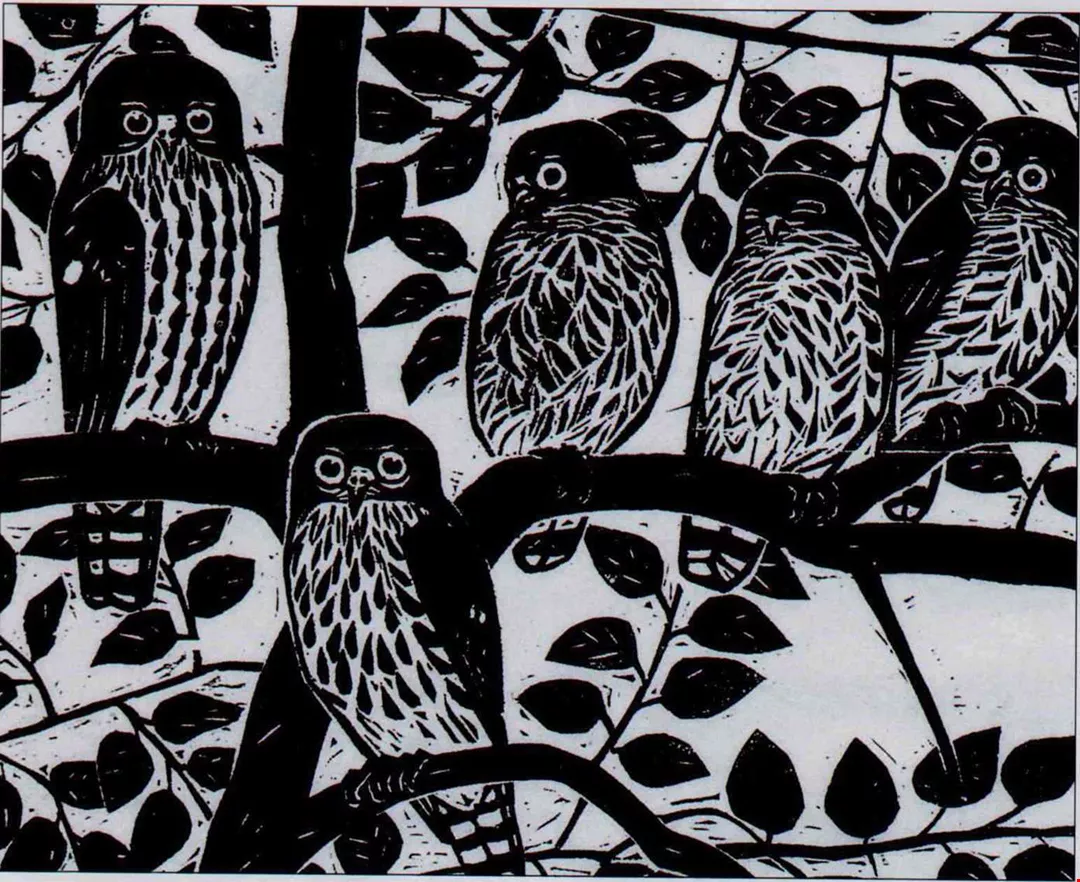
Ho Hua-jen, who held an exhibition of woodcut prints of Taiwan's birds, once left the city to travel to Liukuei and observe birds as an aid to capturing their spirit and ecology. This woodcut shows an innocent-looking wide-eyed owl in a style that is natural, simple and unexaggerated. (courtesy of Ho Hua-jen)
An 18-year fog in the woods?
In capturing the inner spirit of nature and conveying its living manifestations, the linkage of spirit and matter requires much hard observation. Thus flower and bird painting has been seen to be a refined pursuit using a simple elegance of color, as with the Hsu Hsi school of painting of the Southern Tang of the Five Dynasties period which managed to integrate its art with nature to such a great degree. I Yuanchi of the Northern Sung once went deep into the mountains to live with the apes so as to observe their ecology. Digging a pond for flowers, letting water fowl gather there and concealing himself in dark places to observe their activities, his spirit of investigation was not so far removed from that of today's ecologists.
Because the ability of the Sung artists to work from nature was built on the foundation of observation, when you share their ornithological experience many problems are revealed in what are faked Sung paintings as it is possible to observe whether they have been done from life or are just imitations. Lin Po-ting explains, "Usually later people imitated the Sung paintings with great skill, but they had not been through the process of observation, so they could often unwittingly reveal their weak points."
This is especially so with the Ming dynasty, when artists also worked from life, had great ability when it came to realistic portrayal and adopted a more florid style than the Northern Sung. Many works from that time were stamped with seals counterfeiting the Sung paintings. But if you look carefully you can discover that what they ultimately lacked was actually that special quality of thinking developed by the Sung after its engagement in studying the anatomy of objects.
Lin Po-ting says that one cannot go so far as to say that everyone in the Sung was possessed by the empiricist spirit, but at that time it was certainly a prerequisite for any artist who wanted to set about painting birds. It was this flourishing of research into the nature of birds that gives Sung paintings their degree of rationality when looked at from today's perspective.
Finding the self in contemplation of nature:
The basic nature of art is to evolve according to the principle of moving from simplicity to complexity, then returning back from over-complexity to simplicity. By the Southern Sung, painting had developed to such extreme realism that brush work tended now to veer back towards calligraphic simplicity. In sketching flowers and birds, the Southern Sung painters gave up intricate lines of neat perfection in favor of bold and vigorous strokes and forsook rich colors in favor of more gentle pigments. Simplification of form could bring out the impressionistic meaning of subjects, opening the way to vigorous brush work, forlorn imagery and the world of impressionism.
In his writing On Sparrows and Painting Sparrows, Lin Yu-shan, a painter of the older generation, says that the paintings of that time already show an understanding that beauty can be achieved without florid shapes and colors but through a simplicity and plain elegance that emphasizes the effects of brush work. Under the influence of this tide of thinking, although the "appearance" of a sparrow might be plain, its status is not inferior to that of a rare species and it came to play an important role in bird painting.
Art is essentially free and there are no fixed rules to determine how it should be done. After the Southern Sung, painters forsook appearances for the sake of spirit, thinking it was enough to just pursue the spirit of things and that true appearances could be given up. Those who followed could only say that this was a choice made by Chinese artists, an aesthetic shift that could be judged to be neither right nor wrong. Yet even this kind of change was still built on the detailed observation by which it was preceded, passing through the intermediary of formal expression, although the ultimate aim was complete self-fulfilment.
In the later development of Chinese art, artists on the whole came to believe that all that was needed was a richness of thought and no fear of crude technique and simple colors. People felt that human beings would never be able to really attain the rigorous standards of such a teacher as nature and had to get rid of gaudy representations. The return to nature was thus rather seen as a returning to one's own heart, a quiet listening to the dialog of nature with the self. Such was the case of the animal and bird paintings of Pa Ta Shan Jen of the Ching dynasty in which the subject is portrayed with just a few minimal strokes of the brush. Here the aim of using birds as subjects is to express the territory of the artist's inner being. It is this that the Chinese literati came to think of as being the highest attainment in art.
If you do not suffer the winter . . .:
Unfortunately, later developments, no matter whether of an impressionistic or realistic bent, have all been considered not in tune with the times. Lacking form and structure, following the whims of subjective opinion, "fish eyes came to be passed off as pearls, " while flower and bird painters gradually lost their interest in quiet contemplation of the myriad things of nature. The Ching dynasty artist Fang Hsun could thus say that while the flower and bird painting of the Sung was held in high esteem for its capturing of the vital significance of life, "Today when people paint vegetables, insects and fish using blobs of ink it is called impressionist, while detailed outlines and filled in colors are called realistic; thinking that impressionism follows impressions and realism is like life and resembles objects, they know not the meaning of the laws and ordinances established by the ancients. In reality, impressionism and realism are merely the portraying of the vital significance of the being of objects."
Apart from a small minority, most people arrived at the misunderstanding that Chinese flower and bird painting lacks the qualities of observation, only knowing the detailed craftsmanship and polish that harks after the refined brush work of the ancients.
At this time the West was passing through a turbulent stage in which observation of nature developed to become a special discipline.
In Europe after the Renaissance, the Enlightenment and the rise of commerce, the individual was released from the yoke of religion and people became conscious of the value of their own nature. Human existence and the materials conquered by people became the stuff of art. This was especially so for the Dutch, who colonized Taiwan and were the earliest to expand their markets and search for resources. When the ascending bourgeoisie became important buyers in the art market, this led to the rise of portraiture and the gentrification of subjects which came to include scenes common in everyday life, animals and plants, with rabbits, fish and birds often appearing in still lifes. The development of science and medicine and the flourishing of anatomy meant that gashed horses and wounded birds appeared in hunting scenes and became fashionable for a time. However, such art, revelling in the human conquest of nature, never became mainstream.
When China meets the West:
With the eighteenth century explosion in the natural sciences, many artists followed explorers to all corners of the earth to portray the flora and fauna they found. Such painting for the scientific record was concerned primarily with seeking factual truth. When tools were developed to aid in the appreciation of nature and ecological research took off, conservationism swept the world and the number of bird watchers increased daily. Scientific illustrations were produced in great quantities and the demands of the art market gave rise to the ecological art of today.
While the West is in the process of learning from nature, Western artists appealing for respect for the environment and set on portraying nature still lock swords with the traditional painters of the hunt. Now that the dust has settled, the natural ecology of plants and animals has become a favorite subject for artists. Birds, with their resplendent colors and great variety, have especially come to play an important role. "In this way China and the West are connected," thinks Chiang Hsun. Although Chinese artists in the past did not have the Western biological knowledge of what animals eat and how their bodies are shaped, "There are different kinds of scientific method, and the level of respect for the fundamental essence of nature had already reached a very high point."
Looking at it from the long river of art, China once took the lead in ecology. Yet aesthetics developed to take roads leading in different directions, no matter who has been fastest or most able. The ideals and thinking given to painting by the Western meeting of art and science in bird painting might accidentally be the same as those of the classical Chinese, but it can only be said that people today have finally discovered the wonders of nature and drawn them to areas of great beauty. It is thus that it has become the subject matter of painting.
Realism easy--art from life hard:
Today native culture is increasingly receiving more attention, and people are concerned about indigenous bird species. In science, great emphasis is placed on exact breeds and species, and painters strive to portray Mikado pheasants or other precise species of birds. What must be aspired to in painting birds, apart from aesthetic enjoyment, must still be to let spectators understand birds at a glance. The challenge for artists is very great.
"Ultimately, impressionism can paint with a bold freedom, although there is a fear that it lacks any real significance. But wanting to paint in a refined and detailed way that can bring your work to life is not at all easy," says Lin Po-ting. That the flower and bird painting of the Ming and Ching dynasties is said to have fallen into an ossified pattern was precisely because, having followed classical styles for too long, their work lacked vitality.
In fact, it is not that difficult to just go through a rigorous artistic training to overcome the difficulties of true representation. But to achieve the meeting of spirit and form, as did the artists of the Sung dynasty, artists must overcome the problem of style and not just technique.
Perhaps modern bird painting originated from the West. Yet an artist like Ho Hua-jen, who gave up his job to go to the central mountains to make observations, apart from seeking to paint birds realistically also wants to use his prints to represent the bird species of Taiwan with simple bold lines. Instead of being called Western, such an evolution might better be said to be even more Chinese in its travelling of the same road as the ancients. What must be fully realized is that just portraying a good likeness is not the essence of art. If you want to get back to real art, then questions of "real or unreal" are really of secondary importance.
[Picture Caption]
p.77
Nature's myriad manifestations have always been subjects for Chinses painting, although artists have never been confined to realistic portrayal but have pursued the spirit behind appearances. In this work by Ming dynasty artist Sun Lung, simple patches of ink fully capture the lofty air of the hoopoe. The photograph below shows a hoopoe caught in the lens of photographer Kuo Chih-yung.
p.79
In this painting of a "bamboo pigeon" (shrike) by Li An-chung of the Sung dynasty, the upper part of the bird's beak is slightly curved, covering the lower part, while there is white coloring over the eye and on the shoulders and layers of coloring on the body are disdtinct. It seems as vivid as either the one in the wild or the one painted by Ho Hua-jen, except that the Sung dynasty painter chose to emphasize the round body shape. (right photo by Kuo Chih-yung, left picture courtesy of Ho Hua-jen)
p.81
(Above)The maroon oriole painted by the nineteenth century German artist Wolf appeared in the English ornithological journal /bis. The modern style of painting wild birds began with depictions by Western painters of the flora and fauna collected by biologists from all over the world.
p.81
(Below)Two years ago, the issue of stamps by the Chinese Postal Museum showing the wild bird species of Taiwan's mountain streams by Yang En-sheng was widely welcomed. The challenge for artists wanting to unify art and acience is a big one.(courtesy of the Chinese Postal Museum)
p.83
The unity of form and spirit evident in Tsui Pai's Double Happiness is representative of the Sung dynasty genre of flower and bird painting from
p.85
Art historians say that Plum, Bamboo and Animals from the painting academy of the Sung emperor Hui Tsung reveals that the artist not only knew how bamboo grows and sprouts leaves, but also that he understood the difference between the long fine feathers of the pigeon and the pointed plumage of the quail.
p.87
Huang Chuan's scroll of rare species painted from life features birds the names of which today's bird watchers can call out with ease. To the left and center of the picture can be seen the migratory white wagtail which passes through Taiwan every year. Below is a photograph of the white wagtail taken by photographer Kuo Chih-yung.
p.88
Ho Hua-jen, who held an exhibition of woodcut prints of Taiwan's birds, once left the city to travel to Liukuei and observe birds as an aid to capturing their spirit and ecology. This woodcut shows an innocent-looking wide-eyed owl in a style that is natural, simple and unexaggerated. (courtesy of Ho Hua-jen)

@List.jpg?w=522&h=410&mode=crop&format=webp&quality=80)


