Taiwan’s Pop Music Incubator
The Taipei Music Center
Lee Shan Wei / photos Lin Min-hsuan / tr. by Phil Newell
January 2021
With its avant-garde architecture and cutting-edge technology, the Taipei Music Center stands proudly in the Nangang District of Taipei City. The first venue in Taiwan dedicated exclusively to popular music, its area of 8.92 hectares is divided by Civic Boulevard into a North Base and a South Base. From conception to completion the project took 17 years, at an investment of over NT$6 billion.
The center is a compound facility combining music and culture. The original concept was to create a pop music cluster, and the layout, with buildings surrounding a plaza, blends together performance, culture, and industry. It not only offers venues for live pop music performances but also provides an industry base for the creation of popular culture and lifestyles. It aims to harness the power of culture to add color to life in ways both educational and entertaining, helping spread the soft power of Taiwan’s pop music to the world.
.jpg?w=1080&mode=crop&format=webp&quality=80)
Music industry veteran Lu Sheng-fei is skilled at creating a musical atmosphere for different situations. Many people have fond memories of the movie soundtracks he scored for such films as Cape No. 7 and Twa-Tiu-Tiann.
Pop music cluster
On an expansive site near the Kunyang metro station, there now proudly stand three buildings of novel, futuristic design: this is the Taipei Music Center (TMC). What first catches the eye is a round building that glitters in the sunlight. The jagged outline of its roof is like a series of mountain ridges, giving the viewer a different impression when seen from different angles: this is the Concert Hall. Across from it stands a six-story cuboid structure known as the Cultural Cube. And finally there is an elongated building like a multifaceted jewel—the Creative Hub—its architecture mirroring its diverse content. Linked by pedestrian bridges, the three buildings form a ring-shaped cluster where the popular music and culture industry can be nurtured. “Many venues are built to be multifunctional, but the TMC was designed with a single goal in mind, which is something of a world first,” says Ding Dulan (known as Baboo), who as director of the TMC preparatory committee has been responsible for developing the center’s facilities and systems over the past three years.
“I come from the music world, and I want to be able to contribute all I can to popular music.” Lu Sheng-fei, who became the TMC’s CEO in October 2020, recognizes that this is a difficult job with a long road ahead, so he has adopted a flexible approach and is trying not to be overly ambitious. From being named Best Musician and Producer of the Best Album at the Golden Indie Music Awards to winning a Golden Melody Award for Best Album (Instrumental Category) and a Golden Horse Award, Lu has played a variety of roles, but has been persistent in always moving forward in his music career.
“Because the center has a specified purpose, we are better able to design the performance spaces.” From his perspective as a music professional, Lu rigorously scrutinizes the suitability of each aspect of the facilities. “The Concert Hall and the other small and medium-sized performance spaces are demonstration venues for cutting-edge technology.” Defined by its role as a leader in future technology trends, the TMC’s facilities are all built around a benchmark of future development. “We must stay on the cutting edge and keep up with global trends.”
Beautiful sets and a wonderful sound system are derived from the sophisticated backstage facilities. When you walk into the vast backstage space of the Concert Hall, you find hidden there the TMC’s “four treasures,” which enable performers to express completely novel concepts and give audiences an unforgettable feast for the eyes and ears.
At 16 meters wide and ten meters high, the TMC’s soundproof door is the largest in Taiwan. This scientifically tested piece of cutting-edge equipment offers superb sound insulation, meeting world-class standards. And its shock-resistant structure leaves it unaffected by the vibrations produced by an excited audience jumping about.
The sophisticated L-Acoustics K2 sound system, designed specifically for the Concert Hall, makes possible the finest in sound projection and range and gives audience members in different parts of the hall the highest possible sound quality. The robust “mother truss” stage rigging system can lower equipment directly down to the level of the first floor, reducing the number of tasks that workers have to do on catwalks. There is also a computer-controlled, electrically powered segmented elevator stage capable of a height difference of nearly three stories and with a load capacity of 750 kilograms per square meter; not only is it environmentally friendly, it reduces the time required for setting up the stage for performances.
The Concert Hall, with five stories above ground and three below, provides audience seating on three stories, designed for optimal comfort and vision. It has a maximum audience capacity of 6000 people.
As part of the Concert Hall’s visual design, specific colors are used to distinguish entranceways on each floor. The color used for the first floor is blue-green, with orange for the second floor, blue for the third, and yellow for the fourth. “We hope to give every person who enters the Concert Hall the most refreshing sensory experience possible.” By handling the subtleties with care, the TMC hopes to create an intimate space for the enjoyment of music.

.jpg?w=1080&mode=crop&format=webp&quality=80)
A cuboid look at the past
“The Cultural Cube will display a record of the history of the music scene in Taiwan.” Expected to open at the end of summer 2021, the “Cultural Cube” (which, true to its name, is cuboid in shape) is Taiwan’s first exhibition space with the theme of popular music.
The plan is for three stories in the structure to be used for a permanent exhibit, on the theme of “Our Songs, our Island: Stories from Popular Music.” It will tie together the evolution of Taiwan’s musical culture and provide microcosms of each era, enabling visitors to sense the power of history.
Inside the Cultural Cube, not only will there be static displays of artifacts to record classic moments in popular music in Taiwan, there will also be special exhibitions of diverse styles capturing the essence of each era. As well as showcasing local creative work, there will also be an effort to adopt an international perspective, using depth and breadth to inspire forward-looking thinking. These exhibitions will not be just about music, but even more about culture and life. Through cross-disciplinary cooperation, the Cube will accommodate a rich variety of styles and features.
.jpg?w=1080&mode=crop&format=webp&quality=80)
The architectural design of the TMC is very novel. There is beauty everywhere.
A strategic center
“I hope that the TMC will become a facilitator, so that people who want to enter this industry will no longer have to start from square one.” Lu Sheng-fei, as someone who has been there himself, well understands the hardship of entrepreneurship, and hopes that the TMC will be able to play the role of helpmate to newcomers entering the pop music industry. The Creative Hub, expected to open in 2021, will include live house performance spaces, recording studios, rehearsal spaces, and music classrooms. Providing full one-stop services, it will tie together the up-, mid-, and downstream segments the industry, becoming a comprehensive industry campus.
“At this venue we can hold forums, so this is like a strategic center.” Given the responsibility for executing the mission of the TMC, Lu has many strategic plans. “Given today’s market demassification, there has to be a complete transformation of marketing models.” For creators and performers, how to grab the attention of the listening or viewing audience in ten seconds or less is an enormous challenge. “Through a dialogue between people inside and outside the industry, we can produce even more ideas.”
Lu looks forward to the Creative Hub leading the way in training skilled people for the pop music industry. “I think it should start from high school and vocational high school.” An optimal performance is not simply the result of the artist’s work, but involves a variety of facets, from marketing to stage design, from the performance of instrumental music to the lighting and sound system.
Just as there are campus lecture tours during which senior music professionals share the tricks of the pop music trade with students who want to work in the music industry, the TMC will in the future also facilitate the transmission of knowledge from masters to pupils, sparking greater creativity.

The Concert Hall has a large “rock and roll area” where performers can interact face to face with audience members. (courtesy of the Taipei City Department of Cultural Affairs)
Pop music incubator
The TMC has come up with the concept of “a Concert Hall that embraces the future, a Cultural Cube that salutes the future, and a Creative Hub that takes one into the future” in order to live up to its core value of inheriting wisdom from the past and instructing future generations. In the tripartite space of the TMC, people will be able to immerse themselves in music and culture.
“Music has the power to add color to life.” It is an indispensible source of sustenance for the human spirit. Lu Sheng-fei, who won a Golden Horse Award in 2008 for Best Original Film Score and the prize for Best Music for a dramatic feature film at the 2012 Taipei Film Festival, takes an open-minded attitude, giving free rein to pop music. “We live in changing environments and circumstances and have to stay in step with the times.” Lu hopes to effectively bring into play the TMC’s function as the heart of popular music in Taiwan, not only as an incubator of talent for the pop music industry, but even more as an engine to revitalize pop music in Taiwan and bring the country’s soft power to the international stage.
.jpg?w=1080&mode=crop&format=webp&quality=80)
The Concert Hall has a vast backstage with multiple functions, including an enormous soundproof door, a mother truss stage rigging system, an elevator stage, and an international-quality sound system. These “four treasures” behind the scenes at the TMC are key to successful performances. (courtesy of TMC)
.jpg?w=1080&mode=crop&format=webp&quality=80)
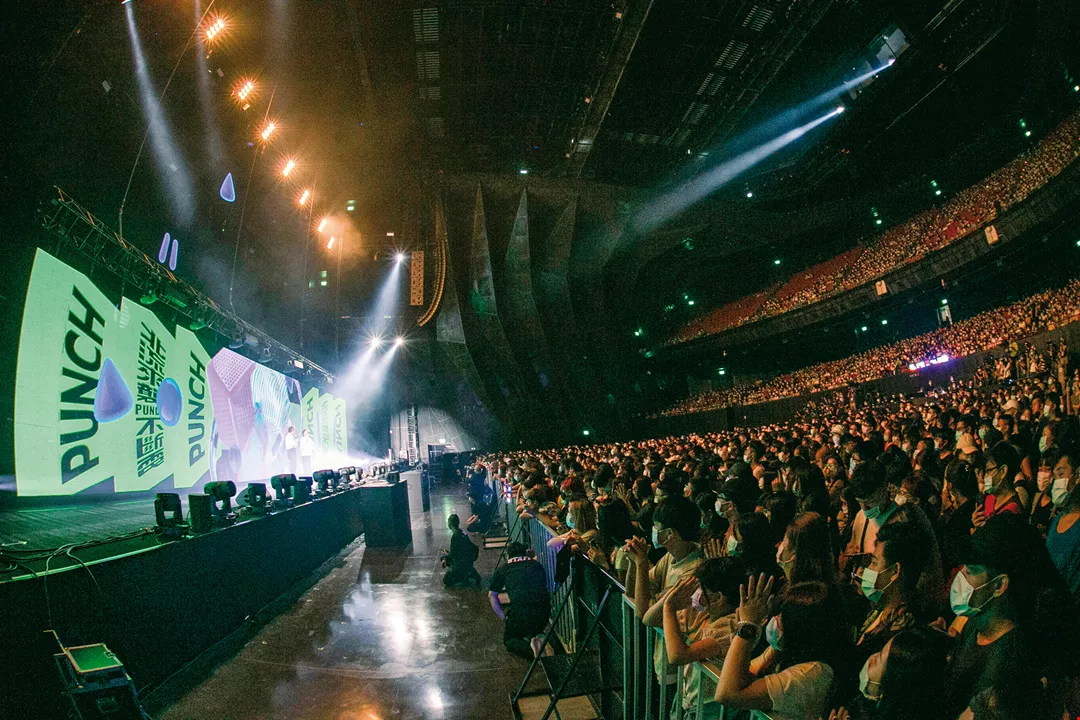
The Concert Hall can seat audiences of up to 6000. (courtesy of TMC)
