Home is Where the Part Is--Aging Taiwanese Opera Stars in the PRC
Tsai Wen-ting / tr. by David Mayer
November 2001


Wherever the Minnan dialect (southern Fujianese) is spoken, Taiwanese Opera is performed. Don't let the name fool you, however; the art form is not limited to Taiwan. Its peripatetic practitioners also ramble from stage to stage in places as far away as southern Fujian Province and Southeast Asia.
After mainland China fell to the Communists, a political barrier came to separate the two sides of the Taiwan Strait. Many stars of Taiwanese Opera, after enjoying marvelous careers in the 1930s and 40s, ended up staying on the mainland and suffering through the Cultural Revolution. The story of their lives is a moving one. . . .
Chen Ma-ling, a Taiwanese Opera performer nearing 70, sits reciting the names of others who, like herself, ended up in mainland China after the founding of the People's Republic. "Of those of us who came over from Taiwan, I may be the only one left. Both of my parents were Taiwanese Opera performers. They went to join up with a troupe in Singapore in 1934, and that's where I was born. I was ten years old before I ever got to Taiwan." In the stage world, this type of story is hardly unusual.
Never to return
Once in Taiwan she began studying for the stage under Little-Treasure Phoenix, a big star at the time. "I was just a kid, but I was already a very good performer." Having grown up in a stage family, Chen Ma-ling could remember stage lines after listening to them just once.
After the end of the war against Japan, Chinese all over Southeast Asia rushed back to their hometowns in southern Fujian to see relatives, venerate ancestors, build homes, take brides, and construct temples. Those were halcyon days for Taiwanese Opera. A Taiwanese Opera troupe from Xiamen traveled to Taiwan to put on a performance, and when the troupe, whose cast included Ma-ling's aunt, returned to the mainland in 1948, they were accompanied by over 30 performers from Taiwan, including young Ma-ling and her parents. They received an enthusiastic reception from fans who, recalls Ma-ling, were every bit as fervent as the ones you see today going to big pop concerts. "People would camp out every night to be first in line at the ticket window the next day." And everyone who played a xiao dan (young female) role had a nickname. Says Ma-ling with a laugh, "I was called Big-Head!"
Everyone figured at the time that they would be going back and forth between Taiwan and the mainland, but when the mainland fell to the Communists the next year, return to Taiwan became impossible.
Before Taiwan and the mainland came under divided rule, Taiwanese Opera troupes traveled frequently across the strait. Chen Ma-ling was one of the last to make the journey. The bustling commercial port of Xiamen, in particular, was the destination for many famous troupes from Taiwan in the 1920s and 30s. Of the "four superstars" of Taiwanese Opera in Xiamen back then, Jin Shanghua was the only one from Xiamen. The other three (Sai Yue-chin, Wei Ju-chen, and Tsu Tu-mei) were all from Taiwan. The people of Xiamen considered Sai Yue-chin the best of the four. Renowned for her performance of young male roles, she knew a huge repertoire of Taiwanese Opera tunes and folk songs, and was great at extemporaneous performances. Her fame soared with a play lasting several days called "Meng Lijun," in which she played the part of a woman who disguised herself as a man.
But society was in great tumult, and the fortunes of stage performers often rose and fell precipitously. During the war against Japan, Taiwanese Opera was prohibited on the mainland due to the fact that the land of its birth, Taiwan, was under Japanese colonial rule. Sai Yue-chin borrowed money left and right in order to flee to a rural inland area, where she performed on stage by night. The shows lasted until dawn, and the tough schedule brought on a serious gastric ailment for the frail Sai.
Worst of the bogeymen
After the Communist Party came to power, art was expected to serve politics. Private theater troupes were totally reorganized. All the Taiwanese Opera troupes there were made into state-run troupes, and their theater genre became known uniformly as Xiang Opera. Performers from Taiwan still living on the mainland were not exempted from the sweeping new changes.
In 1954, at only 20 years of age, Ma-ling played the part of a middle-aged woman in Beijing and Shanghai. Her strikingly convincing portrayal of an older woman garnered her several big awards.
Things went less smoothly for the more famous Sai Yue-chin. Her husband Li Chung-sheng, who was very accomplished at a wide range of Taiwanese Opera roles, died on stage when the gunpowder he was using for special stage effects accidentally exploded in his face. Sai herself later got into political hot water. Branded as a "capitalist roader," she was thrown into jail for several months. The voluble, strong-willed Sai found her treatment unbearable and attempted suicide by throwing herself down a well, but fortunately she was rescued. After her name was cleared in the early 60s, she became an instructor at an arts academy and went on to make a great contribution by compiling a big collection of traditional stage pieces.
All her fine work was destroyed, however, just a few years later in the Cultural Revolution. Worse still, artists from Taiwan suffered much more abuse during the Cultural Revolution than most others. Their profession alone got them classed as "one of the five counterrevolutionary types." The biggest stars were regarded as the worst of the lot, and were labeled accordingly.
Chen Ma-ling was seen as especially pernicious. Not only was she a big star, she was from Taiwan and led her own troupe, which qualified her as both a Taiwanese traitor and someone in a position of authority, which was just the sort of person Chairman Mao had singled out for attack. On top of that, she was in the habit of dressing differently from most other people, which got her labeled as an "anti-social heretic" who routinely behaved in an outrageous manner. When asked how she managed to get through those years, Chen is reluctant to say much: "It was naturally a very difficult time for me."
The outsider
As the PRC moved into a period of reform and liberalization in the 1980s, Xiang Opera got a second lease on life. Ma-ling received several awards in Fujian Province for her acting. The aged Sai Yue-chin became a staff member at the Fujian provincial archives, and later worked from her sickbed with scholars collecting oral histories. She was appointed to the local People's Political Consultative Conference in Xiamen, and passed away in 1986. As she neared death, she thought constantly about her relatives back in Taiwan.
Chen Ma-ling, on the other hand, spent only four years in Taiwan. All she remembers of Taipei is that "the meat-and-rice dumplings they sold at Ta Chiao Tou were delicious." Her parents are dead. She has never seen her Taiwanese relatives, and wouldn't know where to find them. When shown a videotape of recent street scenes from Taipei, she says, "That's not a bit like what I remember." Her household registration certificate lists her as a native of Taipei, but in reality, says Chen, "I'm an outsider in either place."
People have begun to forget Chen Ma-ling's name now that she is retired. When asked to see some photos of her past performances, she merely pounds on her legs, grown extremely painful from years of sleeping on hard floors, and says, "A retired person doesn't dwell on good times gone by."
Perhaps, for one who has chosen the stage life, political persecution and the lack of a homeland are not the scariest things in life. Perhaps the worst thing of all is seeing the curtain fall and the crowds go home.
p.077
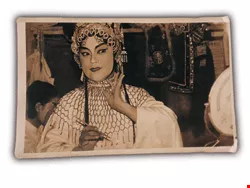
After Taiwan and the mainland came under divided rule, many Taiwanese Opera performers from Taiwan got stranded for decades in mainland China. A good number never saw Taiwan again. Shown at right is the Taiwanese performer Sai Yue-chin, who was regarded by audiences in southern Fujian in the 1930s as one of the four greatest stars of Taiwanese Opera. (courtesy of the Xiamen Municipal Institute of Taiwanese Arts)
p.078
(facing page) Chen Ma-ling, who traveled with her parents to mainland China just before the Communist takeover, remembers that when she first arrived in the mainland, theatergoers would spend hours in line waiting to buy tickets. Audiences nicknamed her "Big Head." (courtesy of Chen Ma-ling)
p.079
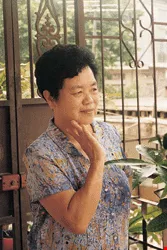
In her simple dorm room at the Zhangzhou Municipal Xiang Opera Troupe, Chen Ma-ling looks at an old photo and wistfully recalls the good times and the bad. (photo by Tsai Wen-ting)

@List.jpg?w=522&h=410&mode=crop&format=webp&quality=80)

@List.jpg?w=522&h=410&mode=crop&format=webp&quality=80)


