

Standing in front of a fire-belching furnace, a man swaddled in thick protective wear ladles out a scoop of molten bronze and pours the hissing liquid down the waiting mouth of a hollow stone. This could be a scene from the 21st century, or from millennia ago. The sight of a person casting bronze has not changed much in thousands of years.
It is recorded in the History of the Former Han Dynasty (a classic work completed in the second century of the Common Era) that the Yellow Emperor, founder of the Chinese nation, had bronze castings made as symbols of heaven, earth, and mankind, while Emperor Yu, tamer of the Yellow River, had nine tripods made to symbolize the territory under his rule. Bronze tripods, which originated in ancient China, came to symbolize righteousness and state rule.
Few people today have the slightest idea how bronzes are cast, but the symbolic meaning of the bronze tripods of old remains alive in the Chinese language even still-trustworthiness ("his word carries the weight of nine tripods"), excellence ("the power of his calligraphy brush could suspend a heavy tripod in mid-air"), and success ("they eat their meals from the finest tripods").
Anyone who visits the National Palace Museum (NPM) with frequency will have noticed that exiting Room 303 and entering Room 305 takes one out of the Neolithic Age and into the Bronze Age, when Chinese culture began making huge strides forward. For years now, the Mao Gong Tripod has stood at the entrance to the room, perched on three legs modeled after those of a wild beast.
The Mao Gong Tripod was cast in the latter years of the Western Zhou Dynasty by the emperor to show his gratitude for the excellent service to the state provided by his uncle, Mao Gong. There are older bronzes from the Xia and Shang periods, but the 500-character inscription on the Mao Gong Tripod is unprecedented in the history of early bronzes.
There are many types of ancient bronzes, classified according to their use. Tripods (ding) were for food, pan for water, and jue, jiao, jia, zun, you, and he for wines. These bronzes were used during the Shang and Zhou periods as ceremonial vessels in various rites and celebrations, and were also used as burial objects to show the status of the departed.
Craftsmen hired by the NPM to reproduce its ancient bronzes can recite these bronze facts like the ABCs. Surprisingly, however, even though these craftsmen spend their days closely communing with the models made from national treasures of the museum, some of them have never actually been there to see the originals.

A modern-day forge operator wrapped from head to toe in thick protective gear ladles out molten bronze at 1,200°C (facing page). The fiery liquid makes its way into the mold (detail above), where it puts on a hissing, glowing display of awesome beauty.
Little new in bronze casting
Liu Guoqing, a lost-wax craftsman who works on contract to the National Palace Museum, ticks off a list of reproductions that must be delivered to the museum by the end of September. In all, the list runs to 486 pieces. The third of five brothers, Liu Guoqing took over his father's business along with second brother Liu Guoxian and fourth brother Liu Guozheng.
Their late father first started doing contract work for the museum over 20 years ago, having been referred by an acquaintance. Now that a government procurement system is in force, such contracts must be awarded through an open bidding process, but the Liu brothers are almost always awarded a contract in the bidding procedures held every one or two years because there are so few lost-wax artisans left these days. The contracts have always called for the production of anywhere from several dozen to several hundred pieces.
Liu Guozheng, who also does original art making bronze flowers, notes that "the National Palace Museum always waits until they have almost nothing left in stock before they hold a bidding procedure." Contracts are not awarded on any regular schedule, so the income is not steady. The brothers therefore do other types of metal work, as well. Among other items, they make saxophone mouthpieces, incense burners, and ashtrays using lost-wax casting.
Bronze is an alloy of 80% copper and at least 2% of either tin or lead (or both). Most bronzes are made by casting. Archaeologists have discovered the remains of bronze casting operations at three different locations in Henan Province, and have determined that ancient craftsmen made their molds from pottery clay, and melted the metal in crucibles. Today the molds are generally made of silicone while the metal is melted in an electric furnace, but two things remain unchanged-the metal must be melted and cast at 1200°C or higher, and those working the metal must endure infernal heat as they sweat away in front of an open furnace.
Strolling into the Liu family's workshop in Xinzhuang City, Taipei County, I catch a slight smell of wax. The brothers are scheduled to fire up the furnace the next day, and are busy making a reproduction of Zi Fu Xin, a jue (wine vessel) from the late Shang made by a Prince Xin in memory of his father; thus the inscription zi (son) fu (father) xin (Xin family) that appears on the rim.
Liu Guoqing pours molten wax into the gap between the polyresin outer mold and the silicone inner mold. A half-hour later, after the wax has cooled and become solid again, Liu Guoqing opens the mold and takes out the wax model and hands it off to his wife and sister-in-law, who look for blemishes in the wax. Pockmarks are filled with beeswax, but if there is anything wrong with the patterns on the wax model, repair is impossible and they have to start all over again. Being a traditional mom-and-pop operation, the Liu family has no computerized equipment to ensure a perfect process, so in addition to painstaking attention to detail, a bit of luck is also needed.
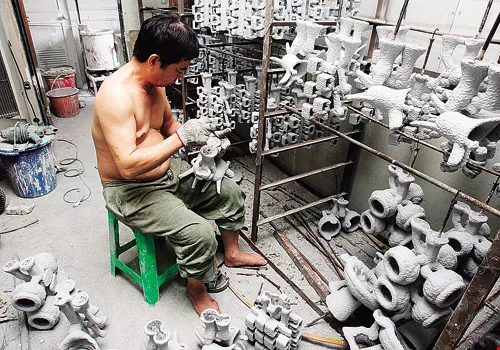
A wax model free of defects is covered with a coat of zirconium silica hydrogel, after which Liu Guoxian makes a sand casting mold by covering the model with a layer of coarse casting sand. This completes the preparations for the dewaxing.
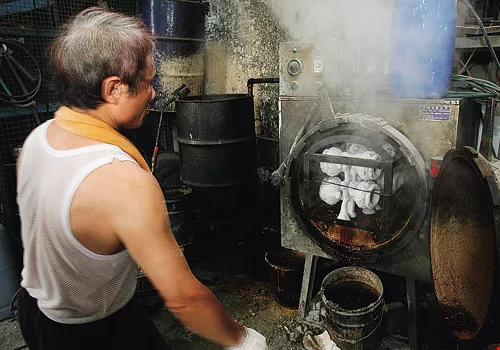
Two or three days later, the three brothers transfer an entire rack of air-dried sand molds into a steam dewaxer, where they are evenly heated to 100-150°C, and the wax comes gushing out of the machine. After the wax is removed, the inside surfaces of the empty sand mold constitute a negative image of the Zi Fu Xin wine vessel.

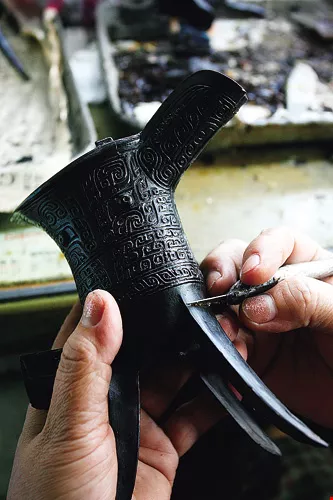
To cast an imitation of an ancient bronze, the artisan must go through several steps that precede the pouring of the molten metal into the mold (left to right): (1) Preparation of a wax model. (2) The wax model is dipped into a slurry, which dries to form a sand mold. (3) Removal of the mold. (4) High-temperature dewaxing. The casting is then poured, and later removed from mold, resulting in a reproduction of the famous Zi Fu Xin (a jue-type wine vessel). The product is a strikingly accurate reproduction of the original.
Fire in the hole
After dewaxing, the molds are placed in a burnout oven and fired at 800°C to remove any bits of remaining wax. The molds are now complete, and sit for about four days, stacked and ready for the metal pouring "ceremony." As he places the white molds one by one into the oven using long-handled tongs, Liu Guoxian explains the need for the burnout process: "You have to do that to make sure you get an even casting."
While his brother is busy with the tongs, Liu Guozheng starts up the fusion furnace and throws in a 10-kilogram ingot of lead bronze. Throughout the process, I often notice the brothers getting splashed with molten bronze and flicking it away. Liu Guozheng nonchalantly assures me that their heavily padded aprons keep the molten metal from raising a blister, and even if a bit does land directly on the skin, rubbing a bit of anti-swelling medication on the spot is sufficient.
With two furnaces going full blast at nearly 2000°C, the heat is oppressive and the fire is so bright it hurts to look at, while a rush of air incoming from two directions practically splits my eardrums.
As the air in the workshop fills with a smoky suspension of carbon, lead, and copper particles, the process nears its climax. The molten bronze comes into view, and everyone's attention is riveted upon it. One of the brothers uses long-handled tongs to remove the molds from their furnace while the other two use long-handled ladles to pour the bronze into the molds, hitting the coin-sized pouring mouth with uncanny accuracy.
Liu Guozheng comments: "This is the metal at its most beautiful, just before it reverts to the dark color of solid bronze." The poured molds now sit on the ground like so many pumpkins.
After two hours, the molds have cooled down and the bronze has turned a yellow brown. The three brothers then break open the molds and sand-blast the vessels with a magnesium oxide powder for polishing. The wine vessel is now completely free of the mold, and has taken on the color of human skin. "The next thing is to soak it for one minute in a solution of bronze blackener and bronze green, and presto! It looks like an ancient bronze," says Liu Guozheng. Finally, each piece is waxed and packed. It is now a 20-centimeter Zi Fu Xin wine vessel, just what you will see in the National Palace Museum souvenir shop.
The next generation of the Liu family has no interest in carrying on with their fathers' craft for, as Liu Guozheng explains, "vaporized wax is really irritating on the eyes, the lead content in the bronze ingots is highly toxic, the firing process generates sulfur dioxide, and the workplace is hot as hell. Most people don't want to do this sort of work." In another 10 years the three brothers will all be in their 60s and ready to retire for good. He estimates that there are fewer than five firms in Taipei County still making bronze reproductions, and most lost-wax practitioners have already switched to the metalworking business, which is much more profitable.
Each contract of a bit over NT$1 million is barely enough to take care of their three families, yet the Liu brothers don't seem to care how much they can sell a bronze reproduction for. They wouldn't be doing the work if it weren't for the love of it.
To cast an imitation of an ancient bronze, the artisan must go through several steps that precede the pouring of the molten metal into the mold (left to right): (1) Preparation of a wax model. (2) The wax model is dipped into a slurry, which dries to form a sand mold. (3) Removal of the mold. (4) High-temperature dewaxing. The casting is then poured, and later removed from mold, resulting in a reproduction of the famous Zi Fu Xin (a jue-type wine vessel). The product is a strikingly accurate reproduction of the original.
To cast an imitation of an ancient bronze, the artisan must go through several steps that precede the pouring of the molten metal into the mold (left to right): (1) Preparation of a wax model. (2) The wax model is dipped into a slurry, which dries to form a sand mold. (3) Removal of the mold. (4) High-temperature dewaxing. The casting is then poured, and later removed from mold, resulting in a reproduction of the famous Zi Fu Xin (a jue-type wine vessel). The product is a strikingly accurate reproduction of the original.
To cast an imitation of an ancient bronze, the artisan must go through several steps that precede the pouring of the molten metal into the mold (left to right): (1) Preparation of a wax model. (2) The wax model is dipped into a slurry, which dries to form a sand mold. (3) Removal of the mold. (4) High-temperature dewaxing. The casting is then poured, and later removed from mold, resulting in a reproduction of the famous Zi Fu Xin (a jue-type wine vessel). The product is a strikingly accurate reproduction of the original.


