No Looking Back--Tang Mei-Yun's Dreams for Taiwanese Opera
Kuo Li-chuan / photos courtesy of Tang Mei-yun / tr. by Jonathan Barnard
December 2005


Tang Mei-yun, renowned for her outstanding perfor-mances of Taiwanese Opera for theater, television and film, has just staged a public performance of World of Crooks to celebrate the seventh anniversary of her Taiwanese Opera company. Although she was born into the world of Taiwanese Opera, she long resisted the cards fate had dealt her. It wasn't until she was 15 that she performed in her famous father Chiang Wu-tung's opera company--and that was supposed to be just a temporary gig. In the 20-some years that followed, she has gone from disliking Taiwanese Opera to playing the male leads, and from outdoor performances to exquisite productions in theaters. Tang has taken a Taiwanese Opera road that has been both harder and more wide-ranging than the norm.
The 1920s to the 1960s was the golden era of Taiwanese Opera. Senior opera fans like to say, "A top performer in the imperial civil service exams appeared only once in three years, but a truly top Taiwanese Opera performer won't come even once a decade." In Taiwanese Opera's nearly 100-year history, only three artistes have been able to lay claim to that title: Hsiao Shou-li, Chiao Tsai-pao and Chiang Wu-tung.
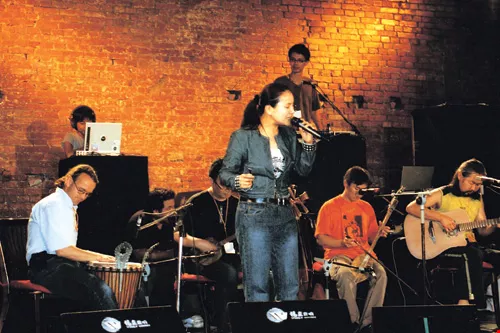
At "Old Styles, New Grooves: Traditional Beiguan Sounds in Modern Music," a music festival held in 2005, Tang sang her heart out.
Japanese master of Taiwanese Opera
Chiang Wu-tung was a pureblood Japanese. When Taiwan was under Japanese rule, his parents, surnamed Morita, traveled back and forth between Japan and Taiwan on business. In 1909, after Ichiro Morita was born in Tainan, they hired the Chiang family to care for the child while they went back to Japan. When their ship went down at sea, the Chiangs changed the babe's name to Chiang Wu-tung and raised him as their own. The first words Chiang spoke were Taiwanese, and as he grew all the friends and relatives he knew were Taiwanese. The land of the rising sun wasn't even a part of his dreams.
Consequently, at the close of World War II in 1945, when his older brother came from Kyushu, Japan with his family tree and urged him to return to the land of his ancestors, Chiang, by then in his thirties and well established as a leading light of Taiwanese Opera, weighed his options and decided to stay in Taiwan.
When Chiang was at the peak of his career, he was the subject of numerous legends that fans relish to this day. For instance, before a performance actors would put on their make up and costumes and parade around the streets on horseback or in tricycle rickshaws as the band played in accompaniment. But Chiang was so talented and well known that a theater needed only to display his name and the show was sure to sell out.
When he'd perform in the Hsinting area of Tainan, geishas and bar girls would make every effort to see him, even skipping work and refusing to see customers. All gussied up, they would go to wait at the theater first thing in the morning. Afterwards, they would strive to invite Chiang back to their geisha bars, where they would play the pipa or the dulcimer, and sing and dance for their idol.
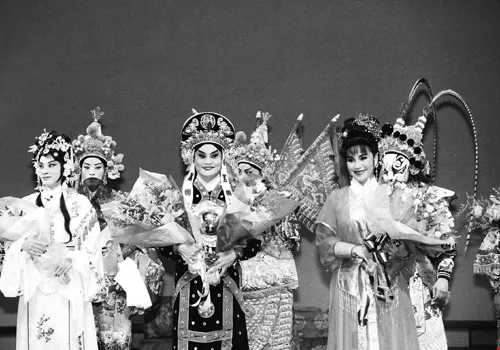
In August of 1998, at a festival of Henan, Peking and Taiwanese Opera, Tang Mei-yun (far right) played the title role in the Taiwanese Opera Mulan.
On the move
In 1945 the Japanese forces surrendered, and in celebration Taiwanese hired opera troupes to reward the gods with performances. Freed from Japanese military suppression, more than 300 Taiwanese Opera troupes formed in just one year. Four years later there were over 500. The ten years after the war were a golden age for Taiwanese Opera. There were many talented stars, and in addition to live performances in theaters, Taiwanese Opera found audiences on radio and in films.
In 1962 Taiwan Television began to broadcast Taiwanese operas. As a result, opera lovers no longer needed to leave their homes to see them. With live performances losing audiences, opera troupes began to break up, and performers were forced to change careers. Chiang Wu-tung struggled to keep the Paoan Opera Troupe together, but live performances of Taiwanese Opera shifted from the theaters back to outdoor performances at temple fairs. Having personally experienced the artform's rise to glory and fall, he deeply understood the drawbacks of the peripatetic existence of an opera performer, so he wouldn't let his youngest daughter Tang Mei-yun study opera, hoping instead she would concentrate on her schoolwork.
Nevertheless, because her home was also an opera training school, she grew up immersed in opera and naturally learned numerous operatic tunes. She recalls that once she imitated her mother singing a duma tune while doing her homework, and her father scolded her. Yet, as her mother would say, "A pig living beside a music hall may not know how to play the flute, but he'll at least be able to keep time." It would seem as if all had been preordained: this child who had not studied Taiwanese Opera would later find her own way into the field.
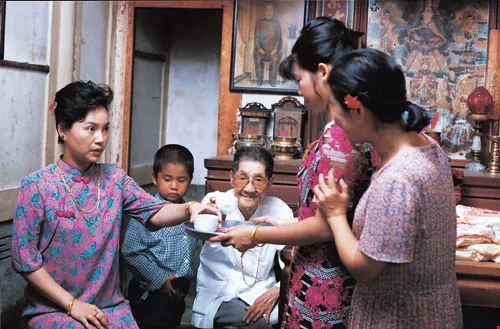
Tang Mei-yun (far left) appeared in the 1997 film Such a Life. Her performance earned her a Golden Horse nomination for best supporting actress.
The lure of embroidered shoes
Born in 1964, with eight older brothers and sisters, Tang would see her father teaching his troupe's students the stylized gestures and vocal style of Taiwanese Opera when she passed through her home's front courtyard every day as a child.
Because training students required large expenditures of time and money, the students had to sign contracts that committed them to work for the company for a certain period of time. But there was also a special source of labor with a higher return on investment: kinfolk. The Ming Hwa Yuan Taiwanese Opera Company was particularly famous for making good use of that resource. To avoid having an actress build up a reputation only to switch to another troupe or change professions, the head of a company would often marry her, turning the troupe's leading actresses into members of his family. It was common for the head of a troupe to have three or four wives. Chiang had two. (Tang Mei-yun was born to the second, and took her mother's surname.) Chen Ming-chi, head of Ming Hwa Yuan, had six wives altogether.
Chiang Wu-tung had a great reputation and would teach his students everything. Consequently, other troupes tried to steal his performers, so that his own company was perennially understaffed. Once, when the company was short just as Chiang prepared to go out to perform, Tang Mei-yun's mother considered the situation. Although she knew her youngest daughter hadn't studied opera, Mei-yun would only have to play a fairy, with no lines to speak or sing. Figuring she was up to the job, her mother took this tack with her: "Do you like your older sister's embroidered shoes?"
Having never learned to perform, Tang Mei-yun had always looked enviously upon her sisters' fancy embroidered shoes and jewel-studded headdresses. As soon as her mother asked the question, she quickly nodded in affirmation. Her mother said that if she helped out for just one day, her father would buy her a pair of embroidered shoes. And so, thanks to her mother's cajolery, Tang appeared for the first time on stage when she was 15.
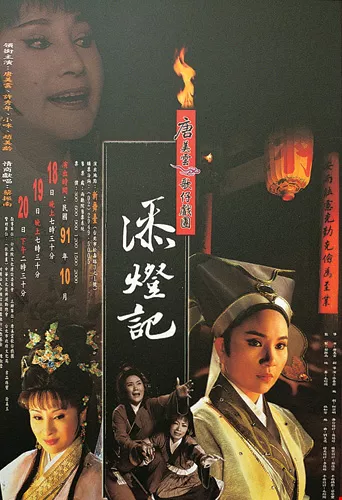
In 2002 Tang's company put on Tian Deng Chi, which deals with modern myths about continuing the family line. The script tackles various social issues, including whether to have children, relations between daughter-in-law and mother-in-law and husband and wife, and missing children.
Learning on the job
That first stage appearance was during a sparsely attended matinee. Tang Mei-yun just followed the others as they kneeled or bowed. But that night, they lacked a performer for a supporting female role, and once again they looked to her. This time the role had a wedding-night bedroom scene, in which she had to sing in a duma duet. Her mother had to give her a crash course, summarizing the plot and helping her to memorize her part line by line. To put her mind at rest, they told her that once she got through that section, the older actress on stage (playing the role of a prince) would sing the rest by herself.
With great reservations, Tang Mei-yun appeared as the princess, finished singing the section she had learned, and breathed a sigh of relief. She didn't realize that the actress playing the prince hadn't sung to the end of the scene. The other actress widened her eyes, hinting it was Mei-yun's turn to sing. But her mother hadn't taught her any more lyrics. How could she continue?
Tang looked at the other actress, who ignored her, turning her body and gesturing. She looked at the musicians, who were suppressing laughs, and felt humiliated. "If there had been a hole on that stage, I would have crawled into it." Fortunately, her mother backstage had heard the musicians playing without anyone singing, and realized the predicament. She positioned herself on the other side of a curtain right behind Mei-yun and fed her her lines one at a time. With her mother's help, Mei-yun was able to get through her part.
Afterwards, Tang felt she had suffered a loss of face and believed her parents had deliberately misled her. She swore her opera career was over. But destiny had other plans, for the company was always short of actors. Eventually, Mei-yun reluctantly gave up on her schooling and started to help out in the opera company. Because she lacked basic training, she had to learn on the job. Whatever role the company lacked, she would play, be it male or female leads, painted-face male roles, the elderly, clowns, or bit parts. To get her up to speed, her father would bring her along whenever he left home to teach opera. But she wasn't particularly excited about it. Whenever she saw her old classmates on the way to school in their neat uniforms, she couldn't help breaking into tears. It wasn't until she was 18 and went abroad for public performances that her view of Taiwanese Opera began to change.
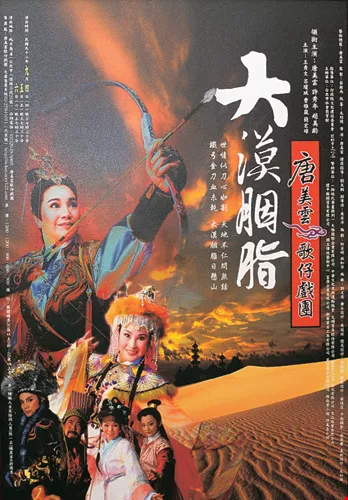
Experts lauded Desert Rouge in 2003 as one of the rare new Taiwanese operas to have an outstanding score. The opera was inspired by Sima Guang's classic Comprehensive Mirror for Aid in Government.
First time on a modern stage
In 1981 elite Taiwanese Opera performers formed a company to tour Southeast Asia. Huangmei diao, a style of singing in Mandarin, was very popular among overseas Chinese in Southeast Asia, and Tang, a film buff, was able to sing all the huangmei diao parts from films. Consequently, her father was able to get her a job on the tour doing "backstage vocal accompaniment."
The experience utterly transformed her view of Taiwanese Opera. The venues were much like the theaters used during the early "indoor" period of Taiwanese Opera in Taiwan. But the sets, lighting, sound, and costumes were all outstanding, and various mechanical props, such as strings of beads to represent rain, and flying coffins, delighted audiences. Because they were paying for the privilege, their attentiveness and expectations were high, and the star-studded cast did not disappoint. It brought down the house night after night. Tang finally understood what her father had meant about the moving beauty of Taiwanese Opera performed indoors.
On returning to Taiwan, Tang resolved to become a diligent student of Taiwanese Opera. She no longer performed only when the company was short cast. For singing and intonation, she studied with her mother and with company drama teacher Ko Mu-shui. For gestures and mannerisms, she studied with her father.
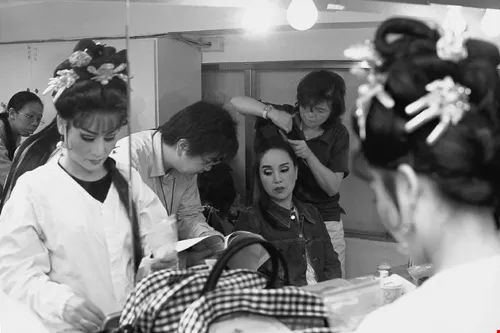
A good script sets the tone for the whole production. Right before going out on stage, Tang leads members of the company as they carefully go over every detail.
Conveying an imaginary world
Apart from teaching the basic moves, to train her in facial expressiveness her father would light candles and have her stare at the flames. They would also take trips to Kuantu in Taipei County to look at birds. As her pupils followed the birds' movements, her eyes grew more animated--"showing in her gaze the solidity of mountains, the flow of the water."
For the xiaosheng or male leads, an actress must be tall and statuesque with an elegant aura, a broad face and bright, gentle eyes. Tang was a natural for these roles, and at 19 began to play them regularly. On stage, her voice was throaty and magnetic. To make her voice raspy, she would go alone to the shore and shout at the ocean. "Back then military sentinels were stationed there, and when the soldiers on patrol would see me screaming at the top of my lungs at the sea, they'd worry that I was about to commit suicide and would follow me around," says Tang, laughing her throaty laugh.
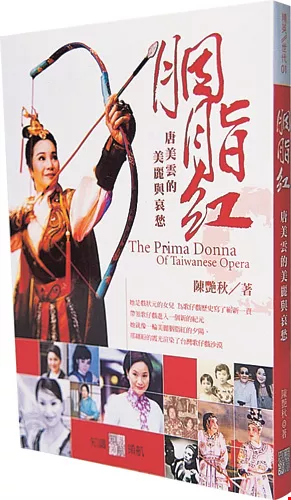
Detailing how Tang Mei-yun learned the art of Taiwanese Opera and went about forming her own company, The Prima Donna of Taiwanese Opera uses words to give people a deeper understanding about this leading light of Taiwanese Opera.
Gut check
Traditionally, writer-directors of Taiwanese Opera would "describe the drama," providing only a general outline of the acts and scenes to the actors. The actual lines, spoken and sung, and the movements, were left to the actors themselves to flesh out. Senior actors call this skill "having guts." The director would describe the play in ten minutes, but the actors would have two hours to perform it. They had to rely on their accumulated acting experience, as well as what they had gleaned from their everyday lives. Performance of this sort is true "living theater."
With its high degree of difficulty, this kind of acting was hard at first for Tang to master. Her experience was insufficient, and she lacked "guts"--her training had been limited. In particular, it was difficult when she made cameo appearances with other troupes. They didn't make allowances for her inexperience; they simply assumed--based on her father's reputation--that she would perform well. These experiences provided even more motivation for Tang to work hard and improve.
To this end, she perused storybooks and scripts that she found in her father's chests, and read numerous classical novels and memorized poetry. She read anthologies of classics and learned that lines taken from them were rhythmic and poetic. Taiwanese slang and proverbs were indispensable too. "To practice developing and chanting lines, I'd put what I saw into seven-character verse all through the day. Hearing me speak in verse, some people thought I was going a little overboard."
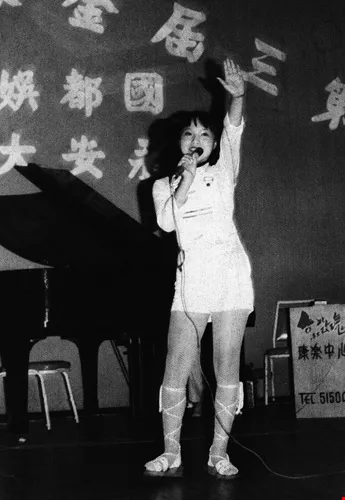
When Tang was 14, she participated in a singing contest. Her rendition of "Unfettered" earned her third place.
Mysteries of love
Tang Mei-yun is upfront about her origins in the world of outdoor Taiwanese Opera. From age 15 until seven years ago when she founded the Tang Mei-yun Taiwanese Opera Company, she worked for 20 years outside, playing in hundreds of operas and thousands of performances. Although she took up the challenges of vastly different characters, many opera fans were particularly charmed by the dashing way she handled male leads.
Sometimes women fans would get so caught up in the performances that they would write her. "My heart has been absent ever since I saw your opera," wrote one. "The next time you see me, please remember to return it."
Tang Mei-yun remarks how great it would be if the authors of such romantic and moving letters were men. One can't help but be curious about the romantic life of an unmarried woman already in her forties who has played handsome male leads. But Tang coolly explains that performing Taiwanese Opera for 20 years has meant constantly being out on the road. Moreover, since her father died, she has assumed responsibility for the whole family and simply doesn't have time for romance.
Since its founding, the company has given public performances year after year, building a repertoire of seven outstanding operas. After seeing a performance, Tzeng Tao-hsiung, a director of Western opera, remarked: "The Taiwanese Opera we saw is no longer folk performance but rather a truly exquisite new form of musical drama." Tzeng affirms that Tang Mei-yun has given Taiwanese Opera a new status in performance art.
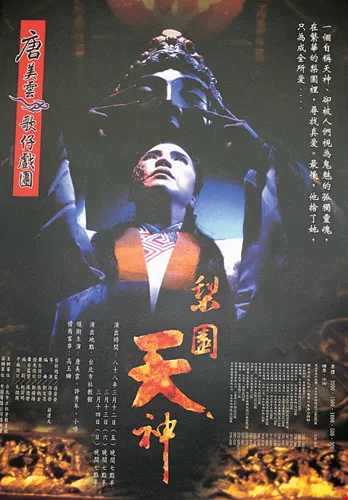
In 1998 Tang formed her own company, and the following year they put on their first production, Sky God of the Opera Company, adapted from the French novel Phantom of the Opera.
No looking back
Unfortunately, although the shows have been well received both critically and at the box office, the company has consistently lost money. To keep the company afloat, Tang has had to work in film and TV. Those who know her well all say, "Tang Mei-yun accepts TV and film work to support Taiwanese Opera." Some call her an idealist; others laugh that her troubles are self-inflicted. Singer Tsai Chen-nan has acted with her in many a TV serial and has a cameo role in one of Tang's Taiwanese operas this year. He marvels at how her operas use Taiwanese, operatic melodies and actors' creativity to convey characters' joys and sorrows in a deeply moving way.
A good show, apart from requiring skilled performers, also demands an excellent company. Husband-and-wife team Ko Tzung-ming and Shih Ju-fang are the company's writers. They are adept at bringing historical books to life and giving an Oriental flavor to Western operatic material. For the company's debut, they put on Sky God of the Opera Company, adapted from the French novel Phantom of the Opera. Apart from adding to the diversity of roles that Tang has taken on, the tragically beautiful love story was big hit with longtime opera fans.
Shih Ju-fang explains, "In the opera, the boss of the Little Wind Theater comes up with the idea of putting on a masked ball to catch a ghost. Although there's no tradition of this kind in the Orient, we decided to keep it in the plot for the sake of dramatic tension." All over the stage people are wearing masks, while only the "God of the Opera Company" wears his true face, which is horribly scarred. He takes great pleasure in breathing freely. The scene highlights the hypocrisy of mankind.
Up on stage, a gong resounds. The curtain gently opens, as Tang Mei-yun sings "The Charm of Opera" in seven-character lines. Her voice meanders up and down, at times surging valiantly, and the emotions of the actors and audience rise and fall with her singing. Such performances are bringing Taiwanese Opera into a new realm.
There is an expression in opera: "Once you've shot the arrow, there's no getting it back." Tang Mei-yun's devotion to Taiwanese Opera is like an arrow that has left the bow: showing unyielding determination to pursue her destiny in spite of obstacles.
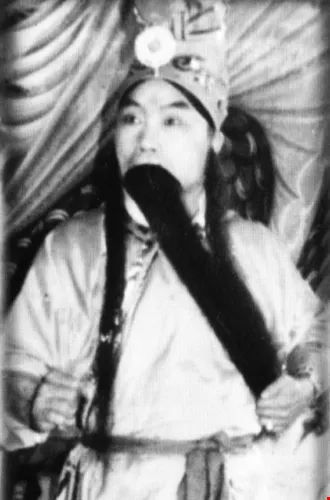
Tang Mei-yun's father Chiang Wu-tung was a pureblood Japanese, and one of the three greatest performers of Taiwanese Opera in the nearly 100-year history of the performance art.
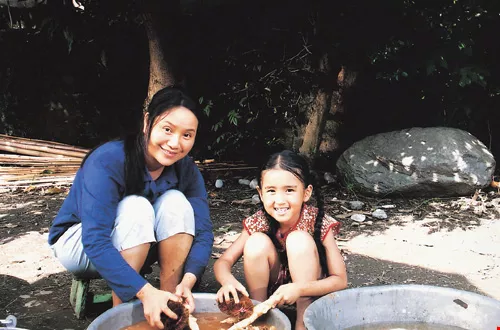
In 2004 Tang Mei-yun appeared in the Da-Ai Television production of Spirit Master. Tang always delivers outstanding performances, whether for theater, TV or film.
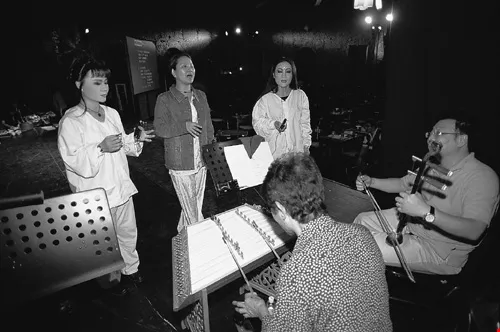
Three minutes of performance draws from ten years of practice. Practice, practice, practice... it's what the performing arts are based on.
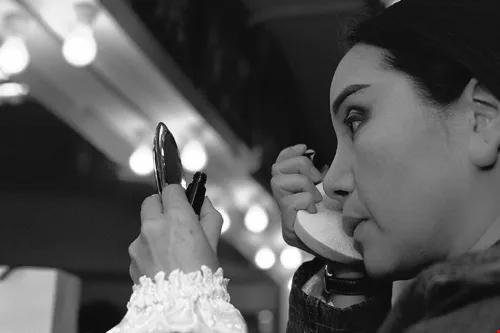
Backstage, Tang Mei-yun, who first stepped out on stage to acquire a pair of embroidered shoes, painstakingly applies make-up as she prepares to give her audience a good show.
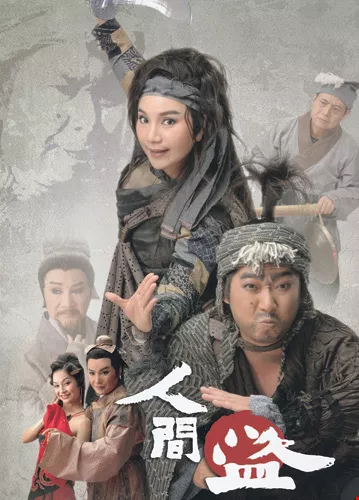
World of Crooks, a black comedy describing mishaps that bring corrupt officials and thieves together, was the Tang Mei-yun Taiwanese Opera Company's major production for 2005.

@List.jpg?w=522&h=410&mode=crop&format=webp&quality=80)


