Painted Ceramics--A Tale of Three Artists
Anna Wang and Tsai Wen-ting / photos Pu Hua-chih / tr. by Christopher MacDonald
May 2000


During last year's 9/21 Earthquake, the Nantou County-based ink-wash artist Lee Ku-mo lost several dozen works with a combined value of NT$5-6 million. Some of the partially damaged works later became part of a special exhibition organized by the Taichung City Bureau of Cultural Affairs in the aftermath of the quake.
It might seem odd. How can ink-wash paintings, works of ink and paper, get "smashed" in an earthquake? In fact, for some time now painters have been extending their skills with the ink brush into a new medium-ceramics. Ink painting and ceramics are arts with thousands of years of pedigree in China, and the recent merging of the two has elevated the artistic value of ceramics while further diversifying the options for ink painting.
A dozen or so years ago the painter Lee Ku-mo, who has been painting with ink for over 40 years, began regularly traveling the three or four hours by road from his home in Tsaotun, Nantou County to the Ciyang Kiln in the hills outside Tucheng, Taipei County. There he worked on the unfired forms of ceramic articles, painting directly onto the body with his ink brush or inscribing calligraphy on the surface. Because he rarely forayed from home, whenever he went to Ciyang he tended to stay with the kiln owners for a few days, working away to his heart's content on various vases and jars.
Flower vases and fish bowls
It was inscribing teapots that initially led Lee Ku-mo, a painter and calligrapher who has at times also supported his family by seal-carving, into the art of ceramics. In fact, his love for ceramic painting stems from his own artistic preoccupation with themes from daily life.
Lee was born and raised in the hills near Tsaotun, a country boy who never even saw the sea until he was 16 years old. He helped out in the fields with his family and tended to oxen, and spent every day in close proximity with nature. As a youth he studied with a local artist, learning how to paint for temples and acquiring professional picture-mounting skills. Lee has never been to art school, and there is no separation for him between creative work on the one hand, and nature and life on the other.
Lee, who stresses the accessibility of his work, doesn't believe that a jar or vase loses artistic merit just because it also has some practical function. Quoting the Qing dynasty scholar Cheng Pan-chiao, he says: "If it's got something good about it, then let everyone have a look. And if not, then use it to paper the walls and fix your windows [if it's a painting], or keep things in it [if it's piece of pottery]." Lee laughs that if people don't see any merit in his painted vases and inscribed jars, then they can at least put flowers or store liquor in them, or fill them with water and keep goldfish-so long as the article's function as a vessel is realized.
Lee's studio home, paintings on its whitewashed walls and various ceramic articles on view, provides a cool and spacious living environment.
At the door between the living room and dining room, there's a tall ceramic cylinder suitable for storing scrolls, with a design that features the bright red canna blossom-a common sight in the countryside-around which bees are buzzing. Above are the words: "Busy Bees at Work." The hardworking artist himself, who spends all day at his labors, is perhaps not unlike those bees. On another work of his, a painted ceramic dish, two snails are crawling about, leaving winding trails in their wake. The epigraph on the dish reads: "Less words, more action."
Lee's work features common-or-garden themes, often enlivened by a dash of visual humor that brings a knowing smile to the lips of the viewer. The artist may feel it's sufficient for his works to be used as flower vases or fish bowls, but every one of them is more than just functionally attractive, and each repays careful appreciation.
Art without national boundaries
While working on ceramics at the Ciyang Kiln Lee often runs into his old friend Cheng Shan-hsi, an ink-wash painter who last year won the first National Arts and Culture Award. Cheng was drawn to ceramics painting even earlier than Lee, and often used to turn up at the kiln while its owner was still asleep in the morning, and stay painting until late at night before returning home. Sometimes he had to rush back to Taipei in the middle of the day to teach at National Taiwan Normal University (NTNU), making up to three taxi-trips out to the kiln in one day. In the last two decades Cheng has mounted a number of individual exhibitions of his ceramics.
Cheng Shan-hsi taught Chinese painting for many years at NTNU, and though now formally retired, he still teaches a few classes at the NTNU graduate school of fine art. He has never imposed artificial restrictions on himself in terms of what he could learn, teach and paint. Among ink-wash painters Cheng has a particularly strong grasp of Western art, drawing inspiration for his own work from Renaissance art and contemporary Western painters, as well as the Japanese ukiyo-e school of painting and Indian religious art. At NTNU he ran an "ink-wash drawing" class in which students were encouraged to paint using a bold variety of brush strokes, without having to adhere to the traditional requirement for graceful lines, if necessary even "uglifying" the subject as a means of finding their own brush style.
For Cheng Shan-hsi there is no East and West when it comes to artistic creation, so he has never limited himself to the traditional modes of ink-wash painting, whether in terms of subject matter or medium. This is why he has felt free to include images of dolls, cars, high-rise buildings, and fashionably garbed youths in his paintings, subjects unknown to the tradition.
Artists in the West have generally been freer to move between different media, from pictures to sculpture, from oils to installation art. Picasso and Miro were two of the great painters whose output included highly creative and distinctive ceramic works.
Says Cheng: "A real artist should be able to draw on a wide range of subjects and materials and apply these as he feels fit, without being limited to a single one." Ceramics provides a medium that can be shaped by hand, can be painted on, and also be engraved, which makes it ideal for an artist like Cheng Shan-hsi to realize his unrestricted creative nature.
Roaming in art
"Dragons need to be a bit wild," says Cheng, abstractedly dabbing black-red pigment onto the unglazed dish he is working on. Gradually the image of a dragon among the clouds takes shape. For this, the millennial dragon year, Cheng has produced many paintings of celebratory dragons, each bursting with pride and energy while also appearing familiar and approachable. In spite of the enthusiasm of collectors for these pictures he has resisted selling them, and wants instead to bestow them on members of his own family.
Cheng paints in a range of different forms, but always with the same inimitable style. During his career in art he has won numerous prizes and held plenty of individual and joint exhibitions. One was a much-talked about "Birthday Blessings Exhibition," featuring more than 100 works of painting and calligraphy, that Cheng mounted on the occasion of his elder brother's birthday, with all the exhibits being presented to his brother's wife. When Cheng won the National Arts and Culture Award in 1997, he received the following tribute: "He is straightforward by nature, and portrays a wide range of subject matters, often drawing for material on the experience of life as it is lived here [in Taiwan], while maintaining the traditional elegance of brush-and-ink art. In his work, a unique mode of expression is formed from the combination of refinement within rawness, bold coloring, and dynamic ink lines."
The award also described Cheng as "bringing a positive attitude to the tradition of ink painting, rather than trying to subvert and dismantle it, and manifesting the innovative spirit of the age." Cheng doesn't consider himself a painter of genius, just one who is true to his interests and works hard at his art, with a liking for the practicality and naturalness of folk art. In an essay entitled "Chinese Painting in a Democratic Era," Cheng once wrote that in this age of democracy everyone can paint pictures and anything can serve as subject matter, with painting no longer being the exclusive preserve of palaces and intellectuals. The artist he most admires, the late Qi Baishi, also started out as a craftsman, and eventually became a great painter through a lifetime of hard work.
Cheng's highly cultured Chineseness and unremitting hard work have enabled him to become expert in both Chinese and Western art. Through his work both on paper and ceramics he has created an individual body of art without needing to subvert tradition.
"I think that China is best in every way. Chinese people believe in learning from nature to gain wisdom, and emphasize the proper ordering of human relations, such as the bond of affection and obedience between father and son, the correct form of relationship between husband and wife, and the code of loyalty between friends. This is extremely important." Cheng also believes that China's hundred-year-plus period of economic backwardness was a good thing: "Why do we have to pursue economic development? By raising economic levels do we really enrich the cultural quality of life?" he asks. "Having enough money to take care of one's needs is sufficient. Is economic development really going to make subsequent generations any happier?" He continues: "Chinese people are so clever. By the second century AD we had already invented a device capable of forecasting earthquakes, over a thousand years before people in the West had anything similar. So how come we didn't further develop our science and technology? We invented gunpowder so early on but only used it for firecrackers, a way of brightening up people's lives."
Cheng believes that the forefathers of today's Chinese were against excessive development because they didn't want everyone lazing around instead of working hard, and traditional Confucian thought directed people to live in harmony with nature, showing respect for Heaven and honoring one's forefathers. "Chinese people believe in learning from nature to gain wisdom, basing the hierarchy of human relations on their observations of natural phenomena. Western people on the other hand believe in studying nature for utilitarian purposes, and want to make use of everything they can lay their hands on. They even went to Africa to round up people for use as slaves, treating people as if they were animals, mere chattel. As barbaric as it's possible to be!"
For Cheng, everything Chinese is good. Art critics agree that Cheng Shan-hsi achieves a perfect combination between the traditional painting of China's cultured elite, and folk art, while his professional skills, including his mastery of draftsmanship and watercolor painting, enable him to make frequent artistic breakthroughs in the course of producing a succession of masterworks. This is particularly evident in his ceramic works. He is able to paint ceramic relief images in dazzling colors, can present an ink-wash nude on a handled pot, and can also inscribe a vase with text in precisely rendered Han dynasty script. Cheng Shan-hsi truly realizes the life of "roaming in art and being joyful at heart" that he talks of.
Literati on a vase
No discussion of the combination of ceramics and ink-wash painting would be complete without mentioning the ceramicist Wang Hsiu-kung, former head of the Chinese Ceramics Company. Wang knows everything there is to know about the development of Chinese painted ceramics, and has been instrumental in raising Taiwan ceramics from the status of handicraft to the realm of art.
There were originally two methods of producing painted ceramics. One involved painting directly onto the unfired article, exploiting the natural capillarity of the clay to create a spreading effect. The main drawback to "underglaze painting" of this type was that mistakes could not easily be rectified, so the work had to be done by an artist working with confidence and surety. Most painted ceramics in the past were therefore made by another method, in which a coat of white glaze was first applied to the semi-finished article, producing a glossy, impermeable surface on which a craftsman could copy out intricate designs. These designs typically featured auspicious imagery of dragons and phoenixes, or colorful bats, birds and flowers, all rendered in the detailed, realist style of traditional Chinese gongbi brushwork.
Chinese ink-wash painting can be divided into the gongbi and xieyi styles, the latter employing a more fluid, freehand style of brushwork. Xieyi, which allows for liberal play of the imagination, was popular with the philosophically minded scholar-painters of the Song dynasty (960-1279), who developed an insouciant style of brushwork characterized by sweeping lines of ink and plenty of blank space. The Song dynasty was also a period in which porcelain reached a technical and creative pinnacle, but there was no crossover between xieyi painting and ceramics at that time owing to the difficulty of combining the two. This seems to have left an empty page in the history of Chinese ceramic art, and is something that Wang Hsiu-kung, who graduated in Chinese painting from art school in Hangzhou, considers a matter of real regret.
Thus it was that Wang felt impelled to try and combine the arts of xieyi ink painting and Chinese ceramics. This was over 40 years ago, when Wang was chief of the Chinese Ceramics Company. Ceramics was not widely thought of as "art" in those days, but Wang was able to encourage the watercolorist Hsi Te-chin, the calligrapher Chang Kuang-ping and the ink painter Pu Hsin-yi to join his endeavor. In 1972 Wang also brought together artists Huang Chun-pi, Fu Chuan-fu and Lin Yu-shan for a joint exhibition of painted ceramics. Back in those days, when land in Chungho, Taipei County, could still be obtained for just NT$600 per ping (36 sq. ft.), government dignitaries began using these artistically painted ceramic works as official state gifts. Wang recalls that a small, shallow four-cornered dish made by Hsi Te-chin, sold for about NT$100, while a vase by Pu Hsin-yi, whose output was more restricted, would fetch around NT$2,500.
To portray a scene of verdant, mist-shrouded mountains in ceramic painting, it is necessary to use underglaze painting in combination with certain fluid, translucent glazes of brown and green. When fired, these glazes can produce a hazy effect which even ink and paper cannot match. This accounts for the lustrous, vibrant quality of the tricolor glazed pottery of the Tang dynasty (618-907), though the fact that tricolor pottery was fired at less than 1000 _C meant it was prone to break. Also, the finished works differed widely from each other depending on the quality of the clay, the type of glaze, the temperature and even the kind of chimney in the kiln. At higher temperatures, for example, the glaze lost its fluidity.
In order to find a kind of glaze that would remain fluid at higher temperatures, at a time when the choice of glazes was still fairly limited, Wang Hsiu-kung abandoned readymade glazes and formulas and started experimenting with different ratios. Through trial and error he gradually developed the right combination of constituents for a glaze suited to representing the ink-wash style of painting. Thanks to Wang's intensive research and the involvement of the other artists, it did at last become possible to incorporate the techniques of xieyi ink painting into Chinese ceramics.
Three-dimensional ink painting
Su Fung-nan is another ink-wash painter with a background in art teaching. In the 1960s, having been invited by Wang Hsiu-kung, Su began producing painted ceramics in volume. He says he was motivated at the time by the desire to try a new medium. Hearing this his wife, who is sitting beside him, chips in: "The main reason for doing painted ceramics back then was to make a living!" As an assistant teacher at art school, the recently married Su was on a salary of around NT$900 per month, while half a day's work painting at the kiln could net him over NT$200. Another positive factor was the consideration that Wang showed to the artists, giving them full artistic freedom and always sending a pedicab to meet them at the train station. Su put in three years of uninterrupted painting at the kilns in Yingko, as a result of which he has a profound personal knowledge of the technique for reproducing ink-wash painting on ceramics.
Su, an expert at painting flowers and landscapes, explains that while a brush is used for painting on both paper and ceramics, one difference is that glaze has the consistency of paste. If the glaze is too thick the brush doesn't move freely, and if it's not thick enough then it runs. At the same, time, different thicknesses of glaze can produce textural effects that are not seen with ink and paper. Su notes that thickly coated glaze is what best depicts the heavy, cloth-like quality of the silk-cotton blossom, in contrast, say, to the ethereal thinness of peony petals.
Su Fung-nan's landscapes are filled with transcendental, mist-shrouded crags and cliffs, rendered with a kind of watery brushwork that works well on paper but not on ceramics. Su found that clay, because of its chalky permeability, draws off moisture from the glaze leaving just the pigment on the surface, but that it is possible to create the desired hazy effect by slowly pushing the glaze around with one's finger.
Also, the fact that ceramics is a three-dimensional medium means that consideration needs to be given to the form of the article when selecting a subject matter. For example, a picture of bamboo works well on a tall, thin vase, while lotus blossoms do better on squat round jars. And when inscribing text on pots and vases with narrow necks and plump bodies, the line of the characters needs to follow the body to create visual balance. An example is the famous inscribed bronze vessel from the Zhou dynasty (11th to 3rd century BC) known as the Maogong Tripod, on which the text slopes out towards the bottom (as a rubbing of the text shows), though it appears to be laid out in straight lines.
Millennia of painting and pottery
In 1994, when he was in his fifties, Su Fung-nan put aside his teaching duties and went to San Francisco to study for a Masters at art school. Having spent a lifetime steeped in Chinese painting, Su found that there were similarities between certain forms of Western printmaking, and ink-wash painting. On returning to Taiwan he began working with new media, and produced a series of landscape prints.
In the last few years Su has produced "single print paintings," for which he first paints an imposing scene of mountains and clouds, using oil paint on acrylic board, then adds smaller features in outline, and finally transfers the image, as a print, onto a special kind of paper. This method produces a hazy, far-off effect, reminiscent of rubbings taken from ancient engravings, that works well with this type of subject matter.
Chinese ink-wash painters have traditionally been uncompromising when it comes to the tools and materials of their art: brush, ink, paper and inkstone. But Lee Ku-mo, Cheng Shan-hsi and Su Fung-nan are three painters who have experimented with different media, and who, through their work with painted ceramics, have opened up a new dimension for the art of Chinese ceramics.
Paintings on silk tend to degenerate fairly quickly, generally lasting a century or two, with the oldest surviving examples (safely buried underground) dating back no further than two thousand years to the Han dynasty. But ceramic works can keep their color for millennia, and today we can still appreciate works of colored pottery and black pottery from as far back as six and seven thousand years ago.
"Painting enhances the value of ceramics, and ceramics enables painting to last through time." Which is to say that the coming together of contemporary ink painting and ceramic art elevates the artistic worth of ceramic articles, while also immeasurably extending the life of ink-wash painting.
p.42
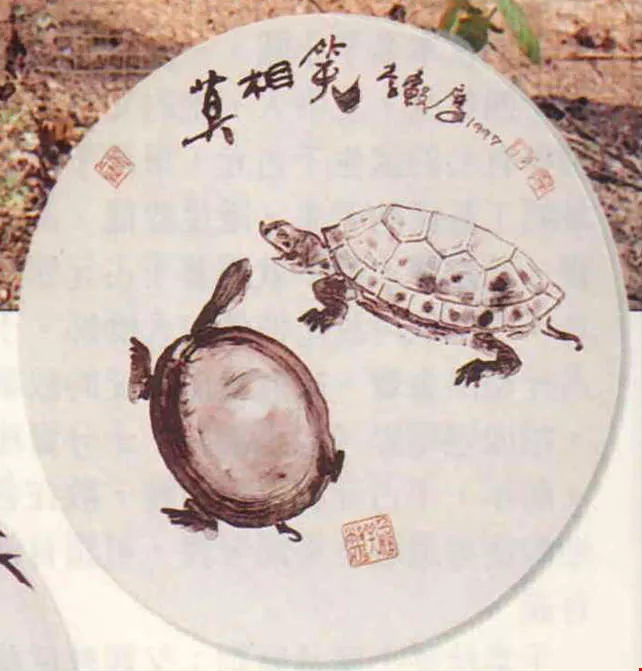
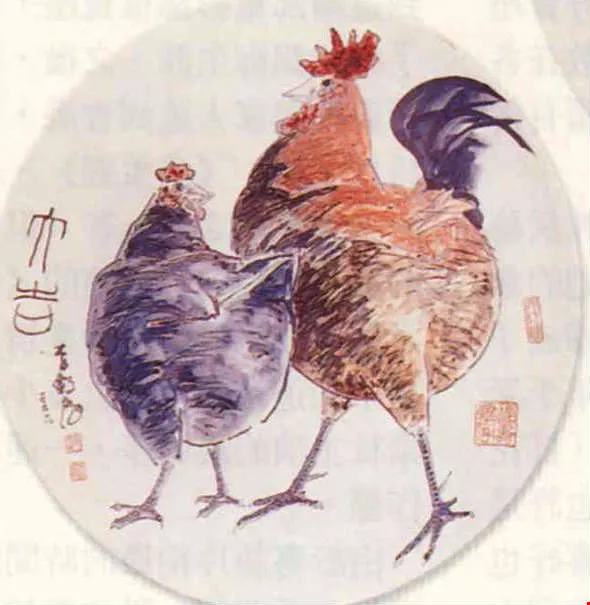
Lee Ku-mo's paintings feature common-or-gardern subjects and often include visual puns. For example, a chicken (ji in Chinese) may symbolize that which is auspicious (also ji), while a painting of a kuei and a pieh, two varieties of turtle, stands for the common saying "a kuei mocks a pieh for having no tail" (i.e. the pot calling the kettle black).
p.43
Lee Ku-mo grew up in the hills and spends most of his time in the Nantou County township of Tsaotun, where he can be found, when not painting, tending to his vegetable plot and looking after his ducks and geese.
p.44
Lee Ku-mo's "One-off Studio" (as his house is named) forms a cool, spacious living environment, with ink paintings and colored ceramics on display.
p.45
Ink-type painting on ceramics can retain its color for thousands of years, far longer than the equivalent pictures on paper. But earthquakes are a threat. Several dozen of Lee's precious ceramics were smashed during the 9/21 Earthquake.
p.46
"Dragons need to be a bit wild." The first recipient of the National Arts and Culture Award for fine art, Cheng Shan-hsi, was one of the first artists in Taiwan to produce painted ceramics.
p.48
Cheng Shan-hsi has dabbled in recent years with baroque-style painted ceramic relief designs, which are coveted by collectors.
p.49
One of Cheng Shan-hsi's playfully designed recent works.
p.49
"Painting and calligraphy come from the same source," as Cheng's blunt-looking Han dynasty script shows.When she was little, Cheng's daughter always thought her dad's writing looked "clumsy."
p.50
Painter Su Fung-nan is a master at flowers and landscapes, and takes plenty of photographs to help in his observations of nature. Su explains that a thick coating of glaze is what best brings out the spirited character of the silk-cotton tree blossom.
p.51
Glaze has to be slowly applied by finger in order to create a stirring, misty ceramic landscape like this.
p.52
Teacups and an intricate potted landscape crafted by Su Fung-nan testify to the artist's cultivated personality.
Lee Ku-mo grew up in the hills and spends most of his time in the Nantou County township of Tsaotun, where he can be found, when not painting, tending to his vegetable plot and looking after his ducks and geese.
For example, a chicken (ji in Chinese)

@List.jpg?w=522&h=410&mode=crop&format=webp&quality=80)

@List.jpg?w=522&h=410&mode=crop&format=webp&quality=80)


