Tears that Smile-Huang Chun-ming's Letting Them Go
Yang Chao / photos Pu Hua-chih / tr. by Scott Williams
January 2000


After more than ten years of silence, a new collection of stories from Huang Chun-ming is a major event, and not just in literary circles. For readers who have been anticipating a new collection for years, the publication of Letting Them Go is big news.
After such a long "hibernation," how does this new work compare to Huang's previous works? Sinorama invited the literary critic Yang Chao to provide our readers with the in-depth review which follows.
Huang Chun-ming's use of fiction to express his concern for the elderly has a long history. "Cheng-tsai Gets off the Bus," Huang's earliest published work, is the tale of an elderly woman taking her grandson to the city to visit her daughter and son-in-law. Although she is "only 50," "her withered face was deeply etched by life and the passage of time. . . giving people the impression that she was in her 60s." What really marks her as elderly is not her visage, however, but her inability to carry out a task as simple as catching a bus into the city, and the apprehensive feelings she harbors towards the "cold, unfamiliar" city and the unknown future.
Rural aesthetics
The title of "An Irrational Old Man" makes it plain that it too is a story about an elderly person. Here, however, Huang has written about a different sort of senior citizen, one who carries within himself a traditional wisdom uncorrupted by modern education. This wisdom, extremely practical in nature, is part of a piecemeal oral tradition. It is non-systematic and lacks mechanisms with which to check its own validity. Nonetheless, when taken as a whole it presents the ideas that there are spirits in the earth and sky, and that the universe is an organic and connected whole. This is the elderly's perspective on the universe, and it gives them very different ideas about meaning and beauty.
In dialogue with his grandson Ah-ming, the "Irrational Old Man" passes on his old knowledge: listen to the sound of the waves the wind makes in the rice paddies to discover if the rice is ripe; fill the bellies of grasshoppers with salt before grilling them; sparrows are ghosts or spirits which understand human speech; and killing the lu ti bird brings floods. At the end, the old man tells the boy of the spirit of the Choshui River, which searches for people to take its place. In "An Irrational Old Man," the reader feels very strongly that Huang Chun-ming is playing two roles: that of a little boy listening intently to his grandfather and that of a mature author who longs for the past and wishes to give voice to its earthy old knowledge.
Ah-sheng is the unforgettable elderly protagonist of "Drowning an Old Cat," the next story in the collection. Ah-sheng doesn't have the life of ease of the "Irrational Old Man," and he stubbornly resists the encroachment of his enemy, modern life. In this tragic story, Ah-sheng is ultimately steamrollered by the massive momentum of the new. But while the tragedy plays itself out, Huang makes it clear to the reader that he stands firmly on the side of Ah-sheng in this conflict.
Not everything in the story is bleak, however. Huang includes several comic and even farcical scenes, one of which occurs during a carnivalesque town meeting. There, Ah-sheng demonstrates a startling ability to respond to circumstances and succeeds in wrecking the meeting hall as he makes an eloquent speech on the love of one's family and birthplace, making "the entire village jump to its feet in agitation." And there is a farcical moment at the end as he takes off his clothes and jumps into a private swimming pool, making the ultimate protest by taking his own life.
Old people "let go" by the modern era
This theme of tragedy resulting from changing times has appeared in Huang's earlier work, in "Cymbal," for example, which was strongly influenced by Lu Xun's The Story of Ah Q. In "Cymbal," the age of the protagonist, Foolish Chin, is unclear, but the theme of obsolescence remains. Chin's work-making announcements in the street while using a cymbal to attract attention-has been made obsolete by the spread of the megaphone, undercutting his social status and taking away his livelihood. Chin thus takes on the role of a member of the older generation who has lost his struggle to make the transition to modern reality. Of necessity, his misfortune and his way of thinking have a very "old' character.
There are reasons to look back to Huang's early work. The first is to point out that Letting Them Go-in which the protagonist of every story is an elderly person-is entirely of a piece with his other work. In fact, it is a return to the main thread of his concerns of 30 years ago. In the extremely nationalistic atmosphere of the 1970s, Huang changed his focus for a time, writing about the hatred of Japan (Sayonara, Goodbye) and about anti-American sentiments (I Love Mary). Although well received at the time they were written, these works were flawed. First, they lacked the fine composition of true literature. Second, in them Huang had moved away from his greatest strength, the characters and settings with which he was truly familiar. As a result, Huang's 1970s writings were simply records of the period in which they were written and creative experiments. They are interesting in their own way, but are by no means among his best works.
Two generations removed
The second reason to look back at Huang's early fiction is to highlight the continuity of Letting Them Go. Although it has been more than ten years since Huang's last collection of fiction, and in spite of the fact that 37 years separate "Cheng-tsai Gets off the Bus" and "Ticket Window," there is something at the core of Huang's fiction which has not changed.
In his introduction to Letting Them Go, Huang mentions his deep distress at the plight of the elderly in Taiwan today, notes that he himself is just beginning to enter his twilight years, and compares Taiwan's callous treatment of the elderly to the way in which the elderly were left to live or die on their own in the mountains in You Shan Jie Kao. All of this could very easily give the reader the mistaken impression that Huang's vision of the elderly is a new development. But this is simply not the case.
In Letting Them Go, what we are actually seeing is the rebirth of Huang's original passion. If there has been any change in his portrayal of old people over the last 37 years, it is only in perspective. He used to write of grandfathers from the point of view of grandsons. Now he is a grandfather himself.
Huang Chun-ming has often discussed the fact that he was raised largely by his grandparents, and that he had an unusually close relationship to them. This background accounts for the unique "generation gap" approach utilized by Huang in his fiction. Each of Huang's works describes a particular person or thing, and has an "implied reader" at which it is directed. In the past, Huang's "generation gap" separated him from the people he was writing about-people of his grandparents' generation, two generations removed from his own. Now, this "generation gap" stands between him and the "implied reader" of his fiction-children of his grandchildren's generation who are ignorant of traditional wisdom.
Another aspect of Huang's work is that it presents many of the characteristics sociology attributes to relationships between people two generations removed from one another. For example, such relationships are not usually as tense, direct or hurried as those between parents and children because grandparents are not as busy as parents, and have less responsibility to supervise and teach. Also, difficulties in communication between grandparents and grandchildren frequently arise because of the very different modes of expression employed by each. As a result, there are typically more miscommunications in such relationships than there are between parents and their children.
A soft heart
Viewing Huang's fiction in this way, we can perhaps more clearly see wherein lies its charm. Huang is never derisive or critical of his elderly characters. If we compare him to other Nativist writers who address the tragedy of the rural elderly unable to adapt to the modern industrial world, we note that Huang is reluctant to expose his elderly characters to unmitigated suffering. Other Nativist writers use stories of suffering and pitiable elderly persons to make the case for reform. Huang takes a much gentler approach-not because he thinks the modern world a perfect place, but because he cannot bear to be so harsh. Huang's tender-heartedness is apparent to the reader of his work.
In his fiction, Huang is both more sensitive to and places greater importance on the elderly's haphazard means of expressing affection than are other Nativist writers. "Fish," one of his early works, has become very widely known since being incorporated into the national middle-school literature curriculum. The story describes an unexpected conflict that arises out of a misunderstanding between a child and a grandfather who care deeply for one another. Similar sorts of emotions are expressed in "Letting Them Go" as well. In this later story, the elderly Ah-wei inexplicably goes out and catches an egret, then just as inexplicably lets it go. Both of these actions are indirect expressions of a deep love he cannot give voice to yet nonetheless feels for his son Wen-tung.
A smile and a tear
When Huang writes of sad events, his readers' eyes really do fill with tears. However, the most exceptional thing about Huang as a writer is that he is not satisfied with making his readers cry. He wants every tear that falls to be accompanied by a small smile. And he is able to have it both ways because of the deep and tender sympathy of his work.
The stories in Letting Them Go are filled with elderly characters. Some are ignorant and suffer, like the old woman of "Cheng-tsai Gets off the Bus." But more of them are, like the protagonist of the "Irrational Old Man," full of a wisdom unsuited to the times in which they live. Their tragedy is that they are out of step with the times, that they do not know how to adapt to this cold and chaotic new society. The comedy of their predicament grows out of their unwillingness to let go of the "old" wisdom and "old" ways that they have treasured for so long, out of their flaunting of this "old" knowledge, and out of their use of their "old" assumptions to guess their way through the "new" world. Their guesses are all wrong, of course, but in their creation of misunderstanding upon misunderstanding, we see a different kind of dignity. And in this "old" wisdom and these "old" ways, we also see a light that time cannot dim.
Title: Letting Them Go
Author: Huang Chun-ming
Publisher: Unitas
Length: 250 pages
Price: NT$220
p.55
The rural elderly are the protagonists of Letting Them Go. Huang's characters bring both a smile to the lips, and a tear to the eye. (Sinorama file photo)
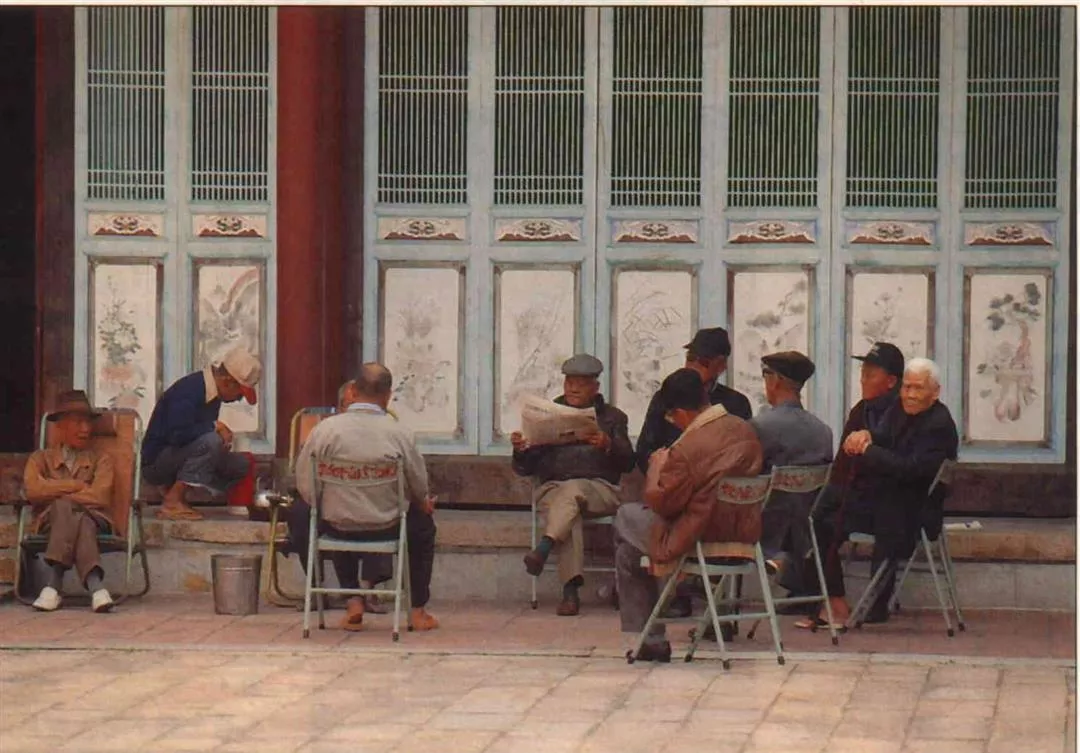
The rural elderly are the protagonists of Letting Them Go. Huang's characters bring both a smile to the lips, and a tear to the eye. (Sinorama file photo)


@List.jpg?w=522&h=410&mode=crop&format=webp&quality=80)


@List.jpg?w=522&h=410&mode=crop&format=webp&quality=80)
