

Who was China's beauty queen at the turn of the millennium 2,000 years ago? Alas, we picked the wrong year! But we weren't far off. Zhao Feiyan, considered one of the four greatest Chinese beauties of all time, had only committed suicide the year before, and another of the fabulous four, Wang Zhaojun, was still around but had already turned 50.
What kind of women were considered beautiful in China 2,000 years ago? What kind of power and responsibilities did they hold in the home and in the larger society? What did they aspire to? And how did their lifestyles affect those of Chinese women to come in later periods?
It is very difficult to arrive at clear-cut answers that would apply to the entire span of the Han dynasty which, after all, lasted more than four centuries, but the wife of the Marquis Yi of Zeng offers a lot of thought-provoking clues. Her body was unearthed in the 1970s from a 2,000-year-old tomb in Changsha, Hunan Province.
The most impressive thing about the marchioness is that after all this time her skin remains supple and her facial features are clearly distinguishable. When a reproduction of her was on display in Taipei recently, people flocked from near and far to get a glimpse of this "timeless beauty." One of the most interesting things about her marvelously preserved body is her big feet, for they prove that not every woman in ancient China necessarily had her feet bound.
If the marchioness went shopping for shoes today, she would need at least a size 37 for her 23-centimeter feet. The three pairs of shoes laid out in a neat little row in her tomb are each 26 centimeters long. Opinions differ as to when Chinese women began binding their feet, but in any case, there can be no doubt that this practice grew up in a society that looked upon weakness in women as something beautiful. The marchioness proves that not everyone in the Han dynasty period subscribed to the idea that weak and submissive women were the most desirable.
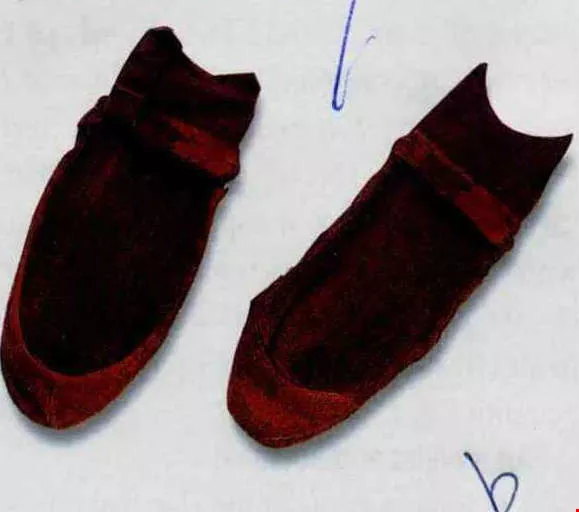
The feet don't lie! Three pairs of 26-cm women's shoes unearthed from the world-famous tomb at Mawangdui hint at the stature of women in Han society.(courtesy of Liang Yi Culture Co.)
I am woman, hear me roar
Liu Tseng-kuei, of Academia Sinica's Institute of History and Philology, once analyzed over 570 female names used during the Han dynasty in hopes it might shed some light on what the people of that time hoped to see in a woman. It turns out that about two-thirds of the names examined were suitable for either women or men. Wang Mang, who usurped the throne in 9 AD, named his daughter Jie ("nimble and quick"). The daughter of the emperor Huan Di (132-167 AD) was named Jian ("solid and resolute") while her mother, the empress Deng, had the even more emphatic name of Mengnu, which means "fierce woman"!
Says Liu, "These names show that society at that time had not yet come to hold the two sexes to such very different standards." Although they were gradually beginning to use specifically feminine names alluding to a gentle and submissive nature, such traits as a resolute spirit and an agile, tough body were also seen as virtues in a woman. "The notion of the ideal woman being soft and weak was not so universally accepted then as it would later come to be."
According to Hsing Yi-tien, a specialist in the history of the Qin and Han periods at the Academia Sinica's Institute of History and Philology, "In a country like China, with its belief in the mutually complementary nature of the yin and the yang, the idea that women should be subservient to men in all things has never held complete sway." Although the elite social classes gradually began to develop a male-oriented system of etiquette as early as the Shang and Zhou dynasties (16th to 3rd centuries BC), plebeian society continued to exhibit many throwbacks to an earlier matriarchal time.
The first emperor and empress of the Han dynasty were both commoners by birth, and the imperial family maintained certain matriarchal customs during the early years of the dynasty. Indeed, these customs eventually came to cause enormous political problems, for when relatives of the throne wormed their way deep into the inner circles of power, it was their connection to the empress that they relied on. Interference in state affairs by the empress dowager would be repeated from time to time throughout China's long history, with a notable example occurring as the last imperial line lumbered in the late 19th century toward its final extinction.
The problem was at its worst during the Han dynasty, however. After helping her husband found the new dynasty, empress Lu slaughtered many of the able ministers who had helped him achieve his ambition. After the emperor's death, her well-meaning but timid son (Hui Di) attempted to act as ruler, but she forced him into early retirement. After her wretched son came to an early death she continued to hold an iron grip on power, ruling as regent for her remaining years.
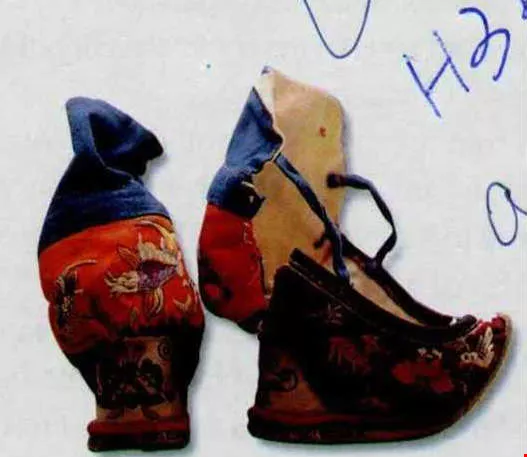
The predilection for tiny feet that had taken firm root among the upper classes by the latter part of the Song dynasty was a huge step in the wrong direction for women's rights. (courtesy of Chang Su-ching)
Lie Nu Zhuan and Nu Jie
Historians have been decidedly negative in their judgment of empress Lu, who is not nearly so well known to the general public today as the Tang dynasty's Wu Zetian, another woman who wielded power in the same ruthless manner. When we think of women in the Han dynasty, we always think of Zhao Feiyan and Wang Zhaojun, the one a concubine who dazzled the emperor with her looks, the other a raving beauty whose happiness was sacrificed for the sake of the empire. If you only knew about these two, you would think that the women of the Han court either spent their days relying on their beauty as weapons in internecine power struggles, or ended up getting married off to the ruler of a distant land to cement some strategic alliance.
A code of proper female conduct was explicitly prescribed for the first time by two books that were written about 2,000 years ago. One was Lie Nu Zhuan, by Liu Xiang, and the other was Nu Jie, by Ban Zhao. Every book written about women in the succeeding two millennia has adopted the conceptual framework of one or the other of these two seminal works.
Lie Nu Zhuan was a highly didactic work intended to warn women against using their beauty to throw government into chaos, as had been done by the sisters Zhao Feiyan and Zhao Hede. The first chapter includes over 60 stories illustrating the author's concept of the ideal woman, and praises a long list of wise and kind-hearted empresses and imperial concubines going back to the dawn of China's recorded history.
Ko Ching-ming, a professor of Chinese at National Taiwan University, notes that Lie Nu Zhuan describes many different types of women. Some are praised for their intelligent minds and eloquent speech, and it is evident that Liu Xiang didn't limit his list of feminine virtues to chastity, submissiveness, or dedication to one's maternal duties.
The female author Ban Zhao (ca. 49-120 AD) wrote Nu Jie after 40 years of loyalty to her dead husband, and intended for the book to show her daughter how a woman ought to behave. Ban Zhao exhorted women to "think of themselves last in all situations" (bei ruo xia ren). She further argued that a woman should serve her husband, who should in turn regulate his wife's life. She also urged women to obey their husbands' parents.
Those today who are critical of the low status of women in Chinese society have always excoriated Ban Zhao as the one who first explicitly put forward the idea that weakness is a feminine virtue and that the husband should act as his wife's master. When you really take a close look at her writings, however, you will discover that she defined the term bei ruo xia ren as follows: "Be modest, yield to others, and respect them. When you have done well, do not boast. When you have done wrong, do not deny your mistake." Although this set of ideals may have limited the development of one's personality, in fact it was nothing more than a call for humility.

As Macau celebrates the millennium along with the rest of the planet, could the woman on the billboard be pondering the complex web of relations among Macau, Hong Kong, Taiwan and the mainland?
Upstairs, downstairs
In reality, the Confucian idea that "a maiden obeys her father, a wife her husband, a widow her son" predates the writing of Ban Zhao, having been previously introduced in Bai Hu Tong, a work written in 79 AD. Furthermore, notes Hsing Yi-tien, classical literature like this circulated exclusively in the upper echelons of society for many years before the ideas espoused therein gradually percolated down to society at large. Commoners during the Han dynasty didn't pay any attention to these ruminations of the elite, which for the time being wreaked no harm upon the average woman.
Ban Zhao herself was a thoroughly upper-class woman. Her father and older brother were both famous historians. Although she lost her husband at an early age and thus experienced little of marital bliss, she no doubt found considerable fulfillment in her very active life as a writer. She finished the writing of Ba Biao and Tianwen Zhi, both of which had been started by her father and continued by her brother. In addition, the emperor appointed her to act as tutor to the empress and concubines. Because of her role as educator, her name has always been synonymous with a love of learning.
A document discovered in an ancient tomb tells much about the power wielded by at least some women during the Han dynasty. Written in the year 5 BC, the document tells the story of a widow who asked a local official to serve as witness to her decision concerning the division of the family's land among her children. She took back rice paddies and mulberry orchards that had already been granted to two daughters and gave them instead to her youngest son, who previously had received nothing with which to make a living. The mother specified that her son would not be allowed to sell off his land to anyone. There are countless other examples like this in which Han-dynasty mothers are seen exercising control over family assets.
Han-period standards of filial conduct did not distinguish between father and mother, and the idea that "a widow must obey her son" was not accepted among the general populace. After the father died, the mother took over as head of the household regardless of whether her children had already come of age. An excellent example of this is seen in the epic poem "The Peacocks Fly South," in which an iron-fisted mother breaks up her son's loving marriage. The very mention of her name brings a shudder of disgust, but you have to grant her one thing-she was nobody's doormat!
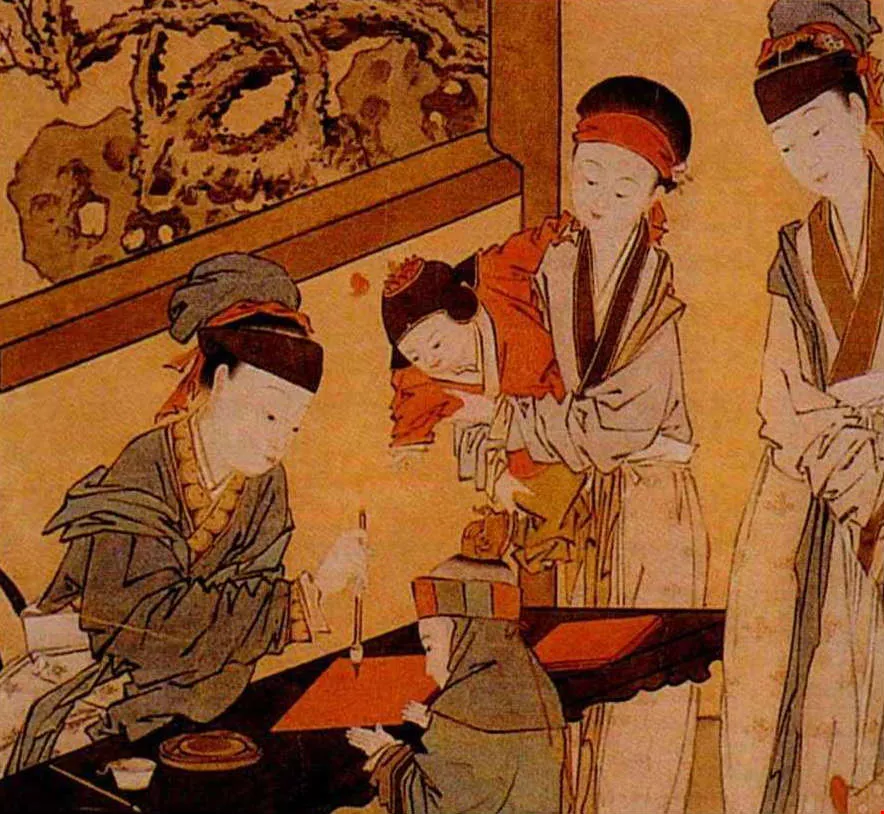
Ban Zhao is regarded as China's first female historian, and she also tutored the empress and concubines. This highly respected woman was known to many as Cao Dagu ("Madame Cao"). Shown here is the painting "Madame Cao Tutoring the Imperial Ladies." (courtesy of the National Palace Museum)
Changing partners
Although it is true that the Han court handed out official titles to reward widows who refrained from remarriage, A History of Chinese Women argues, "The larger society did not attach any great importance to this idea. No one ever tried to stop a widow from remarrying, and there was no lack of suitors."
The Han-dynasty poem "Picking Hemlock Parsley on the Mountain" tells the story of a divorced woman who happens across her ex-husband on her way back home from the mountains. The woman nonchalantly asks, "How's it going? Is that new wife of yours working out okay?"
Perhaps all men come down with a grass-is-greener complex after marriage. The ex-husband complains, "Don't ask! She doesn't even spin thread as well as you, and that's just for starters!" The man has come to realize what he has lost, but it is too late, for his former wife has long since washed her hands of him so completely that she is able to treat him like an old friend. Perhaps it hasn't been until today, in a society where one marriage in four ends in divorce, that Chinese women have once again learned to take such a free-spirited attitude.
The women of the Han dynasty were capable of much more ferocious displays of willfulness than that, though. The Hou Han Shu includes a chapter that tells of a girl who kills a person to avenge her father's death. The girl is sentenced to die, but a 15-year-old boy from her hometown appeals the sentence, describing the killing as the ultimate act of family loyalty. In the end the girl's death sentence is rescinded. Lie Nu Zhuan includes a story entitled Ti Ying Saves Her Father, in which the protagonist braves a long journey to the capital all by herself, where she successfully petitions the emperor to save her father's life. This was the only instance during all the centuries of Han rule that a commoner managed to deliver a petition directly to the emperor and have it granted.
Notes Fu Hsi-jen, a professor of Chinese at Tamkang University, "It wasn't just men during the Han dynasty who could avenge injustice; this course of action was also open to women. Although women could only do so on behalf of a murdered father, it still shows just how unrestrained and tough they could be."
Even Zhao Feiyan and Wang Zhaojun were a far cry from the dainty, fainting sort of woman who came to be so adored during the Ming and Qing dynasties. Feiyan came out on the losing end of intrigue among the women of the court, to be sure, but she was a vivacious dancer full of energy and life. As for Zhaojun, who can doubt the physical and emotional resilience of a woman who, having known the refined delights of the Chinese court, could not only survive but even flourish after being married off to Huns in the barren Asiatic steppes?
A woman for all seasons
The stories of Feiyan and Zhaojun have been played up so much over the centuries that we tend to forget that their lives were not actually representative of the way most women lived during the Han dynasty. Ko Ching-ming regards Luo Fu, the female protagonist in the ballad Mo Shang Sang, as a better illustration of the ideals to which women of the Han period aspired.
Luo Fu was a talented and robust woman who enjoyed working outdoors. Not only was she beautiful, she also knew how to accent her natural beauty with fashionable hairstyles and tasteful jewelry. When an official passing through from the south took a fancy to her and invited her for a ride in his carriage, she refused laughingly with the immortal words: "Such a fool you are! You have a wife, and I a husband." This quick-witted woman served as a role model for many.
In Mo Shang Sang we see a confident and strong woman who is faithful to her principles. It is always fascinating to look back at the past, but in the end we must live our lives in the present and reflect upon where we stand in the here and now. Is there some still higher ideal to which we can aspire as we enter upon a new century?


