Ceramics with a Taiwanese Spirit-Samuel Shih
Kuo Li-chuan / photos courtesy of Samuel Shih / tr. by Scott Gregory
November 2008


Award-winning Taiwanese ceramicistSamuel Shih is known in the ceramics world as "the Young Hero." At 18, he won a silver medal in the first annual Hocheng Cultural and Educational Foundation's Golden Ceramic Prize, and in the first half of this year he was invited to show at several exhibitions including the Yingge Ceramics Museum's "Taiwanese Elegance in Banquets, and Exhibition of Tableware" show, the "Staring at the Area to Record the World while it is Changing Dissipating and Reconstructing" exhibition at the International Fair of Contemporary Ceramics (CERCO) Aragon, in Zaragoza, Spain, and "Art, Craft-Contemporary Taiwanese Ceramics" at the National Art Museum of China in Beijing. At the same time, he was the first Taiwanese ceramicist to have works sold by Beijing's China Guardian auction house.
But the 34-year-old ceramicist only chose art after a life-changing experience. To carry out his promise to himself, he's been working as hard as he can with clay and fire. In the process, he's writing a new chapter in the story of Taiwanese ceramics.
Samuel Shih was born in Taipei in 1974. His father Shih Ping-chih and his mother Kuo Ya-mei were both painters. His mother also studied ceramics at Li Liang-yi's Tienmu Ceramics Workshop. Shih became a workshop assistant at just 14 years of age and began his lifelong relationship with clay.
Award-winning Taiwanese ceramicistSamuel Shih is known in the ceramics world as "the Young Hero." At 18, he won a silver medal in the first annual Hocheng Cultural and Educational Foundation's Golden Ceramic Prize, and in the first half of this year he was invited to show at several exhibitions including the Yingge Ceramics Museum's "Taiwanese Elegance in Banquets, and Exhibition of Tableware" show, the "Staring at the Area to Record the World while it is Changing Dissipating and Reconstructing" exhibition at the International Fair of Contemporary Ceramics (CERCO) Aragon, in Zaragoza, Spain, and "Art, Craft-Contemporary Taiwanese Ceramics" at the National Art Museum of China in Beijing. At the same time, he was the first Taiwanese ceramicist to have works sold by Beijing's China Guardian auction house.
But the 34-year-old ceramicist only chose art after a life-changing experience. To carry out his promise to himself, he's been working as hard as he can with clay and fire. In the process, he's writing a new chapter in the story of Taiwanese ceramics.
Samuel Shih was born in Taipei in 1974. His father Shih Ping-chih and his mother Kuo Ya-mei were both painters. His mother also studied ceramics at Li Liang-yi's Tienmu Ceramics Workshop. Shih became a workshop assistant at just 14 years of age and began his lifelong relationship with clay.
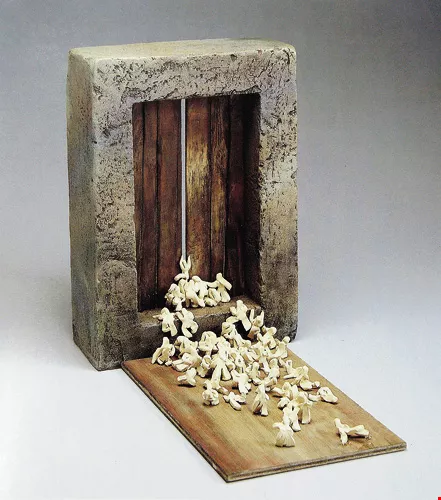
In 1992, Shih, at the age of 18, won a silver medal in the Hocheng Cultural and Educational Foundation's first annual Golden Ceramic Prize with his work "Narrow Door."
Pain of alienation
With no inclination to study, he had a difficult time in elementary and junior high. "When you're not good at anything, no one cares about you. I'd ditch classes and no one would notice. Even when I poured out my inner thoughts in essays, my teachers would always say it was just nonsense," he says. Despite his relaxed manner of speaking, his frequent use of words like "loser" and "punk" to describe himself betray the pain that he still feels from his alienation at school.
It was only after he began night school at Taipei High School's department of arts and crafts and started spending his days concentrating on his art and winning awards did he begin to feel self-confident. He also had works on consignment at Taipei's Caves Arts Center. At the time, this artistic prodigy only wanted to save up enough money to buy a motorbike of his own so he could race around with his friends.
Then, with a desire to hurry up and enter university, he overworked himself. Before the entrance examinations, he suffered from fulminant hepatitis. Doctors gave him only a 40% chance to live. At age 18, he lay on his hospital bed and started to contemplate his life. The enjoyment and confidence he'd gained from art, which previously had been more of a hobby, gave him a reason to live. In 1994, he held his first solo exhibition at the Caves Arts Center, "Be in a State of Equilibrium." He had just turned 20.
Pain of alienation
With no inclination to study, he had a difficult time in elementary and junior high. "When you're not good at anything, no one cares about you. I'd ditch classes and no one would notice. Even when I poured out my inner thoughts in essays, my teachers would always say it was just nonsense," he says. Despite his relaxed manner of speaking, his frequent use of words like "loser" and "punk" to describe himself betray the pain that he still feels from his alienation at school.
It was only after he began night school at Taipei High School's department of arts and crafts and started spending his days concentrating on his art and winning awards did he begin to feel self-confident. He also had works on consignment at Taipei's Caves Arts Center. At the time, this artistic prodigy only wanted to save up enough money to buy a motorbike of his own so he could race around with his friends.
Then, with a desire to hurry up and enter university, he overworked himself. Before the entrance examinations, he suffered from fulminant hepatitis. Doctors gave him only a 40% chance to live. At age 18, he lay on his hospital bed and started to contemplate his life. The enjoyment and confidence he'd gained from art, which previously had been more of a hobby, gave him a reason to live. In 1994, he held his first solo exhibition at the Caves Arts Center, "Be in a State of Equilibrium." He had just turned 20.
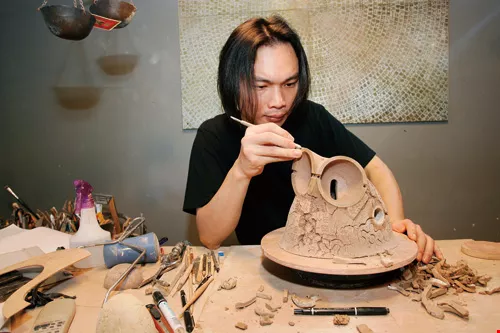
Shih lives an almost monastic existence, with clay, water, and fire as his only companions. Sometimes he spends days on end working without saying a word to anyone. When he goes out shopping, he discovers he can't speak anymore and has to use hand motions to communicate.
Nomadic life of study
After finishing his military service in the marines, Shih decided to work as an artist professionally. In Taiwan, whether you are famous or not, you're not going to be rich. His father, the painter, only said, "To be an artist, you have to have the attitude. You have to be able to endure poverty. As long as you can endure that, you have a chance."
In 1996, he took the train down from Taipei to Lungtan in Taoyuan to start his life again. In his mind, he had only the thought: "I want to be an artist!" The same year he founded the UNIT-9 Workshop. Every day he would throw and create ceramics. He'd take odd jobs when he needed to get by, taking positions as a convenience store clerk, a delivery man, or a janitor. From these experiences, he learned humility and respect. "People who've learned welding in school aren't any more skilled than the old guys in the alley who fix air conditioners. Their livelihoods depend on it so they can't make a mistake," he says.
Unable to study formally, Shih attended professional training sessions and workshop classes to enrich himself in his off-time. In 1998, at the suggestion of Li Liang-yi, he took classes at the Santa Anna Art Academy's ceramics studio. "An artist's life is short and cruel. The time between graduating and reaching the end of the golden era is never more than 30 years. Subtract the first ten years of stylistic experimentation and the last ten years when one's powers begin to fade, and the peak is only around ten years. So I chose a life of nomadic study, and I hope that from this I'll have the opportunity to see the world," he says.
Once he became a professional artist, he achieved a string of successes. In 1999, he was awarded entrance prizes for the Asian Exhibition of Arts and Crafts at Japan's Fukuoka Art Museum for two years running; in 2000 he won the UK Special Award at the Gold Coast Arts Center International Ceramic Fair; in 2002 he took first prize at the 16th Nan-Yin Annual Art Competition; and in 2003 he won first prize at the third annual Taipei Ceramics Awards.
Nomadic life of study
After finishing his military service in the marines, Shih decided to work as an artist professionally. In Taiwan, whether you are famous or not, you're not going to be rich. His father, the painter, only said, "To be an artist, you have to have the attitude. You have to be able to endure poverty. As long as you can endure that, you have a chance."
In 1996, he took the train down from Taipei to Lungtan in Taoyuan to start his life again. In his mind, he had only the thought: "I want to be an artist!" The same year he founded the UNIT-9 Workshop. Every day he would throw and create ceramics. He'd take odd jobs when he needed to get by, taking positions as a convenience store clerk, a delivery man, or a janitor. From these experiences, he learned humility and respect. "People who've learned welding in school aren't any more skilled than the old guys in the alley who fix air conditioners. Their livelihoods depend on it so they can't make a mistake," he says.
Unable to study formally, Shih attended professional training sessions and workshop classes to enrich himself in his off-time. In 1998, at the suggestion of Li Liang-yi, he took classes at the Santa Anna Art Academy's ceramics studio. "An artist's life is short and cruel. The time between graduating and reaching the end of the golden era is never more than 30 years. Subtract the first ten years of stylistic experimentation and the last ten years when one's powers begin to fade, and the peak is only around ten years. So I chose a life of nomadic study, and I hope that from this I'll have the opportunity to see the world," he says.
Once he became a professional artist, he achieved a string of successes. In 1999, he was awarded entrance prizes for the Asian Exhibition of Arts and Crafts at Japan's Fukuoka Art Museum for two years running; in 2000 he won the UK Special Award at the Gold Coast Arts Center International Ceramic Fair; in 2002 he took first prize at the 16th Nan-Yin Annual Art Competition; and in 2003 he won first prize at the third annual Taipei Ceramics Awards.
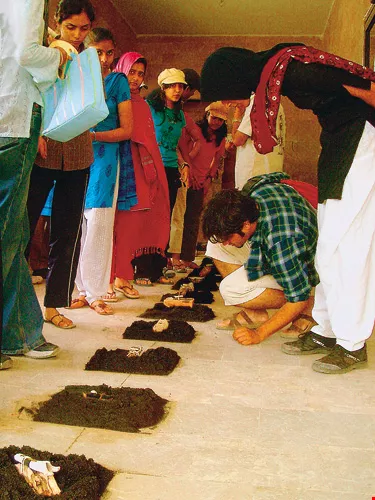
Though the artist workshop in Gaddani, Pakistan, was remote, a huge crowd turned out by bus or on foot for the rare chance to see an art exhibition.
Pakistani adventure
As ceramic pieces are large and easily broken in transit, there aren't many opportunities to show internationally. For someone wanting the international community to see Taiwanese art, an artist in residence position is a good choice.
In 2001, with funding from the Council for Cultural Affairs, Shih became an artist in residence at the Anderson Arts Center in Kenosha, Wisconsin. In 2004, he was originally to go to Bangladesh with funding from the Taipei City Department of Cultural Affairs and the British Triangle Arts Trust, but due to flooding in Bangladesh he ended up at the VASL International Artists' Collective in Pakistan for the year 2006 instead. In 2007, he held an artist in residence position at Minonokuni Arts Center in Gifu Prefecture, Japan.
His residency in Pakistan was an amazing experience-this country, which had seen so much war and strife, had artists' collectives?
There was another problem plaguing Shih. Though he had a letter of guarantee from the British Museum, a letter of recommendation from the Taipei City Government, all the necessary legal documents, and full funding from British and Taiwanese sources, when he went to the Ministry of Foreign Affairs office to ask about conditions in Pakistan he was told, "Mr. Shih, we're sorry. Taiwan and Pakistan do not have good relations. We don't have any groups, business associations, or Taiwanese nationals in Pakistan. If you want to go, you'll have to go through their consulates in Hong Kong or Bangkok. But we don't have close relations with either of these places either. We only have relatively good relations with India, but they are Pakistan's enemy...."
In the end he asked a private travel agent: "If I can pretend to be Chinese and trick the customs agents into letting me through, then would I be able to safely return to Taiwan two months later?"
With a worried heart he started his journey. Though he'd read Saint Exupery's The Little Prince before, he'd never imagined that he would end up "dropping into" the desert himself. After he landed at the airport in Karachi, he covered the "Republic of" in "Republic of China Passport" with his fingers. As for its color, which is green instead of red like the PRC passports, he says, "Money can make people temporarily colorblind."
Pakistani adventure
As ceramic pieces are large and easily broken in transit, there aren't many opportunities to show internationally. For someone wanting the international community to see Taiwanese art, an artist in residence position is a good choice.
In 2001, with funding from the Council for Cultural Affairs, Shih became an artist in residence at the Anderson Arts Center in Kenosha, Wisconsin. In 2004, he was originally to go to Bangladesh with funding from the Taipei City Department of Cultural Affairs and the British Triangle Arts Trust, but due to flooding in Bangladesh he ended up at the VASL International Artists' Collective in Pakistan for the year 2006 instead. In 2007, he held an artist in residence position at Minonokuni Arts Center in Gifu Prefecture, Japan.
His residency in Pakistan was an amazing experience-this country, which had seen so much war and strife, had artists' collectives?
There was another problem plaguing Shih. Though he had a letter of guarantee from the British Museum, a letter of recommendation from the Taipei City Government, all the necessary legal documents, and full funding from British and Taiwanese sources, when he went to the Ministry of Foreign Affairs office to ask about conditions in Pakistan he was told, "Mr. Shih, we're sorry. Taiwan and Pakistan do not have good relations. We don't have any groups, business associations, or Taiwanese nationals in Pakistan. If you want to go, you'll have to go through their consulates in Hong Kong or Bangkok. But we don't have close relations with either of these places either. We only have relatively good relations with India, but they are Pakistan's enemy...."
In the end he asked a private travel agent: "If I can pretend to be Chinese and trick the customs agents into letting me through, then would I be able to safely return to Taiwan two months later?"
With a worried heart he started his journey. Though he'd read Saint Exupery's The Little Prince before, he'd never imagined that he would end up "dropping into" the desert himself. After he landed at the airport in Karachi, he covered the "Republic of" in "Republic of China Passport" with his fingers. As for its color, which is green instead of red like the PRC passports, he says, "Money can make people temporarily colorblind."
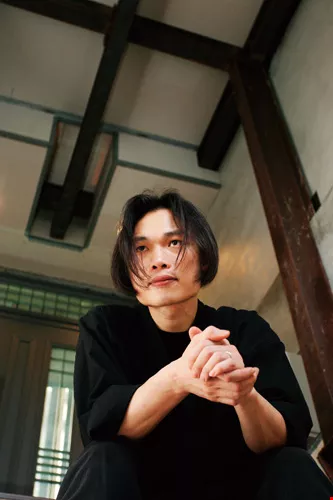
(facing page) Ceramicist Samuel Shih, who found artistic maturity at an early age, makes frequent trips abroad to find inspiration and to challenge himself.
"Where's the water?"
Pakistan is a country with a wide gap between the rich and the poor. The rich live lives of luxury, and in order to allow their children to participate in the international arts scene, VASL-an organization run by artists-invites other artists from abroad to participate in exchanges. In 2006, 24 artists from 14 countries were invited. They had 18 days to turn an empty space into an exhibition large enough to hold thousands of visitors.
The workshop was in Gaddani, on the border of Sindh and Balochistan around 65 kilometers from Karachi, and known for its shipbreaking yard and a huge rock that protrudes into the sea. In order to maintain the artists' safety, 14 armed guards were posted outside the workshop to protect and monitor them. But was it all to lock the danger outside, or to keep the safety locked inside? Shih says, with a trace of resignation in his voice, "After a while we all got used to living with a few guns trained on us from time to time."
In Pakistan, language wasn't a problem. Communication was by smiles and tacit understanding. The only problem was a lack of material resources. There weren't enough art supplies, and they even had to rely on deliveries for food, water, electricity, and fuel as they were surrounded by desert on all sides. The next town was a two-week hike away.
As a desert town, Gaddani only sees a chance of rain for two weeks every October. With no water to use, the artists frequently had to take a two-hour bus ride to the nearest village. They'd bathe at a well by the side of the road, and like that scene in Kung Fu Hustle, the water would often run out when they were halfway through and leave them with a head covered in shampoo. They felt like Stephen Chow, shouting out, "Landlady, where's the water?"
"Where's the water?"
Pakistan is a country with a wide gap between the rich and the poor. The rich live lives of luxury, and in order to allow their children to participate in the international arts scene, VASL-an organization run by artists-invites other artists from abroad to participate in exchanges. In 2006, 24 artists from 14 countries were invited. They had 18 days to turn an empty space into an exhibition large enough to hold thousands of visitors.
The workshop was in Gaddani, on the border of Sindh and Balochistan around 65 kilometers from Karachi, and known for its shipbreaking yard and a huge rock that protrudes into the sea. In order to maintain the artists' safety, 14 armed guards were posted outside the workshop to protect and monitor them. But was it all to lock the danger outside, or to keep the safety locked inside? Shih says, with a trace of resignation in his voice, "After a while we all got used to living with a few guns trained on us from time to time."
In Pakistan, language wasn't a problem. Communication was by smiles and tacit understanding. The only problem was a lack of material resources. There weren't enough art supplies, and they even had to rely on deliveries for food, water, electricity, and fuel as they were surrounded by desert on all sides. The next town was a two-week hike away.
As a desert town, Gaddani only sees a chance of rain for two weeks every October. With no water to use, the artists frequently had to take a two-hour bus ride to the nearest village. They'd bathe at a well by the side of the road, and like that scene in Kung Fu Hustle, the water would often run out when they were halfway through and leave them with a head covered in shampoo. They felt like Stephen Chow, shouting out, "Landlady, where's the water?"
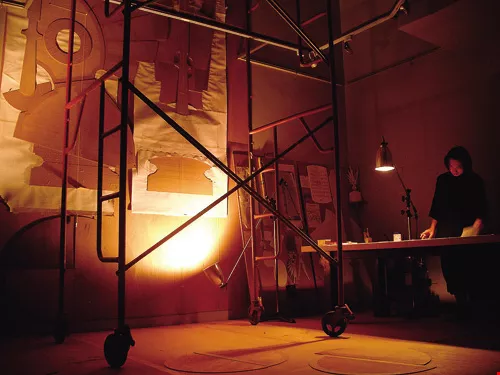
Shih's UNIT-9 Workshop in Lungtan, Taoyuan County, has high ceilings and is suitable for working on large pieces. Here he pushes himself to his physical and creative limits.
Desert flowers of art
He also encountered new problems in his work. "There's no clay or wood in Pakistan," he says. "The two materials needed for ceramics weren't available. There was only sand and garbage!" He shows a wry smile at the memory of his shock and helplessness. He ended up mixing paste and sand to make a base and selecting pieces of trash, including animal carcasses, shards of tile, and withered sticks, to create pieces of notepaper.
"Inconvenient living standards, the horrors of war, the guards' guns.... Every day in Pakistan I felt afraid and helpless. I wanted these notes to say 'Save me!' to the world, and at the same time I wanted to express my inner feelings of insecurity," he explains.
After they finished their pieces, the organizers opened the exhibition to the public for just one day. The artists wondered if anyone would come to such a remote place, but early in the morning of the opening, they saw to their surprise a crowd of thousands on its way. Some took buses and some walked through the night just to take the rare opportunity to attend an art exhibition. It was a moving sight.
"It seems it wasn't a cultural desert. They say that in the desert, flowers bloom the morning after a rain. I really believe it!" Shih sighs, "But when you look here at home, there are so many galleries and museums that are empty most of the time. It's really a shame that Taiwanese don't cherish them and take advantage of them."
Desert flowers of art
He also encountered new problems in his work. "There's no clay or wood in Pakistan," he says. "The two materials needed for ceramics weren't available. There was only sand and garbage!" He shows a wry smile at the memory of his shock and helplessness. He ended up mixing paste and sand to make a base and selecting pieces of trash, including animal carcasses, shards of tile, and withered sticks, to create pieces of notepaper.
"Inconvenient living standards, the horrors of war, the guards' guns.... Every day in Pakistan I felt afraid and helpless. I wanted these notes to say 'Save me!' to the world, and at the same time I wanted to express my inner feelings of insecurity," he explains.
After they finished their pieces, the organizers opened the exhibition to the public for just one day. The artists wondered if anyone would come to such a remote place, but early in the morning of the opening, they saw to their surprise a crowd of thousands on its way. Some took buses and some walked through the night just to take the rare opportunity to attend an art exhibition. It was a moving sight.
"It seems it wasn't a cultural desert. They say that in the desert, flowers bloom the morning after a rain. I really believe it!" Shih sighs, "But when you look here at home, there are so many galleries and museums that are empty most of the time. It's really a shame that Taiwanese don't cherish them and take advantage of them."
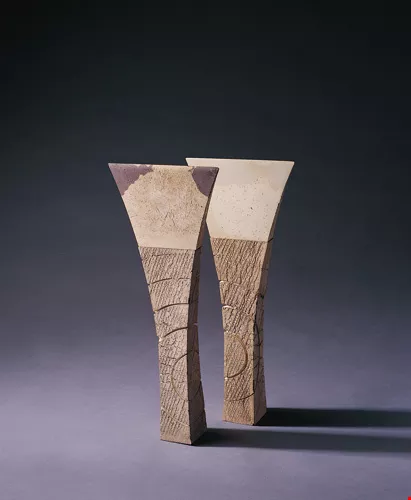
Shamisen Plectrums, 2003. Ceramics.
Trial by snow
He thought that after having worked in Pakistan, he could create in any environment. Yet last year, when Tajimi City in Gifu, Japan, supported him as an artist in residence at the Minonokuni Arts Center, he found himself facing another challenge-snow.
He arrived in Gifu in January 2007, at the height of winter. As the workshop was a temporary structure, it had no heating. Every day, Shih had to wear thick clothes and carry a personal heater to work. But that wasn't the greatest challenge of working in a snowy environment. Worse was the lack of feeling in his hands from the cold, which for him was like a musician losing his hearing or a master chef losing his sense of taste. The skin of his hands chapped due to the cold, leaving them bloody and painful.
The weather in a snowy climate is unpredictable. He'd often awake to find pieces that he'd already finished had somehow "self-destructed." Later, he realized that they were freezing overnight, and when the sun came out they'd thaw. "When they'd freeze, the moisture in the clay would expand so the structure would break and the piece would crack. When they'd thaw out, they'd do so from the surface in. The clay would become like mud, and between the expansion from the cold and shrinkage from the heat, the pieces would shatter.
Once he knew what was happening, he developed two strategies: he'd keep the pieces warm and finish them quickly. He'd try to complete them in one day, and then after using a hair dryer to dry them he would fire them in the kiln as soon as possible. If he couldn't make it in time, he'd "put them to bed" with a blanket for the night.
That same year, he held a solo exhibit at the Gifu Museum of Modern Ceramic Art called "Memory in the Wind-Poetry 14." Among the pieces, one called Memory in the Wind IV was purchased by the Tajimi City Government and one called Song VII was purchased by the museum. While there, he also met and married a local woman-the greatest "prize" of all.
Trial by snow
He thought that after having worked in Pakistan, he could create in any environment. Yet last year, when Tajimi City in Gifu, Japan, supported him as an artist in residence at the Minonokuni Arts Center, he found himself facing another challenge-snow.
He arrived in Gifu in January 2007, at the height of winter. As the workshop was a temporary structure, it had no heating. Every day, Shih had to wear thick clothes and carry a personal heater to work. But that wasn't the greatest challenge of working in a snowy environment. Worse was the lack of feeling in his hands from the cold, which for him was like a musician losing his hearing or a master chef losing his sense of taste. The skin of his hands chapped due to the cold, leaving them bloody and painful.
The weather in a snowy climate is unpredictable. He'd often awake to find pieces that he'd already finished had somehow "self-destructed." Later, he realized that they were freezing overnight, and when the sun came out they'd thaw. "When they'd freeze, the moisture in the clay would expand so the structure would break and the piece would crack. When they'd thaw out, they'd do so from the surface in. The clay would become like mud, and between the expansion from the cold and shrinkage from the heat, the pieces would shatter.
Once he knew what was happening, he developed two strategies: he'd keep the pieces warm and finish them quickly. He'd try to complete them in one day, and then after using a hair dryer to dry them he would fire them in the kiln as soon as possible. If he couldn't make it in time, he'd "put them to bed" with a blanket for the night.
That same year, he held a solo exhibit at the Gifu Museum of Modern Ceramic Art called "Memory in the Wind-Poetry 14." Among the pieces, one called Memory in the Wind IV was purchased by the Tajimi City Government and one called Song VII was purchased by the museum. While there, he also met and married a local woman-the greatest "prize" of all.
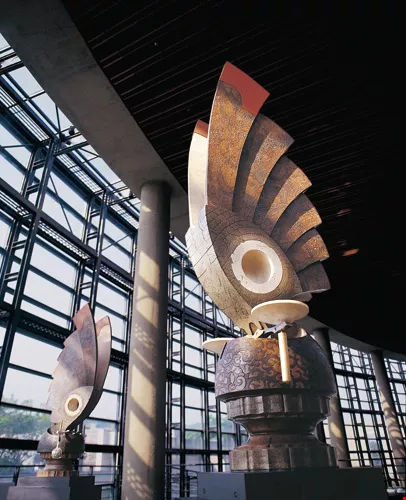
Wings in the Wind-Thoth, 2003. Ceramics, wood, and metal alloy. This work is covered with words from the ancient Records of the Han, the names of modern computer viruses, and the sort of tattoos popular with young people today. It shows the way language morphs and changes.
Writing and symbols
With his high level of international exposure, Shih has become a representative of Taiwanese contemporary arts. And his generation of Taiwanese artists faces new challenges. The greatest difference between them and previous generations is that they have more opportunities to step onto the world stage and become part of the international scene in "competition without borders." With their pieces, they not only represent themselves and their country but also the greater region in which they live.
"I only realized after going abroad that, to Westerners, I wasn't a representative of Taiwan but of the East," he says. Many times he found himself being asked questions he couldn't answer, so he took to studying up on the Yi Jing and Daoist classics the Dao De Jing and the Zhuangzi. He began to think that if he wanted to bring something unique to the world stage, traditional culture was a necessary and vital element. Thus the ancient Eastern art of the written word became one of the most important and seriously considered themes in his work. He began his "Wings in the Wind" series.
"I believe that people's writing systems come from mud, so I want to use earth to describe them," he says. "The ancient Egyptians, the Mayans, and the Mesopotamians made their historical records on clay. Computer files and paper can be destroyed, but with clay even if it is shattered the pieces still have fragments from which traces of the culture can be interpreted and discerned."
One piece from the series is entitled Wings in the Wind-Thoth. Thoth is the ancient Egyptian god of wisdom and knowledge, with the face of a bird and the body of a man. This ceramic statue of him is covered with all sorts of writing. There are phrases from classical texts like the Records of the Han, the Er Ya, and the Shuo Wen Jie Zi. There are floral patterns, the names of computer viruses, and the types of tattoos that are currently trendy. In this series, which he describes as a "language digestion project," writing and symbols appear and disappear, flow and change, reflecting Shih's fascination with the concepts of change and constancy from the Yi Jing. The pieces, which get bigger and more complex in layer upon layer in what he calls "minimal architecture," were another test of his strength, endurance, time, and financial resources.
Writing and symbols
With his high level of international exposure, Shih has become a representative of Taiwanese contemporary arts. And his generation of Taiwanese artists faces new challenges. The greatest difference between them and previous generations is that they have more opportunities to step onto the world stage and become part of the international scene in "competition without borders." With their pieces, they not only represent themselves and their country but also the greater region in which they live.
"I only realized after going abroad that, to Westerners, I wasn't a representative of Taiwan but of the East," he says. Many times he found himself being asked questions he couldn't answer, so he took to studying up on the Yi Jing and Daoist classics the Dao De Jing and the Zhuangzi. He began to think that if he wanted to bring something unique to the world stage, traditional culture was a necessary and vital element. Thus the ancient Eastern art of the written word became one of the most important and seriously considered themes in his work. He began his "Wings in the Wind" series.
"I believe that people's writing systems come from mud, so I want to use earth to describe them," he says. "The ancient Egyptians, the Mayans, and the Mesopotamians made their historical records on clay. Computer files and paper can be destroyed, but with clay even if it is shattered the pieces still have fragments from which traces of the culture can be interpreted and discerned."
One piece from the series is entitled Wings in the Wind-Thoth. Thoth is the ancient Egyptian god of wisdom and knowledge, with the face of a bird and the body of a man. This ceramic statue of him is covered with all sorts of writing. There are phrases from classical texts like the Records of the Han, the Er Ya, and the Shuo Wen Jie Zi. There are floral patterns, the names of computer viruses, and the types of tattoos that are currently trendy. In this series, which he describes as a "language digestion project," writing and symbols appear and disappear, flow and change, reflecting Shih's fascination with the concepts of change and constancy from the Yi Jing. The pieces, which get bigger and more complex in layer upon layer in what he calls "minimal architecture," were another test of his strength, endurance, time, and financial resources.
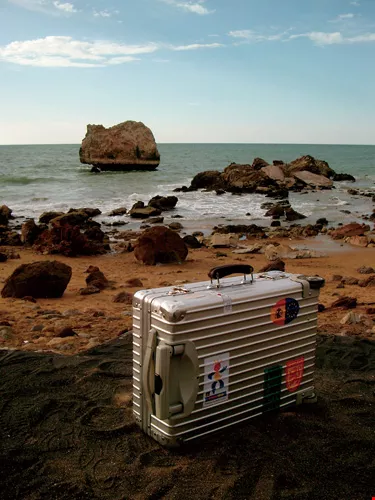
Shih's old silver toolbox has accompanied him around the world, becoming another of his artistic works.
A solitary mole, digging
While the art world expresses surprise at his constant innovation and daring breakthroughs, Shih admits that it is sometimes difficult to surpass himself and he can only strive to take a little step forward each day. As ceramics depends on clay, water, and fire, and must be done indoors in special facilities, he feels like a mole-an animal gathering dirt and avoiding the sun. On his blog, he wrote:
"Seeing myself in the mirror, I find I'm becoming more and more like a mole. I spend every day in the dark alone, digging alone. My eyes are getting smaller and my hands bigger. Sometimes I come near the surface of the earth and I can hear the outside world. There are flowers and sun and air, and the sounds of all the happy people. I cover my ears and head in another direction. My dreams are on the other side of the earth. In my life, how deep can I dig? Can I penetrate all the layers of the earth?"
What directions and styles this ceramicist, bravely building his dreams out of clay, will take up in the future remains to be seen. His goal is to hold a solo exhibition outside the Louvre's pyramid by age 55. To him, this is not an ideal or a dream but part of a plan to work toward step by step. Putting a plan into action is not only in the soul of an artist, but in the soul of the Taiwanese people.
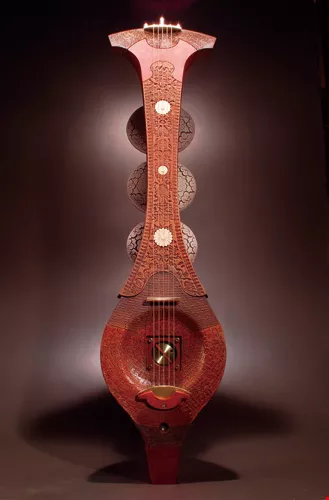
Shih was exposed to the Yi Jing and fortune-telling from an early age through his father, a painter. His 2006 work Standardize the Adjustment, Then Gain the Standard and Use it to Adjust uses ceramics, glass, wood, and metal.
A loving future father
In his workshop, which is filled with totemic symbols, I can tell from the plate on which he offers snacks that he also creates fine tableware. Last year, the Yingge Ceramics Museum invited Taiwanese artists to create tableware around the theme "Taiwanese Traditional Snack Utensils." Though it wasn't Shih's forte, after a long period of contemplation and study he found that utensils currently on the market were nearly perfect in their design and function. If they had any fault, it was that they lacked feeling.
"This might be the element most lacking in my own work as well," he says. "I've never specially made anything with an important person from my life in mind." Shih apologetically realized, "A work with no feeling is just a product. When something has feeling put into it, the technique can even be a little rough and people will still be moved."
After three weeks of contemplation, he decided to make a beautiful set of dishes as if for a wedding banquet for a daughter who'd be moving far away. Though he was single at the time he made them, the beautiful works intended for a future daughter hold infinite love and blessings. But this plan was put on hold when he accepted the artist in residence position in Japan.
By coincidence, this year the ceramics museum's invitational exhibition took wedding banquets as its theme in the hopes that participants could put a new spin on the traditional Taiwanese wedding banquet. For this reason, he expanded his previous idea and tied it to this theme. With his Peony Wedding Banquet Platter, he boldly put the pattern and signature on the face rather than the back, and set a hollowed-out flower-petal shape in it. There is also a square plate, suitable for serving small cakes or cookies, that is eye-catchingly celebratory. These are rare glimpses of the more tender side of Shih's work.
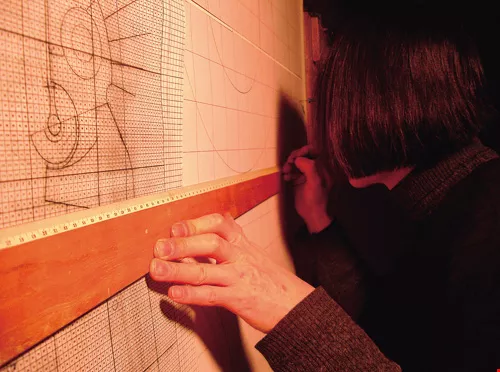
Shih's UNIT-9 Workshop in Lungtan, Taoyuan County, has high ceilings and is suitable for working on large pieces. Here he pushes himself to his physical and creative limits.
A solitary mole, digging
While the art world expresses surprise at his constant innovation and daring breakthroughs, Shih admits that it is sometimes difficult to surpass himself and he can only strive to take a little step forward each day. As ceramics depends on clay, water, and fire, and must be done indoors in special facilities, he feels like a mole-an animal gathering dirt and avoiding the sun. On his blog, he wrote:
"Seeing myself in the mirror, I find I'm becoming more and more like a mole. I spend every day in the dark alone, digging alone. My eyes are getting smaller and my hands bigger. Sometimes I come near the surface of the earth and I can hear the outside world. There are flowers and sun and air, and the sounds of all the happy people. I cover my ears and head in another direction. My dreams are on the other side of the earth. In my life, how deep can I dig? Can I penetrate all the layers of the earth?"
What directions and styles this ceramicist, bravely building his dreams out of clay, will take up in the future remains to be seen. His goal is to hold a solo exhibition outside the Louvre's pyramid by age 55. To him, this is not an ideal or a dream but part of a plan to work toward step by step. Putting a plan into action is not only in the soul of an artist, but in the soul of the Taiwanese people.


